Coming soon
CV Formats by Country

American Resume Format: How to Write a US Resume (With Template)

Learn the American resume format: US Letter, one or two pages, no photo or date of birth, a work authorization line, and how to convert a foreign CV.

Mira Resume Editorial Team · Career content team Published Updated 11 min read
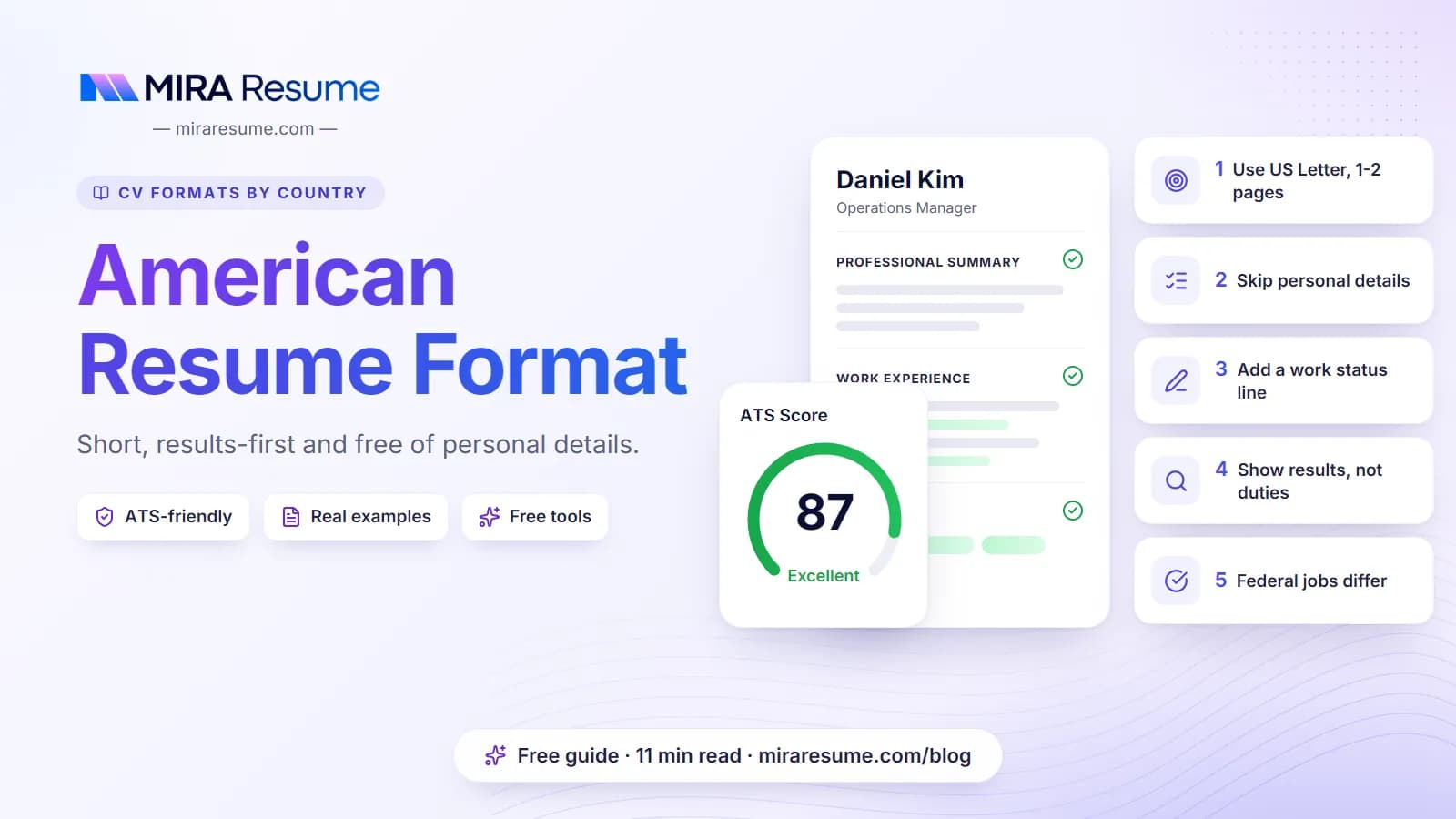
American Resume Format: cover image for the Mira Resume guide, with an example resume and the 5 main points

The American resume format is short, direct and built around results. Most US employers expect a one or two page resume on US Letter paper, written in American English, with no photo, no date of birth and no marital status. Instead of a full life history, it picks the experience that fits one job and shows what you achieved there.

That can feel unusual if you grew up writing a CV in India, the UK, Germany, Nigeria or the Philippines. Many habits that are normal elsewhere, such as a photo, a personal details box or a signed declaration, are left out in the US. Some of them can even work against you.

This guide covers what US employers commonly expect, the usual section order, a short sample, how international applicants can mention work authorization, and step by step advice on converting a CV from another country into a US resume.
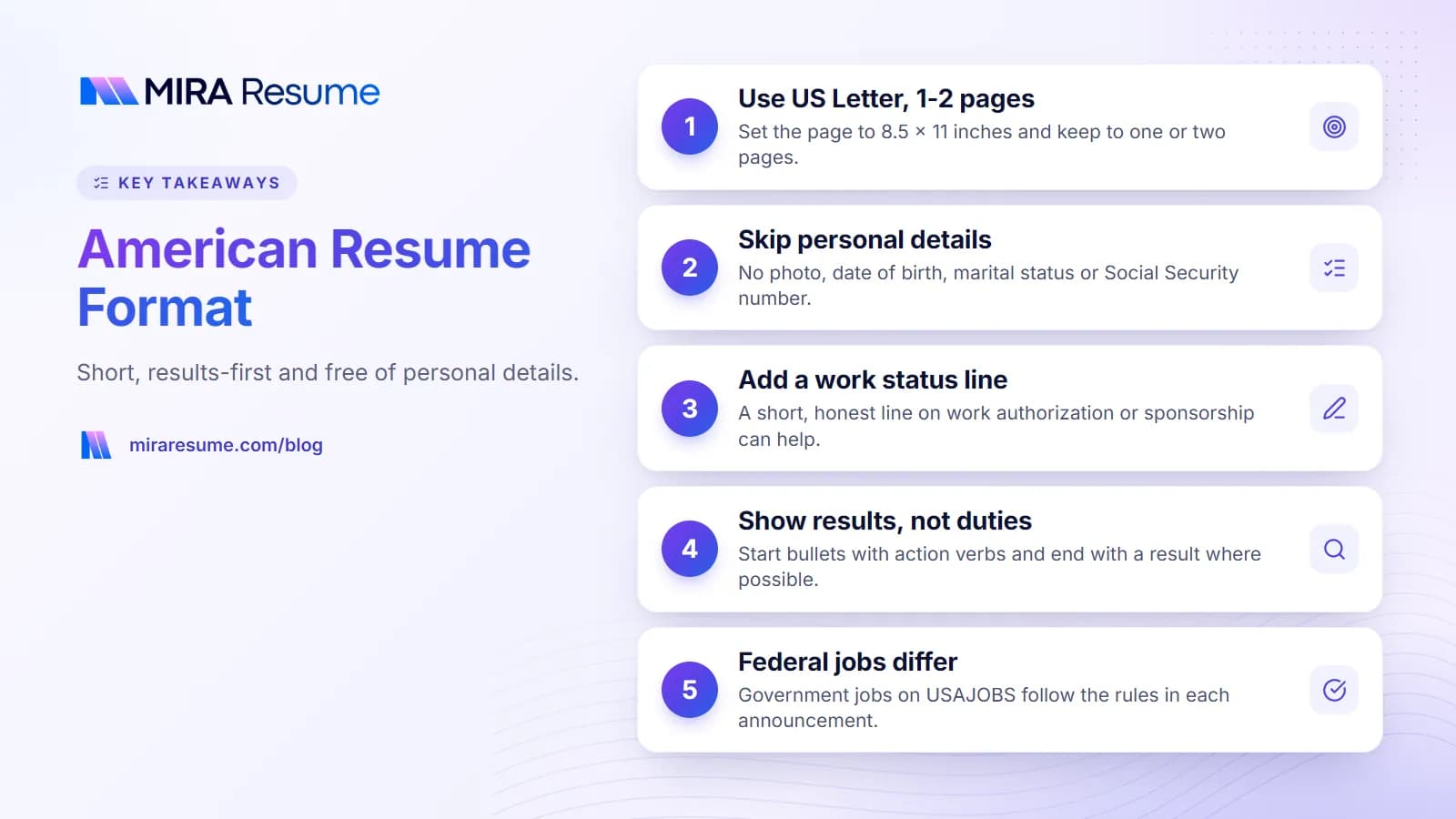
Key takeaways: 1. Use US Letter, 1-2 pages; 2. Skip personal details; 3. Add a work status line; 4. Show results, not duties; 5. Federal jobs differ
Key takeaways from this guide.

Resume or CV: what Americans call it

In the United States, the document you send for most jobs is called a resume. A CV (curriculum vitae) is a different, longer document that is mainly used for academic, research, scientific and some medical roles. If someone asks for a CV for USA jobs in business, tech, sales, health care support, retail or the trades, they almost always mean a resume.

DocumentWhere it is used in the USTypical length
ResumeMost private-sector and nonprofit jobs1 page early in your career, 2 pages for many experienced people
Academic CVFaculty, research, graduate school, many scientific and medical postsNo fixed limit, grows with publications and teaching
Federal resumeUS government jobs, usually through USAJOBSFollow the job announcement; a two-page limit was introduced for many federal resumes in 2025

If you are not sure which document you need, our guide to the difference between a CV and a resume explains both, and what is a CV covers the academic version. For research roles, a science CV sample is a better model than a business resume.

Federal jobs are different

Government jobs have their own rules about what to include, such as hours worked per week and specific dates for each role. These rules can change, so always read the announcement itself. Our federal resume page explains the basics. The rest of this guide is about private-sector jobs.

The basics: paper size, length, spelling and dates

An American style resume looks plain on purpose. Recruiters often skim it in seconds, so clear layout matters more than decoration.

ElementCommon US practice
Paper sizeUS Letter (8.5 x 11 inches), not A4
Length1 page for students and early-career applicants, 2 pages for many people with 8 to 10 or more years of relevant experience
MarginsAbout 0.5 to 1 inch on all sides
FontA clean font such as Calibri, Arial or Garamond, around 10 to 12 points for body text
SpellingAmerican English: organize, color, center, program, analyze
DatesMonth and year (June 2024) or MM/YYYY (06/2024), used the same way throughout
Phone(512) 555-0147 style for US numbers; add your country code if you live abroad
File typePDF or .docx, unless the job post asks for something else

The US Letter point is easy to miss. If you move an A4 document across without changing the page size, text can shift, and the printed copy may look cramped or cut off. Set the page size before you start editing.

For more detail, see our guides to how many pages a resume should be, resume margins, resume fonts and resume date format.

Personal details: what to include and what to leave out

This is where the USA resume format differs most from CVs in many other countries. A US resume header is short: your name and the ways to reach you.

DetailOn a US resume?Why
Full nameYesUse the name you go by professionally
City and stateYesA full street address is optional and often left off
Phone and emailYesUse a simple, professional email address
LinkedIn or portfolio linkOptional, recommendedMake sure the profile matches your resume
PhotoNoNot expected, and many employers prefer not to receive one
Date of birth or ageNoAge is a protected characteristic for people aged 40 and over
Marital status, childrenNoNot relevant to the job, and can invite bias
Religion, nationality, genderNoProtected characteristics under federal law
Social Security numberNeverShared only after hire, for payroll and tax

Why US resumes leave these details out

Federal equal employment opportunity (EEO) laws make it illegal for most employers to discriminate against applicants because of race, color, religion, sex, national origin, age (40 or older), disability or genetic information, and many states add further protections. Because of this, many US employers do not want to see a photo, birth date or family details on a resume. Removing them keeps the focus on your skills, and it saves the employer from receiving information it would rather not have.

This is general information, not legal advice. The practical point is simple: a photo or a personal details box does not help you in the US, and it can make your American resume look out of place.

Work authorization for international applicants

If you live outside the US or hold a visa, employers will want to know whether you can legally work for them. US employers confirm identity and work eligibility after they hire you, using a federal form called Form I-9. Before that, many online applications ask two direct questions: whether you are legally authorized to work in the US, and whether you will need visa sponsorship now or in the future. Answer these honestly.

You can also add one short line to your resume header or summary. Keep it factual and brief:

  • "US citizen" or "US permanent resident", if you choose to state it
  • "Authorized to work in the US for any employer"
  • "Authorized to work in the US; will require visa sponsorship in the future"
  • "Based in Pune, India; relocating to Seattle in March 2027; will require visa sponsorship"

Only state what is true and current for you. If you are unsure which status words apply, use the plain wording from your official documents or leave the line off and answer the application questions directly. Visa rules change, so check official US government sources such as USCIS, or speak to an immigration attorney. This guide is not immigration advice.

If you are moving for the job, a short note in your cover letter can explain timing. See our relocation cover letter guide for wording.

Most American resumes use reverse-chronological order: your most recent job first. It is the format recruiters and hiring software handle best. Our chronological resume template follows this layout, and our guide to the best resume format compares it with the alternatives.

OrderSectionWhat goes in it
1HeaderName, city and state, phone, email, LinkedIn
2SummaryTwo to four lines on who you are, what you do best and what you want next
3SkillsTools, software, languages and technical skills that match the job post
4Work experienceJob title, company, city, dates and three to six result-focused bullets per role
5EducationDegree, school, city or country, graduation year
6CertificationsLicenses and certificates that matter for the role
7OptionalProjects, volunteer work, languages, awards

Students and recent graduates often move education above experience. Many recent graduates also list their GPA when it is strong. See how to list education on a resume for examples.

There is usually no references section. US employers ask for references later in the process, so you can keep a separate list ready. Our guide to references on a resume explains how.

For the summary, our resume summary examples show the short, confident tone US recruiters expect.

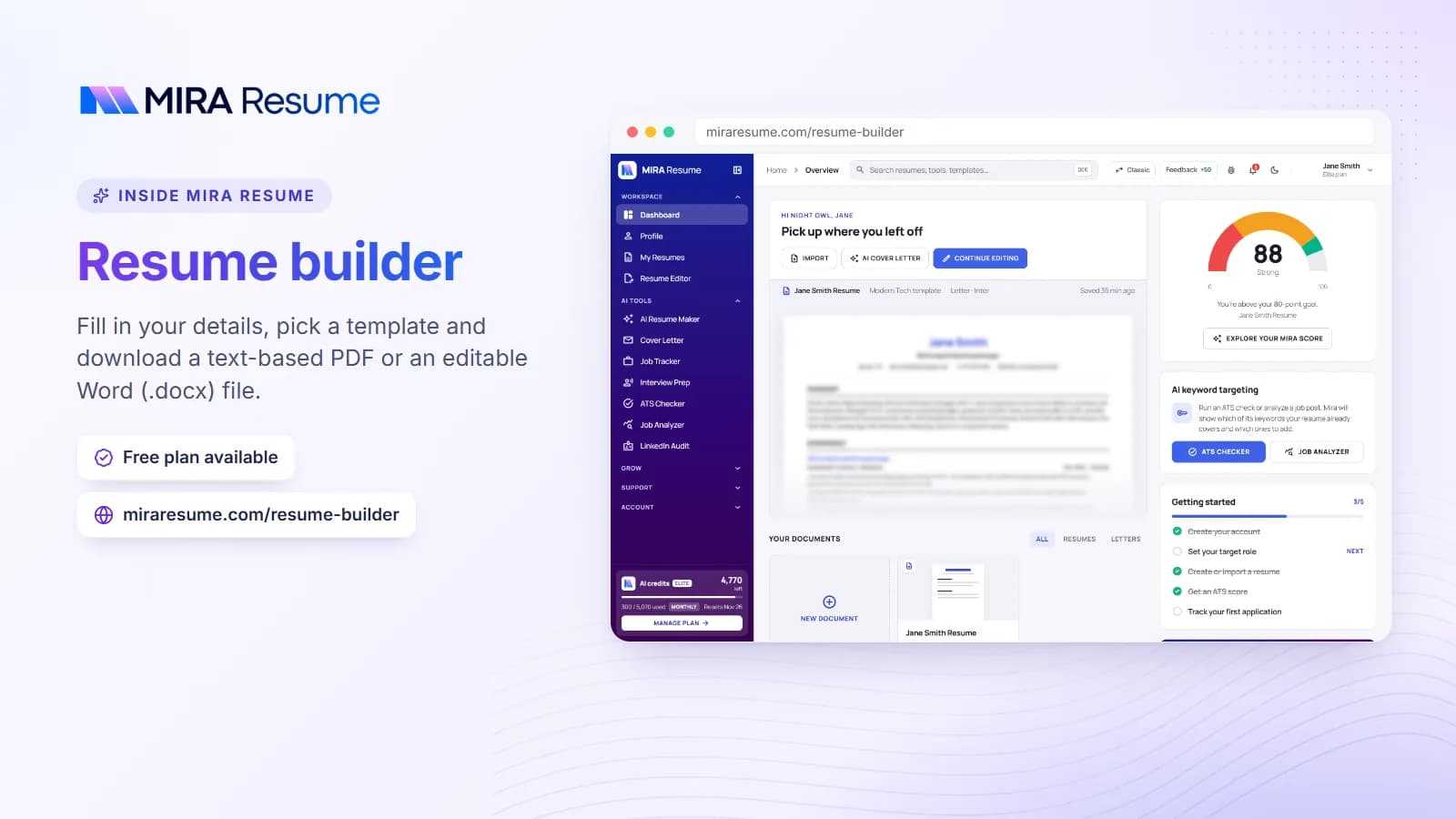
Screenshot of the Mira Resume resume builder (Fill in your details, pick a template and download a text-based PDF or an editable Word (.docx) file.)
Screenshot: Resume builder: Fill in your details, pick a template and download a text-based PDF or an editable Word (.docx) file.Try it

US resume template: a short sample

Here is the top of a fictional US resume for a data analyst. The person and company are made up. Use it as a pattern, not as text to copy.

PRIYA SHARMA
Austin, TX | (512) 555-0147 | [email protected] | linkedin.com/in/priyasharma-example
Authorized to work in the US for any employer

Summary
Data analyst with five years of experience turning sales and operations data into clear dashboards. Skilled in SQL, Python and Tableau. Known for cutting reporting time and helping managers act on numbers faster.

Experience
Data Analyst, Bluepine Logistics, Austin, TX | March 2022 to Present

  • Built a weekly Tableau dashboard used by 40 regional managers, replacing six manual spreadsheets.
  • Automated monthly sales reports with Python, cutting preparation time from two days to three hours.
  • Found a pricing error in shipping data that the finance team corrected, recovering about $85,000 in a quarter.

Notice what is missing: no photo, no birth date, no "Curriculum Vitae" title, no objective about wanting a challenging role. Each bullet starts with an action verb and, where possible, ends with a result. Our resume bullet points guide shows how to write lines like these.

Converting a CV from another country to a US resume

If you already have a CV from your home country, you do not need to start from zero. You do need to cut, rewrite and remove some things. Work through these steps in order.

  1. Change the page size to US Letter and check that nothing shifts onto an extra page.
  2. Remove personal details the US does not use: photo, date of birth, age, nationality, marital status, gender, religion, father's or spouse's name, passport or ID numbers.
  3. Delete the declaration and signature. Lines such as "I hereby declare that the above information is true" are common in some countries but are not used on US resumes.
  4. Replace the objective with a summary. Say what you offer, not only what you want. See resume objective examples if you are early in your career.
  5. Cut to one or two pages. Drop older or unrelated roles, school-level results and long lists of duties.
  6. Turn duties into results. "Responsible for client reports" becomes "Prepared monthly reports for 12 clients, all delivered on time."
  7. Explain your education clearly. Write the full degree name. If your grading system is unfamiliar in the US, you can leave grades off, or note a credential evaluation if you have one.
  8. Add context for local employers. A short phrase such as "national retail chain with 200 stores" helps a US reader understand a company they have never heard of. Keep it accurate.
  9. Switch to American spelling and date style, and use the same date format throughout.
  10. Remove the references list. Keep it ready for later.
Common CV habitUS resume version
Photo in the top cornerNo photo
Personal details box with birth date and nationalityName, city, phone, email, LinkedIn only
Three to five pagesOne or two pages
A4 paperUS Letter
Career objectiveProfessional summary
Long duty listsThree to six achievement bullets per job
Declaration and signatureRemoved
Referees listed at the endSeparate list, shared when asked

Coming from somewhere specific? Our guides to the Indian resume format, the UK CV format and the Canadian resume format show how those documents differ. You can find every country in our CV formats by country hub.

ATS and online applications in the US

Many large US employers use an applicant tracking system (ATS) to collect and search applications. These systems read text, so a simple layout gives your resume the best chance of being read correctly. Our guide to how ATS software works goes deeper.

  • Use one column and standard headings such as Experience, Education and Skills.
  • Avoid text boxes, tables for layout, icons and skill bars.
  • Save as a .docx or a text-based PDF, not a scanned image.
  • Use words from the job post where they truly describe your experience. The job description analyzer can pull out the key terms.
  • Check your file with the ATS checker before you apply.

Most people apply through company career pages and large job boards such as LinkedIn and Indeed. Federal jobs are posted on USAJOBS. If you are sending many applications, a tracker helps. Our free Stealth Mode job search uses a simple spreadsheet layout, and Mira Scout can help you find matching roles.

Cover letters are not required for every US job, but many employers still read them, especially for roles with fewer applicants. See how to write a cover letter.

Do and don't for an American resume

DoDon't
Keep it to one or two pagesSend a long CV for a business role
Use US Letter and American spellingLeave the file set to A4
Lead each bullet with an action verb and a resultList duties with "responsible for"
Tailor the summary and skills to each jobSend the same file to every employer
State work authorization honestly if it helpsGuess at visa terms or overstate your status
Use real job titles and accurate datesInflate titles or hide gaps with false dates
Keep a reference list readyAdd a photo, birth date or marital status

Final checklist before you apply

  • Page size is US Letter and the resume is one or two pages.
  • Header has name, city and state, phone, email and LinkedIn, and nothing more personal.
  • No photo, date of birth, marital status, ID numbers or declaration.
  • Summary is two to four lines and matches the job.
  • Experience is in reverse-chronological order with results, not duty lists.
  • Dates use one format throughout.
  • Spelling is American and consistent.
  • Work authorization line, if used, is accurate and current.
  • File is a .docx or text-based PDF named like Priya-Sharma-Resume.pdf.
  • You have checked it with an ATS checker and read it aloud once for typos.

Ready to build it? The resume builder gives you clean, one-column layouts, and the resume templates page lets you compare styles before you start.

Frequently asked questions

What is the American resume format?

It is a one or two page document on US Letter paper that lists your most relevant experience in reverse-chronological order. It starts with a short header and summary, then skills, work experience and education. It leaves out photos, birth dates and marital status, and it focuses on results rather than long lists of duties.

Should I put a photo on a US resume?

No. Photos are not expected on US resumes, and many employers prefer not to receive them because hiring decisions should not be influenced by appearance, age, race or other protected characteristics. The main exceptions are acting, modeling and similar roles where a headshot is requested. For most jobs, a LinkedIn profile photo is enough.

How long should an American resume be?

One page is common for students, recent graduates and people with a few years of experience. Two pages is normal for many experienced professionals, managers and technical specialists. Go longer only for an academic CV or if a job announcement asks for more detail. Federal jobs follow the rules in each announcement.

Do I need to put my visa status on a US resume?

It is not required, but a short, honest line can help if you are applying from abroad or hold a visa. Examples include authorized to work in the US for any employer, or will require visa sponsorship. Many applications ask about this directly, so answer those questions truthfully. Check official sources such as USCIS for your situation.

Can I send my CV for USA jobs instead of a resume?

For most private-sector jobs, convert your CV into a resume first. Cut it to one or two pages, remove the photo and personal details, change to US Letter and rewrite duties as achievements. Send a full CV only for academic, research or some medical roles, or when the employer clearly asks for one.

What paper size is used for resumes in the USA?

US resumes use US Letter, which is 8.5 by 11 inches. A4, used in most other countries, is slightly narrower and taller. If you send a PDF, set the page size to Letter before you export so the layout prints correctly and does not spill onto an extra page when a US recruiter prints it.

Found this useful? Share it

Send it to a friend who is job hunting, or save it for later.

Read this guide with AI

Get a plain-language summary and help applying it to your own resume. Pick an assistant; it opens with this article and a ready prompt.

Back to CV Formats by Country hub

All articles