Coming soon
CV Formats by Country

Indian Resume Format: Sections, Length and What to Leave Out

Get the Indian resume format right: resume vs biodata, 1-2 page length, CGPA, CTC and notice period lines, the declaration, plus a sample that works with ATS.

Mira Resume Editorial Team · Career content team Published Updated 12 min read
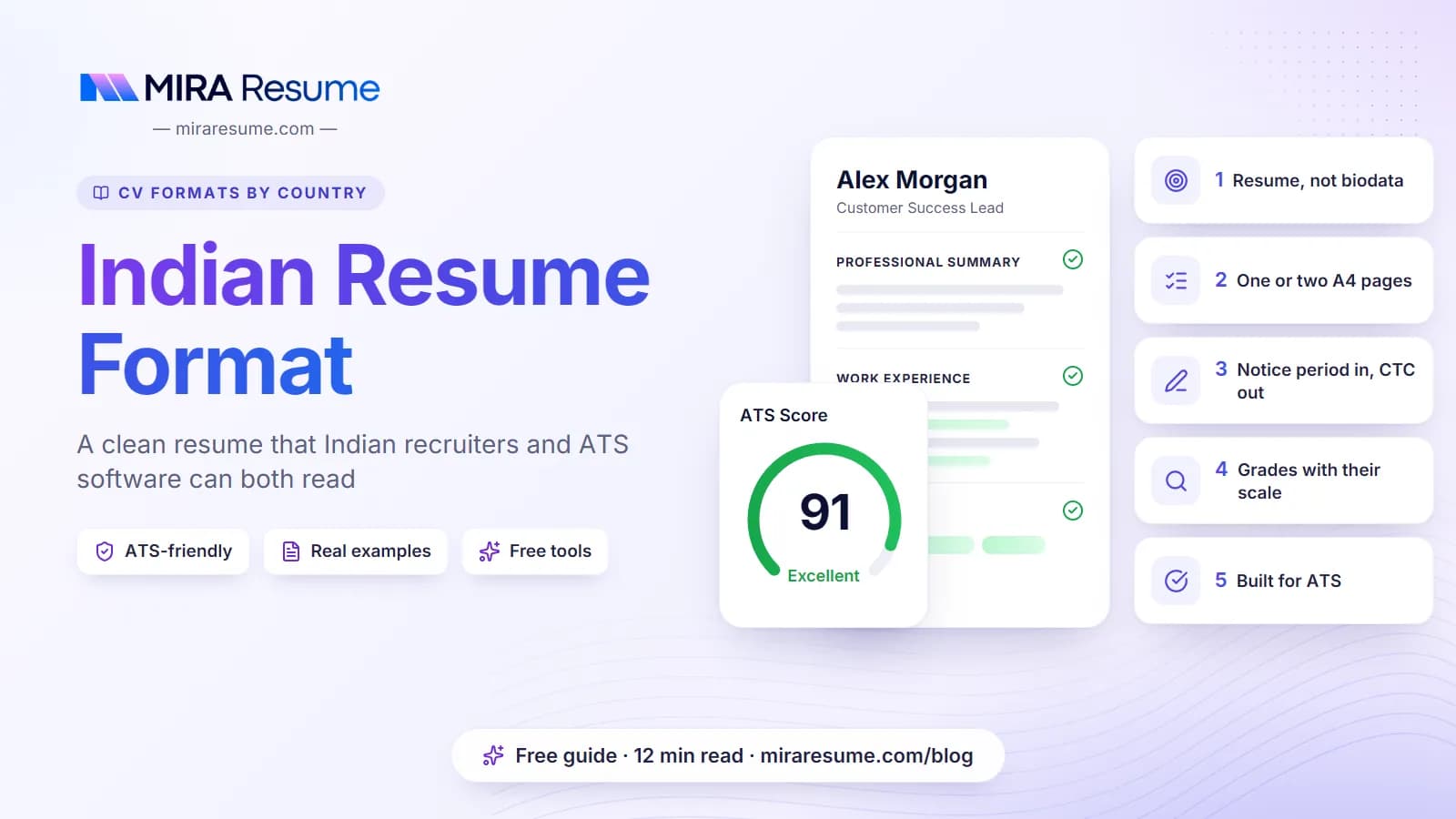
Indian Resume Format: cover image for the Mira Resume guide, with an example resume and the 5 main points

The Indian resume format has moved a long way from the old biodata with a photo, father's name and a signed declaration at the bottom. Most private companies, start-ups and multinationals in India now want something shorter and sharper: one or two pages that show what you can do, what you have achieved and when you can join.

At the same time, some habits are still specific to India. Recruiters often ask about your current and expected CTC, your notice period, and your CGPA or percentage. Many applications also go through a job portal profile as well as a resume file, and large employers commonly screen applications with an applicant tracking system (ATS).

This guide explains the difference between a resume, CV and biodata in India, the section order that works, which personal details to include or skip, how to handle CTC and notice period, and how to make one file that reads well for both people and software. There is a short fictional sample you can adapt, a do and don't table and a final checklist.
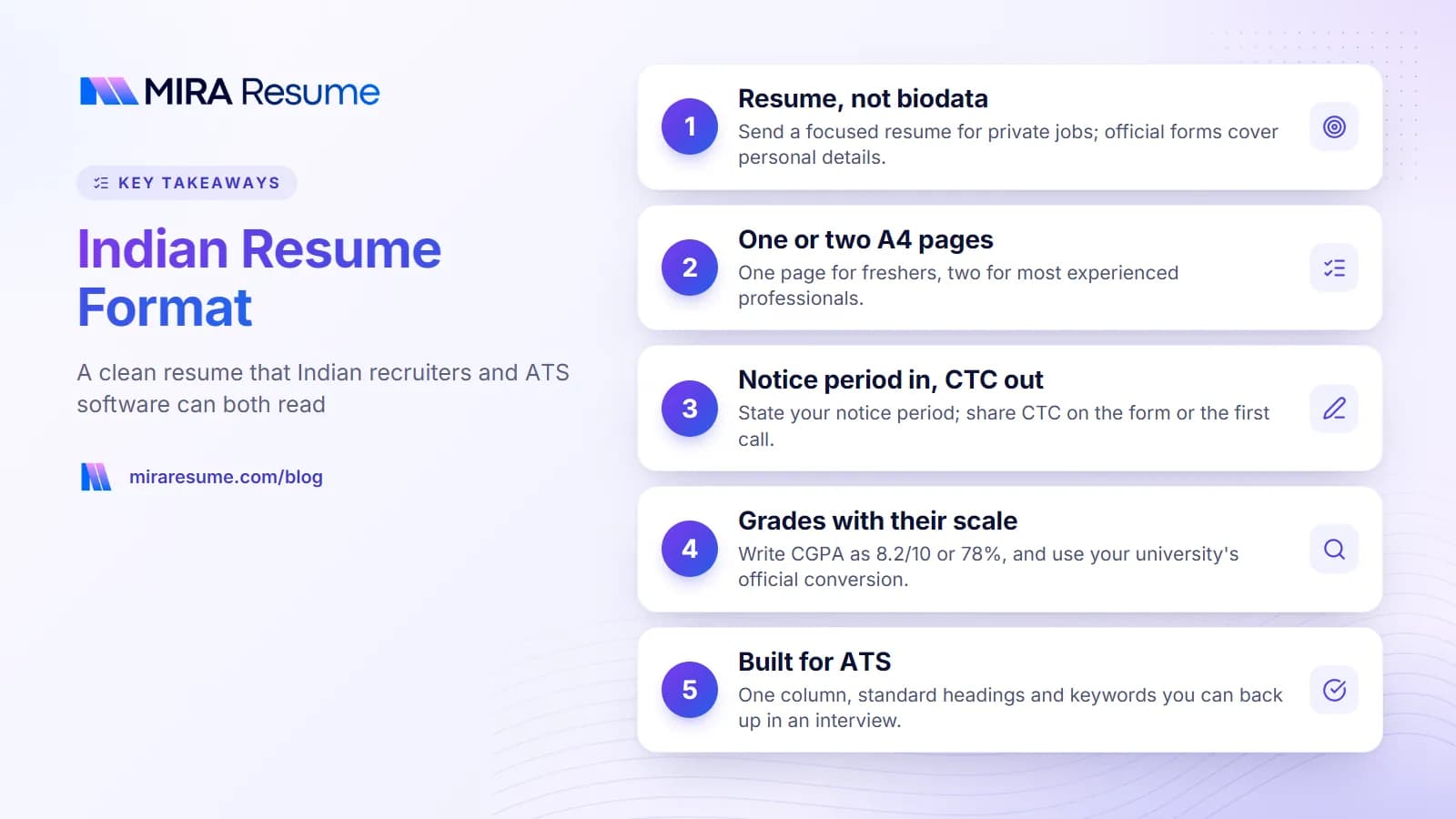
Key takeaways: 1. Resume, not biodata; 2. One or two A4 pages; 3. Notice period in, CTC out; 4. Grades with their scale; 5. Built for ATS
Key takeaways from this guide.

Resume, CV or biodata: what Indian employers mean

In India the words resume, CV and biodata are often used loosely, and a recruiter who asks for your "CV" usually means a normal job resume. Still, the three documents started out differently, and knowing the difference helps you send the right one.

DocumentWhat it usually means in IndiaTypical lengthWhen to use it
ResumeA focused summary of skills, experience and results for one kind of job1 page for freshers, 2 pages for most experienced peopleMost private-sector jobs, start-ups, IT, banking, consulting, MNCs
CVOften the same as a resume in daily use; in academia, a longer full record2 pages for jobs; longer for research and teachingWhen the post says CV, and for academic, research or medical roles
BiodataAn older format focused on personal details such as date of birth, parents' names, religion and marital status1 to 2 pagesRarely needed for private jobs today; some older or government processes use their own forms instead

The short answer to the biodata vs resume question: for a private-sector job, send a resume. Biodata-style details tell an employer about your family and background rather than your ability to do the work. If a government department, public sector undertaking or school asks for specific details, it will normally give you its own application form, and you fill in exactly what that form requests. The same advice applies if you searched for a CV format India employers accept: in everyday use, they mean the same document. For a wider view of the terms, see our guide on CV vs resume.

Length, paper size, language and file type

The basic resume format India recruiters expect follows a few simple layout rules.

  • Length: one page if you are a fresher or have under about three years of experience; two pages for most experienced professionals. Senior leaders and academics can go longer, but every line should still earn its place. Our guide on how many pages a resume should be goes into more detail.
  • Paper size: A4 is standard in India. Set this in your editor before you start so the PDF does not cut off or leave odd margins.
  • Language and spelling: English is the usual language for private-sector resumes. British spelling (organised, programme, centre) is common, but American spelling is fine if you are consistent.
  • Dates: use month and year, such as Jun 2023 to Present. Avoid all-number dates like 06/07/2023, which can be read two ways by international teams. Our resume date format guide shows the options.
  • File type: a text-based PDF is the safest default. Send a .docx if the portal or recruiter asks for Word. Name the file clearly, for example Priya-Sharma-Resume.pdf.
  • Design: one column, a readable font at 10 to 12 points, clear headings, and no tables or text boxes for your main content. These help both recruiters and ATS software.

Use reverse-chronological order (most recent first) for experience and education. This section order works for most Indian private-sector applications.

OrderSectionWhat to include
1HeaderFull name, phone with +91, professional email, city, LinkedIn or portfolio link
2Professional summaryTwo to four lines: role, years of experience, core skills and one or two results
3Key skillsTools, technologies and domain skills that match the job description
4Work experienceJob title, company, city, dates, and three to six bullet points with results
5ProjectsEspecially useful for freshers, IT and engineering roles
6EducationDegree, college, university, year, CGPA or percentage
7CertificationsRelevant courses and professional certificates with the year
8Additional informationNotice period, languages, awards, willingness to relocate

Freshers can move education and projects above experience. If you are early in your career, our separate guide to the resume format for freshers covers that layout, and our guide for experienced professionals covers longer careers. A strong summary makes a big difference; see our resume summary examples for ideas.

Personal details: what to include and what to skip

Traditional Indian resumes often started with a long personal profile. Today most recruiters only need enough to contact you and know where you are based. Sharing less also protects you, because resumes get forwarded, uploaded and stored in many places.

DetailInclude?Why
Name, phone (+91), email, cityYesRecruiters need to reach you and know your location
LinkedIn, GitHub or portfolioYes, if up to dateGives extra proof of your work
Full home addressUsually noCity and state are enough; give the full address later if asked
PhotoUsually noNot needed for most private jobs; add one only if the post asks
Date of birth, gender, marital statusOptional, usually skipNot needed to judge your skills; share on a form if requested
Religion, caste, father's nameNoNot relevant to the job; a form will ask if a process truly needs it
Aadhaar, PAN or passport numbersNoSensitive ID numbers can be misused; share only through official HR onboarding
HobbiesOptionalKeep only if they show a relevant skill and you have room

The declaration line

Many older Indian resumes end with a line such as "I hereby declare that the information above is true to the best of my knowledge," followed by place, date and signature. Modern recruiters often skip over it, because submitting a resume already implies the details are true, and it takes space you could use for results. For most private jobs you can drop it. If a government, public sector or academic application asks for a signed declaration, it will usually be part of their own form.

References

You do not need to list referees on the resume. Prepare two or three names and share them when the employer asks, usually near the offer stage. Our guide to references on a resume explains how to choose them.

Current CTC, expected CTC and notice period

These three questions come up in almost every Indian hiring process, so it helps to decide in advance where you will answer them.

Current and expected CTC

CTC stands for cost to company: the total yearly amount your employer spends on you, which can include basic pay, allowances, the employer's provident fund share and bonuses. Salaries are often written in LPA (lakhs per annum).

In most cases, leave CTC off the resume itself. Your resume is shared widely, and a fixed number on it can limit your negotiation. Many job portals and application forms have a separate field for current and expected CTC, and recruiters usually ask during the first call. Give honest figures when asked, and say what your CTC includes (fixed and variable) so the comparison is fair. If a job post specifically asks you to mention CTC in the resume, a single line in the additional information section is enough.

Notice period

Notice periods in India are commonly one to three months, depending on your contract and level, and recruiters often filter candidates by how soon they can join. Unlike CTC, a notice period line is useful on the resume because it answers an early screening question. Keep it factual:

  • Notice period: 60 days (negotiable)
  • Serving notice; last working day 15 Jan 2027
  • Available to join immediately

Only say "negotiable" or offer an early joining date if your current employer has actually agreed it is possible. Promising a date you cannot meet causes problems later.

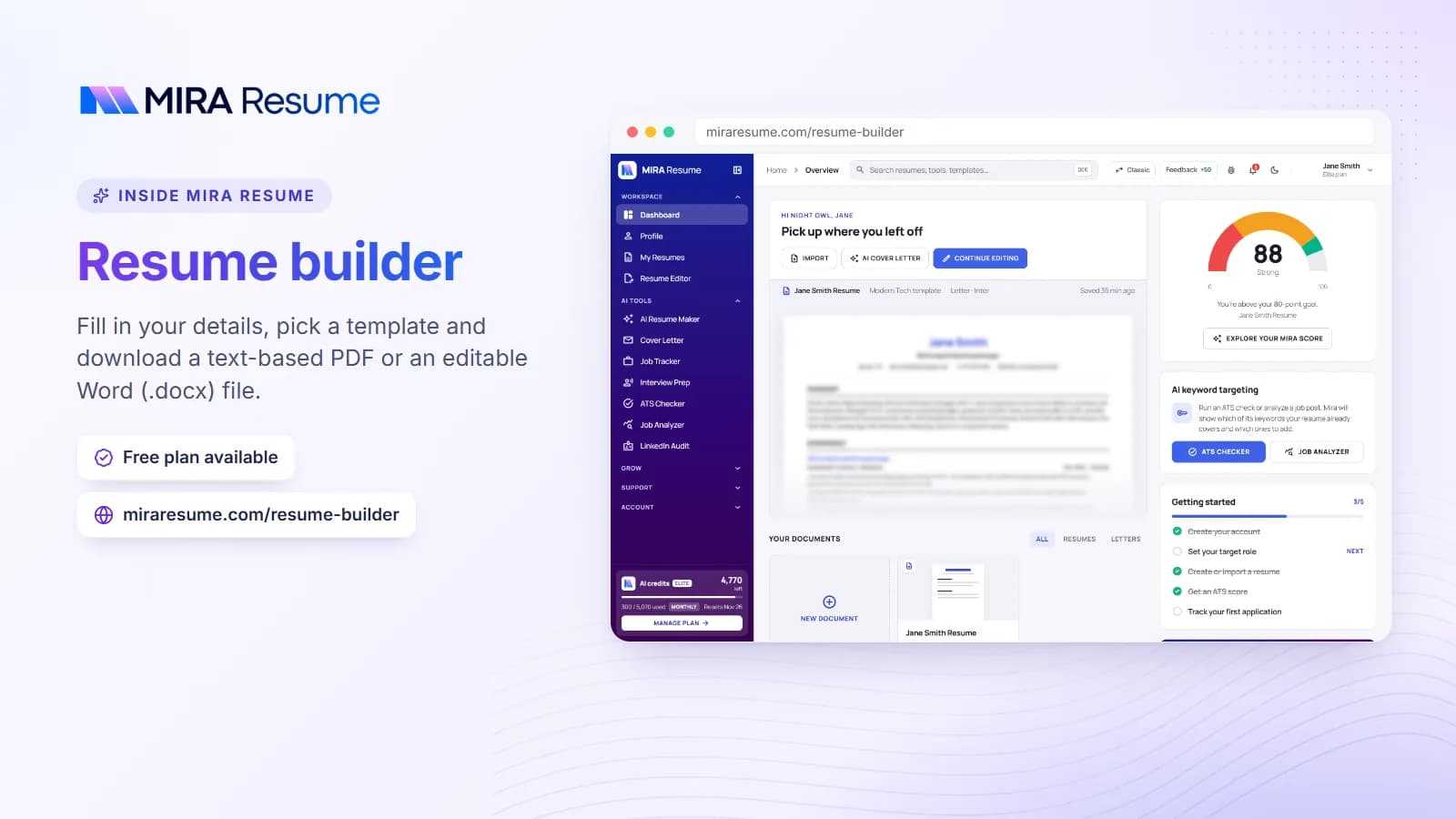
Screenshot of the Mira Resume resume builder (Fill in your details, pick a template and download a text-based PDF or an editable Word (.docx) file.)
Screenshot: Resume builder: Fill in your details, pick a template and download a text-based PDF or an editable Word (.docx) file.Try it

Education: CGPA, percentages and what to list

Education matters a lot to Indian recruiters, especially for freshers and campus hiring, but the detail you need shrinks as your experience grows.

  • Degree first: list your highest qualification at the top, for example B.Tech in Computer Science, college name, university, city, year of passing, and CGPA.
  • Show the scale: write CGPA as 8.2/10 or percentage as 78%, so there is no confusion between systems.
  • Do not convert unless asked: if an application asks for a percentage and your university uses CGPA, use your university's official conversion method, which is often printed on the mark sheet or published by the university. Do not invent your own formula.
  • Class 12 and Class 10: freshers usually include the board (CBSE, ICSE or the state board), year and percentage. With several years of experience you can remove them unless the employer asks.
  • Backlogs and gaps: do not hide anything an employer will check, but you do not need to explain every detail on the resume. Be ready to discuss it honestly in the interview.

For layout examples, see our guide on how to list education on a resume.

A short Indian resume sample (fictional)

Here is the top part of a resume for a mid-level data analyst. The name, companies and figures are made up for illustration.

Priya Sharma
Pune, Maharashtra | +91 98765 43210 | [email protected] | linkedin.com/in/priyasharma

Professional summary
Data analyst with four years of experience in retail and e-commerce analytics. Skilled in SQL, Python and Power BI. Built weekly sales dashboards used by regional managers and cut report preparation time by around half by automating data pulls.

Key skills
SQL, Python (pandas), Power BI, Excel, A/B testing, stakeholder reporting

Experience
Data Analyst, Kestrel Retail Analytics Pvt Ltd, Pune | Jul 2022 to Present

  • Built and maintain 12 Power BI dashboards tracking sales, stock and returns for 40 stores.
  • Automated weekly data extraction with Python and SQL, cutting manual reporting from two days to under one.
  • Analysed a festive-season discount test and recommended a pricing change that the category team adopted.

Additional information
Notice period: 60 days | Languages: English, Hindi, Marathi | Open to relocating to Bengaluru

You can use this as a simple Indian resume template and swap in your own details. Notice what is missing: no photo, no date of birth, no father's name, no CTC and no declaration. Everything left on the page helps the recruiter decide whether to call. You can build a similar layout in the Mira Resume builder or start from one of our resume templates.

Naukri profile vs resume, and getting past ATS

Your portal profile and your resume are two different things

Many Indian job seekers use portals such as Naukri, LinkedIn and company career sites. On a portal, recruiters often search the profile fields (headline, key skills, current role, location, notice period) as well as the attached file. That means you should:

  • Keep the profile and the resume consistent: same job titles, dates and company names.
  • Use the profile's dedicated fields for CTC, notice period and preferred locations, rather than crowding your resume with them.
  • Update your attached resume whenever you change jobs or skills, so recruiters do not download an old version.

ATS at large Indian employers

Many large employers in India, such as IT services firms, banks, global capability centres and multinationals, commonly use applicant tracking systems to collect and filter applications. To give your resume the best chance:

  • Use standard headings such as Experience, Education and Skills.
  • Keep one column and avoid putting key text in headers, footers, images or graphics.
  • Mirror the exact words from the job description where they truthfully describe you, such as "Power BI" rather than just "dashboards".
  • Check the file before you send it with our free ATS checker, and compare it against a posting with the job description analyzer.

If you want help finding roles in the first place, Mira Resume's job finder, Mira Scout, tracks Indian and India-hiring companies. Our guide to AI job search in India explains the best settings for Indian cities and remote roles.

Applying abroad from India

Resume habits change when you apply outside India, so adapt your document to the destination rather than sending the same file everywhere.

  • Gulf countries: employers in the UAE, Saudi Arabia, Qatar and nearby countries commonly expect nationality, visa status and notice period, and a photo is often included. See our Gulf CV format and Dubai CV format guides.
  • Singapore and Southeast Asia: a concise resume similar to the Indian one usually works; check our Singapore resume format guide for local details.
  • UK, Europe and North America: leave out the photo, date of birth and marital status, and focus on results. The UK CV format guide explains why.

Neighbouring markets have their own habits too; compare the Pakistan CV format and Sri Lanka CV format, or browse every country in our CV formats by country hub. Visa and work permit rules are set by each destination country, so check the official government source or your employer; this guide is not immigration advice.

Do's and don'ts for an Indian resume

DoDon't
Keep it to one or two A4 pagesPad it with a long personal profile or a list of every school prize
Lead with a short summary and key skillsOpen with a generic career objective that could fit anyone
Show results with numbers where you know themList only duties such as "responsible for reports"
Add your notice periodPrint your CTC on every copy unless the post asks for it
Show CGPA or percentage with the scaleConvert grades with a made-up formula
Use a clean, single-column, ATS-friendly layoutUse heavy graphics, skill bars or two-column templates for large employers
Tailor keywords to each job descriptionCopy keywords you cannot back up in an interview
Keep your portal profile and resume consistentLeave an outdated resume attached to your profile

Final checklist before you send

  1. Your name, phone with +91, email and city are at the top and correct.
  2. The summary matches the role you are applying for.
  3. Experience is in reverse-chronological order with month and year dates.
  4. Most bullets start with an action verb and show a result or scale.
  5. Skills match the job description and appear in your experience too.
  6. Education shows the degree, university, year and CGPA or percentage with its scale.
  7. Notice period is stated; CTC is kept for the form or the call unless requested.
  8. No Aadhaar, PAN, religion, caste or other sensitive details.
  9. The file is a text-based PDF on A4, named with your name.
  10. You have run it through an ATS check and proofread it once more on your phone.

Frequently asked questions

Should I put a photo on my resume in India?

For most private-sector jobs in India, a photo is not needed and many recruiters prefer resumes without one. It takes space and does not show your skills. Add a photo only if the job post asks for it, which happens more in roles such as aviation, hospitality front office or modelling, or when applying to some Gulf employers.

Should I mention my current CTC on my resume?

Usually no. Most Indian job portals and application forms have separate fields for current and expected CTC, and recruiters ask about it on the first call. Keeping it off the resume protects your negotiation, because the file is shared widely. If a job post specifically asks for CTC in the resume, add one short line under additional information.

Is the declaration at the end of a resume necessary in India?

For most private jobs it is not necessary. Sending a resume already implies the information is true, and many recruiters skip the line. You can use the space for skills or results instead. Some government, public sector or academic applications ask for a signed declaration, but they usually include it in their own application form.

How many pages should a resume be in India?

One page is usually enough for freshers and people with a few years of experience. Most experienced professionals use two pages. Senior leaders and academics may need more, but recruiters still prefer focus over length, so cut older or less relevant details before adding a third page.

Should I include my 10th and 12th marks on my resume?

Freshers usually include Class 10 and Class 12 with the board, year and percentage, because campus recruiters and some employers check them. Once you have several years of relevant experience, you can remove them to save space, unless the employer or application form asks for them.

What is the difference between biodata and a resume in India?

A biodata focuses on personal details such as date of birth, parents' names, religion and marital status, while a resume focuses on skills, experience and results. For private-sector jobs, send a resume. Government and some institutional processes that need personal details usually give you their own form to fill in.

Found this useful? Share it

Send it to a friend who is job hunting, or save it for later.

Read this guide with AI

Get a plain-language summary and help applying it to your own resume. Pick an assistant; it opens with this article and a ready prompt.

Back to CV Formats by Country hub

All articles