
Should you put references on resume pages? Usually, no. Most employers do not need them until later in the hiring process, and the space on your resume is better used for your skills and results. Instead, prepare a separate reference page and send it only when you are asked.
That said, there are a few cases where adding references makes sense, and many people are unsure who to choose or how to list them. This guide covers when to include resume references, how to format a reference list, who makes a good reference, how to ask them politely, and what to avoid. You will also find a copyable template and sample wording.
Do you put references on a resume?
The short answer is no, not as a default. There are three solid reasons:
- Space. A resume is short. Every line should show what you can do, not who will speak for you.
- Privacy. Your references are real people. Printing their names and numbers on a document you send to many employers means their details go to many places.
- Timing. Employers usually check references near the end, after interviews. You can wait until they ask.
You also do not need the line "References available upon request". Employers already assume you have references, so the line takes up space without adding anything. Use that line for something useful instead, such as one more result under your latest job.
When you should include references
There are exceptions. Include them on the resume, or send them along, when:
- The job posting clearly says to submit references with your application.
- You are applying in a place or field where it is common, such as some academic, government, or teaching roles.
- A recruiter or hiring manager asks you for them directly.
Rules differ by country and field. Always read the posting and follow its instructions first.
Resume references vs a separate reference page
When references are needed, the best choice is a separate page that matches your resume. Here is how the options compare.
| Option | Good for | Drawback |
|---|---|---|
| Leave references off entirely | Most applications | You must be ready if asked |
| "References available upon request" line | Almost nothing | Wastes space; reader already assumes it |
| References at the bottom of the resume | Postings that ask for it, short resumes | Uses room and shares private details |
| Separate reference page | Final stages of hiring, formal roles | You need to keep it updated |
A separate page also keeps your resume flexible. If you want a one-page resume, read our guide on how many pages a resume should be.
Who makes a good reference?
A good reference is someone who has seen your work and can describe it honestly. Choose three people when possible. Pick those who know you best, not those with the grandest titles.
Strong choices
- A current or former direct manager or supervisor.
- A coworker who worked closely with you on projects.
- A client or customer who relied on your work (with their agreement).
- A professor, coach, or advisor if you are a student.
- A volunteer leader or community supervisor if you lack work history.
Poor choices
- Family members or close friends. Employers expect an outside view.
- Someone who barely knew you or has not worked with you in many years.
- Anyone you have not asked first.
- A person who might say mixed things about you.
Match the references to the job
If you apply for a data job, a manager who saw your data work is better than a manager from a summer job in a different field. If you have few jobs, mix one manager with one teacher and one volunteer lead. Variety is fine as long as each person can speak with confidence.
How to ask someone to be your reference
Always ask before you list anyone. This is polite, and it prevents a surprise call to someone who has forgotten you. Ask by email or in person, and make it easy for them to say no.
Sample message
Hi Dana, I am applying for a project coordinator role at a logistics company. You managed me at Brightline for two years, and I would be grateful if you would be a reference for me. I can send my resume and the job posting so you know what to highlight. If now is not a good time, I understand completely. Thank you for considering it.
What to give them
- Your current resume.
- The job posting or a short description of the role.
- A reminder of projects you worked on together.
- The approximate time the employer might call.
After the employer contacts them, send a thank-you note. A thank-you matters. If you want help writing one, see our guide on a thank-you letter after an interview for the tone to use.
How to format references on a resume
Whether it is at the bottom of your resume or on its own page, use the same format for every person. Keep it simple, with these details:
- Full name
- Job title and company (or school)
- Phone number and email address
- Your relationship, such as "Direct supervisor, 2022 to 2025"
Reference page template
Use the same header and font as your resume so they look like a set. Start with your name and contact details, then the title "Professional References", then each person in a block.
Marcus Lee
Operations Manager, Harbor Supply Co.
Phone: (555) 010-2233
Email: [email protected]
Relationship: Direct supervisor, 2022 to 2025
Priya Nair
Senior Analyst, Harbor Supply Co.
Phone: (555) 010-4455
Email: [email protected]
Relationship: Team lead on two reporting projects, 2023 to 2025
Dr. Helen Ortiz
Professor of Business, Riverton College
Phone: (555) 010-7788
Email: [email protected]
Relationship: Advisor for capstone project, 2021
Tip: for a one-page resume, our simple resume format leaves room for a clean reference list if a posting needs it.
References on resume examples by situation
What you list depends on where you are in your career. Use this table as a guide.
| Your situation | Who to list | Note |
|---|---|---|
| Student or recent graduate | Professor, internship supervisor, club or sports adviser | Include school email or phone with permission |
| First job, limited history | Volunteer lead, part-time manager, community adviser | Explain how they know you |
| Experienced worker | Two managers and one coworker or client | Use recent people first |
| Career changer | People who saw skills you will use in the new field | Brief them on your new goal |
| Manager or leader | A boss, a peer, and a person you led | Shows you are respected in all directions |
| Confidential job search | Past employers only | Do not list your current boss without telling them |
If you are just starting out, you might also like our guide to writing a cover letter with no experience, which shows how to tell your story with school and volunteering.
What happens when an employer checks your references
Knowing the process can lower stress. Practices differ from one employer to another, but this is common:
- The employer asks for your reference list, often after a good interview.
- Someone from the hiring team or a recruiter contacts your references by phone or email.
- They ask about how you worked, what you did well, and where you could grow.
- They may confirm dates and job titles.
- The employer decides whether to make an offer, which may also depend on other checks.
Typical questions references hear
- How do you know this person, and for how long?
- What were their main duties?
- How did they handle pressure or feedback?
- Would you work with them again?
You cannot control what a reference says. What you can do is choose people who respect your work and prepare them with a short reminder of your best projects. A quick call or message the week before helps a lot.
Letters of recommendation and online profiles
A letter of recommendation is a written note from someone who knows you. Some schools and programs ask for them. For most jobs, a phone number and email still matter more, because employers like to speak with someone directly. If you have a letter, keep it handy but do not attach it unless it is requested.
What if you have no one to list?
Do not panic. A first-time job seeker often has few options, and employers know that. Try these steps:
- Think of anyone who supervised you for any reason, such as a teacher, a coach, a neighbor whose lawn you cared for, or a leader at a place of worship or community group.
- Ask them for a short written letter or a note they are willing to be named in.
- If you have a social profile with recommendations from real people, you can mention it when asked.
- If the application form requires references, tell the truth and list who you can. A smaller honest list beats a long list of weak ones.
If you are not sure what else to put on your page while you build experience, see our guide to skills to put on a resume.
Common mistakes with resume references
- Listing people who did not agree. Never skip the ask.
- Using old or wrong contact details. Check phone numbers and emails before you send them.
- Not briefing your references. A reference who has not seen the job cannot match your strengths to it.
- Adding "References available upon request". It is not harmful, but it adds nothing.
- Listing your current boss without telling them. This can cause trouble. Wait until you have an offer.
- Making the page look different. Use the same font and header so it looks like part of your set.
- Forgetting to say thank you. A short note keeps the relationship strong for the next time.
If you need to quit a job while you are interviewing, our guides on how to resign from a job and the two-week notice letter may help you leave on good terms, which matters for future references.
Final checklist and next steps
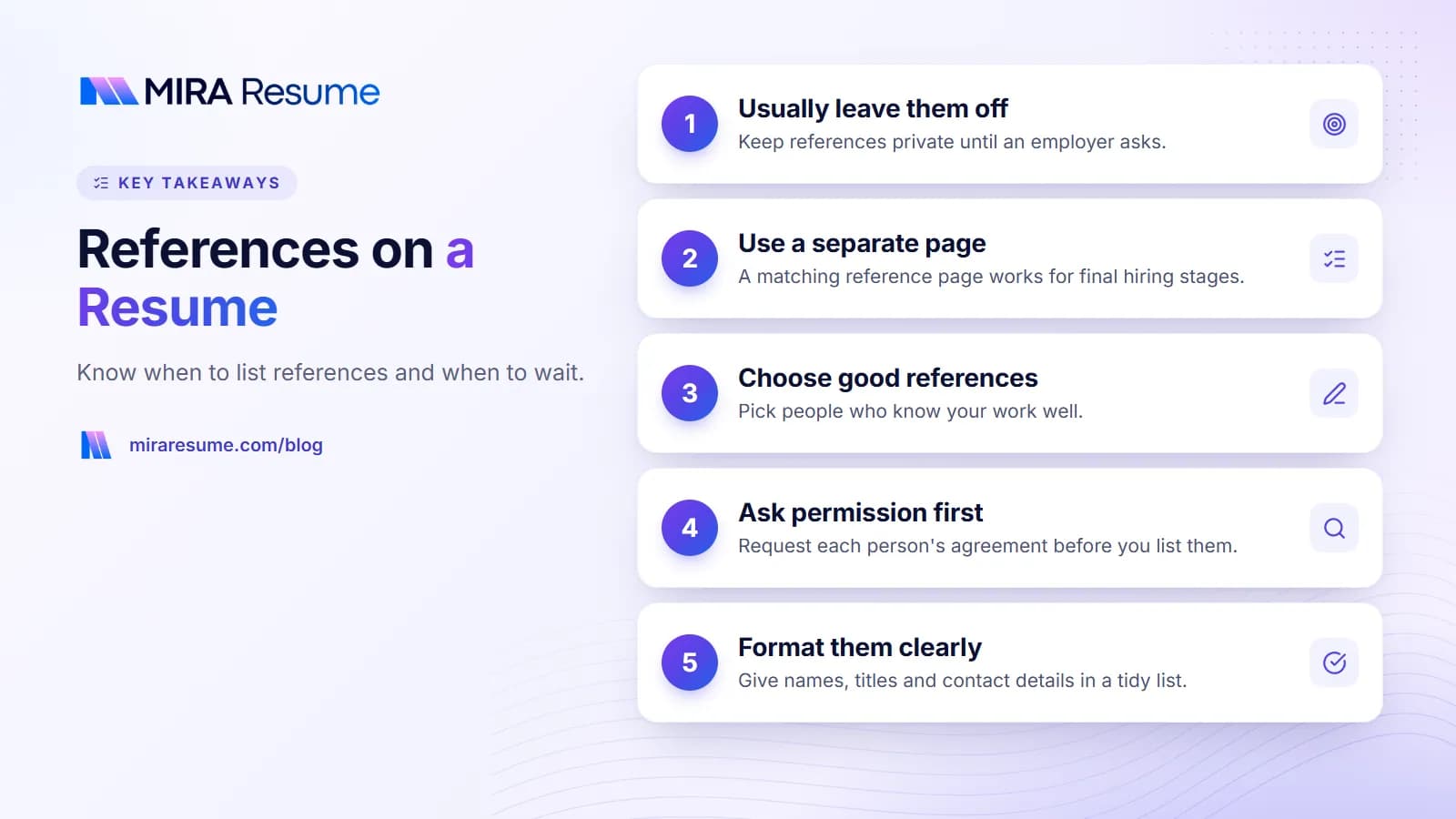
- Leave references off your resume unless the posting asks for them.
- Create a separate page with 3 references in the same style as your resume.
- Ask each person first and give them your resume and the job posting.
- Check that names, titles, phone numbers, and emails are correct.
- Send the page only when an employer requests it.
- Thank your references afterwards.
With the reference page ready, spend your effort on the resume itself. Try the resume builder for a clean layout and run your final draft through the ATS checker before you apply.