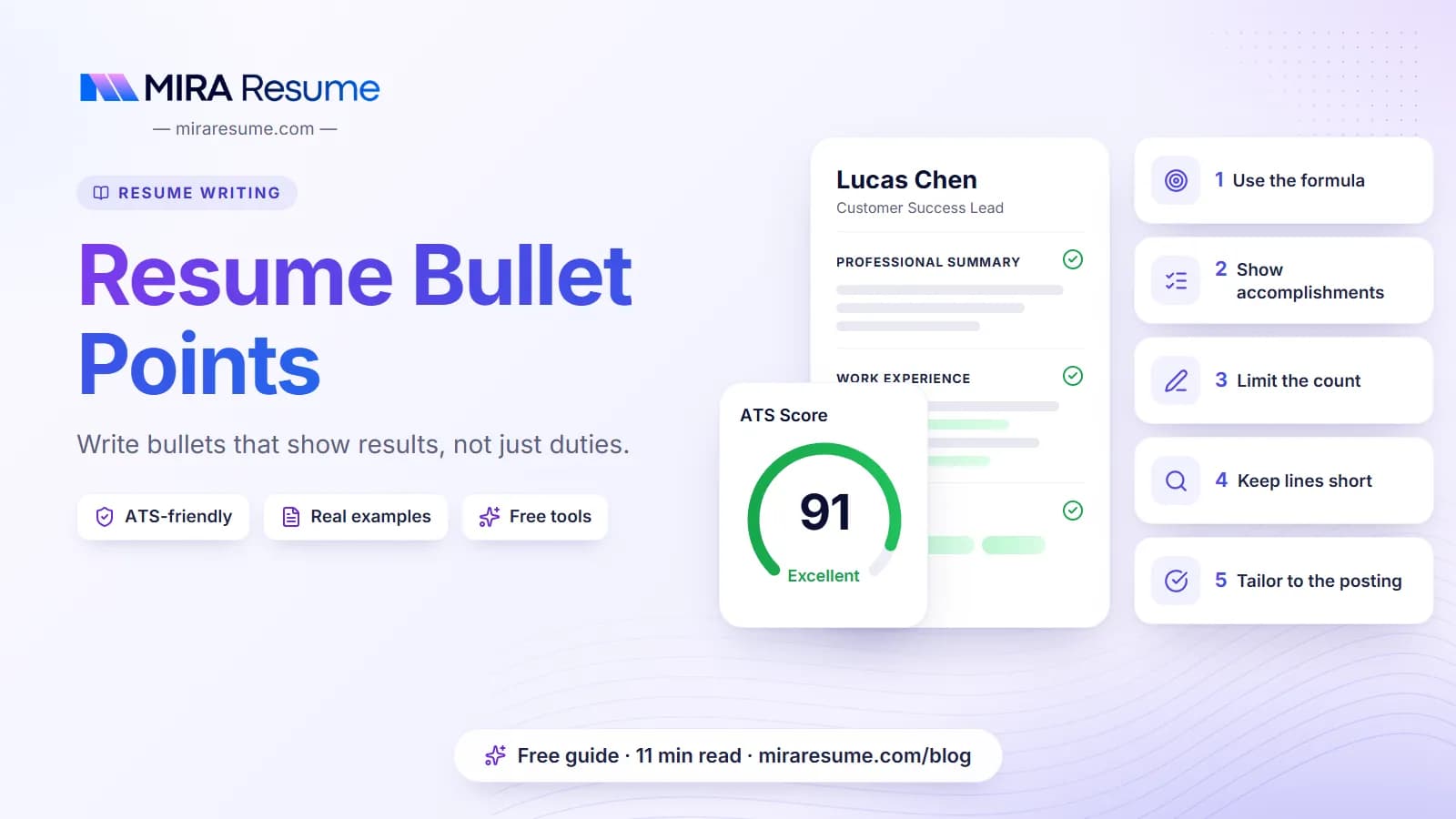

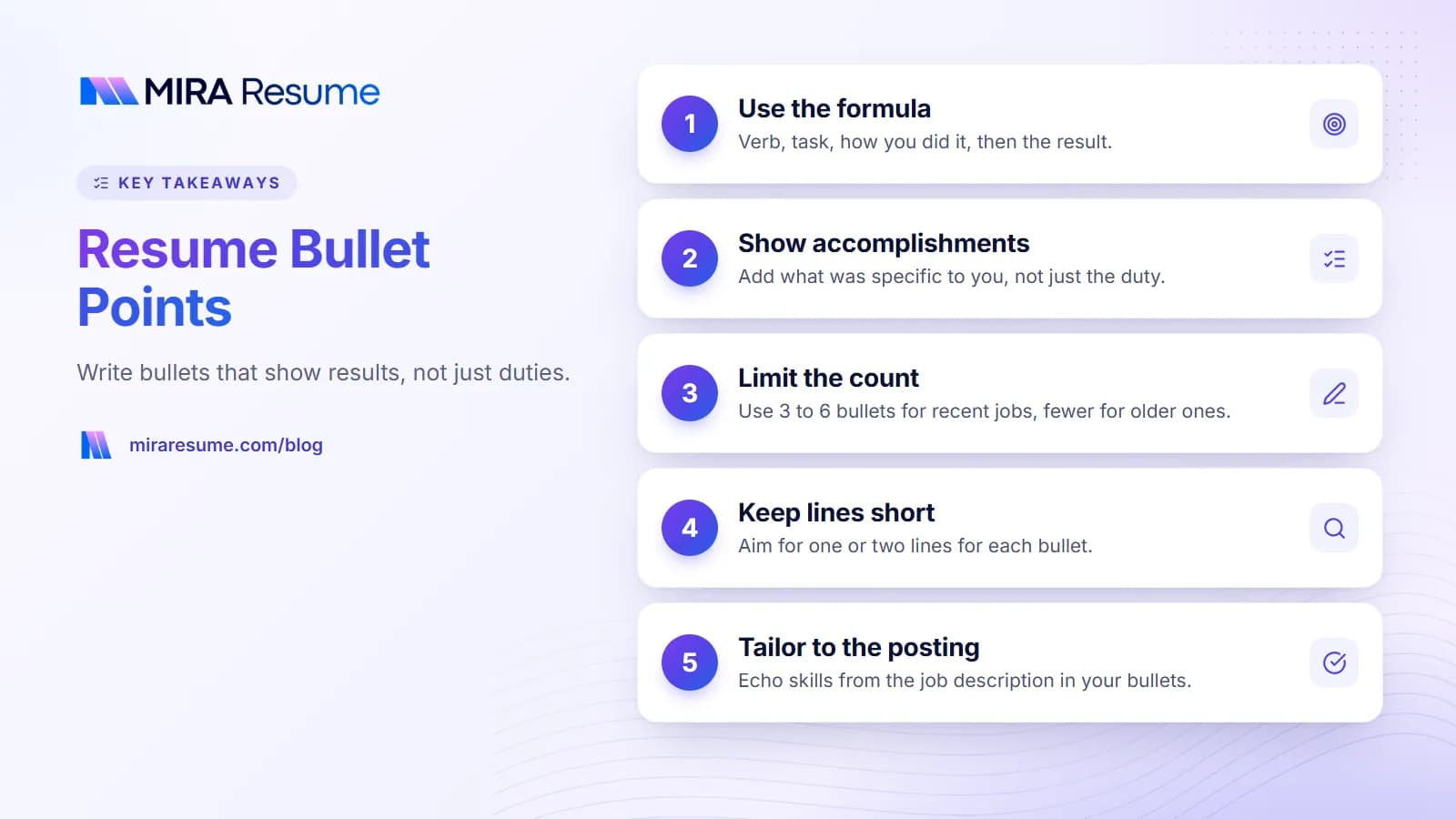
Strong resume bullet points follow a simple pattern: start with an action verb, say what you did, add how you did it, and finish with the result. Keep each one to one or two lines, and give recent jobs more of them than older jobs.
That is the short answer. The rest of this guide shows the formula in detail, how many bullets to write for each job, how to turn duties into accomplishment statements, and how to find honest numbers when you think you have none. You will also find a large before-and-after table across ten common jobs, tense rules, the safest bullet characters for applicant tracking systems, and a quick way to tailor your bullets to each posting.
What a resume bullet point needs to do
A bullet point is a single line of proof. A recruiter skims your page in a short time, often reading only the first few words of each line. Each bullet should answer one question fast: what did this person do, and did it matter?
A good bullet does three jobs at once:
- It shows a skill. Training people, fixing code, calming upset customers, packing orders accurately.
- It shows scale or context. How many, how often, for whom, or with what tools.
- It shows an outcome. What got faster, cheaper, safer, easier, or better because you were there.
Bullets also carry many of the keywords that resume scanners look for. When the words in your bullets match the skills in a posting, both software and people can see the fit more easily. Our guide to resume keywords covers that side in depth.
The bullet point formula: verb + task + how + result
Most strong bullets fit this shape:
Action verb + what you did + how you did it + result
| Part | What it answers | Example |
|---|---|---|
| Action verb | What kind of work was it? | Reorganized |
| What you did | What was the task or object? | the stockroom layout |
| How | With what method, tool, or team? | by grouping items by pick frequency and labeling shelves |
| Result | What changed? | cutting average pick time on busy days |
Put together: "Reorganized the stockroom layout by grouping items by pick frequency and labeling shelves, cutting average pick time on busy days."
You do not need all four parts every time. Sometimes the "how" is obvious. Sometimes the result is hard to pin down. But if a bullet has only the first two parts, it is probably a duty, not an accomplishment.
For a long list of verbs sorted by skill, see action verbs for resume. If you prefer a story-based approach, the STAR method resume guide shows how to shrink a Situation, Task, Action, Result story into one line. The formula here is the same idea in a tighter, everyday form.
Lead with the part that matters most
If the result is the impressive part, you can move it forward: "Cut invoice errors by about half by adding a two-step check to the billing process." Starting with the result works well for senior roles where outcomes are the main selling point.
Duties vs accomplishments
A duty is what the job description said you would do. An accomplishment is what you actually did with it, and how well. Recruiters already know what a cashier or a nurse does. They want to know what you did that another person in the same job might not have.
| Duty (weak) | Accomplishment statement (strong) |
|---|---|
| Responsible for answering phones | Answered and routed about 50 calls a day, keeping hold times short during peak hours |
| In charge of the weekly newsletter | Wrote and sent the weekly newsletter to 3,000 subscribers, testing subject lines to lift open rates |
| Handled inventory | Ran weekly cycle counts and flagged mismatches, helping the store pass its year-end audit |
| Trained new staff | Trained 8 new hires on opening and closing procedures; all were working solo shifts within two weeks |
A quick test: if you could paste the bullet into anyone else's resume for the same job and it would still be true, it is a duty. Add what was specific to you.
How many bullet points per job
There is no fixed rule, but recruiters expect more detail on recent and relevant work. A common pattern looks like this:
| Job | Suggested bullets | Why |
|---|---|---|
| Current or most recent job | 4 to 6 | Most relevant to what you can do now |
| Previous job (2 to 5 years ago) | 3 to 5 | Still shows recent skills |
| Older jobs (5 to 10 years ago) | 2 to 3 | Shows growth, but less detail is needed |
| Jobs over 10 years old | 0 to 2, or an "Earlier experience" line | Saves space for recent work |
| Unrelated short-term jobs | 1 to 2 | Fills gaps and shows reliability |
| Projects, internships, volunteering | 2 to 4 | Useful when paid experience is thin |
Adjust for relevance, not just dates. An older job that matches the new role closely can earn more bullets than a recent job in a different field. If you were promoted inside one company, split the bullets under each title, as shown in how to show a promotion on a resume.
If your page is running long, trim bullets from older jobs first. Our guide on how many pages a resume should be helps you decide when to stop.
How long each bullet should be
Aim for one or two lines on the page, which is usually about 12 to 25 words. Three-line bullets are hard to scan, and the key point gets buried.
- One idea per bullet. If you use "and" twice, you may have two bullets.
- Cut filler. Words like "successfully", "various", "in order to", and "responsible for" add length without meaning.
- Drop "I" and "my". Bullets are written in an implied first person: "Built a dashboard", not "I built a dashboard".
- Skip the period debate. Either end every bullet with a period or none of them. Just be consistent.
Before: "Was responsible for successfully managing various aspects of the onboarding process for new employees in order to make sure they were ready." (22 words, says little)
After: "Ran onboarding for 15 new hires a quarter, using a first-week checklist that cut setup questions to IT." (18 words, says a lot)
How to find numbers when you think you have none
Many people say "I don't have any numbers." Usually you do. They are just not in a report. Look for these kinds of facts, and only use ones you can explain honestly in an interview.
| Type of number | Questions to ask yourself | Example phrase |
|---|---|---|
| Volume | How many customers, tickets, orders, patients, or students? | "for about 40 customers a shift" |
| Frequency | How often did you do it? Daily, weekly, every shift? | "weekly", "every closing shift" |
| Time saved | Did something get faster after your change? | "from two days to one afternoon" |
| Scope | How big was the team, budget, area, or system? | "across 3 locations", "a $10K budget" |
| Rankings | Were you top in a group, picked for something, or recognized? | "top 3 of 20 reps for the quarter" |
| Accuracy | Did errors drop? Did you hit a quality standard? | "with no missed deadlines in 12 months" |
| Speed to competence | How quickly did you or your trainees get up to speed? | "working solo within two weeks" |
Where to look for real figures
- Old performance reviews, goal sheets, or thank-you emails.
- Your calendar, sent folder, or ticket history (count a typical week).
- Team dashboards, sales reports, or shift logs you had access to.
- Simple math: if you served about 30 tables a shift and worked 4 shifts a week, that is roughly 120 tables a week.
Rules for honest numbers
- Never invent a figure. If you cannot explain how you got it, leave it out.
- Use "about", "roughly", or "up to" when you are estimating from a typical week.
- Do not claim team results as your own. Write "helped the team reach" or "one of 4 people who" when that is the truth.
- Use a fact instead of a number when there is no honest figure: who benefited, what was adopted, what you were trusted with.
Resume bullet point examples: before and after for 10 jobs
Each "after" bullet below is an example. The numbers are made up to show the shape. Swap in your own tasks and figures, or remove the number if you do not have a true one.
| Job | Before | After |
|---|---|---|
| Retail associate | Helped customers on the sales floor | Helped about 60 shoppers a shift find sizes and products, and suggested add-ons that raised average basket size |
| Retail associate | Did visual merchandising | Set up weekly front-table displays from the planogram, which the store manager used as the model for other sections |
| Nurse (RN) | Cared for patients | Cared for 5 to 6 patients per shift on a busy medical-surgical unit, documenting assessments in Epic on time |
| Nurse (RN) | Educated patients | Taught discharge and medication plans to patients and families using teach-back, reducing follow-up calls to the unit |
| Software engineer | Worked on the backend | Built REST endpoints in Node.js for the billing service, cutting page load time on the invoices screen |
| Software engineer | Fixed bugs | Fixed 30+ production bugs in a quarter and added regression tests so the same issues did not come back |
| Teacher | Taught math to 8th graders | Taught 8th-grade math to 5 classes of about 28 students, using weekly exit tickets to regroup students for review |
| Administrative assistant | Managed calendars | Managed calendars and travel for 3 executives, booking about 20 meetings a week across time zones without double bookings |
| Sales representative | Sold products to clients | Closed new accounts in a territory of 120 small businesses, finishing the year at 110% of quota (example figure) |
| Customer service rep | Answered customer emails | Resolved about 45 email and chat tickets a day, keeping customer satisfaction scores above the team target |
| Warehouse associate | Picked and packed orders | Picked and packed about 150 orders a shift with RF scanners, keeping a high accuracy rate during peak season |
| Marketing coordinator | Ran social media | Planned and posted 5 social posts a week across Instagram and LinkedIn, growing followers steadily over six months |
| Student | Member of the robotics club | Wired and programmed the drive system for the robotics team's competition robot, which reached the regional semifinals |
| Student | Group project for marketing class | Led a 4-person class project that surveyed 80 students and presented a campus cafe pricing plan to faculty |
See full resumes that use bullets like these on our resume examples page. If you are short on paid work, our guide to a resume with no experience shows how to build bullets from school, volunteering, and projects.
Tense and grammar rules for bullets
Small grammar choices make bullet points for resume sections easier to read. These rules cover most cases:
- Current job: present tense. "Manage", "Train", "Resolve".
- Past jobs: past tense. "Managed", "Trained", "Resolved".
- Finished achievements in a current job: past tense is fine. "Launched the new intake form in March" can sit under a current role, because that project is done.
- Stay consistent within each job. Do not mix "manage" and "managed" for ongoing tasks in the same list.
- Start with the verb. Avoid opening with "Was", "Helped to", or "Responsible for".
- Use digits for numbers. "8 new hires" scans faster than "eight new hires" on a resume.
ATS-safe bullet characters and formatting
Applicant tracking systems read text in different ways, and no one can promise how a specific system will parse a file. Simple choices reduce the risk of garbled text.
| Use | Avoid |
|---|---|
| Standard round bullets from your word processor's bullet list tool | Emoji, icons, arrows, check marks, or images used as bullets |
| Simple hyphens or en dashes if you are typing plain text | Unusual symbol fonts such as Wingdings |
| A single column with bullets under each job | Bullets inside text boxes, tables, or multi-column layouts |
| Plain text for numbers and dates | Charts, skill bars, or rating graphics |
Our scannable resume guide covers the full layout. After you finish, run your file through the ATS checker to see how the text comes through and which posting keywords are missing.
How to tailor your bullets to a job description
The same experience can be described in several true ways. Tailoring means choosing the version that best matches what this employer is asking for.
- Pull the key requirements. Paste the posting into the job description analyzer to see the main skills, tools, and duties it repeats.
- Match bullets to requirements. For each top requirement, find a bullet that proves it. If none does, check whether you have real experience you left out.
- Use their words when they are accurate. If the posting says "client onboarding" and you wrote "new customer setup", switch to their phrase if it describes the same work.
- Reorder. Move the most relevant bullet to the top of each job. Readers notice first bullets most.
- Cut what does not help. A bullet that is true but unrelated can go, especially for older jobs.
Keep a "master resume" with every bullet you have ever written. Then copy and trim it for each application instead of starting from scratch.
Common bullet point mistakes
- Listing tasks with no results. Every bullet reads like a job ad.
- Making every bullet the same length and shape. Some variety reads more naturally.
- Using vague claims. "Improved efficiency" without saying what changed or how.
- Stacking buzzwords. "Leveraged synergies to drive cross-functional value" says nothing.
- Repeating the same verb. Five bullets that start with "Managed" blur together.
- Overstating your role. If you supported a project, say so. You may be asked about any line.
- Burying the best bullet. Put your strongest, most relevant point first.
Using AI to help with bullets
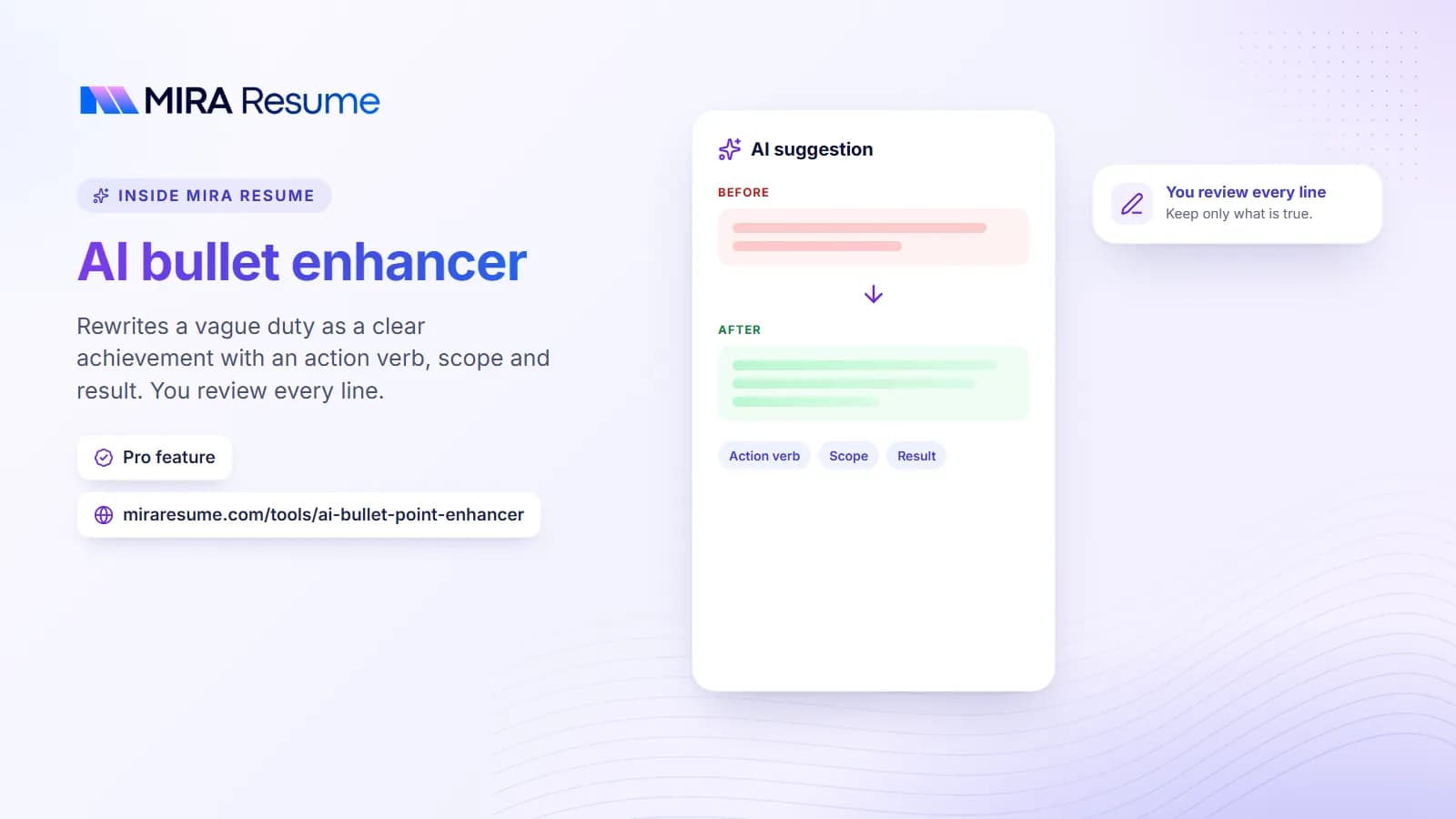
An AI tool can help you rephrase a rough bullet, suggest a stronger verb, or shorten a long line. Mira Resume's AI bullet point enhancer does this. Treat the output as a draft: check every fact, remove any number you did not supply, and make sure it still sounds like you. AI cannot know your real results, so it should never be the source of your figures.