
A science curriculum vitae sample helps most when you can see the whole page: what comes first, how long each part should be, and how to word each line. A science CV is a detailed record of your education, research, lab skills, publications, talks and awards. It is used for graduate school, research posts, fellowships, and many lab and university jobs.
Unlike a short resume, a CV can run past two pages as your career grows. But longer does not mean messier. A good science CV is easy to scan, uses one steady format, and puts the most important items where a busy reader will see them.
Below you will find a section order, a full sample with made-up details, tips for different career stages, and a list of mistakes to avoid. If you are not sure whether you need a CV or a resume, read our CV vs resume guide first.
What a science CV includes
Science fields differ, but most CVs share the same building blocks. Use the sections that fit your story and skip the rest.
| Section | What it shows | Who needs it |
|---|---|---|
| Contact information | Name, email, phone, city, profile links | Everyone |
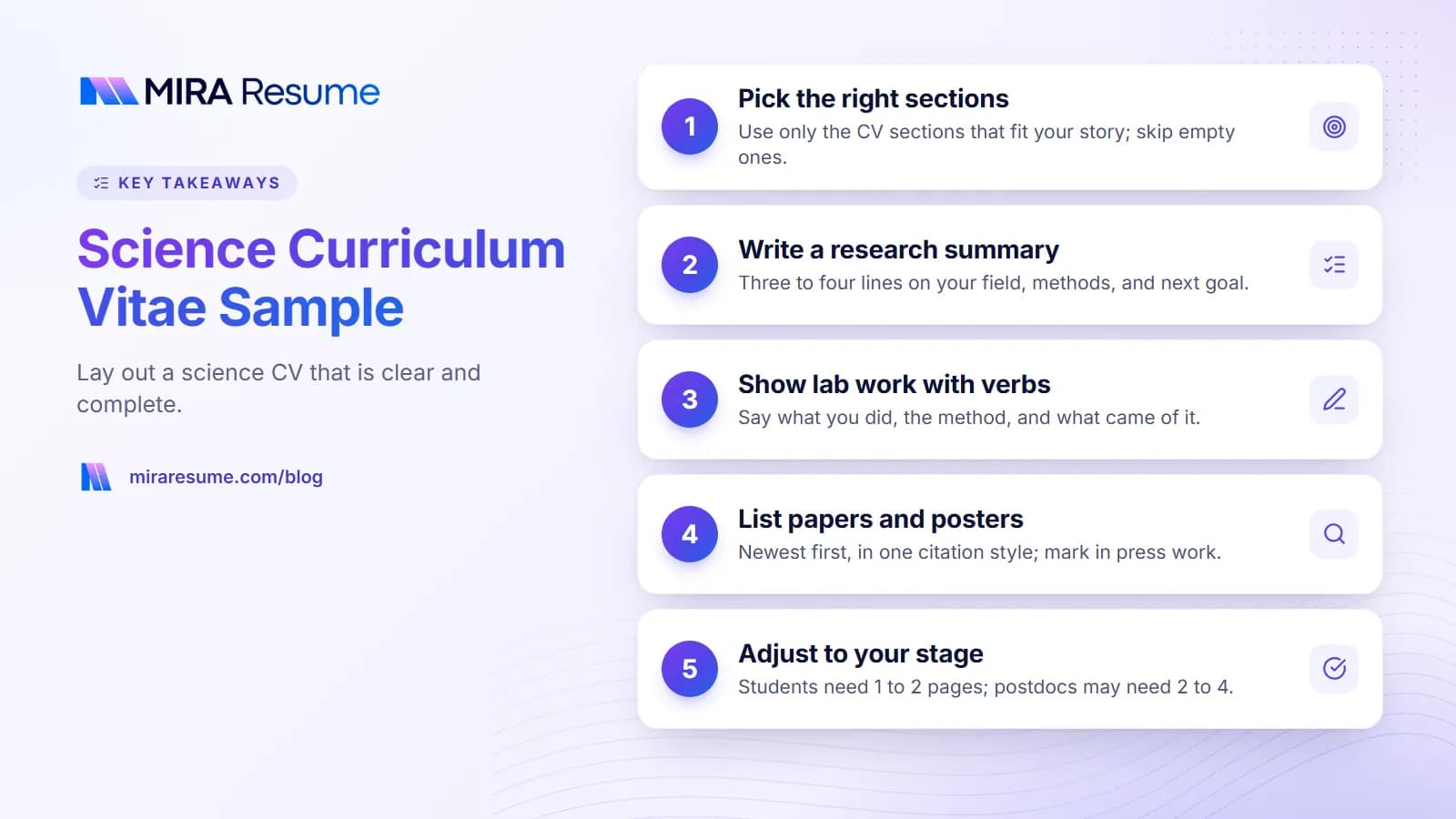
| Research summary | Your focus in 3 to 4 lines | Most applicants |
| Education | Degrees, schools, years, thesis titles | Everyone |
| Research experience | Labs, projects, your role and methods | Everyone |
| Technical skills | Lab methods, software, instruments | Everyone |
| Publications | Papers, preprints, posters | If you have them |
| Presentations | Talks and poster sessions | If you have them |
| Teaching and mentoring | Courses, tutoring, lab supervision | If relevant |
| Grants, awards, fellowships | Recognition and funding | If you have them |
| Memberships and service | Societies, committees, peer review | Optional |
| References | Names of people who can speak for you | Often on request, or follow the post |
If you have no papers yet, that is fine, especially as a student. Highlight lab work, projects, posters and skills. Do not leave blank headings. A heading with nothing under it looks unfinished.
A full science curriculum vitae sample, section by section
Everything below is made up to show structure. Replace the details with your own true facts.
1. Header
Dr. Maya Thompson
Boston, Massachusetts | [email protected] | 555-010-4421
ORCID: 0000-0000-0000-0000 | linkedin.com/in/mayathompson
2. Research summary
Cell biologist with a PhD in molecular biology and five years of experience studying how cells repair damaged DNA. Skilled in microscopy, cell culture and data analysis. Seeking a postdoctoral position in cancer biology.
3. Education
PhD, Molecular Biology, Riverbend University, 2021 to 2026
Thesis: Repair of DNA damage in dividing cells. Advisor: Dr. L. Moreno
BSc, Biology, Lakeview College, 2017 to 2021
Graduated with honors
4. Research experience
Graduate Researcher, Moreno Lab, Riverbend University, 2021 to 2026
- Designed and ran experiments to track how cells fix DNA breaks.
- Trained three junior students on cell culture and safe lab practice.
- Built a simple spreadsheet and script workflow to clean and analyze image data.
Undergraduate Research Assistant, Lakeview College, 2019 to 2021
- Prepared samples and recorded results for a water quality project.
5. Technical skills
Laboratory: cell culture, PCR, western blotting, fluorescence microscopy
Software: R, Python (basic), ImageJ, GraphPad Prism
Other: lab safety, record keeping, protocol writing
6. Publications
Thompson M, Moreno L. Title of paper. Journal Name. 2025;12(3):45-56.
Thompson M, et al. Title of preprint. Preprint server. 2026.
7. Presentations
Poster: Title of poster. Regional Cell Biology Meeting, 2025.
Talk: Title of talk. Riverbend University Graduate Symposium, 2024.
8. Teaching and awards
Teaching Assistant, Introductory Biology, Riverbend University, 2022 to 2024
Graduate Research Fellowship, Riverbend University, 2023
The structure is simple: heading, then entries, newest first. Use the same style for every item in a list. Pick a citation style your field uses and keep it the same throughout.
How to write each part well
The research summary
Write 3 to 4 lines. Say your field, your level, your main methods and what you want next. Avoid big claims. A line like "passionate about science" says little. A line like "studies how cells repair DNA using microscopy" says a lot. See our CV summary examples for more wording ideas.
Research experience
For each role, list the lab, your title, the dates, and then bullets. Start each bullet with a verb. Say what you did, what method you used, and what came of it.
- Weak: Worked on cell experiments.
- Stronger: Ran weekly cell culture experiments and recorded results in a shared lab notebook.
Only include numbers that are real, such as the number of samples or students you trained. Never inflate them.
Technical skills
Group skills in short lines by type, such as Laboratory, Software, and Other. Include only what you can do on your own or with little help. If you list a method, be ready to explain it at an interview.
Publications
List in reverse date order, with your name where it appears. You may bold your own name if your field does this. Mark papers that are accepted but not yet out as "in press," and drafts under review as "submitted." Do not list work as published if it is not.
Awards and funding
Give the name, the giver and the year. If an award is not well known, add a few words on why it was given.
Science CV tips by career stage
| Stage | Put first | Length | Special tip |
|---|---|---|---|
| Undergraduate | Education, then lab experience | 1 to 2 pages | Course projects, lab classes and skills count |
| Master's or early PhD | Education and research | 2 pages | List posters, even if small |
| Late PhD or postdoc | Research summary, education, publications | 2 to 4 pages | Add mentoring and teaching |
| Lab technician | Skills and lab experience | 1 to 2 pages | Name instruments and methods you use |
| Industry scientist | Summary, experience, skills | 2 pages | Shift toward a resume style |
Applying for jobs outside academia
Companies often prefer a shorter resume. Keep the best papers, drop long lists of talks, and show results in plain language. Our guides on the simple resume format and the skills-based resume can help you adapt, especially if you are changing from academia to industry.
Computer science and data roles
If your science is computer science, a different layout may suit you better. See our computer science resume guide for a format built around projects and tools.
First-time applicants
If you are early on, add short entries about coursework, lab classes and group projects. State your role in each one clearly. A short, honest CV is better than a stretched one.
A shorter sample for a student or lab technician
Not every science CV needs papers and grants. Here is a lighter layout for someone early in their path. The details are made up.
| Section | Sample content |
|---|---|
| Header | Daniel Okafor, Austin, Texas, [email protected], 555-010-7788 |
| Summary | Biology graduate with two years of lab experience in sample prep, testing and record keeping. Careful, safety-minded and quick to learn new instruments. |
| Education | BSc Biology, Lone Star State University, 2025. Relevant courses: Genetics, Organic Chemistry, Statistics |
| Lab experience | Lab Assistant, Campus Microbiology Lab, 2023 to 2025: prepared media, ran plate counts, logged results daily |
| Projects | Senior project on soil bacteria: collected samples, ran tests and presented a poster |
| Skills | Sterile technique, pipetting, microscopy, Excel, lab notebook records |
| Awards | Dean's List, four terms |
Why this works
- It fits on one page.
- Every line is true and checkable.
- It shows tasks and methods rather than empty praise.
- It leaves out sections that Daniel has no content for yet.
Turning it into a resume
If you apply to a company, this same content can become a one-page resume. Move skills higher, add a stronger summary, and trim course lists. Our chronological resume template page shows a standard layout that fits well.
A tip for gaps
If you have a gap, such as time off for family or health, you do not need to explain it at length. You can list dates honestly and, if you wish, add one short line. You can discuss the details in an interview if asked.
Format, fonts and ATS tips for a science CV
Many universities and companies use hiring software to collect CVs. Keep your file easy for it to read.
- Use one column and real text. No text boxes.
- Use standard headings such as Education, Research Experience, Publications.
- Choose a clean font like Arial, Calibri or Times New Roman at 10 to 12 points.
- Use margins of 0.8 to 1 inch.
- Keep date style the same, such as 2021 to 2026.
- Number pages and put your name on each page, in the page body or header, so loose pages can be matched up. Also keep your contact details in the main body of page one.
- Save as PDF unless the post asks for another format.
Special characters, such as Greek letters or chemical formulas, can sometimes vanish or change. Spell out important terms where you can, or write the formula in plain text. You can run your final file through our ATS checker to spot reading problems. For a plain template idea, see our ATS friendly CV template.
Where to build it
You can write it in Word or Google Docs; our guides to Microsoft Word resume templates and Google Docs resume templates cover how to keep the layout stable. If you only need a short, polished version for an industry job, look at our resume templates. Note that Mira Resume downloads as PDF and is built for short, resume-style documents, so a long academic CV with many publications is usually better written in a word processor.
Common mistakes on a science CV
- Listing duties, not contributions. Say what you did and what method you used, not only "assisted in lab."
- Claiming credit you did not earn. Be exact about your role in team work and papers.
- Mixing citation styles. Choose one and stay with it.
- Burying the best items. Put your strongest section near the top.
- Padding. Do not list every short course or small event. Choose the ones that matter.
- Missing dates. A reader should always see when something happened.
- Typos in names of methods or journals. Check each term twice.
- Hiding contact details. Make your email easy to find.
- Using the same CV for every post. Reorder sections to match the job. A teaching post should show teaching early. A lab post should show methods early.
Before you send
- Ask someone in your field to read it.
- Check every date and spelling.
- Match section order to what the post values.
- Write a matching cover letter. See what a cover letter is and how it works with your CV.