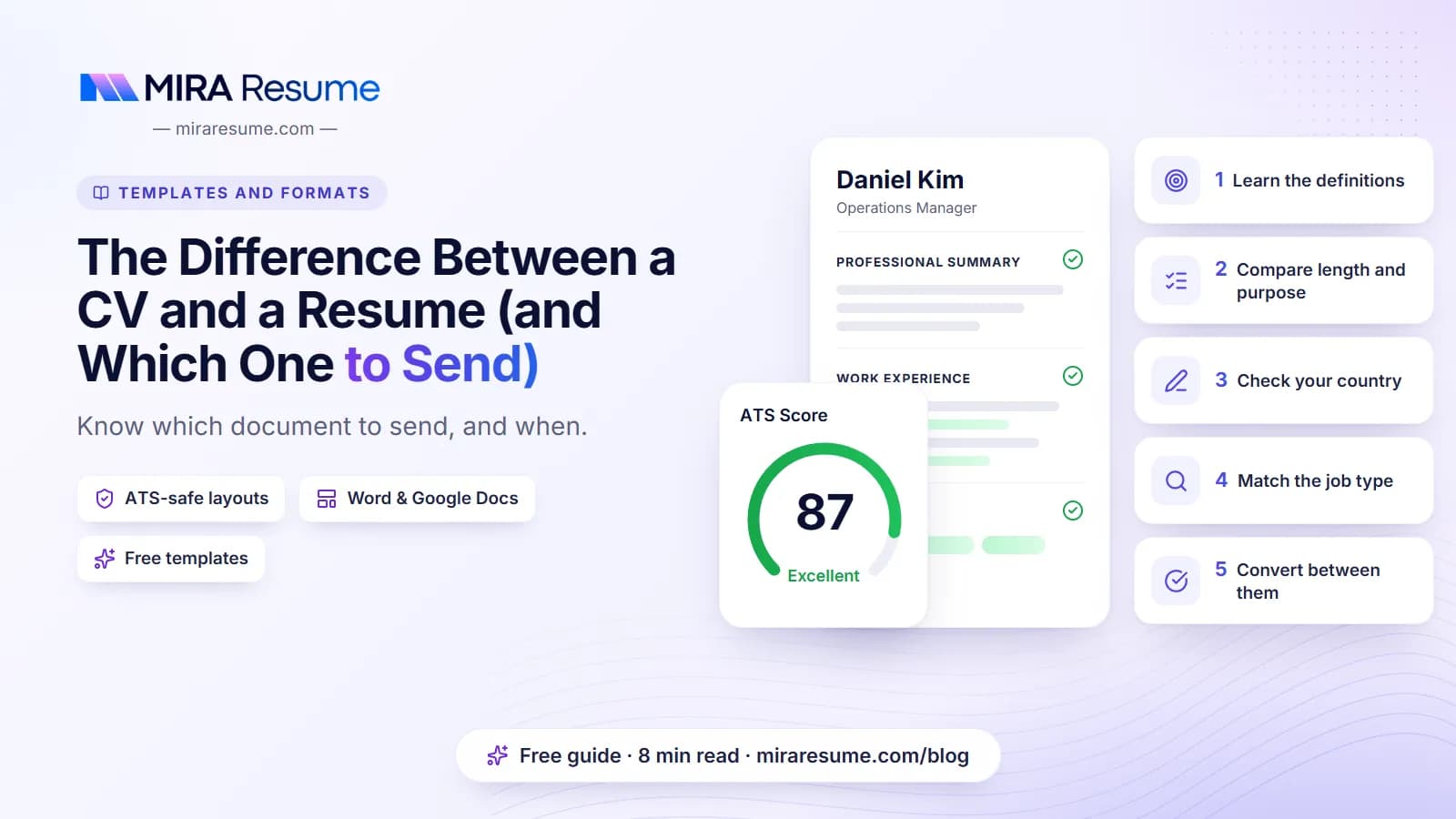

The difference between CV and resume documents comes down to length, purpose and place. A resume is a short document, usually one or two pages, that you adjust for each job. A CV (short for curriculum vitae) is a longer record of your education, work, research and achievements. It can run several pages and changes less from job to job.
The confusing part is that many people use the two words as if they mean the same thing. In some countries they do. In the US and Canada they are different documents. In the UK, Ireland, Australia and many other places, "CV" is simply the normal word for what Americans call a resume.
This guide explains what each one means, shows the differences in a table, tells you which to send, and covers common questions such as what "C.V." stands for.
What do CV and resume mean?
What is a C.V.?
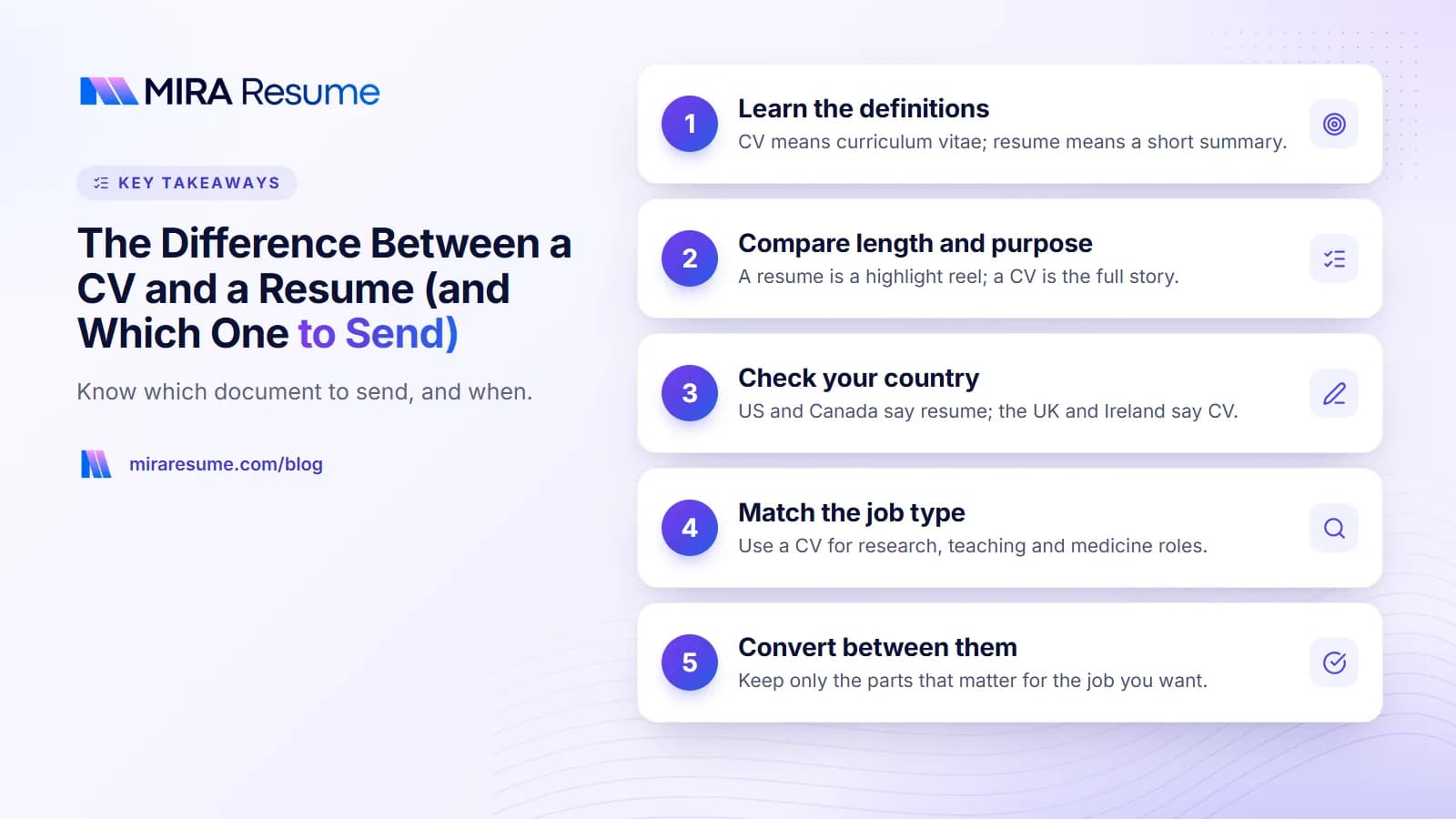
CV stands for curriculum vitae. It is a Latin phrase that is often explained as "course of life." People also write it as C.V. or cv. If you have seen searches like "cv of c.v," they usually mean one of two things: someone wants to know what the letters stand for, or they want an example of a CV to copy. This guide covers both.
A CV lists your path in detail: schooling, jobs, training, research, papers, awards and more. It is a record of what you have done.
What is a resume?
The word comes from French and means "summary." A resume is a short, focused document that picks the parts of your history that fit one specific job. You leave out what does not help.
Resume or CV meaning in daily talk
When someone asks for your "CV or resume," check the country and the job. The same word can ask for different things. A recruiter in London who asks for a CV usually means a two-page work summary. A university in the US that asks for a CV usually means a longer academic record.
CV vs resume: the main differences
Here is a side-by-side view.
| Feature | Resume | CV (curriculum vitae) |
|---|---|---|
| Length | 1 page for most people, 2 at most for many | 2 pages or more, grows with your career |
| Purpose | Show you fit one particular job | Give a full record of your work and learning |
| Changed for each job? | Yes, often | Less often, you add to it over time |
| Main content | Skills, recent jobs, results | Education, research, papers, teaching, awards, jobs |
| Style | Short, punchy bullet points | Detailed lists, often in set categories |
| Typical users | Business, tech, trades, health, most US jobs | Academia, science, medicine, many non-US jobs |
| Photo | Usually not included in the US | Depends on the country |
The simplest way to remember it
A resume is a highlight reel. A CV is the full story.
Still, the line is not rigid. A mid-career professional in the UK might send a two-page "CV" that looks exactly like a US resume. Always follow the job post and local habit.
Which countries use a CV and which use a resume?
Habits vary, and employers can differ even within one country. Treat this as a starting point.
| Region | Common word for job applications | Notes |
|---|---|---|
| United States | Resume | CV is used for academic, research and medical jobs |
| Canada | Resume (CV in Quebec and academia) | Language of the region can change the word |
| United Kingdom, Ireland | CV | Usually 2 pages for most jobs |
| Australia, New Zealand | CV or resume | Both words are used; follow the job post |
| India, South Africa | CV, sometimes resume | Often similar to a UK-style CV |
| Much of Europe | CV | Some countries use a set format, see our Europass CV page |
If you are applying for a US government job, neither a short resume nor a CV is typical. These roles use a more detailed format. See our federal resume guide.
When in doubt, check the job post or the company careers page. They often say how long the file should be and what to include. If still unsure, ask the recruiter. It is a normal question.
When to use a CV and when to use a resume
Use a resume when...
- You are applying for a job in business, tech, sales, trades, health care, retail or most private companies in the US or Canada.
- The job post says "resume."
- You want to focus on a few skills and recent results.
Use a CV when...
- You are applying for a role at a university or research center.
- You are applying for a fellowship, grant, or scholarship.
- The job is in medicine or science and the post asks for a CV.
- You are applying in a country where CV is the normal word for a job application.
Use a one- or two-page "CV" when...
You are in the UK or similar country and the post says CV. Here you should shape it like a resume: short, focused and tailored. Our ATS friendly CV template guide shows this layout.
Not sure? A quick decision path
- Read the job post. Does it say resume or CV?
- If it names one, use that word and match the length it asks for.
- If it does not, think about the field. Academic or research? Use a CV.
- Otherwise, think about the country. US or Canada? Resume. UK or similar? Short CV.
What goes in each document: a section-by-section view
Here is how typical sections compare.
| Section | On a resume | On an academic CV |
|---|---|---|
| Summary | Short, 2 to 3 lines | Optional; a research interest statement may replace it |
| Education | Degree, school, year | Full detail, including thesis title and advisor |
| Work experience | Recent, relevant jobs with results | Academic and related positions, in full |
| Skills | Important in most layouts | Shorter, often at the end |
| Research | Rarely listed | Core section |
| Publications | Rarely listed, maybe one or two | Full list in a set citation style |
| Presentations and talks | Seldom | Listed |
| Awards and grants | A few that matter to the job | Listed in full |
| Teaching | Only if the job needs it | Courses taught and mentoring |
Want to see an academic layout built out? Look at our science CV sample. For a business-style layout, our chronological resume template and simple resume format pages are good starting points. For senior leaders, see the executive resume guide.
Can you turn a CV into a resume (and the other way)?
Yes. Many people do it. Here is how.
From a CV to a resume
- Pick the job you are applying for and read its post.
- Keep only the parts that match: relevant jobs, skills and results.
- Cut the long lists of papers, talks and committees. Keep one or two highlights.
- Write a short summary at the top.
- Trim to one or two pages and check it with the ATS checker.
From a resume to a CV
- Add the sections that your field expects, such as research, publications, teaching or training.
- Include older jobs that you cut from the short version.
- Expand each role with duties and notable results.
- Use a steady format for every entry.
Keep one master document with everything. Then make a shorter version each time you apply. This saves time and keeps you from forgetting good material. You can also write a short summary at the top of either; see our CV summary examples and resume summary examples.
Same person, two documents: a short example
Seeing both side by side makes the difference clear. Imagine Priya, a lab scientist who is applying for two roles. The details below are made up for teaching.
Priya's resume for a company job
Summary: Laboratory scientist with six years of experience in testing and quality checks. Strong with data records and clear reports.
Experience: Quality Analyst, 2022 to Present. Run daily tests, keep records, and write short reports for managers.
Skills: Lab safety, data entry, report writing, Excel.
Education: MSc Chemistry, 2020.
This fits on one page. It keeps only what matters to a quality role.
Priya's CV for a university post
Research interests: Water quality and testing methods.
Education: MSc Chemistry, thesis title and advisor listed.
Positions: Quality Analyst; Teaching Assistant, two courses named.
Publications: Full list with titles, journals and years.
Conference talks: Each one listed.
Awards and grants: Each one listed.
This runs longer, because the reader wants the whole record.
What this shows
- The facts are the same. The selection and the length are different.
- The resume answers, "Can she do this job?"
- The CV answers, "What has she done in her field over time?"
When you write yours, start with the reader. Ask what they need to decide, then give just that. For a full academic layout with every section, take a look at our science CV sample.
A note on honesty
Whether you send a CV or a resume, everything must be true. Do not claim a degree, a paper, or a job title you did not earn. Employers often check, and a small stretch can cost you a job later.
Common mistakes when choosing between a CV and a resume
- Sending a ten-page CV for a business job. A recruiter will not read it.
- Sending a one-page resume for a research post. You may leave out the publications they need to see.
- Ignoring the job post. If it states a word, a length or a format, follow it.
- Using the wrong word in your file name. Name the file with your name and the right word, like Sam-Rivera-Resume.pdf.
- Including personal details not expected in your country. Photos, age, and marital status are not used in the US. Other places may differ.
- Mixing styles. Do not switch between date formats or fonts.
- Not tailoring. Even a long CV should lead with the most relevant parts when you can.
If you plan to apply with a cover letter, see how a letter differs from your resume in cover letter vs resume.
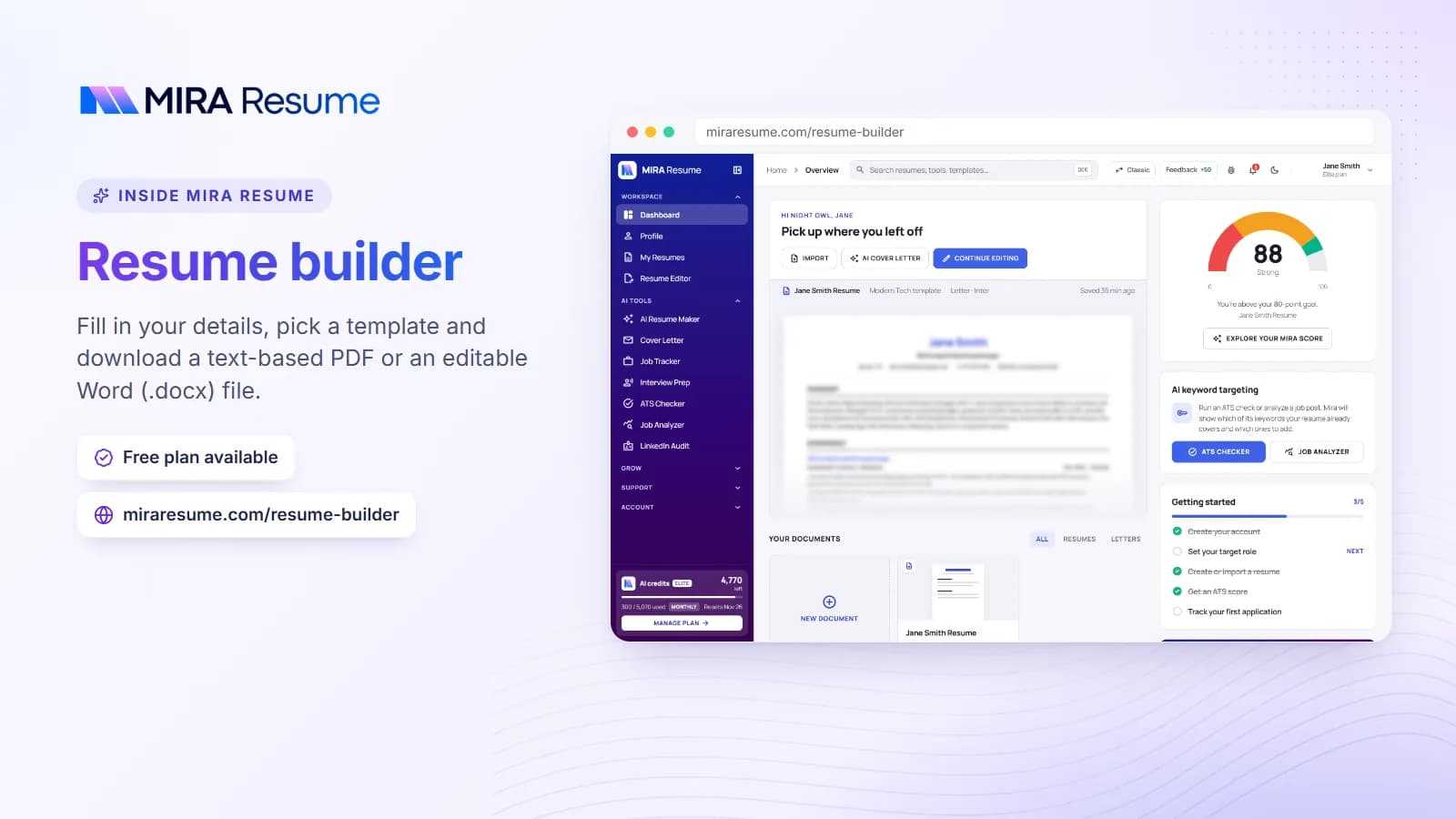
Ready to make a clean, ATS-friendly document? Try our resume builder or browse the resume templates. Mira Resume downloads as a PDF, which works for both resumes and short CVs.