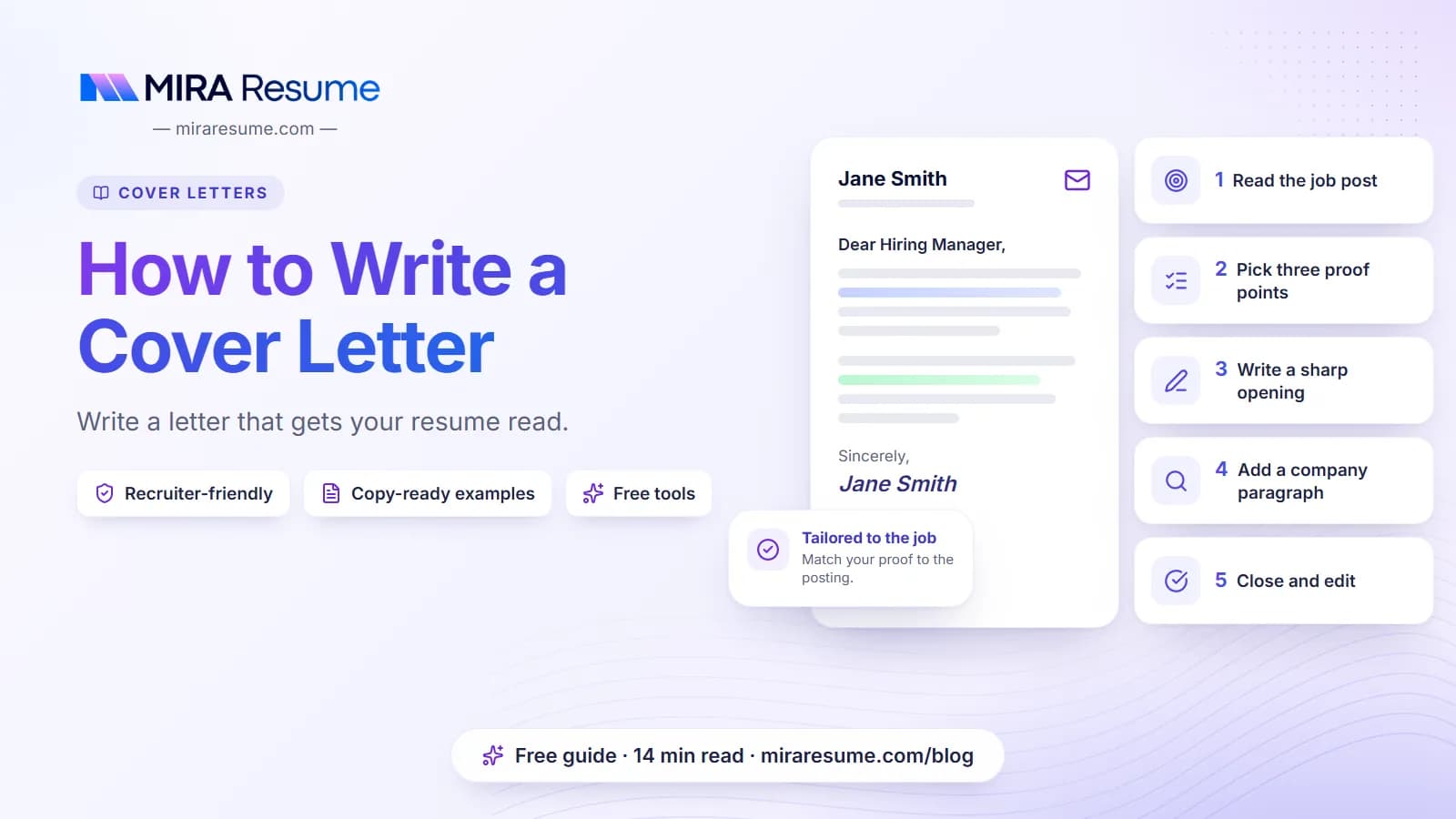

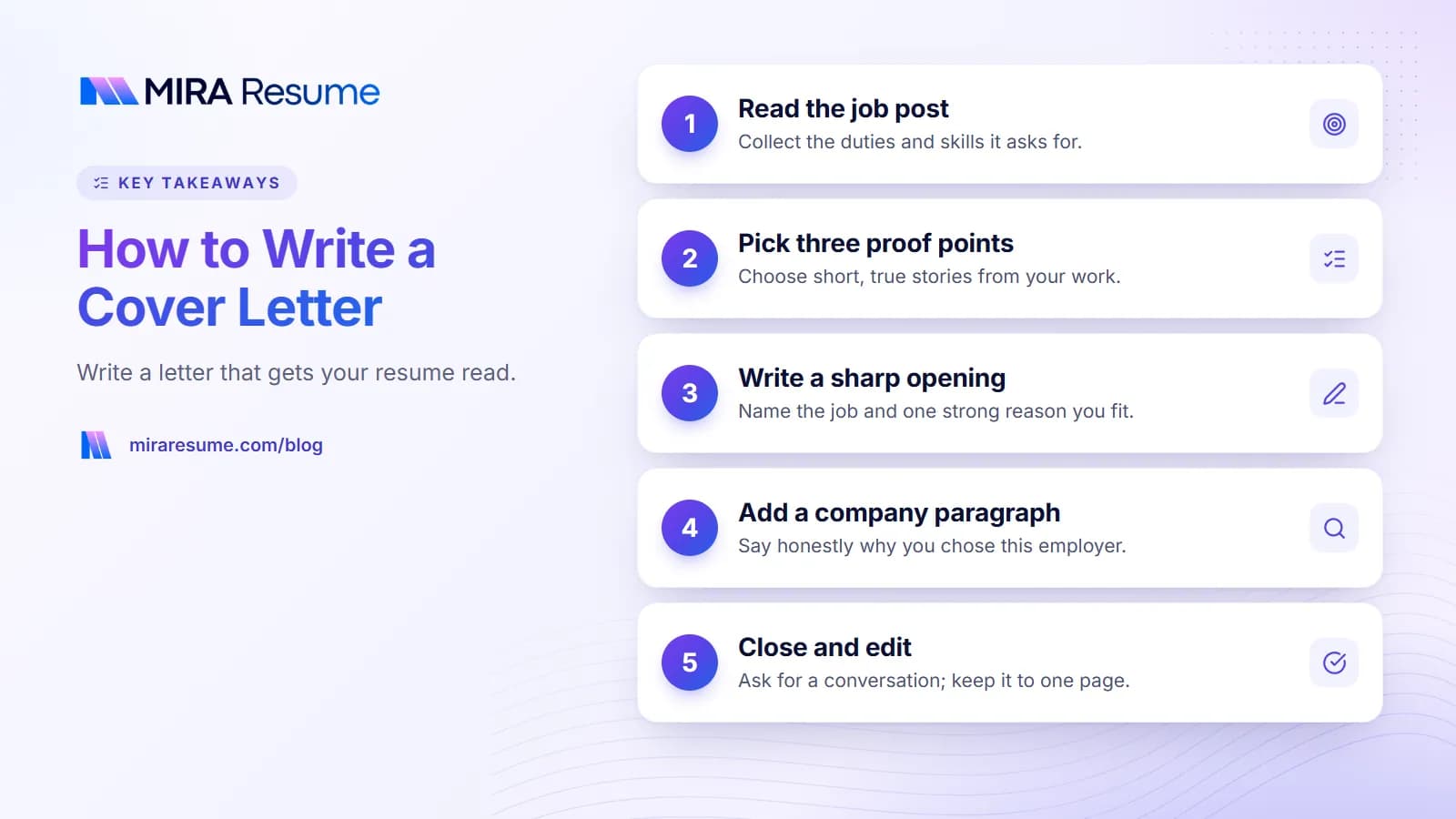
How to write a cover letter comes down to one idea: answer the question "why should we talk to you?" in about 300 words. You do that by matching two or three things you have done to what the job post asks for, then asking for a conversation.
This guide walks you through the whole process in eight steps. You will see what to research first, how to write each paragraph, an annotated example, full templates you can copy, and the mistakes that get letters ignored. It works whether you are applying for your first job or your tenth.
Use the links in each step to go deeper. We have separate guides for starting, closing, formatting, keywords and length, and they are all linked below.
What a cover letter is and what it does
A cover letter is a short letter that goes with your resume. Your resume lists what you did. Your letter explains why it matters for this one job. If you are new to the idea, read what a cover letter is first.
A good letter does three things:
- Shows fit. It links your past work to the needs in the job post.
- Adds context. It explains things a resume cannot, such as a career change or a gap.
- Shows effort and tone. It tells the reader you chose this company on purpose and that you write clearly.
It does not repeat your whole work history. For a clear split between the two documents, see cover letter vs resume.
Do you really need one?
If the job post asks for a letter, yes. If it says optional, a good letter can still help you stand out, especially when you are changing fields or have little experience. If there is no way to upload one, you can add two or three lines in the application notes box or in your email.
Step 1: Read the job post and collect what it wants
Before you write a word, spend ten minutes with the job post. This step is what separates a letter that feels made for the job from a letter that could go to anyone.
- Copy the post into a document.
- Highlight the duties that appear more than once or sit near the top.
- Highlight any skills, tools or qualities named, such as "scheduling", "Excel" or "calm under pressure".
- Write the company name, the exact job title and, if you can find it, the hiring manager's name.
Now pick your top three matches. These are things the job wants and you have really done. Everything else in the letter is built on them. To use the post's words in a natural way, read our guide to cover letter keywords.
Find one real detail about the company
Look at the company's website, news page or a recent post. Find one thing you can respond to honestly: a product, a value, a project, a way they serve customers. You will use it in paragraph three. If you cannot find anything, look at the job post itself for the team's goals.
Step 2: Choose your three proof points
Proof points are short true stories from your work, school or volunteering. They are the heart of the letter. A claim like "I am a hard worker" proves nothing. A story like "I covered two open shifts a week for a month and kept our wait times steady" does.
Use this table to turn your experience into proof.
| Job post asks for | Weak claim | Stronger proof |
|---|---|---|
| Strong communication | I am a great communicator. | I write the weekly update that goes to 30 parents and I answer their questions by email the same day. |
| Organization | I am very organized. | I built a shared calendar that ended double bookings in our front office. |
| Teamwork | I am a team player. | I trained two new hires and covered for them while they learned our system. |
| Problem solving | I solve problems well. | When our supplier was late, I found a local backup and kept the shelves stocked. |
| Sales or targets | I am results driven. | I met my monthly target in each of my last four months. |
Only use numbers that are true. If you do not track numbers, describe the result in plain words. Not sure which strengths to choose? See skills to put on a resume for ideas, and remember that the letter should tell a story that your resume only lists.
If you have no paid experience, use class projects, volunteer work or events you organized. Our guide to a cover letter with no experience shows how.
Step 3: Pick a format and set up the page
Keep the layout plain. A hiring manager should be able to read your letter without effort, and software should be able to read it too. The short version:
- One page, with margins about one inch.
- A simple font such as Arial, Calibri or Georgia at 10.5 to 12 points.
- Left-aligned text with a blank line between paragraphs.
- Your header should match the one on your resume, so the two documents look like a set.
- Save and send as a PDF unless the employer asks for something else, so your layout does not shift.
For the full layout, including the header, date, greeting and sign-off, read how to format a cover letter. If you want a starting file, our cover letter templates and the Google Docs cover letter template are ready to fill in.
Step 4: Write the opening
Your first two sentences decide whether the rest gets a careful read. Say which job you want and give one strong reason you fit. Skip lines such as "I am writing to apply for..." and "I saw your posting on...". Those take space and say little.
Three opening formulas you can copy
Experience first: I am applying for the Dental Receptionist role at Brightfield Dental. I have spent three years running a busy front desk, and I enjoy making nervous patients feel at ease.
Company first: Your team's focus on free repair advice is the reason I want to join Northline Home as a Customer Support Specialist. I have answered about 40 customer messages a day for three years and I would like to bring that to your team.
Referral first: Maria Lopez on your design team suggested I apply for the Junior Designer role. I have completed 12 brand projects for local shops and I would be glad to share them.
Only use a referral opening if the person agreed to be named. For more openings, including ones for career changers, see how to start a cover letter.
Step 5: Write the proof paragraph
This paragraph carries the most weight. Use one or two of your proof points. Say what you did, how you did it and what changed. Then tie it back to the job post in one short sentence.
Try this simple pattern: task, action, result, link to the job.
In my current role, I answer about 40 chats and emails a day. I wrote a set of short help articles for our most common questions, and repeat questions dropped. Your post asks for someone who writes clearly and stays calm with upset customers. Those are the two skills I use most each day.
If you use the STAR method for interviews, the same stories work here in shorter form. Our guide to the STAR method for your resume explains the pattern.
Handling a gap or a career change
If you are switching fields, use this paragraph to link your old work to the new job. Name the skills that carry over and give one example. A gap can get one honest sentence, such as "I took a year to care for a family member and finished a bookkeeping course in that time." Then move on. If your resume has a gap, our resume with gaps in employment sample shows how to handle it there too.
Step 6: Write the company paragraph
Now say why this employer. Use the detail you found in Step 1. Keep it to two to four sentences and make it honest. The reader should see that you chose them, not that you sent the same note to fifty companies.
I like that Northline Home offers free repair advice with every order. It shows your team cares about customers after the sale, which is how I like to work too. I would enjoy helping that promise feel real on every call.
What to avoid
- Empty praise such as "you are an industry leader".
- Facts you copied straight from the "About us" page with no reaction.
- Anything you cannot back up if the interviewer asks about it.
If you cannot find a specific detail, talk about the work itself: the type of problem the team solves and why that interests you.
Step 7: Close with a clear next step
End with thanks and a simple request for a conversation. Make it easy to reply by giving your phone number or email. Do not beg and do not demand.
Thank you for your time. I would welcome the chance to talk about how I can help your support team. You can reach me at 555-0100 or [email protected].
Then add a sign-off such as "Sincerely," or "Best regards," and your full name. We have many closing lines and sign-offs in how to close a cover letter.
When you are ready to follow up after sending, use our guide to the follow-up email after an interview once you have met, and a polite one-line check-in if you have not heard back after about a week or the date in the post.
Step 8: Edit, check and send
Your first draft will be too long. That is normal. Use this checklist before you send.
- Cut to one page. Aim for 250 to 400 words. See how long a cover letter should be.
- Check names. The company name, job title and the person's name should be right everywhere. This is the most common slip when you reuse a letter.
- Read it aloud. Fix anything that sounds stiff or that you would never say.
- Test the keywords. Make sure the main skills from the post appear in real sentences.
- Check spelling and tone. Run a spell check, then read once more yourself.
- Match your resume. Dates, job titles and contact details should agree on both pages.
- Save as a PDF with a clear name, such as "Sam-Rivera-Cover-Letter.pdf".
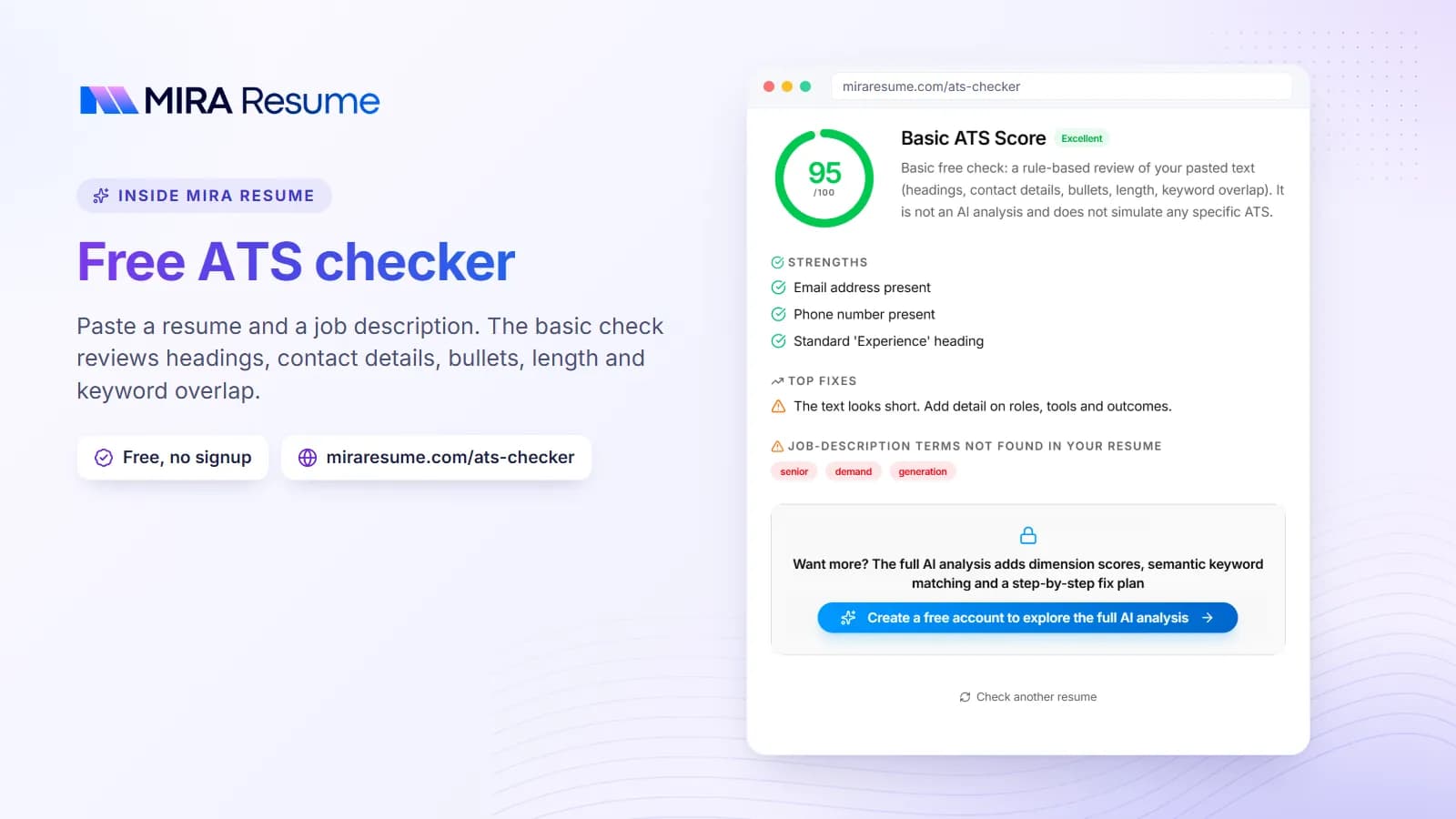
Your resume should be as sharp as your letter. Run it through the ATS checker to see how software reads it before you send both.
An annotated cover letter example
Here is a full letter, followed by notes on why each part works. Replace the details with your own true ones.
Sam Rivera
Austin, TX | 555-0100 | [email protected]October 23, 2026
Dear Ms. Alvarez,
I am applying for the Customer Support Specialist role at Northline Home. I have spent three years answering customer questions for an online store, and I enjoy turning a worried message into a happy reply.
In my current job, I answer about 40 chats and emails a day. I wrote a set of short help articles for our most common questions, and repeat questions dropped. I also trained two new teammates on our ticket system. Your post asks for someone who writes clearly and stays calm with upset customers. Those are the two things I work on every day.
I like that Northline Home offers free repair advice with every order. It shows your team cares about customers after the sale, which is how I like to work too.
I would welcome the chance to talk about how I can help your support team. Thank you for your time. You can reach me at 555-0100 or [email protected].
Sincerely,
Sam Rivera
| Part | What it does |
|---|---|
| Header | Gives name and contact details in one clean block that matches the resume. |
| Greeting | Uses a real name. "Dear Hiring Manager," is the backup if you cannot find one. |
| Opening | Names the job and the company, then states experience in a single sentence. |
| Proof paragraph | Shows a task, an action and a result, then ties them to what the post asks for. |
| Company paragraph | Responds to one specific thing the employer does. |
| Closing | Thanks the reader, asks for a conversation and repeats contact details. |
The letter is about 190 words in the body, which is fine. A little shorter is better than padding. More complete samples for different jobs are in our cover letter examples. For a role-specific letter, try the registered nurse cover letter page or our guides for a teacher cover letter, customer service cover letter and engineering cover letter.
Cover letter templates you can copy
Templates save time, but only if you swap in real details. Use the bracketed parts as prompts, not as text to leave in. Keep your wording plain and your own.
Template 1: The standard letter
Dear [Hiring manager's name],
I am applying for the [job title] role at [company]. I have [number] years of experience in [field], and I [one strength that matches the post].
At [current or past employer], I [action you took] and [result]. I also [second example]. Your post asks for [need 1] and [need 2]. These are skills I use every day.
I am drawn to [company] because [specific detail]. [One sentence on why it matters to you.]
I would welcome the chance to talk about how I can help your team. Thank you for your time. You can reach me at [phone] or [email].
Sincerely,
[Your name]
Template 2: Career changer
Dear [Name],
I am applying for the [job title] role at [company]. After [number] years in [old field], I am moving into [new field] because [honest reason].
My work in [old field] built skills that carry over. I [example 1 that matches the new job] and [example 2]. I have also [course, project or volunteer work that shows commitment].
[Company] interests me because [specific detail]. I would like to bring [skill] to your team.
Thank you for considering my application. I would be glad to talk. You can reach me at [phone] or [email].
Sincerely,
[Your name]
Template 3: Entry level or student
Dear [Name],
I am a [degree or program] student at [school], and I am applying for the [job title] role at [company]. I enjoy [area] and I have built skills in [skill 1] and [skill 2].
In [class, project or club], I [what you did] and [result or lesson]. I also [part-time job, volunteering or event]. This taught me [skill that matches the post].
I would like to join [company] because [specific detail]. I am eager to learn and to contribute.
Thank you for your time. You can reach me at [phone] or [email].
Sincerely,
[Your name]
More layouts, including editable files, are in the cover letter templates collection and our Microsoft Word cover letter templates guide. For very short letters, see short cover letter examples.
How to write a cover letter for different situations
The same eight steps work everywhere. Only the proof points and tone change. Here is how to adjust.
| Situation | What to change | Read next |
|---|---|---|
| No work experience | Lead with school, projects, volunteering and skills. Show eagerness and a reason for choosing this job. | Cover letter with no experience |
| Internship | Keep it near 200 to 300 words. Mention classes and projects that match the role. | Internship application letter sample |
| Career change | Spend the proof paragraph on transferable skills and one sample of work. | Transferable skills examples |
| Nursing and healthcare | Name licenses, unit types and patient care settings. | Nursing application letter example |
| Technical roles | Name tools and projects, and keep the language simple for non-technical readers. | IT internship cover letter sample |
| Applying by email | Shorten to 120 to 200 words and use a clear subject line. | Cover letter length |
If you are applying for a formal role that uses "application letter" wording, the application letter template covers that style. For forms that ask for a "statement of qualifications", see statement of qualifications. A letter of intent has a different purpose, explained in letter of intent format.
Common mistakes when you write a cover letter
- Copying your resume. Add context and stories. Do not repeat each bullet.
- Sending the same letter everywhere. Readers can tell. Change the job title, the proof points and the company paragraph each time.
- Starting with "To whom it may concern". Try to find a name. If you cannot, "Dear Hiring Team," is fine.
- Talking only about what you want. Balance it with what you can do for them.
- Using big claims with no proof. Replace "excellent leader" with a short story.
- Making it too long. More than one page is a common reason letters go unread.
- Leaving in the wrong company name. Check it twice.
- Using fancy design. Plain text on a plain page is easier for people and software to read.
- Typos. They are easy to avoid with one slow read-through.
- Skipping a clear ask. End with a polite invitation to talk.
Want a quick self-check? Read the first paragraph and ask: does it say the job, the company and a reason I fit? If not, rewrite it. If you want a second look at your resume as well, try the resume checker.
You can also use AI tools to draft or tighten a letter, but treat the output as a first draft. Add your own facts, remove generic lines and make sure every claim is true. Our guide to ChatGPT resume prompts shows how to ask for help without losing your own voice.