
What is a CV? A CV is a written summary of your career: the jobs you have held, the schools you attended, the skills you have, and the results you have reached. You send it to an employer, a university, or a funding body so they can decide whether to talk with you. In many countries it is simply the word for the document you use to apply for any job.
The details change by country and by field, which is why people get confused. This guide gives you the plain meaning, what the letters stand for, how a CV differs from a resume, what to put in it, and when to choose one. You will also find a sample layout, a country comparison table, and a short list of mistakes to avoid.
What does CV stand for? The curriculum vitae meaning
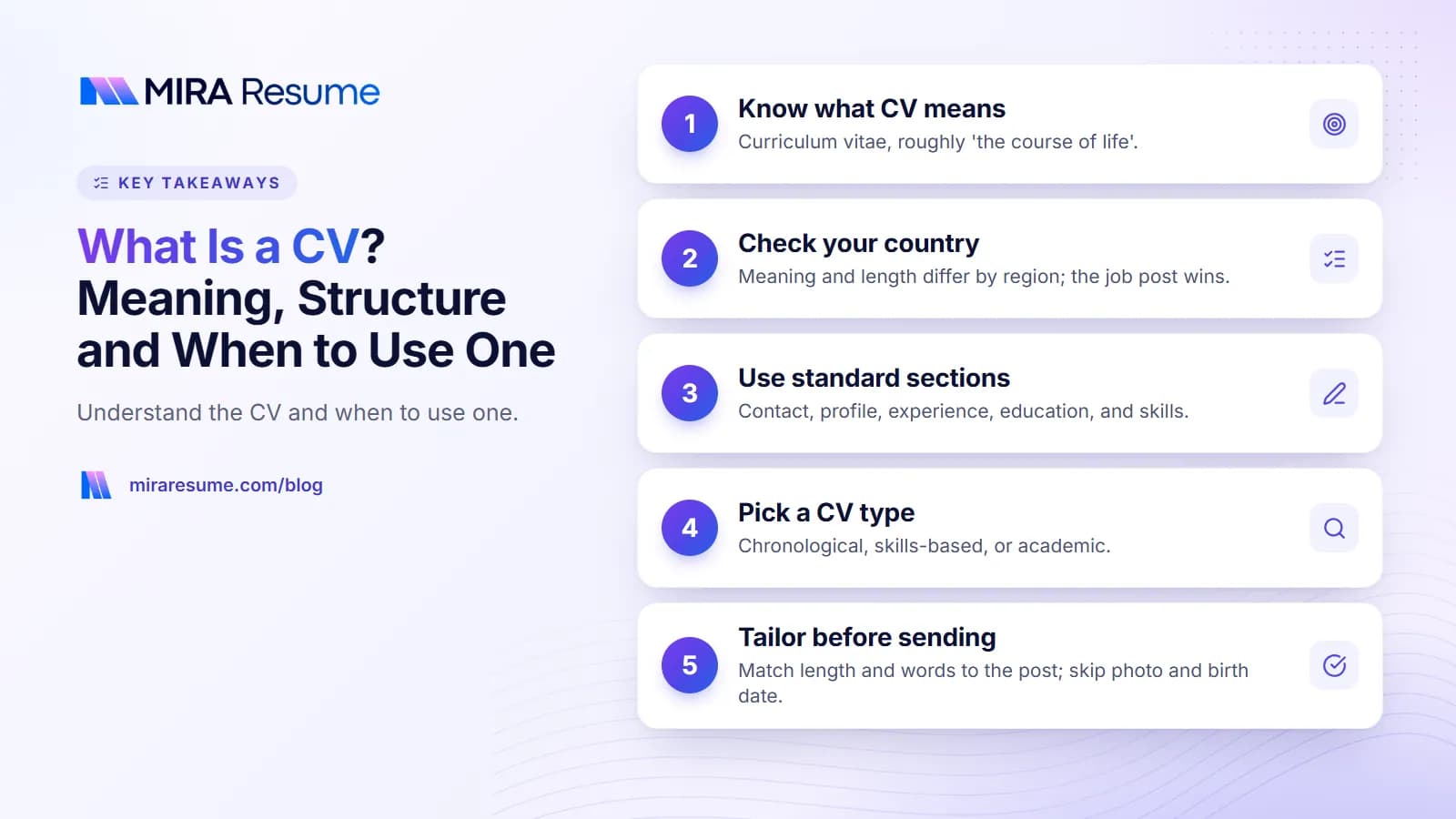
CV stands for curriculum vitae. It is a Latin phrase. In English the curriculum vitae meaning is roughly "the course of life". The phrase points to the idea that the document tells the story of your working life so far: what you studied, where you worked, and what you achieved.
A short CV definition you can remember: a CV is a structured document that lists your education, work history, skills, and achievements, written to help someone decide whether to hire, admit, or fund you.
You may also see these terms used for the same thing or close cousins of it:
- Resume: the word most people in the United States and Canada use for a job application document.
- Resume/CV: a label some job sites use because the two words are mixed up so often.
- Biodata: a term used in parts of South Asia, often with personal details such as date of birth added.
- Academic CV: a long record of research, teaching, grants, and publications.
So when a job post says "send your CV", it usually means your career document. The next section shows how that differs from a resume.
What is a CV resume? How the two words relate
If you have searched for "what is a CV resume", you are really asking whether the two are the same thing. The honest answer is: sometimes yes, sometimes no. It depends on where you are applying and what kind of job it is.
In the UK, Ireland, most of Europe, Australia, New Zealand, South Africa, and India, people say CV for almost every job application. That CV is usually one to two pages. In the United States and Canada, people say resume for jobs and keep a CV for academic, research, and some medical roles.
| Feature | Typical CV | Typical resume |
|---|---|---|
| Length | 2 pages for most jobs; longer for academic work | 1 page, sometimes 2 |
| Purpose | Full record of your career and training | Short pitch for one job |
| Content | Education, work, skills, plus research and publications where they apply | Most relevant experience and skills only |
| Changed for each job? | Lightly for jobs; grows over time for academic CVs | Yes, trimmed for each role |
| Common in | UK, Europe, Australia, India, academia worldwide | US and Canada for most jobs |
For a deeper side-by-side comparison with examples, read our full guide on CV vs resume.
What is a CV for a job application?
When people ask what is a CV for a job, they mean the document you attach to an application. Its goal is simple: show the employer, in under a minute of reading, that you can do the work.
On a job application, a CV does four things:
- It proves you meet the basic requirements, such as experience, training, and licenses.
- It shows how your career has moved forward over time.
- It gives the employer words and facts to ask about in an interview.
- It passes through software that reads and sorts applications, so it should be easy to scan.
You may also be asked, "what is a CV on a job application form" when a website has an upload box labelled CV. In that case, upload one clean file. A PDF keeps your layout the same on every screen, which is why Mira Resume exports PDF.
A CV does not replace a cover letter. The CV lists facts, while a cover letter explains why you want this job. Our guide on what a cover letter is shows how the two work together.
CV meaning by country
The same word can mean a different document depending on where you apply. Use this table as a guide, then check the job post, which always wins.
| Region | What "CV" usually means | Typical length | Extra notes |
|---|---|---|---|
| United States | Academic, research, or medical record of your work | 2 pages to many pages | For regular jobs, use a resume |
| Canada | Academic CV; resume for most jobs | Varies | Both words appear in job posts |
| United Kingdom and Ireland | The standard job document | 1 to 2 pages | Photos and birth dates are not expected |
| Continental Europe | The standard job document; sometimes a set format | 1 to 2 pages | See the Europass CV format |
| Australia and New Zealand | The standard job document | 2 to 3 pages | Often asks for referees |
| India and South Asia | The standard job document; sometimes called biodata | 1 to 2 pages | Personal details are more common |
These are general patterns, not rules. When you are unsure, look at how the employer writes its own job post and copy that word. If it says "resume", send a resume. If it says "CV", send a CV in the style of that country.
What goes in a CV? The standard sections
A good CV follows a clear order. Readers know where to look, and software can read it with ease. Here are the core sections, from top to bottom.
- Contact details. Name, phone number, professional email, city, and a link to your LinkedIn profile if you have one.
- Personal profile or summary (optional). Two to four lines about who you are and what you offer. See our CV summary examples for wording you can adapt.
- Work experience. Newest job first. For each job, list the title, employer, dates, and three to five bullet points that show results.
- Education and training. Degrees, diplomas, and courses, with the school and the year.
- Skills. Tools, languages, and abilities that match the job.
- Extras. Certifications, volunteer work, awards, and projects, if they help your case.
- References. Usually "available on request", or a short list if the employer asks. More in our guide to references on a resume.
Extra sections for academic and research CVs
A CV for a university, lab, or hospital job often adds:
- Publications and conference talks
- Research projects and grants
- Teaching experience
- Fellowships, awards, and memberships
- Thesis title and supervisor
See a worked example in our science CV sample.
A sample CV layout you can copy
Here is a plain layout for a standard two-page CV. Replace each part with your own facts.
Priya Nair
Leeds, UK | 07000 000000 | [email protected] | linkedin.com/in/priya-nairProfile
Operations coordinator with 5 years of experience in logistics. Plans deliveries, manages supplier contacts, and keeps records accurate. Looking for a planning role in a growing distribution business.Work experience
Operations Coordinator, Northline Freight, Leeds (2022 to present)
- Schedule up to 40 deliveries a day across 6 routes
- Set up a weekly supplier check-in that cut late arrivals
- Train 3 new coordinators on the tracking systemLogistics Assistant, Pennine Supplies, Leeds (2020 to 2022)
- Entered and checked 200+ orders a week
- Resolved delivery problems by phone and emailEducation
BA Business Studies, University of Leeds (2020)Skills
Route planning, spreadsheets, inventory software, supplier communication
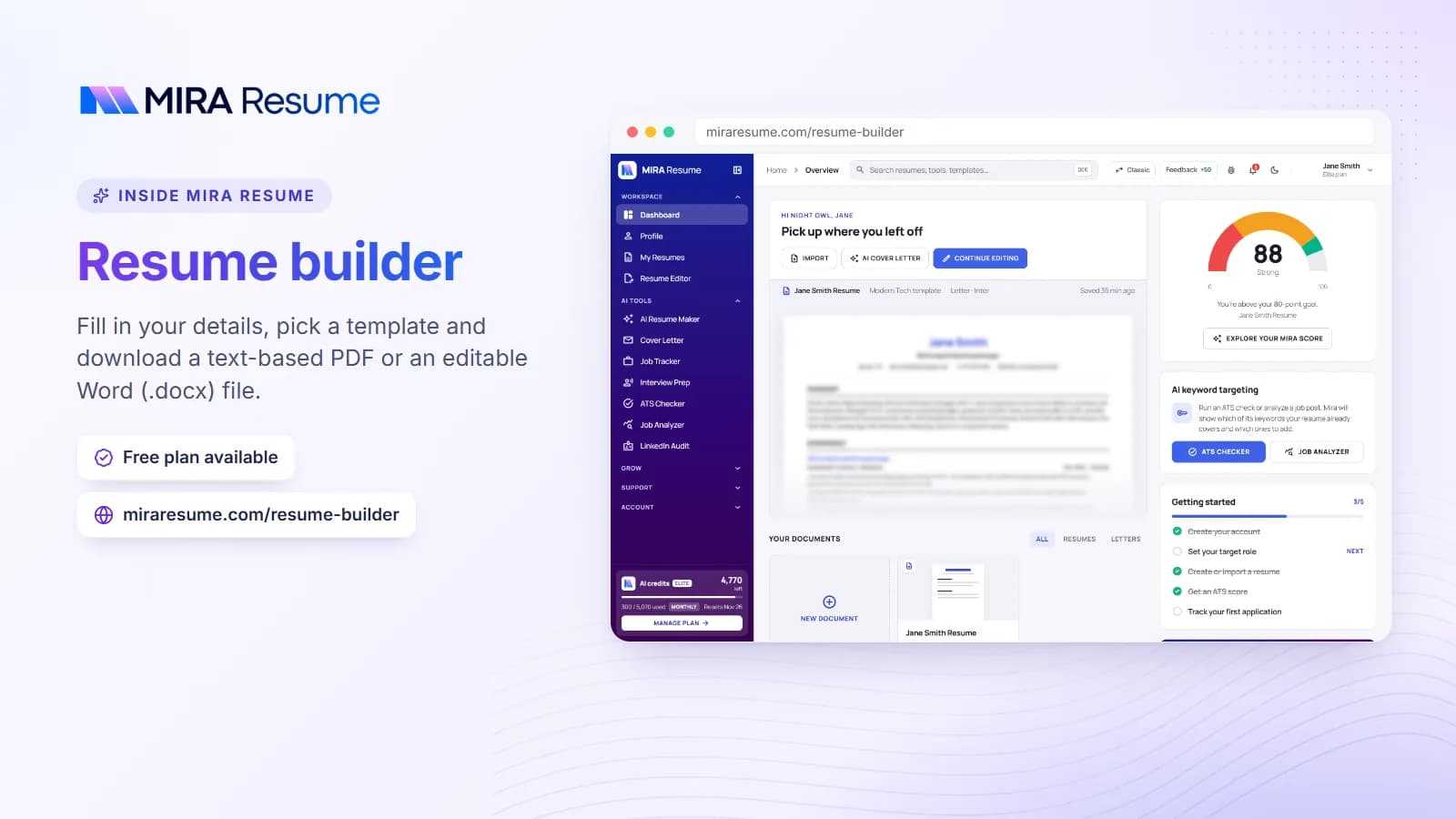
Notice what is missing: no photo, no age, no long paragraphs. The facts are short and easy to scan. To make a page like this without fighting margins, try the resume builder or browse the resume templates and pick a clean, one-column design.
When should you use a CV instead of a resume?
Use a CV when the person reading it expects a full record of your career, or when the local custom calls it a CV. In practice that means these cases:
- You apply in a CV country. In the UK, Ireland, Australia, India, and much of Europe, a CV is the normal document.
- You apply to a university or research role. Teaching posts, lab roles, and fellowships ask for publications and projects that a short resume cannot hold.
- You apply for graduate study or a grant. Committees often want your full education and research record.
- You work in medicine or science. Doctors and scientists keep long CVs listing training, licenses, and papers.
- You are an international applicant. Check the employer's country and follow its custom.
Use a resume when you apply for a regular job in the United States or Canada and the post says resume. A resume is short and fits one role closely. If you need help on structure, see how to format a resume, which applies to a short CV as well.
How long should a CV be?
For most jobs, stick to one or two pages. Add a third page only when you have strong, relevant content that does not fit. Academic CVs can run much longer because they list research output. Read more in our guide to how many pages a resume should be.
CV types: chronological, skills-based, and academic
There is more than one way to arrange a CV. Choose the one that shows your story in the best light.
| Type | How it is arranged | Best for |
|---|---|---|
| Chronological | Work history from newest to oldest | People with steady, related experience |
| Skills-based | Skills groups first, then a short work list | Career changers and people with gaps |
| Academic | Education, research, publications, teaching, grants | University, lab, and research jobs |
| Europass | A fixed European form with set boxes | Applications that ask for the Europass style |
Most people do well with the chronological style. If your path has turns, a skills-based resume layout works for a CV too. For a ready-made look that software can read, see our ATS-friendly CV template and the wider CV templates guide.
How to write a CV in five steps
If you have never written one, do not start with a blank page. Follow these steps in order.
Step 1: Collect your facts
Write down every job, course, volunteer role, and certificate, with dates. Add numbers you can prove, such as team size, customers served, or items handled. This is your master list. You will not use all of it, but it saves time later.
Step 2: Read the job post
Highlight the skills and duties that appear more than once. These are the things the employer cares about most. Your CV should show, early on, that you have done them.
Step 3: Choose a layout
Pick a simple one-column design with clear headings. Use one common font in a readable size. Leave white space between sections so the page does not look crowded.
Step 4: Write short bullets
Start each bullet with a verb, then say what you did and what changed. For example: "Organised the stock room, which cut picking time for the team." Our list of action verbs for resume writing helps when you run out of fresh openers.
Step 5: Check, trim, and save
Remove anything that does not help you get this job. Check dates, spelling, and contact details. Save as a PDF, then open the file once on your phone and once on a computer to be sure it looks right.
Keep one master CV
Many people keep a long master file with every detail, then copy and trim it for each application. That way you never lose old facts, and each version stays short and matched to the job. Store the master in a folder with a date in its name so you always know which is newest.
A note on honesty
A CV is a promise about your past. Employers often check dates, titles, and degrees. Keep every claim true, and be ready to explain each line in an interview. If part of your history is messy, a short, honest note is better than hiding it.
Common CV mistakes to avoid
- Writing a life story. Keep jobs that matter for this role in detail and shorten the rest.
- Using one CV for every job. Move the most relevant facts to the top and match the words in the job post where they are true.
- Adding a photo or birth date by habit. In the UK, US, and Canada these are not expected, and employers often prefer you leave them out. In some countries they are still common, so check local norms.
- Listing duties without results. "Answered phones" says little. "Handled 60 calls a day" says more. Only use numbers you can explain.
- Fancy design. Tables inside tables, graphics, and icons can confuse software that reads your file. Plain headings and one column are safer.
- Unexplained gaps. Add a short, honest line such as "Career break to care for family" so readers are not left guessing.
- Typos. Read it aloud, then ask a friend to read it.
To check how a file reads to software, run it through our ATS checker. It is a quick way to spot layout problems before you apply.
Quick checklist before you send your CV
- Does the job post say CV or resume, and have you matched it?
- Is the length right for your field and country?
- Are your name, phone, and email correct and professional?
- Is the newest experience first?
- Does each job have bullets with a result or a clear fact?
- Are fonts simple and the layout one column?
- Have you saved it as a PDF with a clear name, such as "Priya-Nair-CV.pdf"?
- Have you proofread it twice?
If you are also writing a covering note, take a look at the guide to the resume objective for short opening lines, and keep your CV and cover letter in the same style.