
What is a resume summary? It is a short paragraph, usually two to four sentences, placed right under your name and contact details. It gives a quick picture of your work history, your strongest skills, and the kind of role you want. Think of it as the first thing a busy hiring manager reads, so it should be clear and specific.
A good summary for resume writing does one job: it makes the reader want to keep reading. Below you will learn when to use one, how to write it step by step, and how to adapt more than 20 examples for different jobs and career stages. You will also find a fill-in template, a table of weak versus strong lines, and the mistakes that most often weaken a summary.
A quick note before we begin. Employers differ, and no summary can promise an interview. Always read the job posting and let it guide your word choices.
What a resume summary is (and what it is not)
A resume summary is also called a professional summary or a summary statement. It sits at the top of the page and sums up your career in a few lines. It is written in short phrases, not long stories.
It is easy to mix up with other parts of a resume, so here is a simple comparison.
| Part | What it does | Length |
|---|---|---|
| Resume summary | Shows who you are now and what you have done, with proof | 2 to 4 sentences |
| Resume objective | States the job you want and why you fit, often for people with little experience | 1 to 2 sentences |
| Skills section | Lists tools and abilities as short items | 6 to 12 items |
| Cover letter | Tells a longer story in a separate document | One page |
If you are unsure whether you need an objective instead, read our guide to the resume objective. If you are still deciding on cover letters, see how a cover letter differs from a resume.
Do you need a professional summary on your resume?
You do not have to include one. A resume works without it. But a summary can help in these cases:
- You have several years of experience and want to point to your best results fast.
- You are changing careers and need to explain how your past work fits the new job.
- Your best proof is buried further down the page.
- You are applying for a role where the job posting lists a few clear must-haves, and you can mirror them honestly.
You can skip the summary if your resume is already tight and your job titles speak for themselves. A summary that only repeats your job titles wastes valuable space near the top of the page.
Summary or objective: which one?
Use a summary if you have work history to point to. Use an objective if you are a student, a new graduate, or a career changer with little related experience. Some people with limited experience write a short summary that mixes both: a line about who they are, plus a line about what they want.
How to write a resume summary in 3 steps
Writing the summary last is usually easier. Once the rest of your resume is done, you know what your best points are.
Step 1: Read the job posting
Underline the two or three things the employer asks for most. These might be a skill, a tool, a type of customer, or a result such as "reduce errors". Your summary should speak to those points, using your honest experience.
Step 2: Pick your three strongest facts
Choose three things from this list:
- Your job title or field, and how long you have worked in it.
- Two or three key skills that match the posting.
- One result with a number, such as time saved, people served, or money handled.
Step 3: Write it in plain words
Write two to four short sentences. Drop "I" at the start of each sentence, which is normal on resumes. Cut filler words such as "hardworking" and "team player" unless you can show them with a fact.
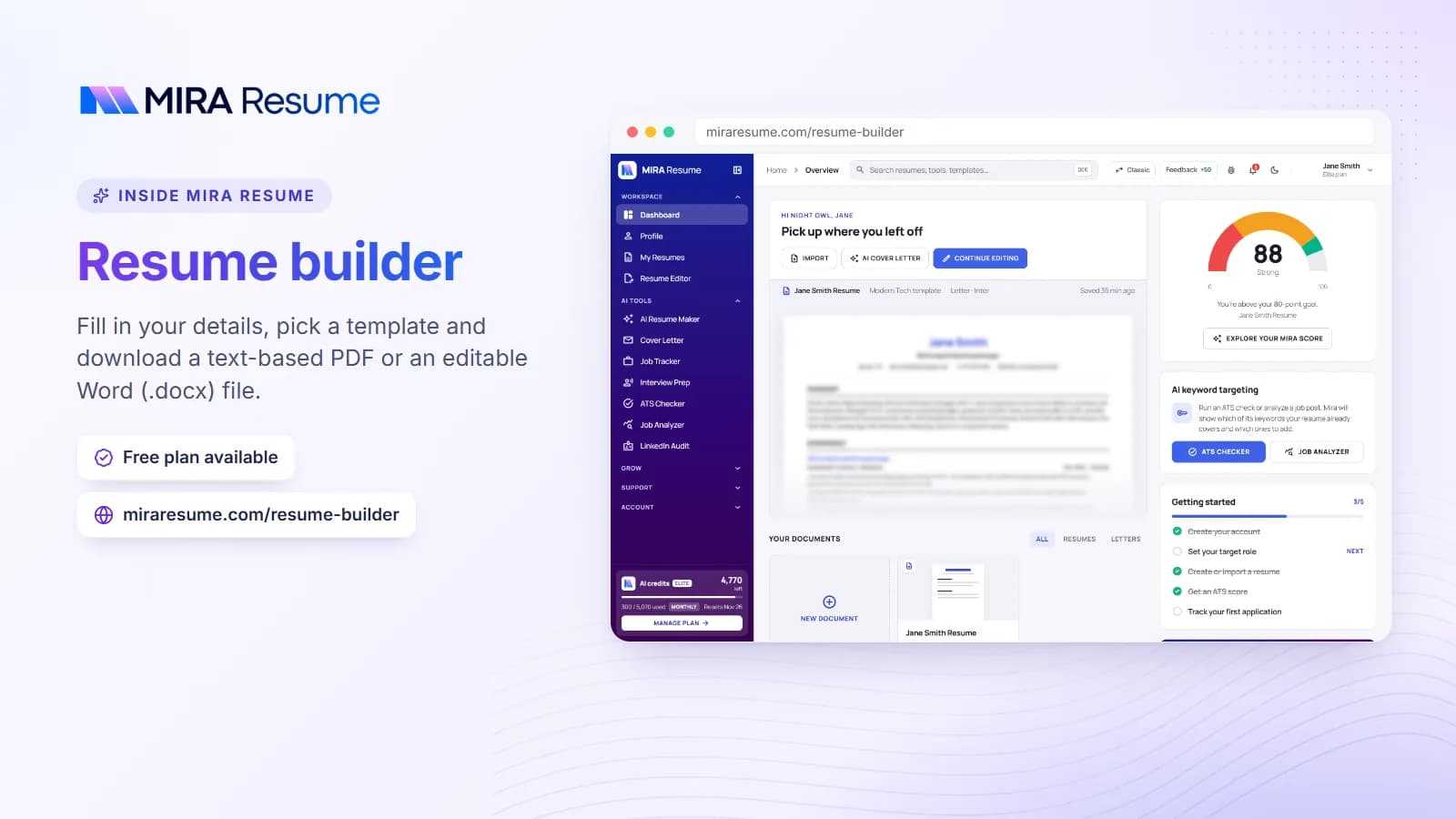
If you want a head start, the AI resume builder can draft a first version from your job history, and you can then edit it to sound like you.
A simple resume summary template
Use this fill-in-the-blank pattern as a starting point. Change the words so they sound natural.
[Job title or field] with [number] years of experience in [area]. Skilled in [skill 1], [skill 2], and [skill 3]. Known for [one result with a number]. Looking to [help this type of employer do what].
Here is that template filled in:
Customer support specialist with 4 years of experience in online retail. Skilled in live chat, order problem solving, and training new staff. Cut average reply time from 12 minutes to 7 minutes. Looking to help a growing store keep its customers happy.
If you do not have a number, use a clear fact instead, such as "handled up to 60 chats per shift" or "trained 10 new hires". Do not invent numbers. Only use figures you can explain in an interview.
Resume summary examples by career stage
Copy the structure, not the exact words. Swap in your own details so your summary is true and unique.
Summary for resume with no experience
If you have no paid work yet, lean on school, volunteering, projects, and personal strengths.
Recent business graduate with strong spreadsheet and presentation skills. Led a 5-person class project that mapped costs for a local bakery. Organized, careful with details, and eager to learn in an entry-level administrative role.
High school graduate with 200 hours of volunteer work at a community food bank. Comfortable greeting people, packing orders, and keeping records accurate. Seeking a part-time retail job where I can grow my customer service skills.
Entry level and early career
Marketing assistant with 2 years of experience in social media and email. Wrote and scheduled 15 posts a week and grew a newsletter list by 1,200 subscribers. Comfortable with simple design tools and weekly reports.
Junior web developer with one year of experience building small business sites in HTML, CSS, and JavaScript. Fixed over 80 reported bugs on a shared project. Enjoys clear code and clear communication.
Mid-career professionals
Project coordinator with 7 years of experience in construction. Keeps schedules, budgets, and subcontractors on track for projects up to $2 million. Reduced change-order delays by setting a weekly check-in with every trade.
Registered nurse with 6 years in a busy medical-surgical unit. Skilled in patient education, charting, and caring for up to 5 patients per shift. Mentored 8 new nurses during their first 90 days.
Senior and management level
Operations manager with 12 years of experience leading warehouse teams of up to 40 people. Cut order errors by half through better pick-lists and daily training. Strong in scheduling, safety, and clear communication with vendors.
Finance director with 15 years in nonprofit accounting. Led two clean audits, simplified month-end close from 10 days to 6, and trained program managers to read budgets with confidence.
Career changers
Former classroom teacher moving into corporate training. Eight years of planning lessons, explaining hard ideas simply, and tracking learner progress. Built a staff workshop series that 60 colleagues attended.
Retail supervisor with 5 years of leading shift teams, handling cash, and solving customer issues. Completed an online bookkeeping course and now seeking an entry-level accounts clerk role.
Professional summary examples by industry
Each industry values different proof. Use this table to see what to highlight, then read the examples that follow.
| Field | What to highlight | Sample result to include |
|---|---|---|
| Customer service | Speed, calm tone, problem solving | Calls or chats handled per day |
| Sales | Targets, accounts, relationships | Revenue or quota reached |
| IT and software | Languages, tools, systems supported | Tickets closed, uptime kept |
| Healthcare | Licenses, patient load, safety | Patients per shift, certifications |
| Administrative | Scheduling, software, accuracy | Executives or team size supported |
| Trades and warehouse | Equipment, safety record, speed | Orders or jobs finished per shift |
Customer service resume summary
Call center agent with 3 years of experience resolving billing and account questions. Takes 70+ calls per shift while keeping notes clear and complete. Calm with upset customers and quick to learn new software.
Sales
Account executive with 5 years selling software to small businesses. Closed 110% of quota in two of the last three years. Skilled at discovery calls, demos, and following up without being pushy.
IT
IT support technician with 4 years of experience in help desk work for a 300-person company. Resolves password, network, and printer issues, and closed an average of 25 tickets a day. Holds CompTIA A+.
Administrative
Executive assistant with 8 years of experience supporting senior leaders. Manages calendars, travel, and meeting notes with Microsoft 365. Known for catching conflicts before they cause delays.
Warehouse
Forklift-certified warehouse associate with 3 years of experience picking, packing, and loading. Maintained a clean safety record and met daily pick goals. Ready to work early shifts and weekends.
Need help for an IT or technical background in particular? See our guide on the computer science resume.
Weak versus strong summary lines
This table shows how small changes make a summary clearer. Notice how the strong versions give a fact you can check.
| Weak line | Why it is weak | Stronger version |
|---|---|---|
| Hardworking professional looking for a great opportunity. | Could describe anyone | Bookkeeper with 6 years of experience in small-business accounts payable. |
| Good at communication and teamwork. | No proof | Ran daily huddles for a 12-person kitchen team and cut order mistakes. |
| Responsible for managing a team. | Describes a duty, not a result | Managed a team of 9 and brought turnover down in one year. |
| Seeking a position at a leading company. | Talks about what you want only | Ready to bring 4 years of inventory experience to a busy retail team. |
| Passionate, detail-oriented self-starter. | Buzzwords with no example | Checks every invoice against the order before payment; found 30 billing errors last year. |
The pattern is simple: replace general claims with a job title, a number of years, or a result. For help choosing strong first words for your bullet points, see our list of action verbs for resume writing.
Common resume summary mistakes
- Writing too much. Past four or five lines, a summary becomes a second resume. Keep it short.
- Using the same summary for every job. Adjust one or two phrases to match each posting.
- Listing soft traits without proof. "Motivated" tells the reader nothing. A fact does.
- Making up numbers. If you cannot back a figure up in an interview, do not use it.
- Writing in the third person or in full "I" sentences. Skip "I am" and write "Nurse with 6 years of experience" instead.
- Stuffing in keywords. Repeating a job title ten times looks odd to humans and can look odd to software. Use the posting's words naturally. You can test your resume with our ATS checker to see how well it matches a role.
- Hiding the main point. Put the strongest fact in the first sentence.
Also check the layout. A clean, single-column page reads best, as explained in our simple resume format guide.
Final checklist before you save
- Is it between two and four sentences?
- Does the first sentence contain your job title or field?
- Does it include at least one fact or number you can explain?
- Does it use words from the job posting where they are true?
- Have you read it aloud and does it sound like you?
- Is it free of spelling mistakes and buzzwords?
Next, check the rest of the page. Our resume examples show how a summary fits with experience, skills, and education, and the resume builder lets you place it at the top of a clean template.