
Your resume education section answers one quick question for the reader: does this person have the schooling the job needs? Most of the time you need only a few lines. This guide shows the standard order, where to place the section, and copyable formats for a degree, a degree in progress, an unfinished degree, a GED, certificates, honors and study abroad.
If you are writing for a specific group, we have other pages. For high school, see high school on a resume. For students, see student resume examples. This page is the plain rulebook for how to list your education on a resume.
The basic format for education on a resume
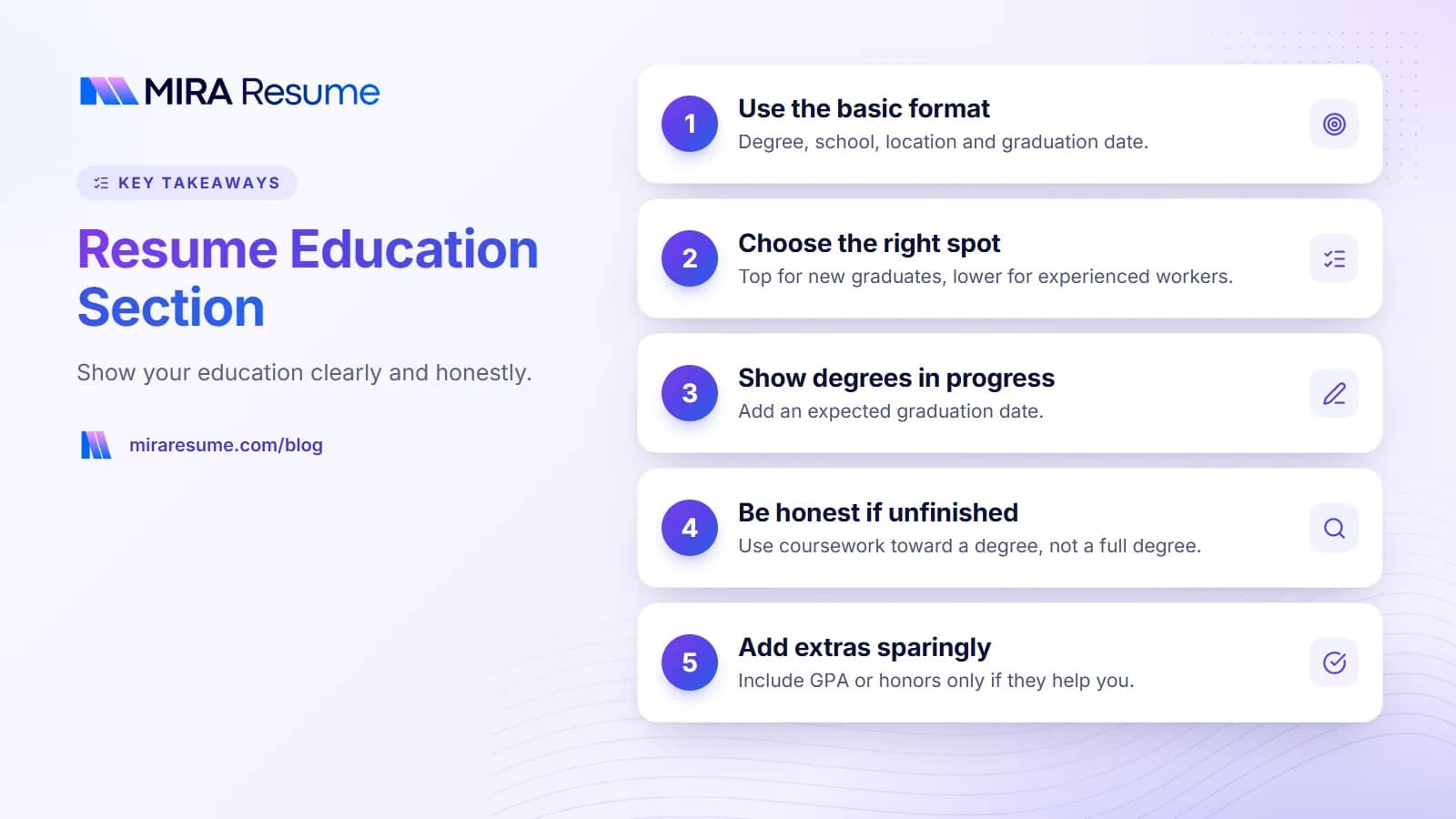
Every entry needs the same few facts. Write them in the same order each time, newest first.
- Degree name and, if you have one, your major.
- School name and its city and state (or country).
- Graduation date, as month and year or just the year. For a degree in progress, write the expected date.
- Extras that help: GPA, honors, relevant courses, thesis or minor.
Here is a standard entry.
Bachelor of Science in Biology, State University, Columbus, Ohio
Graduated May 2025 | GPA 3.6 | Minor in Chemistry
Some people put the school first and the degree second. Both ways work. Pick one style and use it for every entry. Keep each line short and easy to scan.
How to write the degree name
| Style | Example | Notes |
|---|---|---|
| Full name | Bachelor of Arts in English | Safest choice, and clear for any reader |
| Short form | B.A. in English | Fine, if you use the same style across the page |
| Associate degree | Associate of Applied Science in Nursing | Spell out the full title |
| Master's degree | Master of Public Administration | Use the exact name on your diploma |
| Doctorate | Ph.D. in Psychology | Add the dissertation title only if relevant |
Use the title exactly as your school gives it. Do not upgrade it, and do not write a degree you did not finish as if it were complete.
Where to put education on your resume
The right spot depends on how recent your degree is and how strong your work history is.
| Your situation | Where to put education |
|---|---|
| Current student or recent graduate (within about two years) | Near the top, right after your summary or contact details |
| Several years of related work | Below your experience section |
| A job that requires a specific degree or license | High on the page, so the reader sees it fast |
| Career changer who just finished new training | Near the top, to show the new field |
| Long career, degree not needed for the job | Near the bottom, short |
The general idea is simple: put your strongest proof first. For a fresh graduate, that is the degree. For an experienced worker, it is the work. If you want to see how this fits into a whole page, read how to format a resume and the simple resume format.
How much detail is enough
The longer ago you graduated, the shorter the entry should be. A new graduate can add courses, honors and a project. Someone twenty years into a career needs only the degree and school. If you are applying for a job like a nurse, teacher or engineer, where a degree or license is required, keep the entry clear and complete.
How to list a degree in progress
If you are still studying, list the degree and add the expected graduation date. This is the most common form for students and for people finishing a degree while they work.
| Situation | How to write it |
|---|---|
| Currently enrolled | Bachelor of Science in Computer Science, [University Name], expected May 2027 |
| Enrolled, date unsure | Bachelor of Arts in Psychology, [University Name], in progress |
| Part-time or online degree | Master of Business Administration (part-time), [University Name], expected 2028 |
| Degree plus a current semester abroad | B.A. in Economics, [University Name], expected May 2027 | Semester abroad: [City, Country], Spring 2026 |
You can use any of these phrases: "expected", "anticipated", "in progress" or "candidate for". "Expected May 2027" is the plainest. Add your GPA only if it is strong. For ideas about what else to include as a student, see student resume examples and internship resume.
If you do not know the finish date
Use "in progress" or give your best honest estimate, then be ready to explain it. Never list a date you do not expect to meet.
How to list an unfinished degree, a GED or high school
Not everyone finishes a degree, and that is fine. You can still list your education honestly, and show what you did learn. These are the most common cases.
| Situation | How to write it |
|---|---|
| Left college without finishing | Coursework toward a B.A. in Business, [College Name], 2022 to 2024 |
| Took credits only | [College Name], 45 credits completed toward a B.S. in Nursing, 2021 to 2023 |
| GED | High School Equivalency Diploma (GED), [State], 2024 |
| High school diploma | [High School Name], [City, State], Diploma, 2023 |
| Trade school or apprenticeship | Certificate in HVAC Technology, [School Name], 2025 |
| Bootcamp or short course | Full-Stack Web Development Certificate, [Provider], 2025 |
Never write that you hold a degree you did not complete. Employers often check, and a false claim can cost you an offer or a job later. Writing "coursework toward" or listing completed credits is honest and still shows learning.
When to include high school
If you have a college degree, leave high school off. If high school is your highest level of study, list it. If you are a first-year college student, you can still include it with a short line. See high school on a resume for the details.
Certificates and licenses
Short certificates and professional licenses belong either in the education section or in a separate "Certifications" section. Our guide on how to list certifications on a resume explains the format.
What to add to each education entry
After the basics, add only items that help you get this job. More is not better. Choose from this list.
| Extra | Add it when | Example |
|---|---|---|
| GPA | It is 3.5 or higher, or the job asks for it | GPA 3.7 / 4.0 |
| Honors | You earned a recognized honor | Magna Cum Laude; Dean's List, 6 semesters |
| Relevant courses | You are a student or changing fields | Courses: Statistics, Database Design, Technical Writing |
| Minor or double major | It supports the job | Minor in Spanish |
| Thesis or capstone | It matches the role | Thesis: Water use in urban gardens |
| Scholarships | They are merit-based and notable | [Scholarship name], 2023 to 2025 |
| Study abroad | It shows language or global skills | Semester abroad, Madrid, Spain |
About GPA
If your GPA is under about 3.5, you can leave it off, unless an application form asks. If your major GPA is higher than your overall GPA, you can list that and label it clearly, such as "Major GPA 3.8". Report it as your school does, and do not round up.
Graduation dates and age
You do not have to list a graduation year if you worry about age bias, particularly if you graduated many years ago. Leaving the date off an older degree is a common choice. Be aware, though, that some application forms ask for dates, and a few employers want them. Use your judgment, and always be honest if asked directly.
Multiple degrees and schools
List them newest first, with the highest or most recent degree at the top. If you transferred between schools and finished at the second one, list only the school that gave you the degree, unless the first school adds something useful, such as a program in your field. If you hold two degrees from the same school, you can list the school once and put both degrees beneath it. This keeps the section short and easy to scan, and it spares the reader from hunting for your highest level of study.
Education examples for different readers
Here are four made-up entries, each for a different reader. Change them to fit your life.
Recent graduate
Bachelor of Arts in Communications, [University Name], Austin, Texas
May 2026 | GPA 3.6 | Dean's List, 5 semesters
Relevant courses: Public Speaking, Media Writing, Research Methods
Mid-career professional
Master of Business Administration, [University Name], 2019
Bachelor of Science in Accounting, [University Name], 2014
Career changer with new training
Data Analytics Certificate, [Provider], 2026
Bachelor of Arts in History, [University Name], 2018
Relevant projects: sales dashboard in Excel; survey analysis in SQL
Degree earned abroad
Bachelor of Engineering in Mechanical Engineering, [University Name], [City, Country], 2021
Equivalent to a U.S. bachelor's degree (credential evaluation by [service name], 2024)
If your degree is from another country, you can note the equivalent only if you have an official evaluation. Do not guess at equivalents. A credential service can tell you the right comparison.
For help turning your education into proof of skill, read skills to put on a resume and resume with no job experience.
Make the section easy for software to read
Many companies use an applicant tracking system, or ATS, which reads your file and sorts it into fields. A simple education section helps the system get it right.
- Use the heading Education. Avoid clever names such as "My Learning Journey".
- Write the degree in full words at least once, such as "Bachelor of Science", because some systems search for the full term.
- Put dates in a standard form, like "May 2025".
- Do not put your education in a table, text box, header or image.
- Use a standard font and a plain PDF.
Learn more in how an ATS works. If you want to see how a system might read your education lines, you can run your file through the ATS checker. It is a good last check before you apply, though it cannot guarantee an interview.
Common mistakes in the education section
- Listing an unfinished degree as complete. Use "expected" or "coursework toward".
- Mixing styles. Use the same order and date format in every entry.
- Adding a weak GPA. Leave it off if it does not help you.
- Keeping high school after college. Remove it once you have a degree, unless it adds something rare.
- Writing a long list of courses. Pick four to six that match the job.
- Putting education above strong work history. Experienced workers should lead with the work.
- Using school abbreviations only. Write the full school name so anyone can understand it.
- Typos in the school name. It is a small error that looks careless.
To see these and other errors next to fixed versions, read bad resume examples. When you are ready to build, you can pick a plain design from our resume templates and download a PDF from the resume builder.