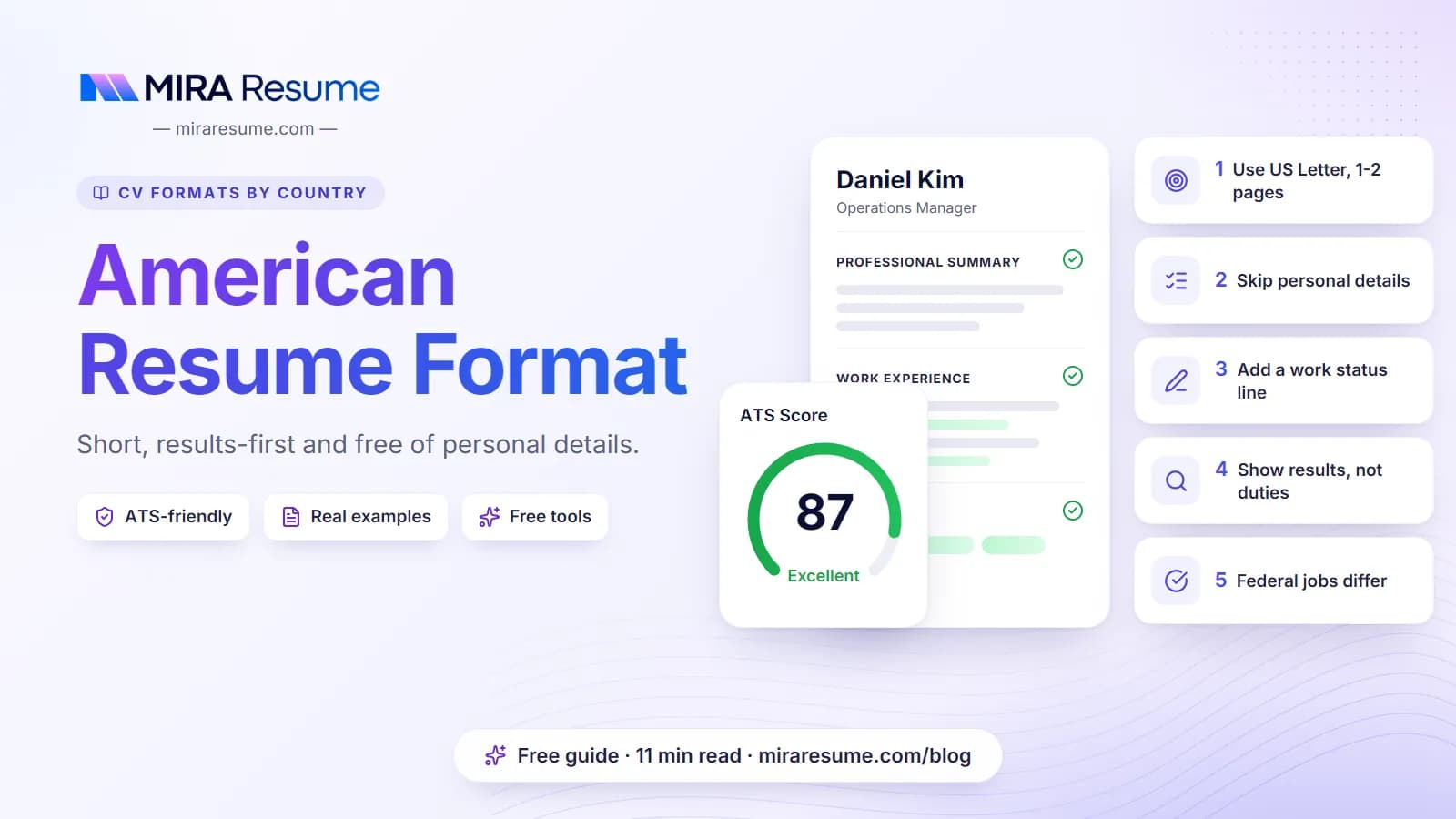
Coming soon
CV Formats by Country

Canadian Resume Format: How to Write a Resume for Jobs in Canada

Learn the Canadian resume format: one or two pages, no photo or birth date, a work permit or PR status line, Canadian spelling and a sample to follow.

Mira Resume Editorial Team · Career content team Published Updated 10 min read
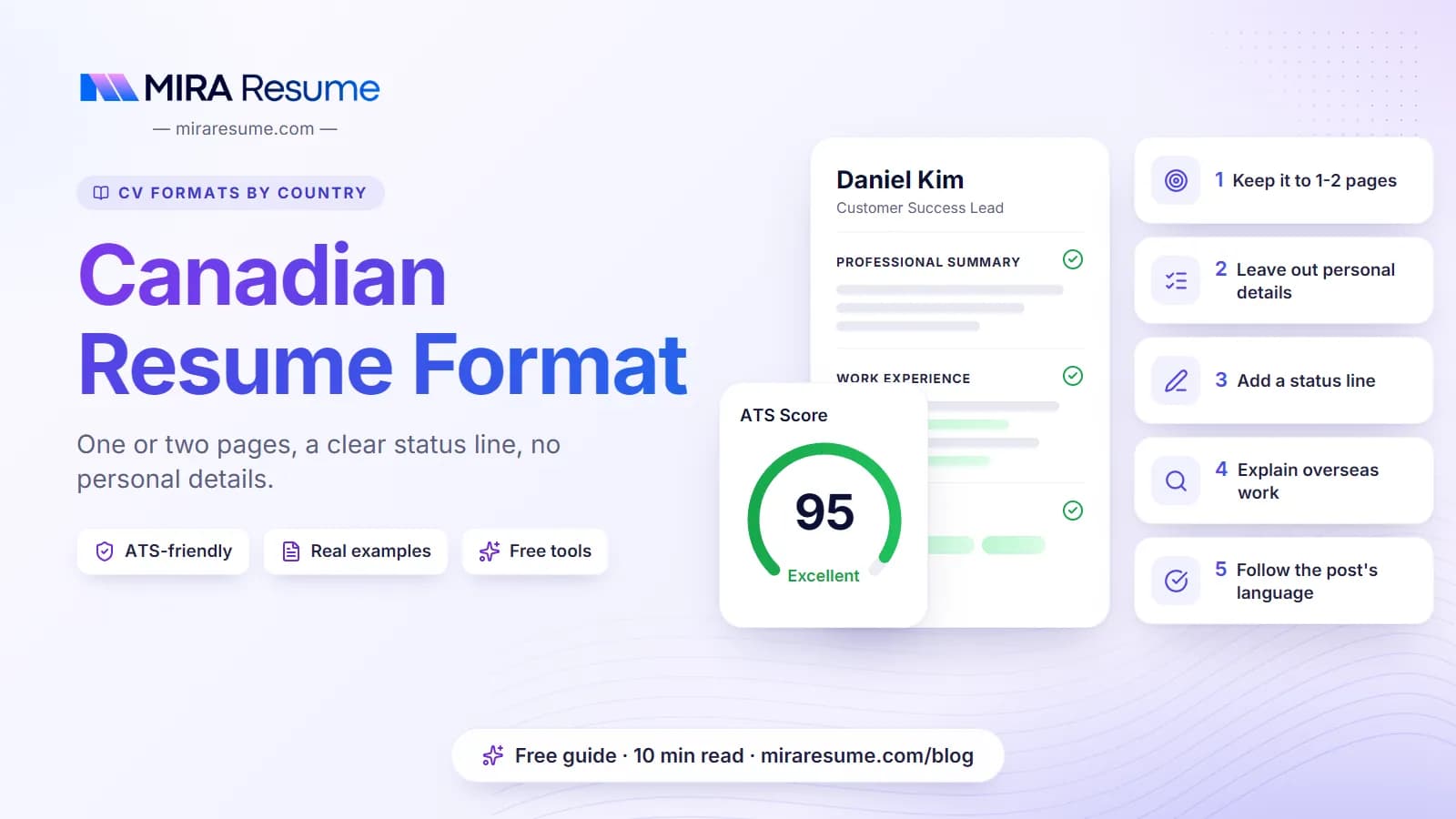
Canadian Resume Format: cover image for the Mira Resume guide, with an example resume and the 5 main points

The Canadian resume format is close to the American one, with a few local twists. Most employers expect one or two pages, a clean layout, your most recent work first and no photo, birth date or marital status. What makes a resume feel Canadian is the detail: consistent Canadian spelling, a clear line about your status to work in Canada, and experience written so a local hiring manager can understand it quickly.

If you are a newcomer, an international student or someone applying from abroad, those details matter even more. Employers want to see quickly where you are, whether you can work, and how your background fits their role.

This guide covers what to include and leave out, the usual section order, how to handle work permit or permanent resident status, how to present overseas experience, what to know about French in Quebec, and a short sample you can adapt.
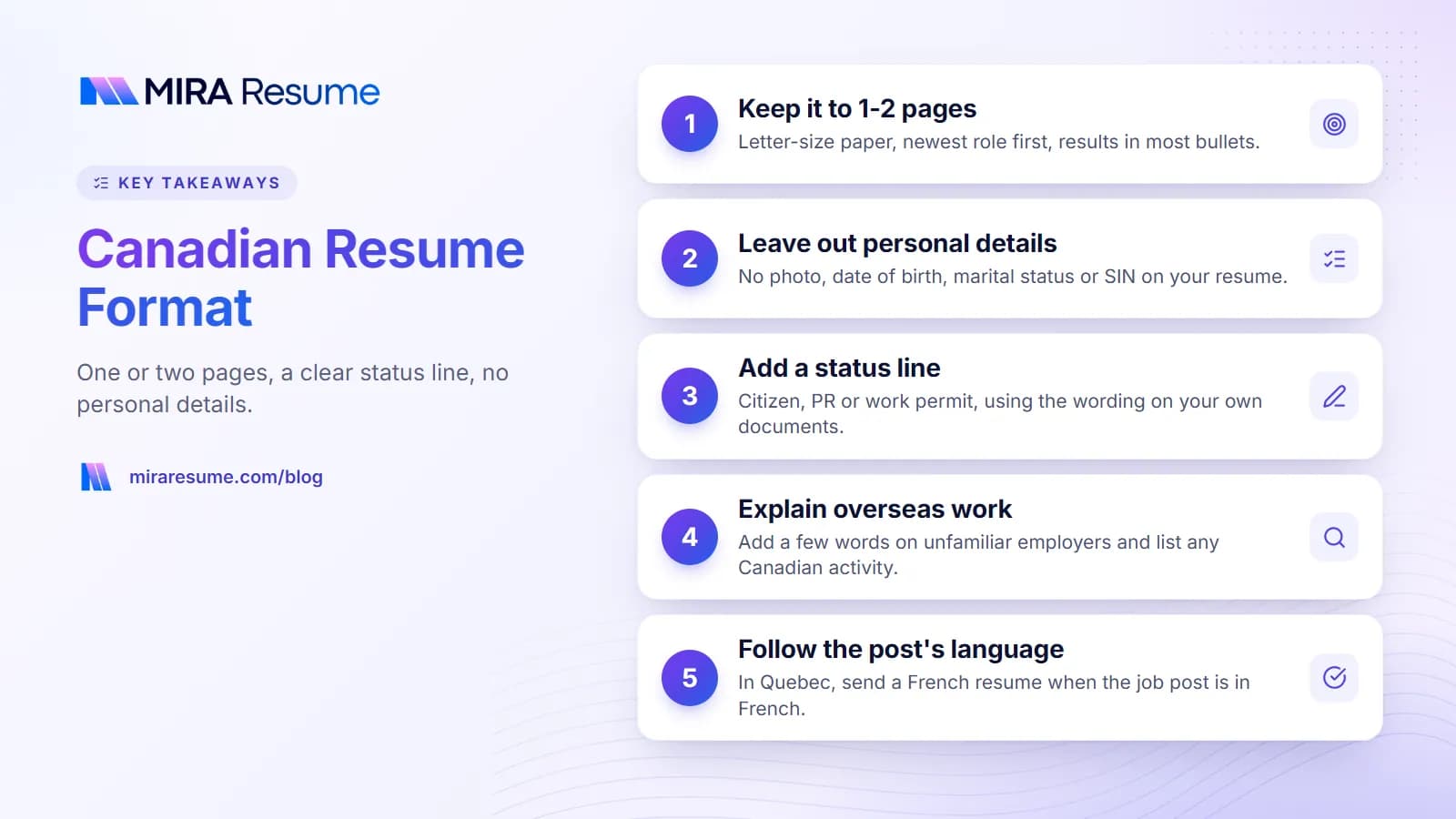
Key takeaways: 1. Keep it to 1-2 pages; 2. Leave out personal details; 3. Add a status line; 4. Explain overseas work; 5. Follow the post's language
Key takeaways from this guide.

Resume or CV in Canada?

In English-speaking Canada, the word for a job application document is usually resume. People also call it a CV, and in Quebec the French term CV is the everyday word. For academic, research and some medical jobs, a CV means a longer document with publications and teaching, as it does in the US.

So if you searched for a Canadian CV format for a regular job, you most likely need a resume. Our guide to the difference between a CV and a resume explains both documents.

ElementCommon practice in Canada
Length1 page for students and early-career applicants, 2 pages for many experienced people
Paper sizeUS Letter (8.5 x 11 inches) is standard in Canada
SpellingCanadian spelling, such as colour, centre and labour, used consistently
DatesMonth and year written out, such as June 2024, to avoid confusion
Phone(416) 555-0182 style; include +1 if you are applying from abroad
LocationCity and province, such as Calgary, AB
File typePDF or .docx, unless the job post says otherwise

A note on Canadian spelling

Canadian English mixes British and American habits. Many Canadians write colour, centre, cheque and labour, but also organize and realize with a z. There is no single rule every employer follows. The safest approach is to pick one style, use it everywhere, and match the spelling in the job post when you quote job titles or skills. Dates are written in several numeric styles in Canada, so writing the month as a word removes any doubt. Our resume date format guide has more options.

Personal details: what to include and what to leave out

A Canadian resume header is short. It tells the employer who you are and how to reach you, and little else.

DetailInclude?Notes
Full nameYesThe name you use professionally
City and provinceYesFull street address is optional and often left off
Phone and emailYesA Canadian number helps if you already have one
LinkedIn or portfolioOptional, recommendedKeep it consistent with your resume
Work status lineOptional, often helpfulSee the next section
PhotoNoNot expected for most jobs
Date of birth or ageNoAge is a protected ground under human rights laws
Marital or family statusNoNot relevant to the job
Religion, ethnic origin, genderNoProtected grounds under human rights laws
Social Insurance Number (SIN)NeverGive it to an employer only after you are hired

Why Canadian resumes leave these details out

Canada has federal and provincial human rights laws that protect job applicants. The Canadian Human Rights Act covers federally regulated employers, such as banks, airlines and telecom companies, and lists grounds including race, national or ethnic origin, colour, religion, age, sex, sexual orientation, gender identity or expression, marital status, family status, genetic characteristics and disability. Each province and territory has its own human rights code for most other employers, with similar protections.

Because of this, many Canadian employers prefer not to see details like a photo, birth date or family status on a resume. Leaving them off keeps the focus on your skills. Service Canada also advises sharing your SIN only when it is legally required, which for a job means after you are hired. This is general information, not legal advice.

Work permit, PR and citizenship: the status line

Many Canadian online applications ask whether you are legally entitled to work in Canada. Employers may also wonder about this when they see overseas experience. A short, honest line near the top of your resume can answer the question before it is asked.

  • "Canadian citizen" or "Permanent resident of Canada"
  • "Eligible to work in Canada"
  • "Open work permit, valid until August 2028"
  • "International student, eligible to work part-time during studies"
  • "Based in Manila; relocating to Vancouver in April 2027; will require a work permit"

Write only what is true and current for you, using the wording from your official documents. Work permit types and conditions differ and change, so check your own permit and the Immigration, Refugees and Citizenship Canada (IRCC) pages on canada.ca. This guide is not immigration advice.

Being a citizen or permanent resident is not required to apply for most jobs, and many employers hire people on work permits. The goal of the line is to remove uncertainty, not to sell your status.

Canadian experience and how to present overseas work

Many newcomers hear that employers want "Canadian experience." In Ontario, the Ontario Human Rights Commission published a policy in 2013 saying that a strict requirement for Canadian experience is likely to be discriminatory under the Ontario Human Rights Code, except in very limited cases, and that employers should consider all relevant experience, Canadian and foreign. Other provinces may treat the issue differently.

Whatever the rules, your resume can make overseas experience easy to understand:

  • Explain unfamiliar employers. Add a few words such as "one of the largest private hospitals in Lagos" or "software firm with 300 staff", as long as it is accurate.
  • Use clear job titles. If your title would confuse a Canadian reader, you can add the closest common equivalent in brackets, as long as it truly describes your role.
  • Show results with numbers. Budgets, team size, customers served and time saved work in any country.
  • List any Canadian activity. Volunteer roles, co-op placements, bridging programs, contract work and local courses all count. Our guide to volunteer work on a resume shows how to list them.
  • Mention licensing in progress. Many professions in Canada, such as nursing, engineering and teaching, are regulated by provincial bodies. If you have started the process, say so with the stage and expected date.
  • Mention a credential assessment if you have had your education assessed, so employers can understand your degree.

French and applying in Quebec

French is the official language of Quebec, and many employers there work mainly in French. If a job post is written in French, send your resume and cover letter in French unless the post says otherwise. Have a fluent speaker check your text, because small errors stand out.

Elsewhere in Canada, many federal government jobs and customer-facing roles value both English and French. List your languages honestly with a simple level, for example:

  • English: fluent
  • French: intermediate (professional working level in progress)
  • Punjabi: native

Avoid inflating a language level. If a role needs French, you may be tested on it.

Screenshot of the Mira Resume resume builder (Fill in your details, pick a template and download a text-based PDF or an editable Word (.docx) file.)
Screenshot: Resume builder: Fill in your details, pick a template and download a text-based PDF or an editable Word (.docx) file.Try it

Most Canadian resumes use reverse-chronological order, with your newest role first. Our chronological resume template follows this structure, and the best resume format guide compares it with skills-based layouts.

OrderSectionWhat goes in it
1HeaderName, city and province, phone, email, LinkedIn, optional status line
2Summary or profileTwo to four lines on your experience and strengths
3SkillsTechnical and job-specific skills from the posting
4Work experienceTitle, employer, city and country, dates, three to six result bullets
5EducationCredential, school, country, year; add assessment or licensing notes if relevant
6Certifications and trainingCanadian or international certificates that matter for the role
7OptionalVolunteer work, languages, projects, awards

Students and new graduates often put education first and add co-op terms or part-time jobs. See student resume examples and how to list education on a resume.

Sample Canadian resume: header, summary and one job

Below is the top of a fictional resume for an accountant who recently moved to Canada. The person and companies are made up.

AHMED KHAN
Mississauga, ON | (905) 555-0136 | [email protected] | linkedin.com/in/ahmedkhan-example
Permanent resident of Canada

Profile
Accountant with six years of experience in month-end close, accounts payable and audit preparation for manufacturing companies. Skilled in Excel, QuickBooks and SAP. Working toward the Canadian CPA designation.

Experience
Senior Accounts Officer, Riverstone Textiles (manufacturer with about 900 employees), Lahore, Pakistan | January 2020 to June 2025

  • Led a three-person team that closed the monthly books five days faster by standardizing reconciliations.
  • Prepared schedules for the annual external audit, which closed with no major findings for four years.
  • Moved supplier payments from cheques to bank transfers, reducing late-payment penalties.

The status line answers the work question, the bracket explains the employer, and each bullet shows a result. The spelling, such as cheques, stays Canadian throughout. For more help writing results, see our resume bullet points guide and resume summary examples.

References, cover letters and job boards

References

Canadian employers commonly contact references before making an offer, but you do not need to list them on your resume or write "references available upon request." Prepare a separate page with two or three people who know your work, and ask their permission first. If your past managers are overseas, give their email and time zone, and let them know a Canadian employer may contact them. Our guide to references on a resume has a template.

Cover letters

Many Canadian employers still read cover letters, and some ask for them. A short letter is a good place to explain a move to Canada, your timing and why you want this job. See how to write a cover letter or try the AI cover letter generator.

Job boards and ATS

Job Bank is the Government of Canada's job site, and many people also search LinkedIn, Indeed and company career pages. Many larger employers use an applicant tracking system, so keep your layout to one column with standard headings, and save as a .docx or text-based PDF. Use the job description analyzer to spot key terms and the ATS checker to test your file. To keep track of applications, try the free Stealth Mode spreadsheet view.

Moving from a US resume or a CV from another country

If you already have a US resume, the changes are small. If you have a CV from another country, they are bigger.

Starting documentMain changes for a Canada resume format
US resumeSwitch to Canadian spelling, change the location to a Canadian city if you live there, add a status line
UK or Irish CVChange A4 to Letter, shorten to one or two pages, keep a short profile
Indian, Pakistani or Filipino CVRemove photo, date of birth, marital status, father's name and declaration; rewrite duties as results
European CV or EuropassRemove photo and personal details, cut length, move languages to a short section

For the full US rules, see our American resume format guide. Applying from Asia? Our Indian resume format and Philippines resume format guides show what you are converting from. Browse every country in the CV formats by country hub.

Do and don't for a Canadian resume

DoDon't
Keep it to one or two pagesSend a long CV for a regular job
Add an honest status line if it helpsGuess at permit terms or claim a status you do not have
Explain overseas employers in a few wordsAssume a Canadian reader knows them
Use one spelling style consistentlyMix colour and color in the same file
Apply in French when the post is in FrenchOverstate your French level
Keep references on a separate pageAdd a photo, birth date, SIN or marital status

Final checklist

  • One or two pages on Letter-size paper.
  • Header has name, city and province, phone, email and LinkedIn.
  • Status line, if used, is accurate and uses official wording.
  • No photo, date of birth, marital status, SIN or declaration.
  • Overseas employers and titles are explained briefly and honestly.
  • Results with numbers in most bullets.
  • Spelling and date format are consistent.
  • French resume ready if you are applying in Quebec.
  • Reference list prepared separately.
  • File tested with an ATS checker and named clearly, such as Ahmed-Khan-Resume.pdf.

When you are ready, open the resume builder or compare layouts on the resume templates page.

Frequently asked questions

What is the Canadian resume format?

It is usually a one or two page resume on Letter-size paper, with your most recent work first. It includes a short header, a profile, skills, experience and education. It leaves out photos, birth dates and marital status, uses consistent Canadian spelling, and often includes a short line about your status to work in Canada.

Should I put a photo on my resume in Canada?

No, not for most jobs. Canadian employers do not expect photos, and many prefer not to receive them because human rights laws protect applicants from discrimination based on things like age, race and sex. Exceptions are roles such as acting or modeling, where a headshot is requested. Otherwise, let your LinkedIn profile carry your photo.

How long should a Canadian resume be?

One page is common for students and people early in their careers. Two pages is normal for experienced professionals and managers. Longer documents are usually reserved for academic or research CVs. If you are converting a long CV from another country, cut older roles and duty lists until you reach two pages.

Should I put my work permit or PR status on my resume?

It is optional but often helpful, especially if your experience is mostly outside Canada. A short line such as permanent resident of Canada or open work permit, valid until a certain date, answers an employer's question early. Use wording from your official documents and check IRCC guidance for your situation. Never claim a status you do not hold.

Is a Canadian CV different from a resume?

For most jobs, no. People in Canada often use the words interchangeably, and in Quebec CV is the everyday French term. For academic, research and some medical roles, a CV means a longer document with publications, teaching and grants. If a regular employer asks for a CV, a one or two page resume is usually what they want.

Do I need a French resume for jobs in Quebec?

Often, yes. French is the official language of Quebec and many employers work mainly in French. If the job post is in French, send a French resume and cover letter unless the post says otherwise. Some employers, especially in tech and international firms, hire in English, so follow the language of each posting.

Found this useful? Share it

Send it to a friend who is job hunting, or save it for later.

Read this guide with AI

Get a plain-language summary and help applying it to your own resume. Pick an assistant; it opens with this article and a ready prompt.

Back to CV Formats by Country hub

All articles