
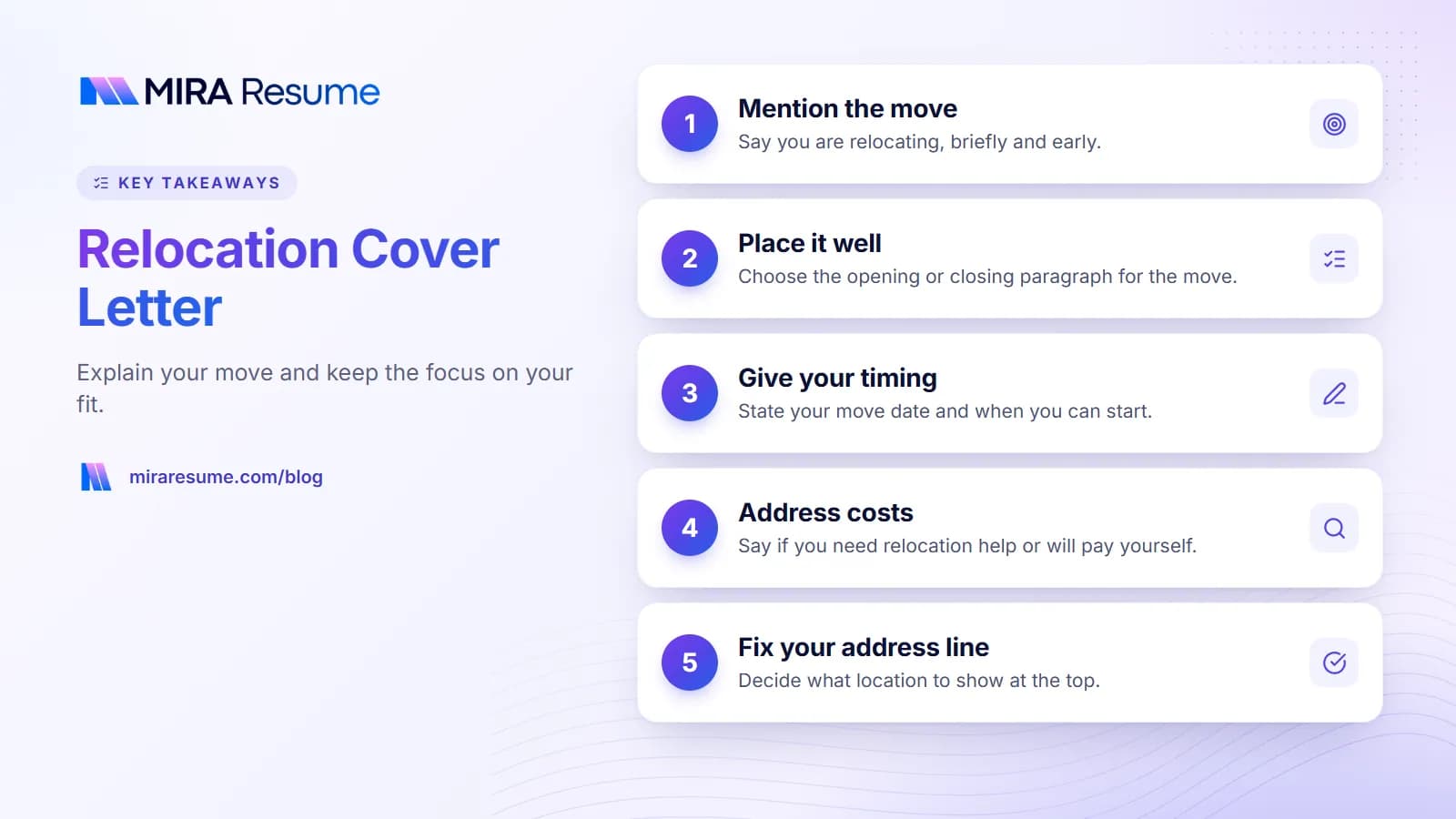
A relocation cover letter is a regular cover letter with one extra job: it tells the employer you plan to move to their area and when you can start. Mention the move in one or two clear sentences, give a realistic date, and then get back to your skills. The move is context. Your fit for the role is still the main point.
Hiring teams who see an out-of-town address often have quick questions. Is this person really moving? When? Will they expect us to pay for it? Can they come in for an interview? A good letter answers those questions before anyone has to ask.
This guide covers when to mention your move, where to put it, how to talk about timing and costs, what to say if you are moving for a partner or moving countries, and four full example letters you can copy and adapt.
Should you mention relocation in your cover letter?
In most cases, yes. If your resume shows a different city or state, the reader will notice. Leaving it unexplained can make it look like you applied by mistake, or that you have not thought about the move. One honest sentence removes the doubt.
Mention it when
- Your current address is in a different city, state or country from the job.
- The job is on-site or hybrid and you will need to live within commuting distance.
- You already have a move date, a lease, or a strong reason for the move.
- The job post says "local candidates only" or "must live within X miles". In that case, explain clearly that you will be local by the start date.
You may leave it out when
- The job is fully remote and location does not matter for the role.
- You already live within commuting distance, even if the company lists a different city.
- You are only exploring and have not decided to move. Do not promise a move you are not sure you will make.
Whatever you decide, be truthful. Never list a local address you do not live at. If an employer learns that later, it can damage trust before you even start.
Where to mention the move: opening or closing paragraph
You have two good places to put the relocation sentence. The right choice depends on how much the move matters to the employer.
| Placement | Best when | Example sentence |
|---|---|---|
| Opening paragraph | The job is on-site, the post asks for local candidates, or your address will clearly raise the question | I am applying for the Office Manager role at Ridgeway Dental and will be relocating to Denver in March. |
| Closing paragraph | The job is hybrid or flexible, and your skills are the stronger first impression | I am relocating to Denver in March and am available for video interviews now and in-person meetings from mid-February. |
| Both (briefly) | Timing is tight or the employer needs someone fast | Open with the move date, then confirm your start availability in the close. |
Do not give the move its own long paragraph. Two sentences are enough. If you write more, the letter starts to feel like it is about your move instead of the job. For the rest of the structure, see how to write a cover letter, and for strong final lines, read how to close a cover letter.
How to address timing and availability
Timing is usually the employer's biggest practical worry. A vague promise such as "I may be moving soon" creates more questions than it answers. Be as specific as you honestly can.
- Give a month, not a maybe. "I will be living in Austin by June 1" is clearer than "I hope to move this summer."
- Separate the move date from the start date. If you need two weeks after arriving to settle in, say "available to start from June 15."
- Say how you can interview. Offer video calls right away, and name any dates you will already be in town.
- Mention notice periods if they apply. "My current role requires four weeks' notice" helps the employer plan.
- Be flexible where you can. If you could move sooner for the right job, say so, but only if it is true.
If you do not have a fixed date yet
Give a window and the reason. For example: "I plan to relocate to Charlotte between August and October, once my lease ends, and I can adjust that for the right role." It is honest and still gives the reader something to plan around.
Relocating at your own expense or open to assistance?
Moving costs money, and some employers offer relocation packages while many do not. Your letter can signal your position without turning into a negotiation.
| Your situation | What to write | Notes |
|---|---|---|
| You are moving anyway and do not need help | I am relocating to Phoenix at my own expense in April. | This removes a cost concern. Only say it if you mean it. |
| You would like help but can move without it | Leave cost out of the letter. | Raise relocation support later, once there is mutual interest. |
| The job post mentions a relocation package | I saw that this role includes relocation support and would be glad to discuss timing. | Fine to mention, since the employer brought it up. |
| You cannot move without support | Leave it out of the letter, then ask the recruiter early in the process. | Asking in the first screening call saves time for both sides. |
The phrase "at my own expense" is useful, but it is a commitment. Once you put it in writing, it is hard to ask for a package later. If you are unsure, it is usually better to say nothing about cost in the letter and discuss it in conversation.
Remote first, then relocate
Some employers will let a new hire work remotely for a short period before moving. If you want to suggest this, keep it as an option, not a condition.
I will be relocating to Minneapolis by September. If it would help the team, I am also happy to start remotely in July and transition to the office once I arrive.
This works best for roles that can be done from anywhere for a while, such as software, writing, design or analysis. It is a harder sell for roles that are hands-on by nature, such as nursing, retail or skilled trades. Read the job post. If it says "on-site from day one", do not suggest a remote start.
Moving for a partner or family: how much to share
Many people move because a partner took a new job, a family member needs care, or they want to be closer to home. You can mention the reason, but you do not have to, and you should keep it short.
- Enough: "I am relocating to Seattle this spring for family reasons."
- Also fine: "My spouse has accepted a position in Seattle, and we are moving in April."
- Too much: details about health, divorce, children's schools, or why you are leaving your current city.
A short reason can help, because it shows the move is real and planned. But the employer does not need your personal story, and you are not obliged to share details about your family. If a reason feels private, "I am relocating to Seattle in April" is complete on its own.
Moving back home
If you are returning to a city where you grew up or studied, say so. It suggests you know the area and plan to stay. "I am moving back to Cleveland, where I grew up, after finishing my degree" is warm and useful in one line.
International relocation and work authorization
A move across borders adds one more question for the employer: can you legally work in that country? Your cover letter should answer that honestly and simply. Rules differ by country and change over time, so we cannot tell you what applies to you. Check official government sources or a qualified immigration adviser for your own situation.
General guidance
- State your authorization status truthfully. If you already have the right to work there, say so in one sentence.
- If you will need sponsorship, do not hide it. Many application forms ask directly. Being clear early avoids wasted time on both sides.
- Do not guess or overstate. Avoid lines like "my visa should be fine". Say only what you know to be true.
- Follow the employer's instructions. If the post says it cannot sponsor visas, respect that and focus on roles where your status fits.
- Adapt to local format. Some countries expect different letter styles, date formats or document names. Read the posting and a few local examples.
Example lines you can adapt, if they are true for you:
- "I hold [citizenship or residency status] and am authorized to work in [country] without sponsorship."
- "I will require employer sponsorship to work in [country] and am happy to discuss this."
- "I am relocating to [city] in [month] and am available for video interviews across time zones."
What to put in your address line
Your letter's header usually shows your city and state. When you are moving, you have a few honest options. For the full header layout, see our guide to the cover letter header.
| Option | Example | When it works |
|---|---|---|
| Current city only | Columbus, OH | The move is a few months away, and you explain it in the letter. |
| Relocating line | Relocating to Denver, CO, by March 2027 | You have a firm date and want the reader to see it at a glance. |
| Both cities | Columbus, OH (relocating to Denver, CO, in March) | You want to be fully transparent and the line still fits. |
| New address | Denver, CO | Only once you actually live there or have a signed lease starting soon. |
Whatever you choose, keep it the same on your resume. A letter that says Denver and a resume that says Columbus with no explanation looks careless. A matching layout from our cover letter templates makes this easier.
Relocation cover letter examples you can copy
These four letters show different situations. The names, companies and details are fictional. Replace every detail with your own true facts, and cut anything that does not apply to you.
Example 1: Nurse moving to another state
Dear Ms. Okafor,
I am applying for the Registered Nurse position on the medical-surgical unit at Lakeshore General Hospital. I will be relocating from Ohio to Wisconsin in February and have started the process for my Wisconsin nursing license.
For the past four years I have worked on a 32-bed med-surg unit, caring for five to six patients per shift. I precept new graduate nurses, and I helped our unit roll out a new bedside handoff checklist. Your post's focus on safe handoffs and team support is exactly the kind of unit I want to join.
I am available for video interviews now and can start from March 1. My resume is attached, and I would welcome the chance to talk.
Sincerely,
Dana Whitfield
Nursing and other licensed roles often depend on local licensing rules, so only describe the license status you actually have. For more healthcare examples, see our healthcare cover letter guide.
Example 2: Software engineer moving to a new city
Dear Jordan Reyes,
I am excited to apply for the Backend Engineer role at Northpine Analytics. I am relocating to Austin at my own expense in May and would be glad to join your hybrid team in person.
At my current company I build and maintain APIs in Python and Go that serve our customer dashboards. Last year I led a project to move our reporting jobs to a queue-based system, which cut failed overnight runs to almost zero. I noticed your team is rebuilding its data pipeline, and that is the work I enjoy most.
If it helps your timeline, I can start remotely in April and move to the Austin office in May. I would welcome a call to discuss the role.
Best regards,
Sam Patel-Moore
Want more ideas for technical roles? Read our software engineer cover letter guide.
Example 3: Recent graduate moving back home
Dear Hiring Team,
I am applying for the Marketing Coordinator role at Bluegate Outdoor Co. I recently graduated with a degree in communications and am moving back to Spokane, where I grew up, in June.
During college I ran social media for our campus outdoor club, growing our event sign-ups each semester, and completed a summer internship writing product emails for a local retailer. I have shopped at Bluegate for years, and I would love to help tell its story to new customers.
I will be in Spokane from June 10 and can interview by video before then. Thank you for your time and consideration.
Sincerely,
Lena Ortiz
If you are early in your career, our guide to a cover letter with no experience shows how to use school and volunteer work as proof.
Example 4: International move
Dear Mr. Lindqvist,
I am applying for the Supply Chain Analyst position at Harborline Logistics. My family and I are relocating from Toronto to Dublin in September, and I hold [your actual work authorization status for Ireland].
For six years I have analyzed shipping and inventory data for a regional distributor. I built the weekly demand forecast our buyers rely on and reduced overstock in our two largest warehouses. Your post mentions a new forecasting project, and I would bring hands-on experience from day one.
I am available for video interviews in Irish business hours and can start from October 1. Thank you for considering my application.
Kind regards,
Aarav Thompson
Notice the bracket in the first paragraph. Fill it with your real status, in plain words, or leave the sentence out and answer the question on the application form.
Phrases to use and phrases to avoid
Small wording choices change how your move comes across. Confident and specific beats vague and apologetic.
| Use | Avoid | Why |
|---|---|---|
| I am relocating to Denver in March. | I might be moving to Denver at some point. | A clear date shows a real plan. |
| I am available to start from April 1. | I can start whenever. | Specific dates help the employer plan. |
| I am relocating at my own expense. | I really need help with moving costs. | Raise cost support later, in conversation. |
| I can interview by video now and in person from March 10. | Sorry, I cannot come in for interviews. | Offer a solution, not a barrier. |
| I am moving to Seattle for family reasons. | A long explanation of personal circumstances. | Short and private is enough. |
| I am authorized to work in [country] without sponsorship. | My visa situation should be fine. | Be accurate, never vague, about legal status. |
| I am excited to build my career in Charlotte. | I am desperate to get out of my current city. | Focus on where you are going, not what you are escaping. |
Common mistakes in a cover letter for relocation
- Using a fake local address. It may get past a filter, but it breaks trust the moment it comes out.
- Making the move the main story. Two sentences on the move, the rest on your fit.
- Being vague about dates. "Soon" and "sometime this year" make planning hard.
- Promising things you cannot deliver. Do not offer a start date or a self-funded move unless you are sure.
- Forgetting the resume. Your header, resume and application form should all tell the same story about where you live.
- Sharing too much personal detail. A short reason is fine. Private matters can stay private.
- Making it too long. A moving cover letter is still one page. See how long a cover letter should be.
Quick checklist before you send
- Is the move mentioned once, clearly, in the opening or closing?
- Did you give a move month and a start date?
- Did you say how you can interview?
- Is any statement about cost or work authorization accurate?
- Does your address line match your resume?
- Is the rest of the letter about the job and your proof?
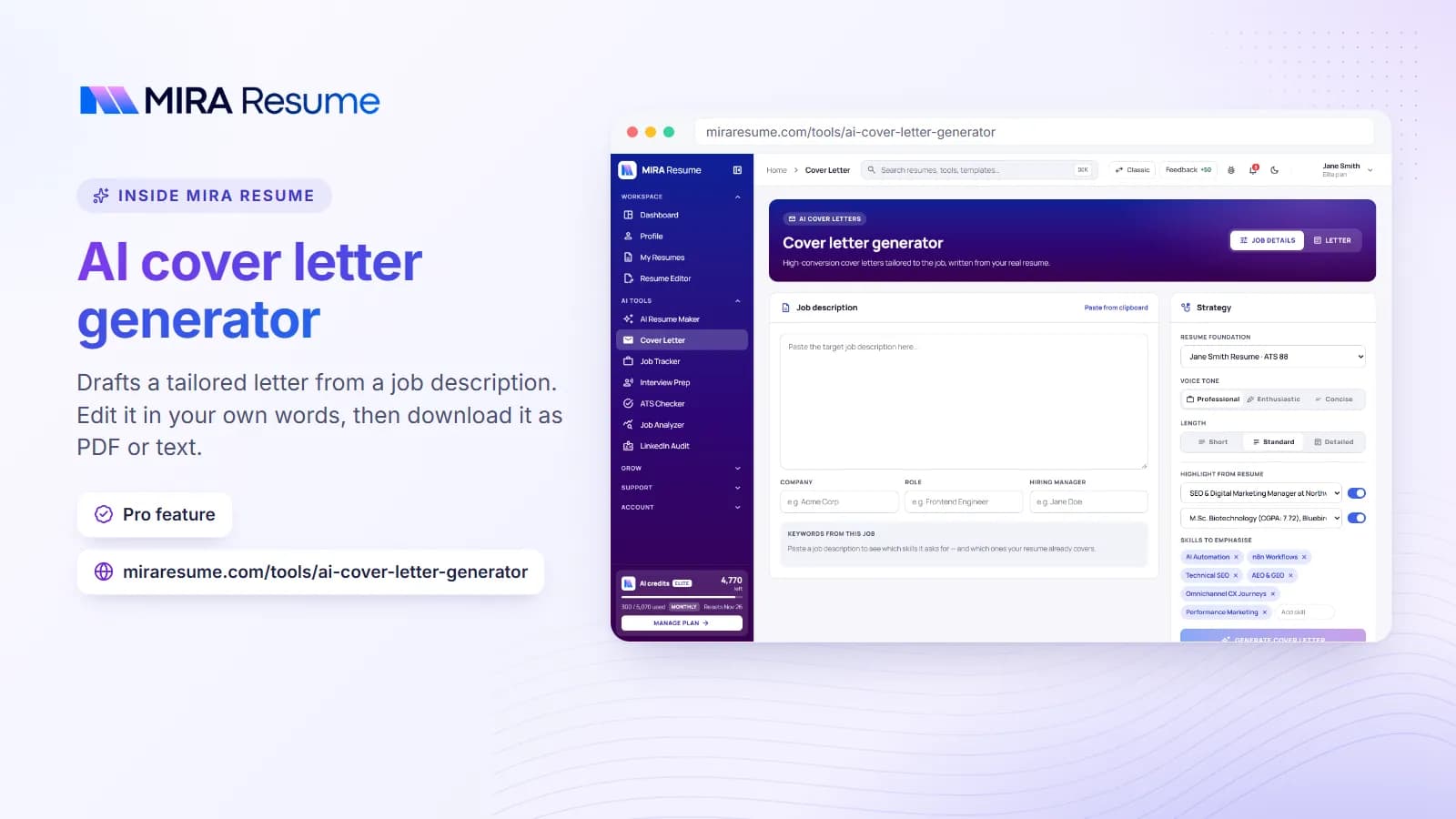
If you want a head start, the AI cover letter generator can draft a tailored letter from the job post and your resume. Add your relocation details, then edit it so every line is true and sounds like you.