
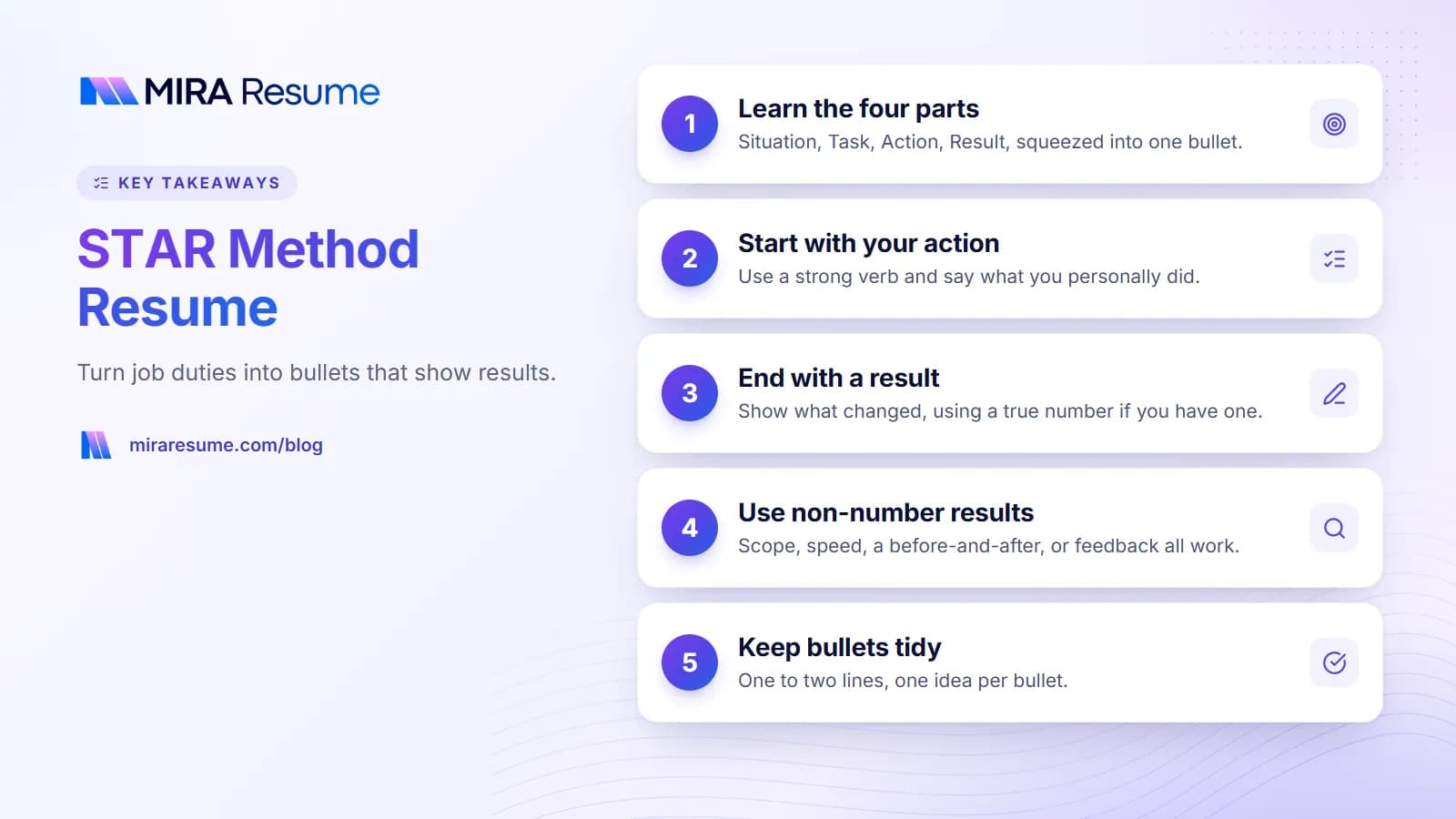
A STAR method resume uses four parts to write each bullet: Situation, Task, Action and Result. Instead of saying what your job description said, you show what problem you faced, what you did, and what happened because of it. The finished bullet is one or two lines, starting with the action and ending with the result.
Many people know STAR from interviews. It works on a resume too. In this guide you will learn what each letter means, how to compress them into a bullet, and how to find results when you have no numbers. You will see before and after examples for several jobs, a fill-in formula, and the mistakes to avoid. Results from any resume vary, but clear proof always beats a vague duty.
What the STAR method means
STAR is a simple story outline.
| Letter | Stands for | Question it answers |
|---|---|---|
| S | Situation | What was going on? |
| T | Task | What did you need to get done? |
| A | Action | What did you personally do? |
| R | Result | What changed because of it? |
In an interview you have time to tell all four parts out loud. A resume bullet has no room for that. So you use STAR as a thinking tool: work through all four in your notes, then write a short line that keeps the most useful parts, usually the action and the result, plus a hint of the situation.
Some people also call this the CAR method (Challenge, Action, Result) or the PAR method (Problem, Action, Result). They work the same way.
How to write a STAR method resume, step by step
- Pick a job and one thing you did there. Choose a task that mattered to your boss or customers.
- Write the Situation and Task in a few words. Example: "Returns line backed up on weekends."
- Describe your Action. Use a strong verb: built, trained, reorganized, negotiated. See action verbs for resume.
- Add the Result. Time saved, errors reduced, money handled, people served, or praise received.
- Squeeze it into one line. Start with the action, end with the result, and fold in the situation if there is space.
- Check that it is true and that you can explain it.
The bullet formula
Action verb + what you did + (for or by) how/why + result
Example: Reorganized the weekend returns line into two lanes, cutting average wait time from 15 minutes to 8.
That one bullet carries all four parts: the situation (long returns line), the task (reduce waiting), the action (reorganized into two lanes), and the result (shorter wait).
STAR method resume examples: before and after
Here are plain duty statements next to STAR-style bullets. The numbers are only samples. Use your own true figures.
| Job | Before (duty) | After (STAR-style) |
|---|---|---|
| Cashier | Handled customer payments | Processed 150+ transactions per shift with an accurate drawer, and trained 4 new cashiers on the refund steps |
| Customer support | Answered customer emails | Cleared a backlog of 300 open tickets in two weeks by sorting urgent cases first, then kept replies under 24 hours |
| Teacher | Taught math to 7th graders | Introduced weekly small-group practice for a class of 28, lifting average quiz scores from 71 to 79 |
| Nurse | Cared for patients | Coordinated care for up to 5 patients per shift and taught discharge steps to families, reducing follow-up calls |
| Software developer | Fixed bugs | Fixed a login bug affecting 2% of users by tracing logs, then added a test to stop it from returning |
| Marketing assistant | Ran social media | Planned 4 posts a week and tested two post times, growing followers from 800 to 1,500 in six months |
| Warehouse associate | Packed orders | Packed 120 orders per shift with a 99% accuracy log and suggested a shelf label change that sped up picking |
Notice how each "after" bullet starts with what you did and ends with a visible change. If you want to see how a full page of bullets fits together, check our resume examples.
What if you do not have numbers?
Not every result is a number. Good proof can also be a before-and-after change, a scope, or feedback. Try these types of results:
| Type of result | Example |
|---|---|
| Scope (how big or how often) | Supported a team of 12 across two shifts |
| Speed | Shortened the weekly report process from three days to one |
| Quality | Brought customer complaints about late orders to near zero for the quarter |
| Money | Managed a $5,000 monthly supply budget |
| Recognition | Named employee of the month by the store manager |
| Process change | Created a checklist that the whole team adopted |
| Trust | Chosen to train new staff after six months on the job |
If you really cannot find a result, ask yourself who benefited from your work and how. A manager had fewer questions, a customer got an answer faster, a patient felt calmer. Write that down plainly and honestly.
Never invent numbers. If you estimate, say "about" or "roughly", and make sure you could explain how you counted.
Make STAR bullets easier to read
A STAR bullet can grow too long. These simple rules keep it tidy.
- One to two lines. If it passes two lines, split it or trim the situation.
- Start with a verb in past tense for old jobs, present tense for your current one.
- One idea per bullet. Do not join three different tasks with commas.
- Keep numbers visible. Put them where the eye can find them.
- Vary your verbs. Repeating "Managed" five times looks flat.
- Use the posting's words where true. See resume keywords for how to find them.
Use STAR for the strongest bullets only
You do not need a full STAR bullet for every line. Use it on the top two or three bullets per job, and keep the others short. Pair this with a clean layout from how to format a resume so that the results stand out.
If you are stuck, paste a plain duty into the AI bullet enhancer to get suggestions, then correct anything that is not accurate.

STAR for entry-level, students and career changers
You do not need a long work history to use STAR. Think about school, volunteer work, clubs and personal projects.
| Source | STAR-style bullet |
|---|---|
| Group project | Led a 4-person class project on local recycling, built the survey, and presented findings to 30 classmates |
| Volunteer shift | Packed 80 food boxes per Saturday and set up a sign-in sheet that cut line time |
| Club role | Planned 3 fundraising events as treasurer, raising $1,800 for new equipment |
| Part-time job | Greeted up to 100 guests per shift and fixed seating mix-ups quickly |
| Personal project | Built a simple budgeting spreadsheet for family use and shared it with five friends |
For more ideas on what to include when your work history is short, see skills-based resume, high school on a resume, and things to put on a resume.
Use the STAR method in interviews and cover letters
Once you have STAR stories for your resume, you have prepared for interviews as well. Pick three or four strong bullets and write out the full story behind each one:
- Situation: two sentences of background.
- Task: one sentence on your goal.
- Action: three to four sentences on exactly what you did.
- Result: one or two sentences on what happened and what you learned.
The same stories help in a cover letter, where you can take one bullet and tell it in a short paragraph. See how to start a cover letter.
Keep the details consistent. If the resume says you cut wait times from 15 minutes to 8, be ready to explain how you measured that.
Common mistakes with STAR bullets
- Telling the whole story. A resume bullet is not an interview answer. Save the details for later.
- Describing the team, not you. Say what you did. "We improved" hides your part. If it was a team effort, say "Helped a team of 5..." and describe your piece.
- Leaving out the result. A bullet that ends on the action is only half done.
- Using buzzwords as results. "Improved synergy" proves nothing.
- Making numbers up. Be ready to explain any figure.
- Making every bullet the same shape. Mix long and short lines so the page is easy to scan.
- Forgetting the basics. Check dates, spelling and layout; see how to update your resume for a full checklist.
When your bullets are ready, drop them into the resume builder and test the result with the ATS checker.
Build a STAR bullet from scratch: a worked example
Let us build one bullet slowly. Imagine you worked at a pharmacy front counter.
| Step | Your notes |
|---|---|
| Situation | Prescription pickups were slow on Monday mornings, and customers complained |
| Task | Shorten the wait without adding staff |
| Action | Sorted bags by last name the night before and set up a separate line for quick pickups |
| Result | Average wait dropped from about 12 minutes to about 6, and complaints dropped |
Draft 1: too long
When Monday pickups were slow and customers were upset, I was asked to find a way to reduce the wait without more staff, so I started sorting bags by last name the night before and created a quick pickup line.
Draft 2: tighter
Sorted pickup bags by last name the night before and added a quick-pickup line, cutting Monday waits from about 12 minutes to about 6.
Draft 2 starts with the action, includes the problem implicitly, and ends with the result. That is the shape to aim for.
Check the bullet with three questions
- Would a stranger understand what I did?
- Is there a clear change at the end?
- Can I explain every detail in an interview?
If you answer yes to all three, the bullet is ready. If not, go back to your notes and fill the gap.
Fill-in templates for STAR bullets
When a blank page feels hard, pick a template and fill it with your own facts.
- Fixed a problem: [Verb] [the problem] by [what you did], [result].
- Saved time or money: [Verb] [process] by [method], saving about [amount] per [week or month].
- Grew something: [Verb] [thing] from [start] to [end] over [time period] by [action].
- Helped people: [Verb] [number] [people] on [topic], leading to [change].
- Took charge: Led [group or project] of [size] to [goal], finishing [on time or early].
Example using the second template: Streamlined the weekly order form by combining three tabs into one, saving about two hours per week.
Fill in only facts you know. If one blank is empty, change the template rather than the truth.