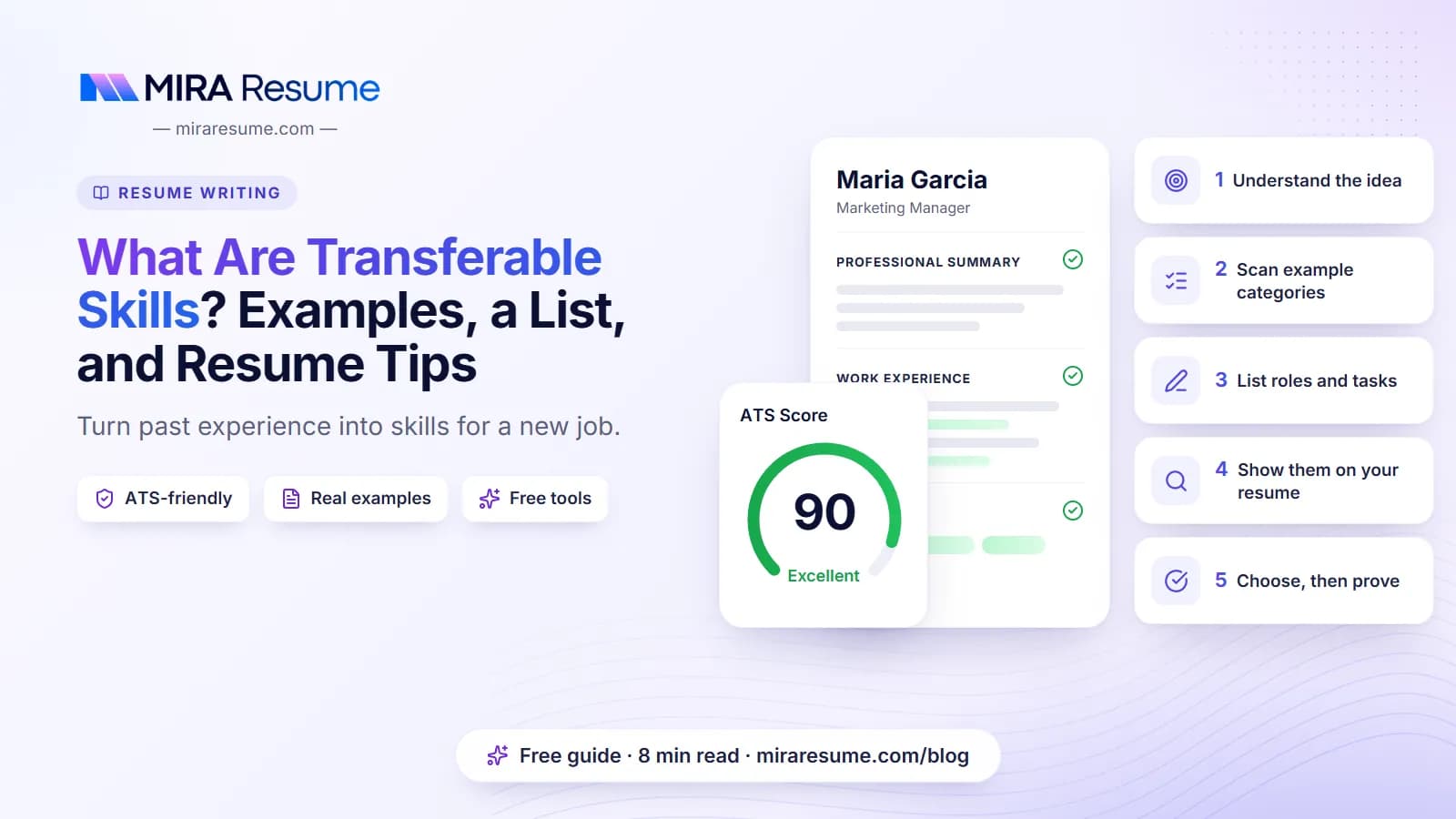

What are transferable skills? They are abilities that are useful in many jobs, not just the one where you learned them. Writing clearly, leading a small team, solving problems, and using a spreadsheet are all examples. If you are changing careers, returning to work, or looking for a first job, these skills are your bridge to a new role.
Some people spell it "transferrable", which is a common variant, and search engines treat both the same. In this guide you will find a clear list of transferable skills examples by category, a table that shows how skills move between jobs, steps to find your own, and ways to place them on your resume without exaggerating.
Transferable skills explained in simple words
A transferable skill is one you can use in more than one place. You build it in one setting and use it in another. A waiter who calms an upset customer has built a skill that also helps in a call center, a clinic front desk, or a sales role.
Transferable skills are different from job-specific skills. Operating a particular machine or writing in a certain coding language is tied to one kind of work. Time management or clear writing is useful nearly everywhere.
Employers often care about them because tools change, but these abilities stay useful. They matter most in three situations:
- You are changing fields and your job titles do not match the new role.
- You have little or no paid experience and need to show what you can do.
- You are coming back after a break and want to show you are ready.
If you want to see how these differ from tool skills, read our guide to hard skills examples, then come back here.
Examples of transferable skills by category
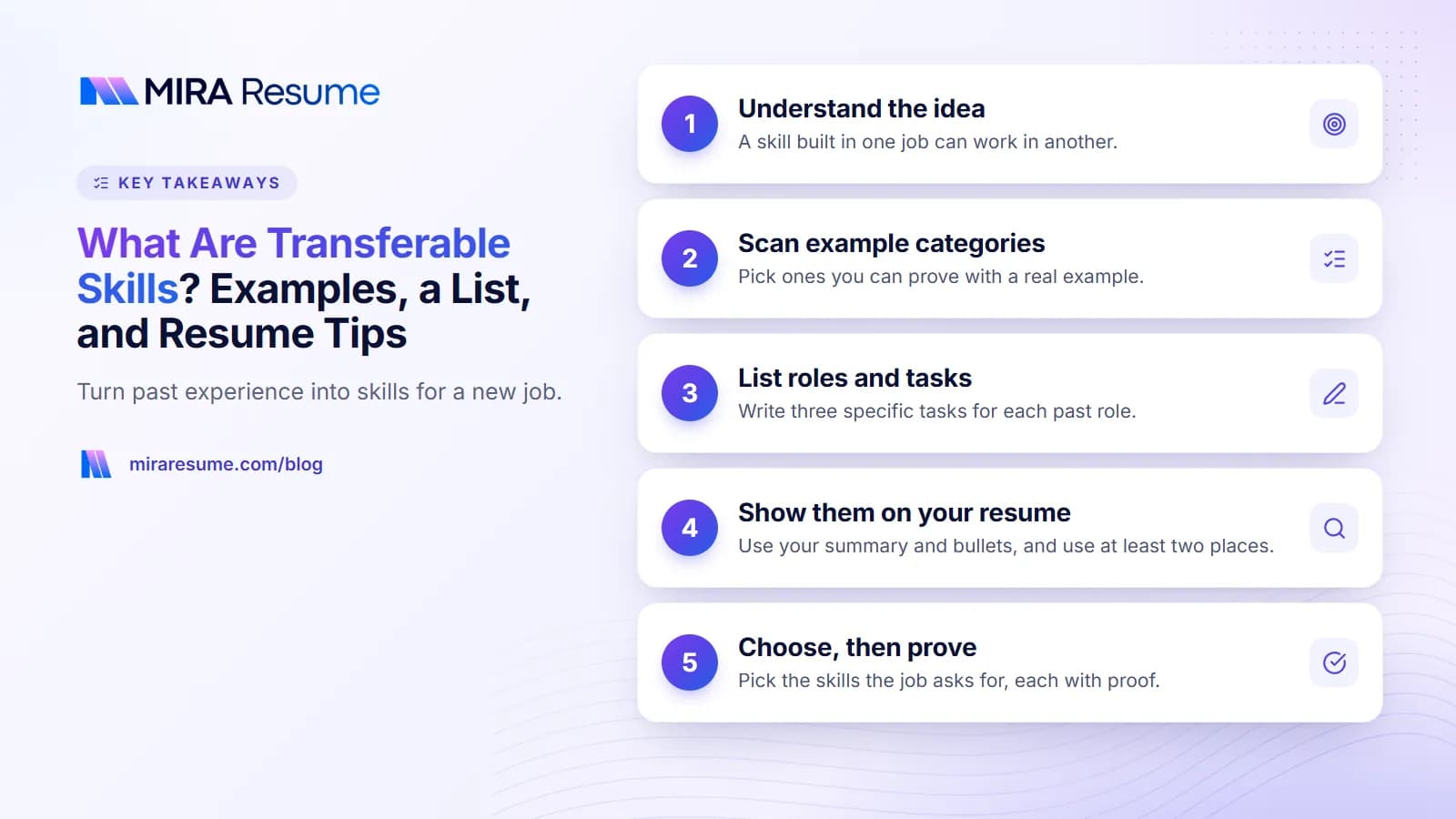
Here is a transferable skills list you can scan. Pick the ones you can prove with a real example from your past.
| Category | Examples | Where you might have used them |
|---|---|---|
| Communication | Active listening, clear writing, public speaking, explaining ideas simply, giving feedback | Customer service, teaching, meetings, group projects |
| Leadership | Coaching, delegating, motivating others, running a shift, mentoring new staff | Team lead roles, sports, volunteering, clubs |
| Problem solving | Finding root causes, weighing options, making decisions, fixing errors, troubleshooting | Support desks, repairs, retail, healthcare |
| Organization | Scheduling, prioritizing, planning, record keeping, meeting deadlines | Office work, events, school, running a home or business |
| Teamwork | Working with different people, sharing credit, handling conflict, supporting colleagues | Restaurants, warehouses, sports, class projects |
| Technology | Spreadsheets, word processing, databases, online research, learning new software fast | Almost any office or school setting |
| Numbers and data | Budgeting, basic math, tracking inventory, reading reports, spotting patterns | Cash handling, stock rooms, bookkeeping |
| Adaptability | Learning quickly, handling change, staying calm under pressure, working different shifts | Startups, hospitals, retail seasons |
| Customer focus | Understanding needs, patience, follow-up, de-escalating, building trust | Retail, hospitality, healthcare, sales |
Not every skill here belongs on your resume. Choose five to eight that match the job you want. The page on good skills to put on a resume and our guide to skills to put on a resume help you pick.
How transferable skills move between jobs
The easiest way to see transfer is to take a past role and ask what skill hides under each task. This table shows real shifts.
| From | Everyday task | Transferable skill | Useful in |
|---|---|---|---|
| Restaurant server | Handling 6 tables at once | Prioritizing and multitasking | Administrative or project support |
| Classroom teacher | Explaining hard ideas to different learners | Training and clear communication | Corporate training, customer success |
| Retail cashier | Counting the till and fixing errors | Accuracy and handling money | Accounts clerk, bank teller |
| Warehouse worker | Picking orders and following safety rules | Following procedures and speed | Logistics, inventory control |
| Nurse | Charting and caring for many patients | Documentation and calm under pressure | Health administration, clinical research |
| Volunteer organizer | Scheduling helpers for an event | Planning and coordination | Event or office coordination |
If you are a teacher thinking about a move, our teacher resume sample shows how classroom work is described. For people with limited paid work, the resume with no experience guide shows how to use school and volunteer tasks.
How to find your own transferable skills
Do this short exercise. It takes about twenty minutes and gives you raw material for your resume.
- List your past roles. Include jobs, volunteering, school projects, and caregiving.
- Write three tasks for each. Keep them specific, like "trained new staff" or "balanced the daily cash drawer".
- Name the skill behind each task. Training new staff is teaching and communication. Balancing a drawer is accuracy.
- Read the new job post. Underline the skills it names more than once.
- Match them. Circle any skill that appears in both lists. Those are your best transferable skills for this application.
- Find proof. For each match, write one example with a number or a result if you have one.
You can also ask friends or former coworkers what you do best. They often spot strengths you take for granted.
Skills versus traits
"Dependable" and "friendly" are traits. They are hard to prove on paper. A skill describes something you can do and show, such as "resolve billing questions by phone". Where possible, describe the skill and let the reader judge the trait.
How to show transferable skills on your resume
You have four main places to put them. Use at least two.
1. In your summary
Name your strongest skills near the top. Example:
Former restaurant supervisor with 6 years of experience leading teams of up to 12. Skilled in scheduling, training, and calm problem solving. Seeking an entry-level coordinator role in event planning.
For more ideas, see our resume summary examples.
2. In a skills section
Group skills in short lines so they are easy to scan.
Skills: Scheduling, team training, customer communication, cash handling, spreadsheets
3. In your experience bullets
This is where proof lives. Describe the task, the skill, and a result.
- Trained 8 new servers on the ordering system, which shortened their first-week mistakes
- Planned weekly schedules for 15 staff and covered last-minute absences
4. In a skills-based layout
If your work history is different from the new field, a layout that groups achievements by skill can help. Learn the approach in our skills-based resume guide.
Use the job post's words
If the post says "client communication" and you did "customer service", use the post's phrase only if it truly describes the work. Our page on resume keywords explains how to do this honestly.
Transferable skills examples for common career changes
These short examples show how a skill from one field can be written for another. Copy the pattern, not the words, and change the facts to match your own history.
| Move | Skills to lead with | Sample bullet |
|---|---|---|
| Retail to office admin | Customer communication, accuracy, organization | Balanced the daily cash drawer and filed end-of-day reports with no missing entries |
| Teaching to training | Presenting, planning, tracking progress | Designed and delivered 20 lessons a month and tracked each learner's progress in a spreadsheet |
| Hospitality to sales | Relationship building, persuasion, working to targets | Suggested menu upgrades to guests and raised the average check on my shifts |
| Warehouse to supervisor | Safety, coaching, scheduling | Coached 5 teammates on safe lifting and set daily pick targets for the group |
| Customer support to IT help desk | Troubleshooting, patience, documentation | Solved login and billing issues by chat and logged each step for the next agent |
Notice that each bullet names an action and the skill underneath it. None of them claims to be an expert in the new field. They show that the person already does part of the new job.
Add proof from outside work
If your paid history is thin, look beyond it. Running a club budget shows money skills. Organizing a charity run shows planning. Helping family members with paperwork shows attention to detail. Put these under a heading like "Volunteer experience" or "Projects" and describe them just as you would a job.
Transferable skills for the AI and software age
Many employers now use software to sort applications, and many workplaces use AI tools for drafts and reports. Two skills help in almost every field.
- Learning new tools fast. Show it by naming the last tool you picked up and how long it took you to use it well.
- Checking your own work. Whether you use a template, a spreadsheet, or an AI draft, being able to review and fix it is a skill by itself.
Be honest about the level you have. A skill listed as "advanced" should hold up under a quick test. For ideas on listing software skills properly, see computer skills on a resume.
Show transferable skills in a cover letter and interview
Your resume lists the skills. A cover letter and an interview let you tell the story behind them. Keep it simple with a three-part answer:
- Situation. Where were you and what was the problem?
- Action. What did you do?
- Result. What changed?
For example: "At my last job, the stock room was messy and orders were late. I made a labelling system and trained two coworkers. Pick times dropped within a few weeks. I would bring the same planning skills to a logistics role."
The same story structure appears in the STAR method for resumes. If you have little paid work, our guide to a cover letter with no experience shows how to lean on these skills in a letter.
Common mistakes when listing transferable skills
- Listing too many. Twenty skills look like a wish list. Pick the ones the job asks for.
- Naming skills without proof. "Strong leader" needs an example, such as "led a team of five".
- Using vague words. "People skills" is weak. "Resolve customer complaints by phone and email" is clear.
- Ignoring the job post. If a skill is not requested, it may not help.
- Overstating. Do not claim a skill you cannot show. You may be asked to demonstrate it.
- Hiding the link. Do not make the reader guess how a past job connects. Say it plainly in your summary, in one clear sentence near the top of the page.
- Forgetting to update. Each time you learn something new, add it to your master list so it is ready for the next application.
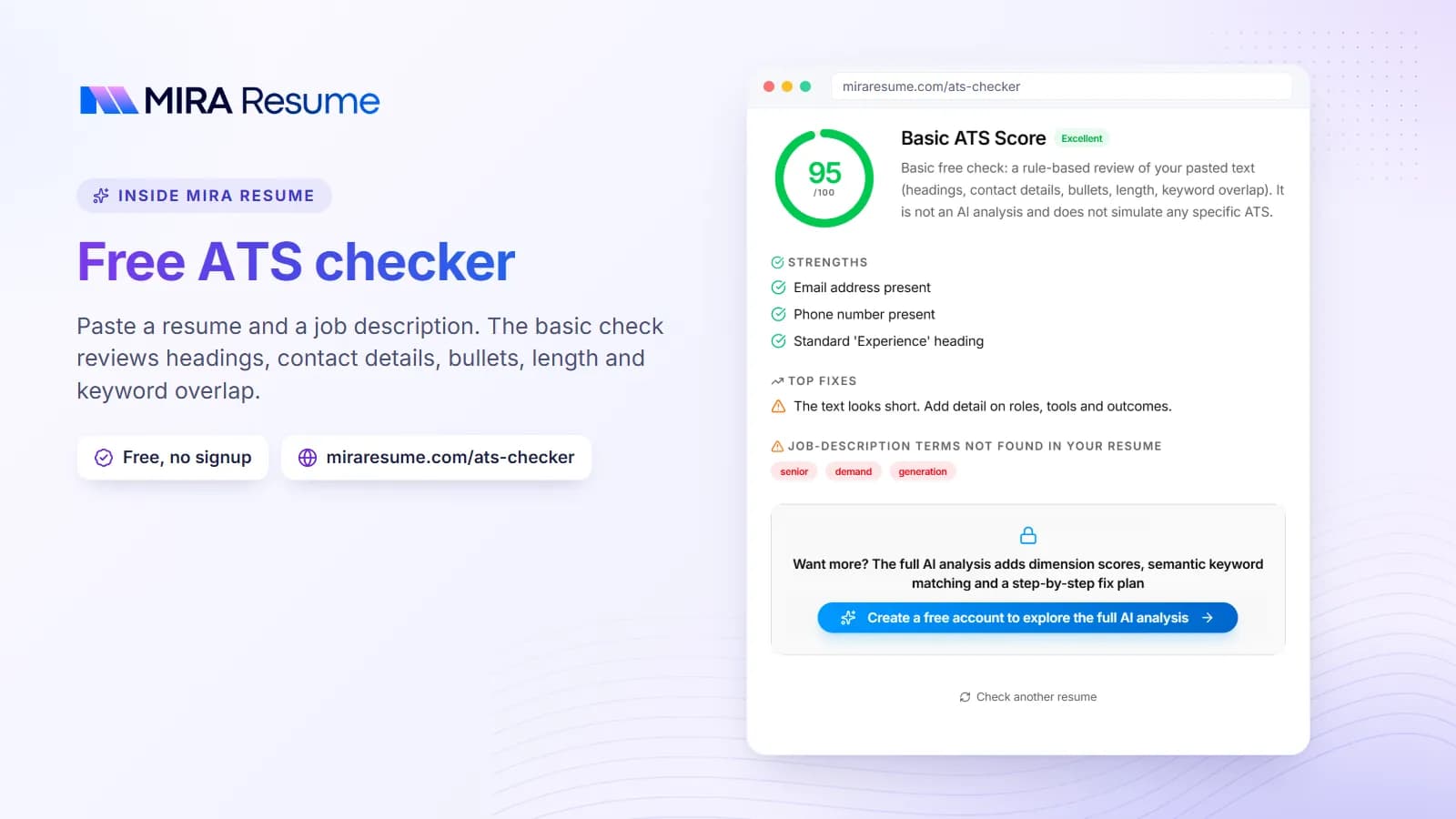
After editing, run your resume through the ATS checker to see how well your skills line up with the words in a real job post.