
An engineering cover letter works best when it reads like a short project report: here was the problem, here is what I did, here is what changed. Hiring managers already know you can do math and use software. They want to know whether you can explain your work clearly, work with a team and solve the kind of problem they have.
This guide gives you a plain structure, samples for a new graduate and an experienced engineer, a table of proof points by engineering field, and a list of mistakes to avoid. All numbers in the samples are made up, so swap in your own true details.
What an engineering letter should do that your resume cannot
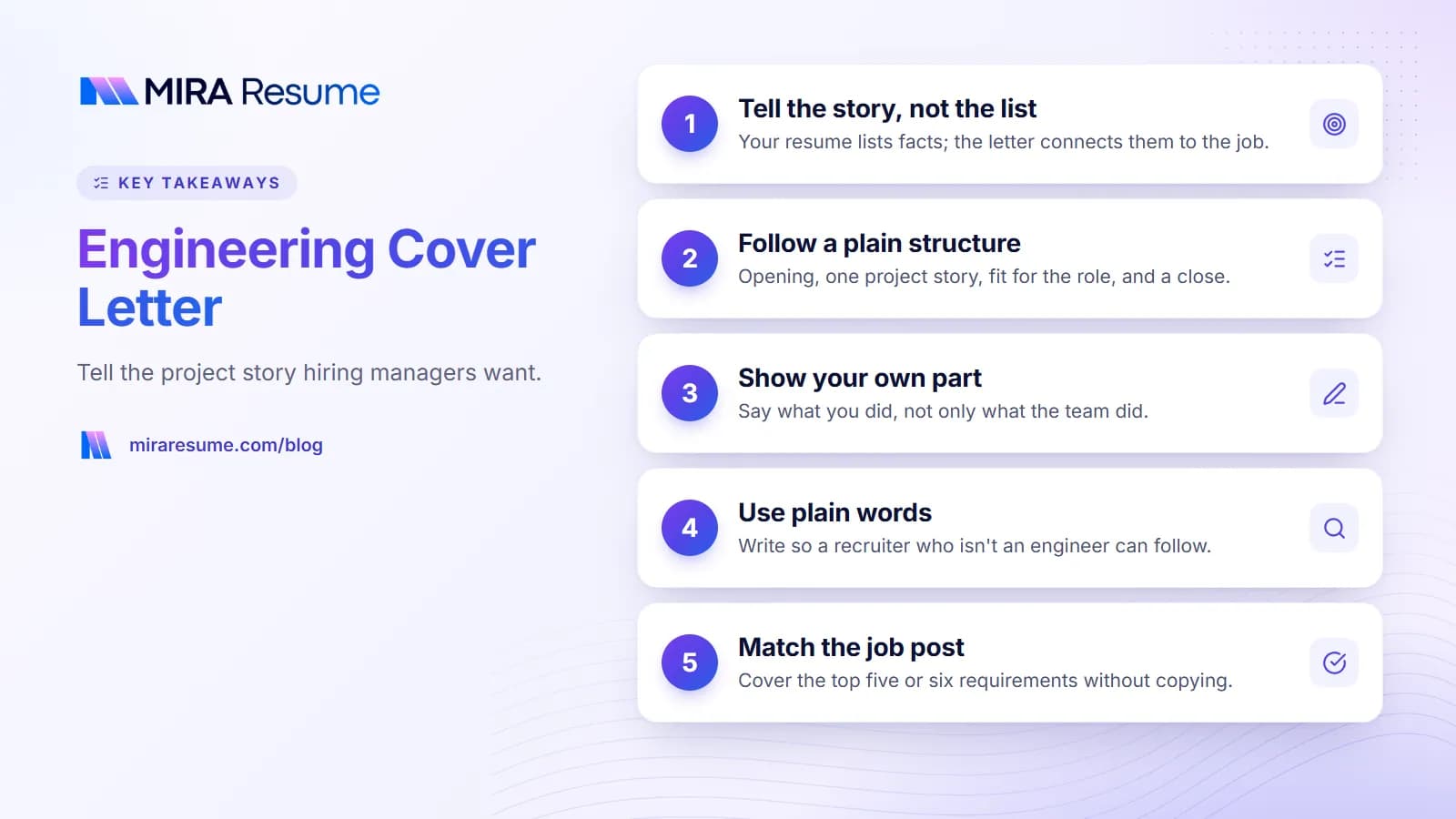
Your resume is a list. Your letter is the story that connects the list to the job. The split looks like this.
| On your resume | In your letter |
|---|---|
| Job titles, dates, degrees | Why this role and this company |
| Bullet points with results | One project told as a short story |
| Software, tools, standards | How you used the right tool to solve a real problem |
| Licenses and certifications | A short mention if the job requires them |
| Skills list | Soft skills shown in action, like teamwork and clear writing |
For a deeper look at how the two documents work together, read cover letter vs resume. If you are not sure what the letter is for in the first place, see what a cover letter is.
A plain structure for an engineering cover letter template
You can use this layout for almost any engineering field. Fill each part with your own true details.
- Opening. Name the role and the company, and give one line on why you fit. For example, "I am applying for the Process Engineer role at Calder Plastics. I have spent two years improving line efficiency at a packaging plant." More ideas are in how to start a cover letter.
- Project story. Use three beats: the problem, your action, the result. Keep the jargon to what the job post uses.
- Second proof or skill match. Add a short example of teamwork, safety, testing, documentation or learning something new.
- Why this company. Mention a product, a project type or a value that is real and specific.
- Close. Thank them and ask to talk. See how to close a cover letter.
A fill-in template
Dear [Hiring Manager name],
I am applying for the [job title] role at [company]. I [one-line summary of your background], and I am interested in this role because [specific reason].
At [employer or school], I worked on [project]. The problem was [problem in one sentence]. I [your action, with tools or methods], which led to [result in plain words or a true number]. I worked with [team or role] and shared the results through [report, review or demo].
I also [second short example that matches the job post]. I am comfortable with [tools named in the post] and I keep learning by [course, project or mentor].
[Company] stood out to me because [real detail]. I would like to help with [specific work].
Thank you for your time. I can be reached at [phone] or [email].
Sincerely,
[Your name]
Entry level engineering cover letter: sample for a new graduate
If you are new to the field, your proof will come from classes, capstone projects, labs, clubs and internships. These count. Describe what you did, not just what your team did.
Dear Ms. Johnson,
I am applying for the Junior Mechanical Engineer position at Delta Fluid Systems. I recently earned my B.S. in mechanical engineering and led the testing portion of my senior design team.
Our capstone project was a low-cost water filter housing for a local community group. Early prototypes leaked at the seals. I redesigned the seal groove in CAD, ran pressure tests on three versions and recorded the results in a simple test log. The final version passed our target test with no leaks, and the team wrote up the steps so another group could rebuild it. I also kept the project schedule, which taught me to share clear updates with a team of five. I use SolidWorks, MATLAB and Excel and I am learning basic GD&T in an online course.
Delta's focus on pumps for small farms interests me because my family runs a small farm, and I have seen how much a good pump matters. I would be glad to learn from your team and contribute where I can.
Thank you for your time. You can reach me at 555-0123 or [email protected].
Sincerely,
Chris Patel
Notice how the project is told in order and in plain words. If you are applying for a student role, the same method works. Our IT internship cover letter sample shows the tone for an internship letter, and the advice in cover letter with no experience helps if your history is thin.
Experienced engineer cover letter: sample
With more years behind you, move from tasks to impact. Show scope (how big the work was), ownership (what you led) and results (what improved). Keep it grounded in facts you can discuss in an interview.
Dear Mr. Alvarez,
I am excited to apply for the Senior Civil Engineer position at Westbrook Infrastructure. I have worked on municipal road and drainage projects for eight years and hold a Professional Engineer license in this state.
In my current role, I lead design for storm drain upgrades. On a recent neighborhood project, the first plan would have closed a main road for several weeks. I worked with the contractor and city staff to phase the work in smaller sections, which kept the road open for most of the job. I also train junior engineers on drawing checks and write short lessons-learned notes after each project so the next team starts with better information. I am skilled in Civil 3D, HEC-RAS and project reporting.
Westbrook's work on flood-resilient neighborhoods matches what I care about most. I would like to bring my field experience and my steady communication style to your design group.
Thank you for your consideration. I would welcome a conversation. My number is 555-0155 and my email is [email protected].
Sincerely,
Dana Whitfield
Only state a license if you hold it, and make sure the details are correct. Do not make claims you cannot document.
Proof points by engineering field
Every branch of engineering has its own typical wins. Use this table to jog your memory. Pick items that are true for you and that match the job post.
| Field | Examples of proof you could mention |
|---|---|
| Mechanical | Redesigned a part, ran stress or pressure tests, cut cost or weight, improved a production step. |
| Civil | Drainage or road design, site plans, permit work, field inspections, working with contractors. |
| Electrical | Circuit design, PCB layout, testing and debugging, control systems, safety checks. |
| Software | Features shipped, bugs fixed, code reviews, tests added, systems made faster or more reliable. |
| Chemical or process | Process improvements, safety reviews, lab-to-plant scale-up, quality checks. |
| Industrial | Time studies, layout changes, workflow maps, waste reduction, scheduling. |
| Manufacturing or quality | Root-cause work, inspection plans, supplier checks, documentation. |
If you apply for software engineering roles, also read the computer science resume guide so your resume and letter tell the same story. Pair both with an ATS-friendly layout. Our how ATS works article explains why plain formatting helps.
How to write about technical work in plain words
Your reader may be an engineer, but the first person to see your letter might be a recruiter who is not. Write so both can follow.
- Explain the point first. Start with what the project did, then add the method.
- Define a term once if it is rare. Skip it if the job post uses it freely.
- Use real numbers only. If you measured a result, share it. If not, say what got better in words.
- Say "I" for your work, "we" for the team. It is honest and clear.
- Name tools sparingly. Mention two or three that match the post. The rest go on your resume.
- Keep sentences short. One idea per sentence is easier to scan.
Before and after
| Hard to read | Clear |
|---|---|
| Utilized a multi-variable optimization methodology to facilitate improvements in throughput. | I tested several settings and found a combination that raised output without adding cost. |
| Responsible for cross-functional stakeholder alignment on deliverables. | I met weekly with design, quality and purchasing to agree on next steps. |
Match the job post without copying it
Many engineering jobs list tools, standards and skills. Applicant tracking systems may search for these terms, and people will scan for them. Read the post and list the top five or six requirements. Then ask: where have I shown this?
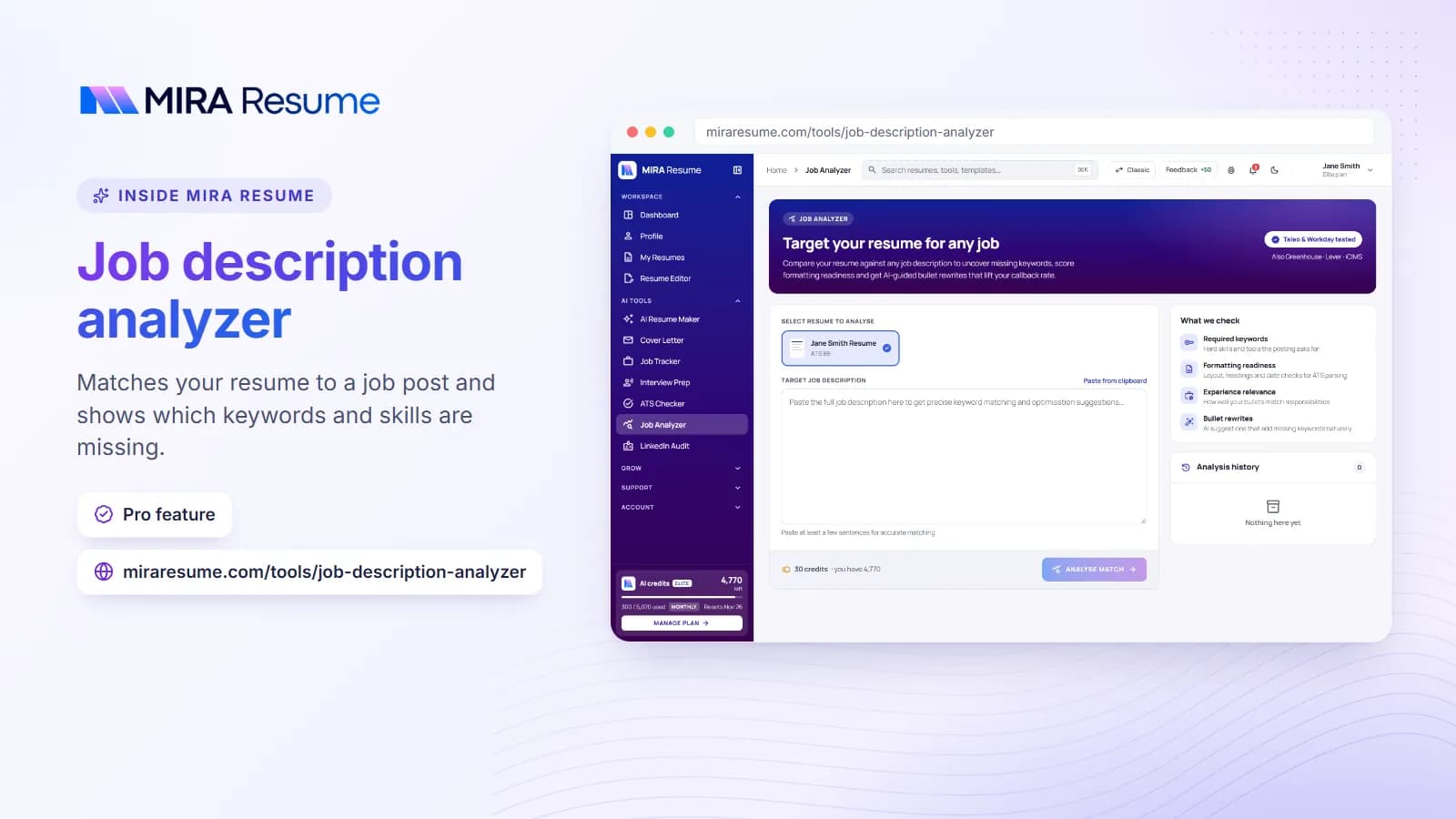
- Copy the post into the job analyzer to see which keywords it repeats.
- Check your resume with the ATS checker to find gaps between the post and your resume.
- Use the post's exact wording in your letter only where it is true. If it says "root cause analysis", use that phrase instead of "finding why things broke".
- Do not claim tools or standards you have not used. Say you are learning them if that is true.
Then use the cover letter tool for a first draft if you like, and edit it so every fact is yours. You can also compare your final text with the cover letter examples to check tone. For the resume side, the resume keywords guide shows how to place terms naturally.
Common mistakes in an engineering cover letter
- Listing tools with no story. A wall of acronyms proves little. Show one tool in use.
- Hiding your own part. If you only say "we", the reader cannot tell what you did.
- Too much jargon. Write for a smart reader who may not know your niche.
- Sharing private company data. Do not reveal secrets or details covered by an NDA. Keep descriptions general.
- Claiming results you cannot support. Be ready to explain every number in an interview.
- Ignoring soft skills. Engineering is teamwork. Mention reviews, handoffs or mentoring.
- One page overload. If it runs past one page, cut the extra tools and keep the best project. Our guide on how long a cover letter should be has tips for trimming.
- Using the same letter everywhere. Change the company paragraph and the project to match each role.
Final checks and next steps
- Is the role and company named correctly?
- Does the first paragraph tell the reader why you fit?
- Is there one project told as problem, action, result?
- Have you matched two or three key requirements from the post?
- Are all numbers and licenses accurate?
- Is it one page, saved as a PDF unless the posting asks for another type?
Your resume should be just as clear. If you need a layout, browse the resume templates or try the resume builder. When you land interviews, practice with the interview prep tool, and send a note afterward using our thank you letter after interview guide.