
How should you start a cover letter? Begin with a greeting that names the reader, such as "Dear Ms. Rivera,". Then write one or two sentences that say which job you want and why you are a strong match. Skip long introductions and get to the point.
The start is the part most people worry about, and with good reason. A busy reader decides within a few seconds whether to keep reading. An opening that sounds like every other letter ("I am writing to apply for...") is easy to forget. An opening that shows a real reason is easy to remember.
Below you will learn how to pick the right greeting, what to do when you do not know a name, five opening styles with examples, and what to avoid.
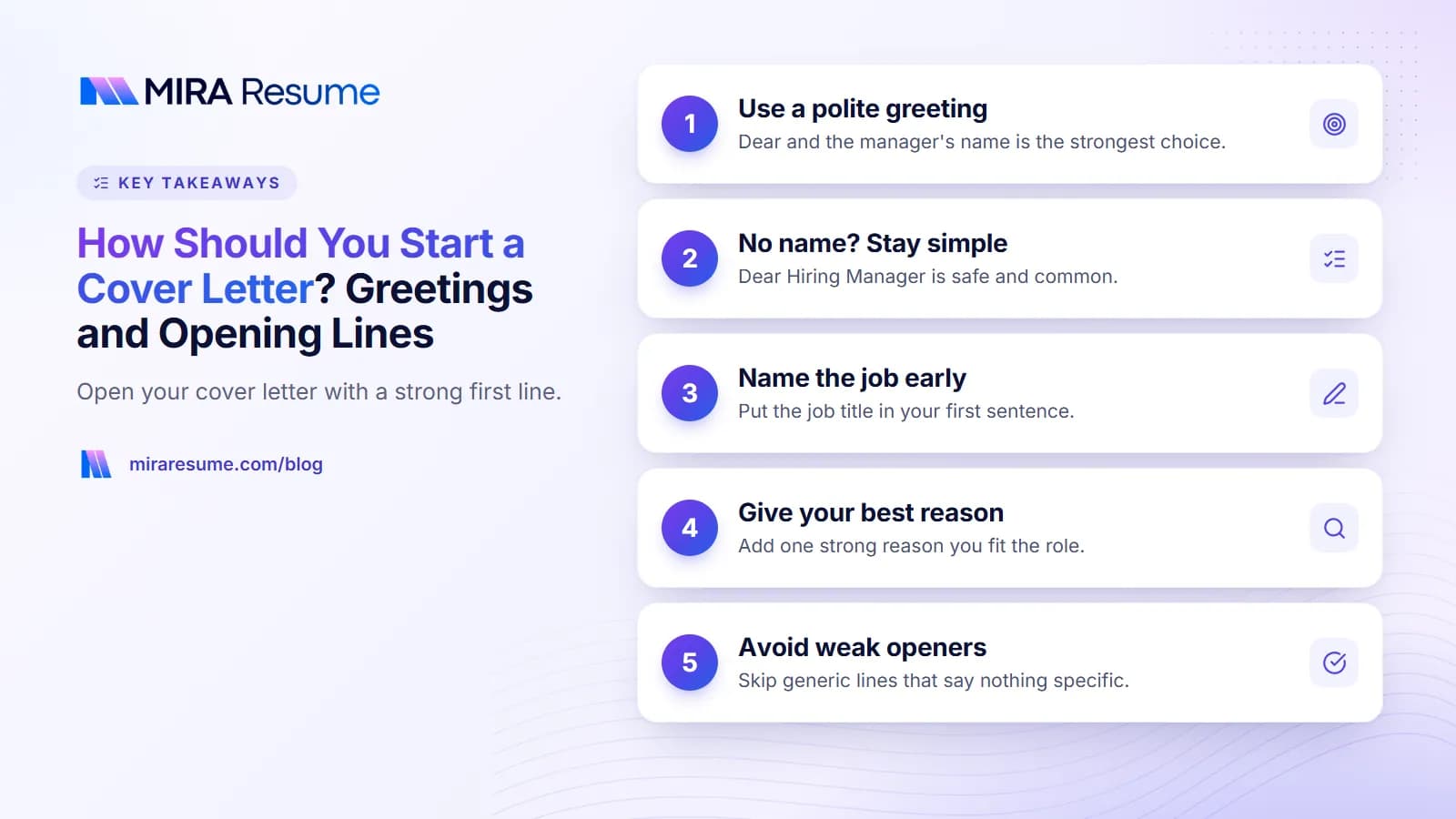
Step 1: How should you start a cover letter greeting?
The greeting comes right after your contact details and the date. It should be polite, correct and easy.
Best options, in order
- Dear [Title] [Last Name], for example, "Dear Ms. Alvarez," or "Dear Dr. Chen,". This is the strongest choice.
- Dear [Full Name], when you cannot tell the title or gender. For example, "Dear Jordan Lee,". Many people prefer this today.
- Dear [Team Name] Hiring Team, for example, "Dear Brightfield Hiring Team,". Good when you have no individual name.
How to find the hiring manager's name
- Read the job post carefully. Names often appear near the bottom or in the contact line.
- Check the company website's team or About page.
- Look at the company's professional-network page for the head of the team you would join.
- Call or email the front desk and politely ask who is hiring for the role.
Spend ten minutes on this, not an hour. If you cannot find a name, use the options in the next section. Spell the name correctly. A wrong name is worse than no name.
How to start a cover letter without a name
Many job posts do not list a contact person. You can still sound polite and professional. Here are the choices, from best to weakest.
| Greeting | Verdict | When to use it |
|---|---|---|
| Dear Hiring Manager, | Safe and common | The default when no name is available. |
| Dear [Company] Hiring Team, | Good, a little warmer | When you know the company but not the person. |
| Dear [Department] Team, | Good | For example, "Dear Marketing Team,". |
| Dear Recruiting Team, | Fine | When a recruiter or agency handles the role. |
| To whom it may concern, | Dated | Avoid unless the instructions require it. |
| Dear Sir or Madam, | Old-fashioned | Avoid. It assumes gender and sounds stiff. |
| Hi everyone, | Too casual | Skip for a first contact. |
If you are wondering how to address a cover letter without a name, the sentence after the greeting matters more than the greeting itself. A strong first line can make up for a plain "Dear Hiring Manager,".
Another option is to leave out the greeting block entirely and begin with a bold subject line, such as "Application for Customer Support Specialist". This works well in emails.
Step 2: Write an opening that names the job and your best reason
Your first paragraph has two jobs. First, say which role you want. Second, give a reason the reader should keep going. Keep it to two or three sentences, and avoid starting every sentence with "I".
A simple three-part formula
- The job: "I am applying for the [Job Title] role at [Company]."
- Your strongest match: "I have [number] years of [skill], including [short proof]."
- The link to them: "Your post's focus on [need] is what I enjoy most."
Example
I am applying for the Junior Accountant role at Harbor Street Financial. For two years I have handled invoices and monthly reports for a small company, and your post's focus on clear, accurate reporting is the part of the job I enjoy most.
That opening names the job, shows experience, and links to the employer's need in 45 words. For the full length picture, read how long a cover letter should be.
15 ways to begin a cover letter (with examples)
Choose the style that fits the job and your personality. Always replace the details with your own, true facts.
1. The direct opening
- I am applying for the [Job Title] role at [Company], and I believe my [number] years in [field] make me a strong fit.
- Please accept my application for the [Job Title] position. My background in [skill] matches the needs in your post.
- I would like to be considered for the [Job Title] role at [Company].
2. The achievement opening
- Last year I helped my team cut customer wait times from [X] to [Y], and I would like to do the same at [Company].
- Over three years I grew our store's weekend sales by changing how we arranged displays, and that practical approach is what I would bring to your team.
- I trained 12 new staff in my last role and enjoy turning new hires into confident team members.
3. The company-first opening
- When I read that [Company] is [specific project or value], I knew I wanted to work on the [team] team.
- I have used [product] for years, and I would like to help make it better for other users.
- [Company]'s plan to [specific goal] caught my attention because I have worked on similar goals at [Employer].
4. The referral opening
- [Name], your [role] at [Company], suggested I apply for the [Job Title] position and said the team values [quality].
- I heard about this opening through [event or person] and wanted to introduce myself.
5. The career-change opening
- After six years in teaching, I am moving into training and development, where my skill in explaining ideas simply will carry over.
- My work in retail taught me how to listen to customers and solve problems quickly, and I am ready to use those skills in customer support.
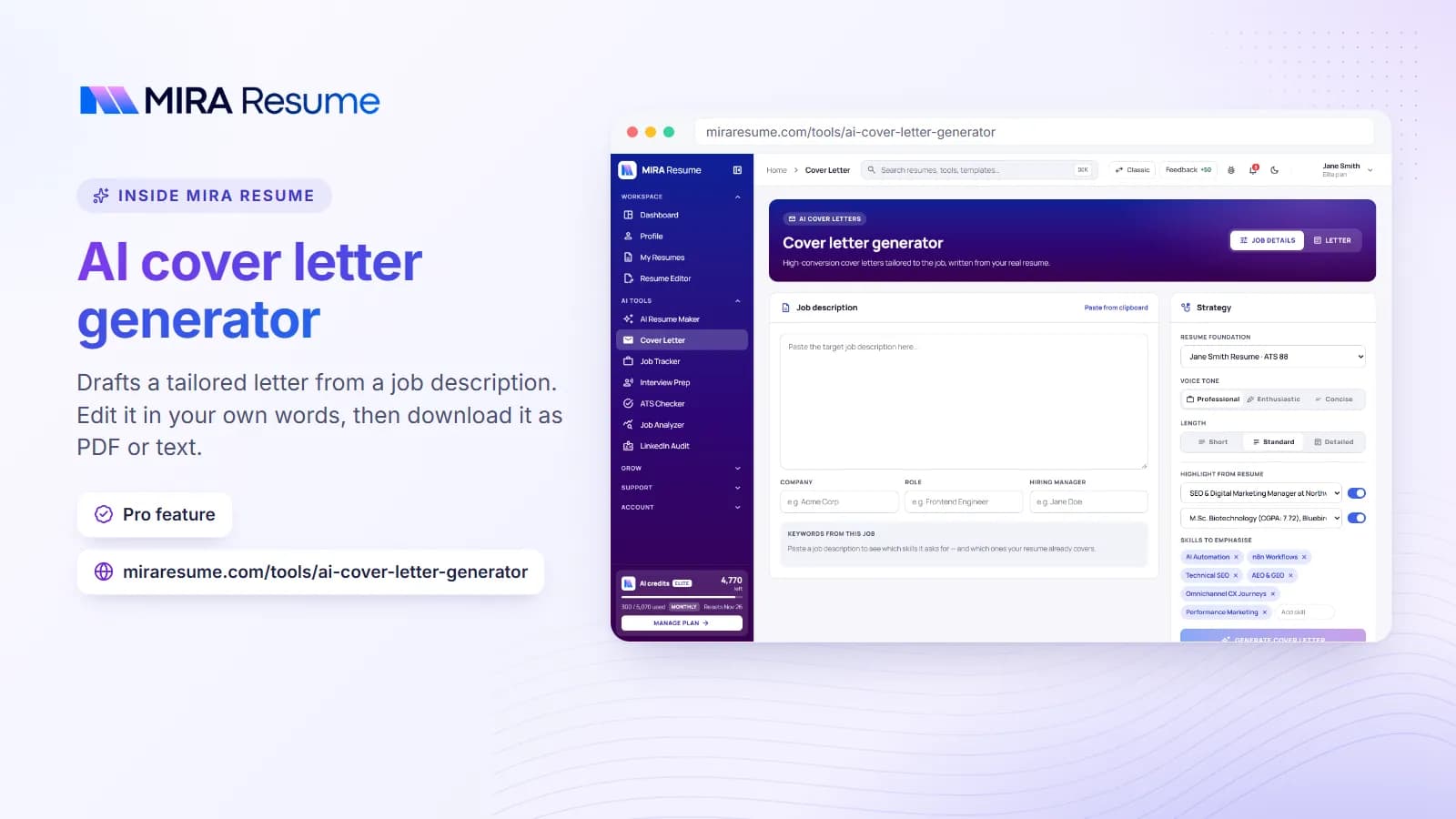
Need a full letter, not just a start? See our cover letter examples or try the cover letter builder for a draft.
Opening lines to avoid
Some openers waste the most valuable space in your letter. Here is what to change.
| Avoid | Why | Better |
|---|---|---|
| I am writing to express my interest in the position advertised. | Says nothing specific. | I am applying for the Office Manager role at Pine Dental. |
| My name is Alex and I am a hard worker. | Self-praise with no proof. | For three years I ran the front desk of a busy clinic. |
| I know you receive many applications, so I'll keep this short. | Draws attention to being one of many. | Open with your best match. |
| I am the perfect candidate. | The reader decides that, not you. | Show a result that supports your fit. |
| Since I was a child, I have dreamed of... | Too personal, too long. | Link one real interest to the job. |
| Please excuse my lack of experience. | Starts with an apology. | Lead with strengths, such as skills from school or volunteering. |
Tone should be confident and warm. You are not begging; you are offering to help.
How to tune your opening for different situations
If you have little experience
Open with what you do have: a class project, volunteer work, or a skill you built. For example, "As treasurer of my college robotics club, I managed a budget of $2,000 and learned to plan carefully." Keep the numbers true. Our IT internship cover letter sample shows this approach in a full letter.
If you are changing careers
Name the bridge between your old and new fields in the first two sentences. Readers may wonder why you are applying, so answer the question early.
If you are applying by email
Write a clear subject line (for example, "Application: Data Entry Clerk, Jane Doe") and make the first line of the email carry your best point. Keep the whole email short.
If the post lists a name to address
Use it exactly. Do not guess at Mr. or Ms. if you are unsure; the full name works well.
When your opening is ready, finish just as well. See how to close a cover letter, and put your pieces together with the Google Docs cover letter template.
A complete opening paragraph, built step by step
It can help to watch an opening grow from a weak draft into a strong one. Here is the journey for a made-up applicant, Priya, who is applying for a Warehouse Team Lead job.
Draft 1: too general
I am writing to apply for the job that was posted on your website. I am a hard worker and would be a good fit for your company.
This could be sent to any company. It does not name the job, and "hard worker" is not proof.
Draft 2: names the job and adds proof
I am applying for the Warehouse Team Lead role at Eastgate Supply. I have spent four years in a busy warehouse, the last year as a shift lead for a team of eight.
Better. The reader now knows the job, the years and the level of responsibility.
Draft 3: links to the employer's need
I am applying for the Warehouse Team Lead role at Eastgate Supply. I have spent four years in a busy warehouse, the last year as a shift lead for a team of eight, and your post's focus on safe, on-time shipping is exactly how I run my shifts.
That final clause turns a list of facts into a reason. It is still only two sentences. If you stop here and move to your proof paragraph, you have a solid start.
| Step | Question to ask |
|---|---|
| 1 | Does the first sentence name the exact job and company? |
| 2 | Does the second sentence give one real fact about you? |
| 3 | Does it connect to something the post actually says? |
| 4 | Could this sentence be sent to a different company without changes? If so, rewrite it. |
Common mistakes when you begin a cover letter
- Misspelling the name or company. Check both twice.
- Using the wrong company name. This happens when you reuse an old letter. Search before sending.
- Burying the job title. Put it in the first sentence.
- Starting with a quote. Unless it is short and directly relevant, it uses space without helping.
- Writing a long first paragraph. Three sentences is plenty.
- Using the same opening for every job. Change at least one detail so it fits the post.
Check your opening against the post using the job analyzer, and make sure the same skills show up on your resume. If you are unsure, an ATS check can point out what is missing.