
What is a cover letter for a job application? It is a one-page letter that goes with your resume. In it you say which job you are applying for, show a few reasons you would do it well, and ask for the next step. Think of it as a friendly introduction that your resume cannot give on its own.
A resume lists facts. A cover letter explains them in your own words. It lets an employer hear your voice, see that you read the job post, and understand why you picked this company.
In this guide you will learn the purpose of a cover letter, what goes inside, when you need one and when you can skip it, and how to write a simple version step by step.
What is the purpose of a cover letter?
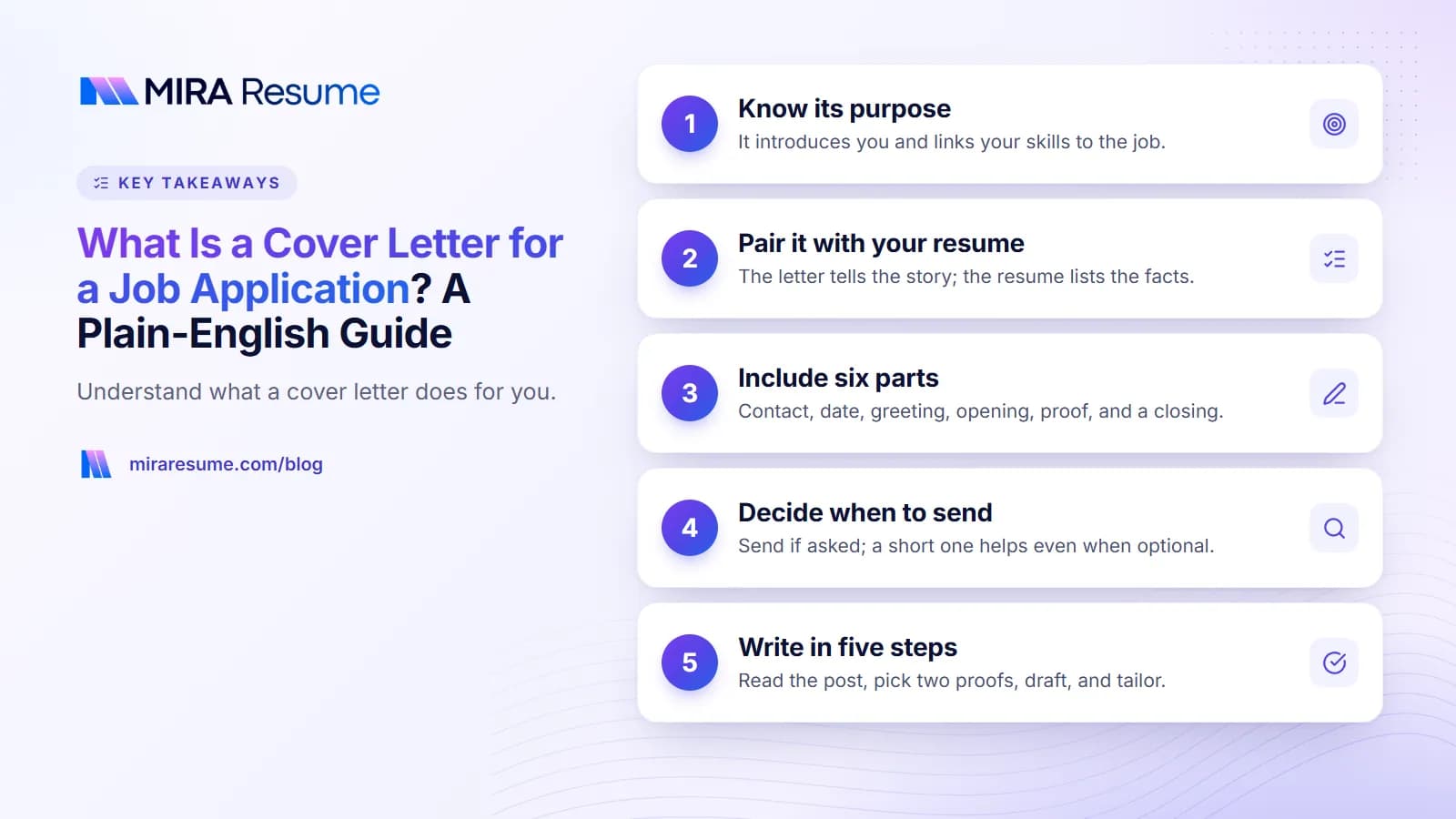
A cover letter has one main purpose: to help the reader say yes to your resume. It does this in four ways.
- It introduces you. The reader sees who you are before reading a list of jobs.
- It connects your skills to the job. You pick the two or three things that matter most for this role.
- It explains anything unusual. A gap in work, a career change or a move to a new city can be explained in one calm sentence.
- It shows how you communicate. Many jobs involve writing emails and talking to people. A clear letter is a small sample of that.
Not every employer reads cover letters, and hiring managers differ. Some read every one. Others only open it if the resume looks promising. That is why a short, specific letter is best: it costs the reader little time and can tip a close decision.
What is a cover letter for a resume? How the two work together
People often ask what is a cover letter for a resume, as if the two were the same thing. They are partners with different roles.
| Resume | Cover letter | |
|---|---|---|
| Format | Lists and short bullet points | Short paragraphs, like a letter |
| Length | One to two pages | About one page or less |
| Main job | Show your history and skills | Show why you fit this job |
| Voice | Brief and factual | Personal and friendly |
| Changes per job | A few tweaks | Rewritten for each employer |
For a deeper side-by-side, read cover letter vs resume. If your resume still needs work, you can start with our AI resume builder.
What should I include in a cover letter?
A standard cover letter has six parts. You can see them in order below.
- Your contact details. Name, city, phone and email.
- The date and the employer's details. Name, title and company, if you know them.
- A greeting. "Dear Ms. Lee," is best. When you have no name, see how to start a cover letter.
- An opening paragraph. The job you want and your strongest reason in one or two sentences.
- One or two body paragraphs. Proof from your past work, school or projects, tied to the job post.
- A closing and signature. Thanks, a next step and your name. For examples, see how to close a cover letter.
What to leave out
- Salary demands, unless the post asks for them.
- Negative comments about past bosses.
- Personal details that are not job-related, such as your age or family status.
- Long lists of every duty you ever had.
A simple cover letter example
Here is a short sample for someone applying to a store job. It is only an example. Change the facts so they match your own life.
Dear Mr. Okafor,
I am writing to apply for the Sales Associate position at Greenleaf Garden Centre. I have worked weekends at a plant nursery for two years, and I enjoy helping people choose the right plants.
At the nursery I greet customers, answer questions about care, and keep the shelves neat and full. Last spring I suggested grouping herbs by sunlight needs, and our manager adopted the idea. Your post asks for someone friendly who knows about plants and can lift stock. I do all three.
I have shopped at Greenleaf since I was a child, and I admire how your staff teach customers instead of just selling to them. I would be glad to work in that way.
Thank you for your time. I would welcome a chance to talk in person. You can reach me at 555-0142.
Sincerely,
Maya Singh
That letter is about 150 words, which is fine for a store job. More samples for different jobs are on our cover letter examples page, and ready layouts live in the cover letter templates.
Do you need a cover letter? When to send one and when to skip it
If the job post asks for a cover letter, send one. If it says optional, it is still smart to send a short one, because many applicants skip it and a good letter helps you stand out. Skip it only when the application clearly has no place for one and no instructions mention it.
| Situation | Send a cover letter? |
|---|---|
| Post says "cover letter required" | Yes. Missing it can remove you from the list. |
| Post says "optional" | Yes, keep it short and specific. |
| Post gives no instructions | Usually yes, if you can attach a file or write an email. |
| Quick-apply form with no upload option | Not needed. Put your best point in any text box offered. |
| Career change or work gap | Yes. It is the best place to explain it. |
| Networking or referral | Yes, mention the person who referred you. |
| Internship or first job | Yes. It shows effort when you have little experience. |
Check the employer's own instructions. If they ask for a specific file type, subject line or word limit, follow them exactly.
How to write a cover letter in five simple steps
- Read the job post. Mark the three duties or skills that appear most. A tool like our job analyzer can help you spot them.
- Pick two proof points. Think of real tasks, results or projects from work, school or volunteering that match those duties.
- Write the opening. Name the job, then give your best reason you fit, in about two sentences.
- Write the body. One short paragraph for your proof, one short paragraph about why this company.
- Close and check. Add a clear thank you and next step. Read it aloud and fix anything that sounds stiff.
How long it should be
Aim for about 250 to 400 words, which fits on one page. Our guide to how long a cover letter should be explains this in more detail.
Write it yourself or use a tool?
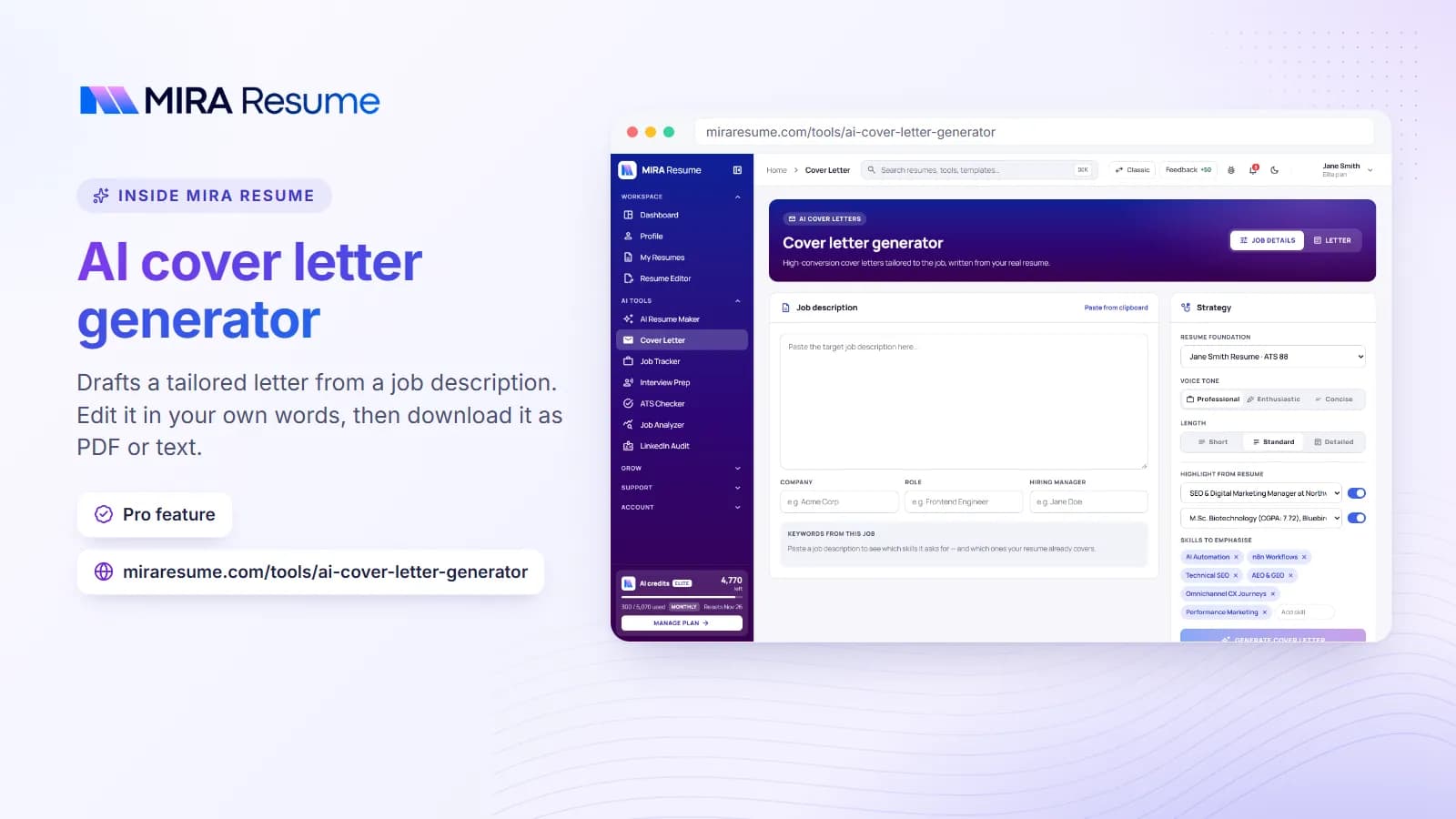
Either is fine. A tool can give you a first draft quickly, as our cover letter builder does, but you should always edit the draft so it is true and sounds like you. The final letter is your promise to the employer.
Types of cover letters you might see
Not every cover letter is the same. The name changes with the reason you are writing. Knowing the types helps you pick the right one.
Application letter
This is the most common type. You write it for a job that is advertised. It answers the question, "Why are you a good match for this opening?" Most of this guide is about this type.
Prospecting letter
Sometimes called a letter of interest. You write to a company that has not posted a job, asking whether any roles might open. Keep it shorter and be clear about the kind of work you want. Mention one thing you admire about the company, and attach your resume.
Networking letter
You write to someone you know, or someone a friend suggested, to ask for advice or an introduction. You are not asking for a job directly. You are asking for a short chat or a tip.
Email cover letter
The body of your email works as the letter. It is shorter than a printed one, usually 120 to 200 words, and your resume is attached. Put the job title in the subject line.
| Type | When to use it | Typical length |
|---|---|---|
| Application letter | There is an open job | 250 to 400 words |
| Prospecting letter | No open job, but you want in | 150 to 300 words |
| Networking letter | You want advice or a contact | 100 to 200 words |
| Email cover letter | You apply by email | 120 to 200 words |
Does an ATS read cover letters?
An applicant tracking system (ATS) is software many employers use to collect and sort applications. Some systems store the cover letter next to your resume, and a person may open it later. Others do not use it for sorting at all. Because setups differ, you cannot be sure how yours will be handled.
What you can do is keep the file simple so any system can read it.
- Use plain text with standard fonts, not images of text.
- Avoid tables, columns and text boxes for the letter itself.
- Use words from the job post where they are honestly true, such as the job title and key skills.
- Save as a PDF or Word file, whichever the employer asks for.
You do not need to cram keywords. A natural letter that names the job and the main skills is enough. To see how software reads your resume, try the ATS checker, and to see how plans differ, visit pricing.
Common mistakes people make with cover letters
- Using one letter for every job. The reader can tell. Change the company, the title and at least one paragraph.
- Repeating the resume. Add a story or a reason instead.
- Starting with "To whom it may concern" when a name is easy to find. Check the job post or the company website.
- Being too modest or too boastful. State facts and let them speak.
- Writing too much. More than one page is rarely read.
- Typos. Wrong names are the worst. Read the company name in every paragraph.
- Forgetting the next step. Always end with a thank you and a way to reach you.
After you send your application, keep going. If you land an interview, a follow-up note helps; our thank you letter after an interview guide shows how.