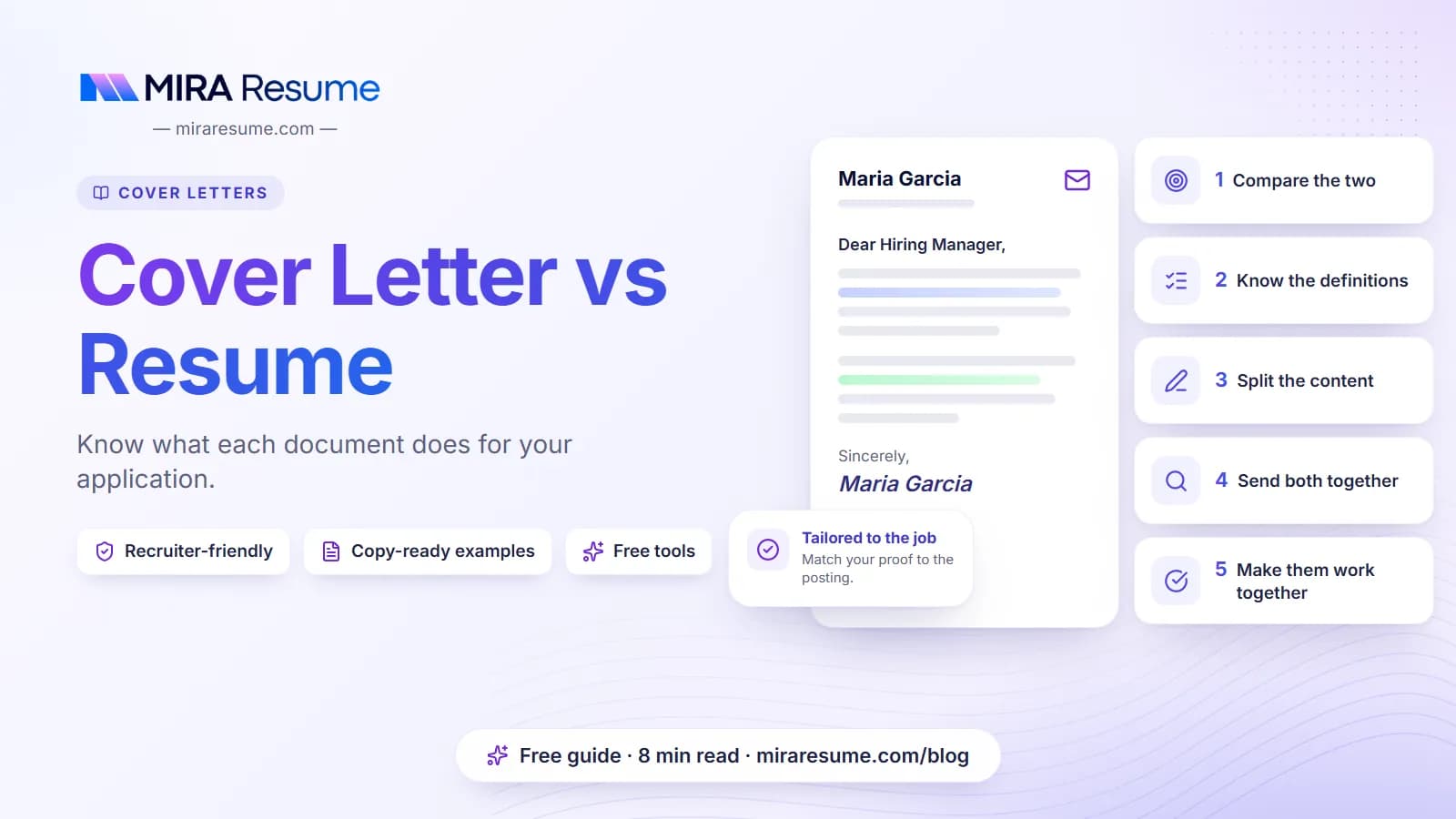

In the cover letter vs resume question, the short answer is this: a resume shows what you have done, and a cover letter explains why it matters for this job. The resume is a list. The letter is a conversation. You usually send both, in the same email or upload.
People mix them up because they travel together and both help you get an interview. But they have different jobs, different shapes and different lengths. If you write them the same way, one of them is wasted.
This guide gives you a clear side-by-side comparison, plain examples, and a simple way to decide what goes where. By the end you will know what to put in each document and how to stop repeating yourself.
Cover letter vs resume: the quick comparison
Here is the difference between a cover letter and a resume at a glance.
| Feature | Resume | Cover letter |
|---|---|---|
| Main purpose | Prove you have the skills and history for the job | Explain why you want this job and how you fit |
| Format | Headings, bullets, short lines | Letter with a greeting and short paragraphs |
| Length | 1 page for many people; 2 for long careers | About 1 page or less (250 to 400 words) |
| Tone | Formal and brief | Professional but personal |
| Content | Jobs, dates, skills, education | Stories, motives, a link to this employer |
| How often you change it | Small edits for each job | Rewritten in part for every job |
| How a reader uses it | Scans in seconds | Reads in about a minute |
| Can you skip it? | Almost never | Sometimes, if the post says optional |
If you want the plain definition of the letter first, read what is a cover letter.
What is a resume and a cover letter? A plain definition of each
The resume
A resume is a one- or two-page summary of your work history, skills, education and any extras such as certificates. It is built for fast scanning. A reader should find your last job, your main skills and your dates in a few seconds.
Resumes follow a pattern: contact details, a short summary, experience, skills, education. Each job gets bullet points that start with action words. If you need help with wording, see our guide on action verbs for resume bullets.
The cover letter
A cover letter is a short letter that goes with the resume. It starts with a greeting, tells the reader what job you want, shares one or two stories that show you can do it, and ends with thanks. It reads like a polite note from a real person.
Where the resume says "Managed a team of five," the letter can say, "I led a team of five through our busiest season, and I learned how to keep everyone calm and on schedule." The letter adds the why and the how.
What goes in each document (and what does not)
The easiest way to avoid repeating yourself is to decide where each fact lives. Use this guide.
| Item | Resume | Cover letter |
|---|---|---|
| Job titles and dates | Yes, in full | Only when needed in a sentence |
| Full list of skills | Yes, in a skills section (see skills to put on a resume) | Pick two or three that match the post |
| Education | Yes | Only if it is a key selling point |
| Achievements with numbers | Short bullet | Tell the story behind one of them |
| Why this company | No | Yes, in one paragraph |
| Explaining a gap or career change | Rarely | Yes, calmly and briefly |
| Contact details | Yes | Yes, in the header or closing |
| Salary expectations | No | Only if the post asks |
A simple rule: facts go in the resume, meaning goes in the letter
If a sentence is a fact you could put in a bullet, it probably belongs in the resume. If a sentence explains your reason, your approach or your link to the employer, it belongs in the letter.
An example: the same job told two ways
Let's use one real-style achievement and see how it changes in each document. This is an invented example for illustration.
In the resume
- Trained 6 new cashiers and reduced till errors by changing the end-of-day check process.
In the cover letter
At my current store I noticed that most till errors happened at closing time, when everyone was tired. I wrote a one-page checklist and trained six new cashiers to use it. Mistakes dropped, and the manager asked me to teach the same steps at our second shop. I would like to bring that same habit of spotting small problems to your team.
The resume bullet is short and easy to scan. The letter shows how you think and links it to the new job. Notice that the letter does not repeat every detail; it picks one story and gives it a little life.
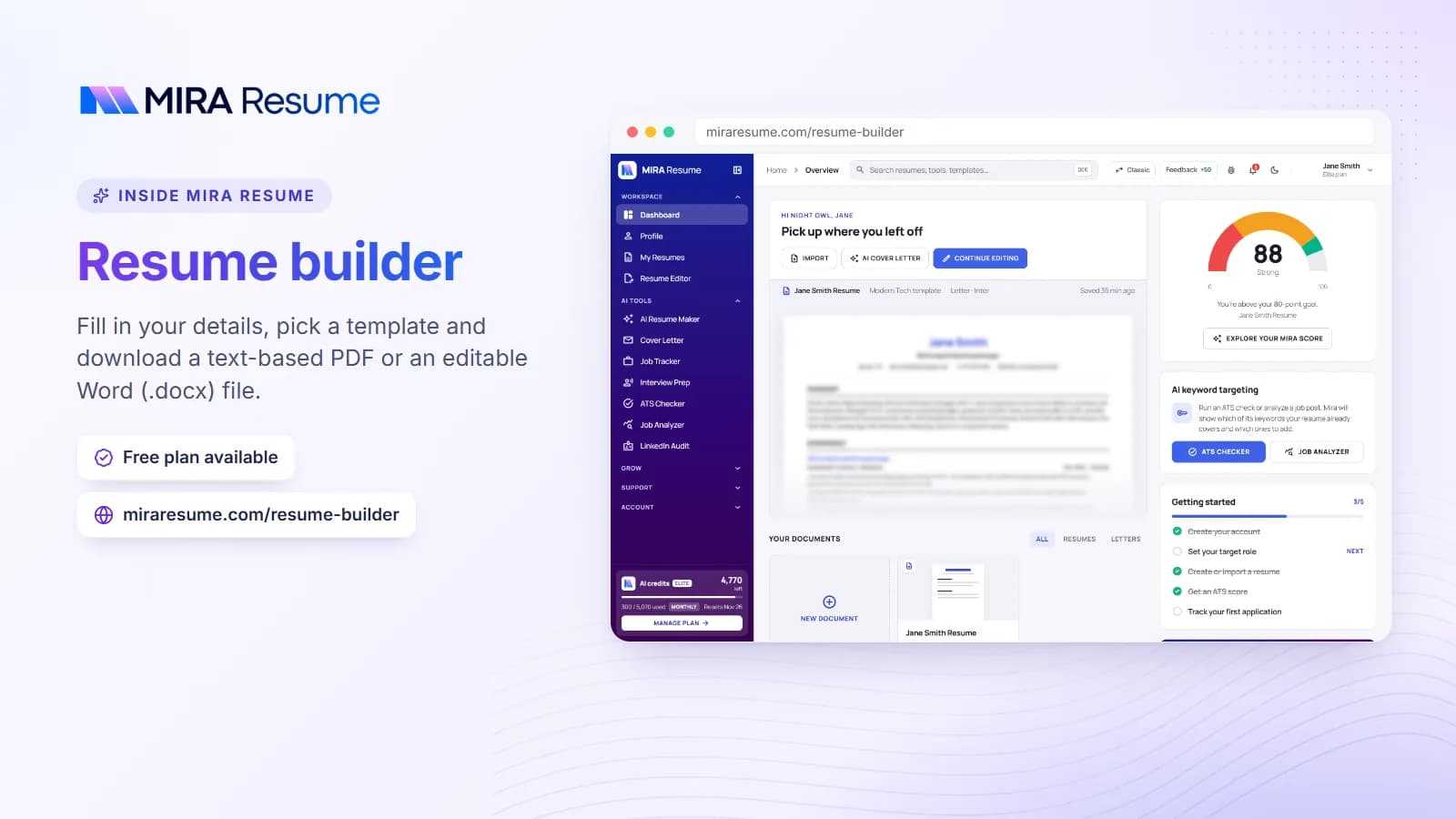
Not sure what to write in the bullet itself? Try our AI resume builder for ideas, then keep the stories in your letter. You can write the letter yourself with the help of our Google Docs template.
CV vs cover letter: what about a CV?
A CV, short for curriculum vitae, is a longer document. In the United States, the word usually means an academic or research record that lists publications, grants and teaching. In many other countries, such as the UK, India and parts of Europe, "CV" simply means what Americans call a resume.
So when people ask about CV vs cover letter, the answer is the same: the CV (or resume) lists your history, and the cover letter explains why you are right for the job. The differences between a CV and a resume are covered in CV vs resume.
| Document | Typical length | Purpose |
|---|---|---|
| Resume (US and Canada) | 1 to 2 pages | Targeted summary of work and skills |
| CV (academic) | 2 pages to many pages | Full record of research, teaching and papers |
| CV (UK, India and others) | 1 to 2 pages | Same use as a resume |
| Cover letter | 1 page or less | Personal case for one job |
Whatever the name, always check the employer's instructions. They may ask for specific documents or file types.
Do you need a cover letter and a resume?
Plan to send both unless the employer says otherwise. Here is how to decide in common cases.
- The post asks for both. Send both. Skipping one may remove you from the pile.
- The post says the letter is optional. A short letter is still a smart choice because it can set you apart.
- The system only lets you upload one file. Upload your resume. If there is a text box, add a few lines that act as a mini letter.
- You are changing careers. Send a letter. It is the best place to link your past skills to a new field.
- You are applying with a referral. A letter lets you mention the person who suggested you.
Hiring managers differ in how they read, and some never open the letter. Even so, a good one costs you an hour and could help in a close race. If you are short on time, a draft from the cover letter tool can get you started.
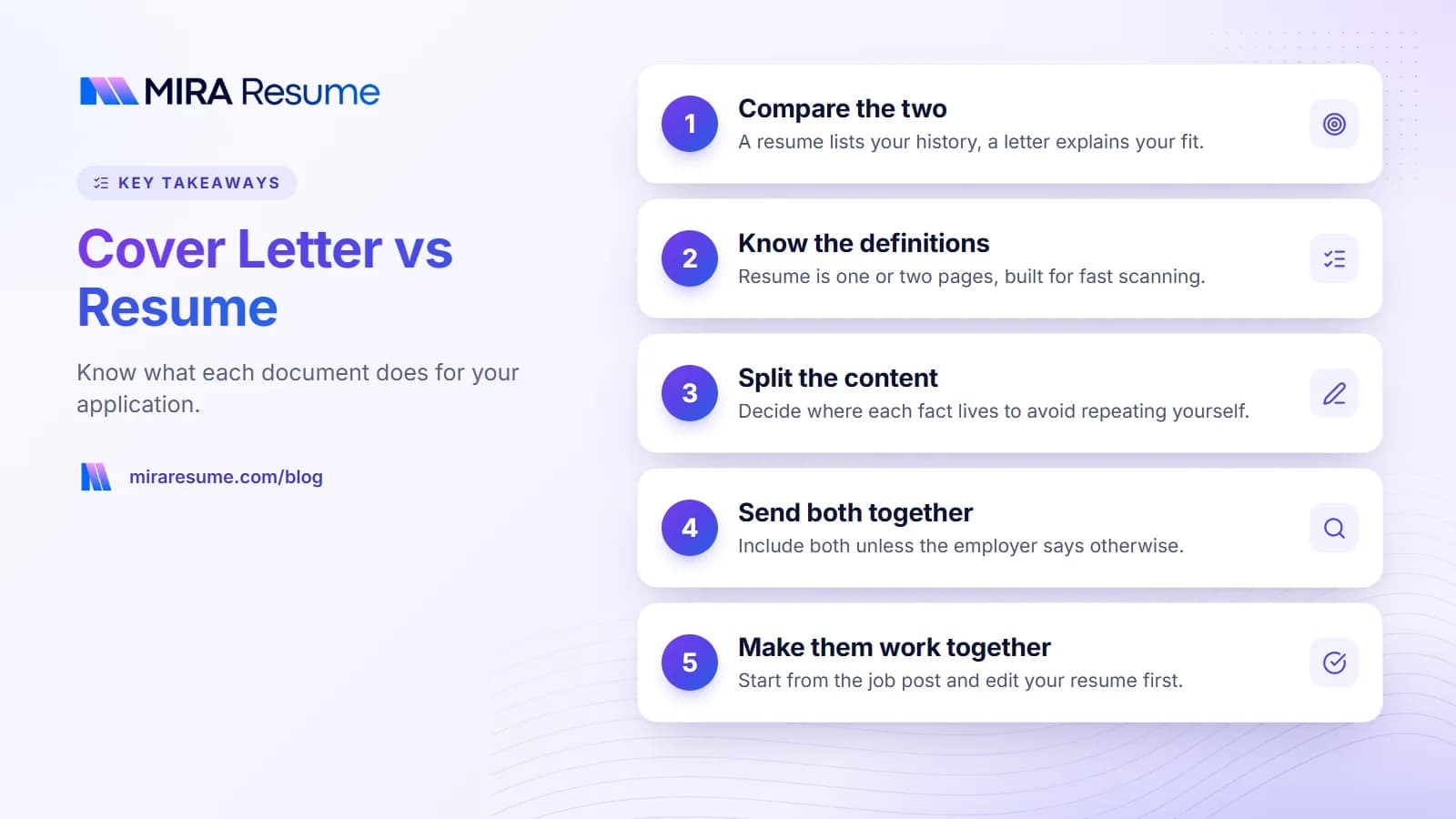
How to make your resume and cover letter work together
- Start with the job post. Highlight the top three needs. Our job analyzer can list them for you.
- Edit the resume first. Move the most relevant experience up, and add real keywords from the post to your summary and skills.
- Pick two stories for the letter. Choose achievements that match the same top needs, and tell them with a little more detail.
- Match the look. Use the same font and header on both so they look like a set. Our resume templates are built so a matching letter is easy.
- Keep the facts consistent. Dates, titles and numbers must match in both documents.
- Check the file. Save both as PDFs unless asked otherwise, and name them clearly, such as Jane-Doe-Resume.pdf and Jane-Doe-Cover-Letter.pdf.
Check how software reads your resume
Many employers use applicant tracking systems, which are programs that collect and sort applications. You can test your resume with an ATS checker to see whether the text is readable and whether you are missing words from the post. For how those systems work, see how ATS works.
Which one do employers read first?
It depends on the employer and on how they receive applications. There is no single rule, and hiring managers differ. Still, a few patterns are common.
- Resume first. Many people look at the resume first because it is fast to scan. If it passes, they may open the letter for more context.
- Letter first. At small companies or in writing-heavy jobs, a reader may start with the letter to get a feel for you.
- Software first. In large companies, an applicant tracking system may store both files, and a person may filter on the resume before opening the letter.
Since you cannot know in advance, make each document stand on its own. The resume should make sense without the letter. The letter should make sense even if the reader has not opened the resume yet, so name the job and one clear strength in its first lines.
A short routine for each application
| Step | Resume | Cover letter |
|---|---|---|
| Time needed | 10 to 20 minutes to adjust | 20 to 40 minutes to write or edit |
| What you change | Summary, top bullets, skills | Opening, one proof paragraph, company reason |
| What stays the same | Dates, titles, education | Your tone and basic structure |
| Final check | Run an ATS check | Read aloud and check the company name |
These time estimates are rough and depend on how much you have prepared. The more stories you collect, the faster each application gets.
Common mistakes when you write both
- Copying the resume into the letter. The reader has seen it already. Add new information.
- Making the letter too long. See how long a cover letter should be.
- Making the resume read like a letter. Long paragraphs on a resume are hard to scan. Use bullets.
- Forgetting to tailor. Send the same generic documents everywhere and you will blend in.
- Mismatched details. A different job title in each document looks careless.
- Weak ending. Finish the letter with a clear next step, using ideas from how to close a cover letter.