
A statement of qualifications, often shortened to SOQ, is a written document that shows how you meet the specific requirements of a job, contract or program. Instead of a general story, you go through the listed requirements one by one and give proof for each.
You will meet an SOQ most often in government hiring, public contracts and some professional and academic settings. The name and the rules differ by employer. Some want a one-page summary. Others want a form with set questions or a long, structured response.
This guide explains what an SOQ is, how it differs from a resume and cover letter, a flexible structure, a sample, and the mistakes to avoid. It is general guidance and not legal or official advice, so always follow the exact instructions on your application.
What is a statement of qualifications?
A statement of qualifications is a focused document that answers one question: do you meet what we asked for? It usually takes the requirements from the job post, call for bids or program page and shows, point by point, how you meet each one.
The term appears in different places:
- Government jobs. Some public agencies ask for a statement that addresses listed knowledge, skills and abilities. Some call this a qualifying statement or a narrative response.
- Contracts and professional services. Firms and consultants may submit an SOQ to show they are qualified to be considered for a project. In that setting it describes the team, past projects and relevant experience.
- Academic or professional programs. A short statement of your background and why you meet entry requirements.
Because the word is used in many ways, never assume. Read the instructions and use their format. This page covers the individual job-seeker version, and the same logic carries over to other uses.
SOQ vs resume vs cover letter
People mix these up. Here is a clear comparison.
| Document | Main job | Structure | Typical length |
|---|---|---|---|
| Resume | Lists your work, skills and education | Sections: summary, experience, skills, education | 1 to 2 pages |
| Cover letter | Introduces you and links you to one job | Letter format with 3 to 4 paragraphs | 1 page |
| Statement of qualifications | Proves you meet each stated requirement | Organized by the employer's requirements | 1 page to several pages, depending on instructions |
In short, the resume is the record, the cover letter is the pitch, and the SOQ is the proof against a checklist. See cover letter vs resume for the first pair, and the application letter template if you only need a standard letter. An SOQ is often sent with a resume, not instead of one.
What goes in a statement of qualifications
When you are free to choose your own format, include these parts.
- Heading. Your name, contact details and the job or reference number.
- Short introduction. The position and a two-sentence summary of your fit.
- Requirement-by-requirement section. The core of the document. List each requirement and answer it.
- Education, licenses and training. Only what the post asks for.
- Brief closing. A thank-you and a line saying you are available for questions.
Keep the order the same as the posting. A scorer often works down a checklist, so if your answers follow the same order, each point is easy to find and credit. If the posting groups items under headings such as "Required" and "Preferred", copy those headings too, and answer the required items first and in the most detail.
How to answer each requirement
Use a short formula for every point:
- Requirement: copy the wording from the post.
- Where and when: name the job, project or class.
- What you did: describe the action in plain words.
- Result: give a true outcome, if you have one.
The STAR method (situation, task, action, result) is a good way to organize each answer.
Statement of qualifications example: a sample structure
Here is a sample for an individual applying for a Program Coordinator role. It is only an example. Real forms vary, so adapt it to the instructions you were given.
Statement of Qualifications
Position: Program Coordinator, Reference #2026-114
Applicant: Maya Torres | Portland, OR | 555-0100 | [email protected]Summary. I have five years of experience coordinating community programs, including scheduling, budget tracking and volunteer support. This statement shows how I meet each requirement in the posting.
Requirement 1: Three years of experience managing programs or events.
From 2021 to 2026 I coordinated 14 community events per year for Riverside Center. I managed the calendar, worked with vendors and handled sign-up lists for up to 200 people.Requirement 2: Ability to manage a budget.
I tracked a yearly program budget of $40,000 in a spreadsheet and sent monthly summaries to the director. I flagged two overspending items early so the team could adjust.Requirement 3: Strong written and spoken communication.
I write the monthly newsletter and lead the volunteer orientation each quarter. I also answer participant questions by phone and email.Requirement 4: Bachelor's degree or equivalent experience.
I hold a Bachelor of Arts in Communication from State University (2020).Thank you for considering my qualifications. I would be glad to provide more detail.
All names, dates and amounts are examples. Use only true facts from your own history. Notice that each answer is short, uses the post's own wording in the heading and gives one clear example.
Statement of qualifications examples for other uses
Different settings call for different versions. These short outlines show the idea.
| Setting | What the SOQ usually covers | Typical content |
|---|---|---|
| Government job | Listed knowledge, skills and abilities | One answer per item, with examples from past roles |
| Consulting or design firm | Firm background, team and past projects | Project summaries, team bios, relevant licenses |
| Construction or engineering contract | Ability to deliver the project | Similar projects, safety record, key staff, references |
| Academic or professional program | Meeting entry requirements | Education, work history, why the program fits |
| Freelance or independent contractor | Skills and track record for one job | Samples, clients, credentials |
If you are applying for a contract or in a construction role, you may also need a strong resume. See our guide on the construction project manager resume for that side of the work.
What a strong answer looks like next to a weak one
| Requirement | Weak answer | Stronger answer |
|---|---|---|
| Experience with public records | I have lots of records experience. | From 2022 to 2026 I managed intake and filing of about 300 client records a month at Lakeview Services, and I trained two new staff on our records system. |
| Ability to work with the public | I am a people person. | I serve about 50 walk-in visitors a day at the front counter and resolve most questions on the spot. |
| Knowledge of safety rules | I follow all safety rules. | I completed a workplace safety course in 2025 and ran monthly safety checks for a team of ten. |
Numbers above are examples. If you do not track numbers, describe the task and result in plain words.
Short letter version
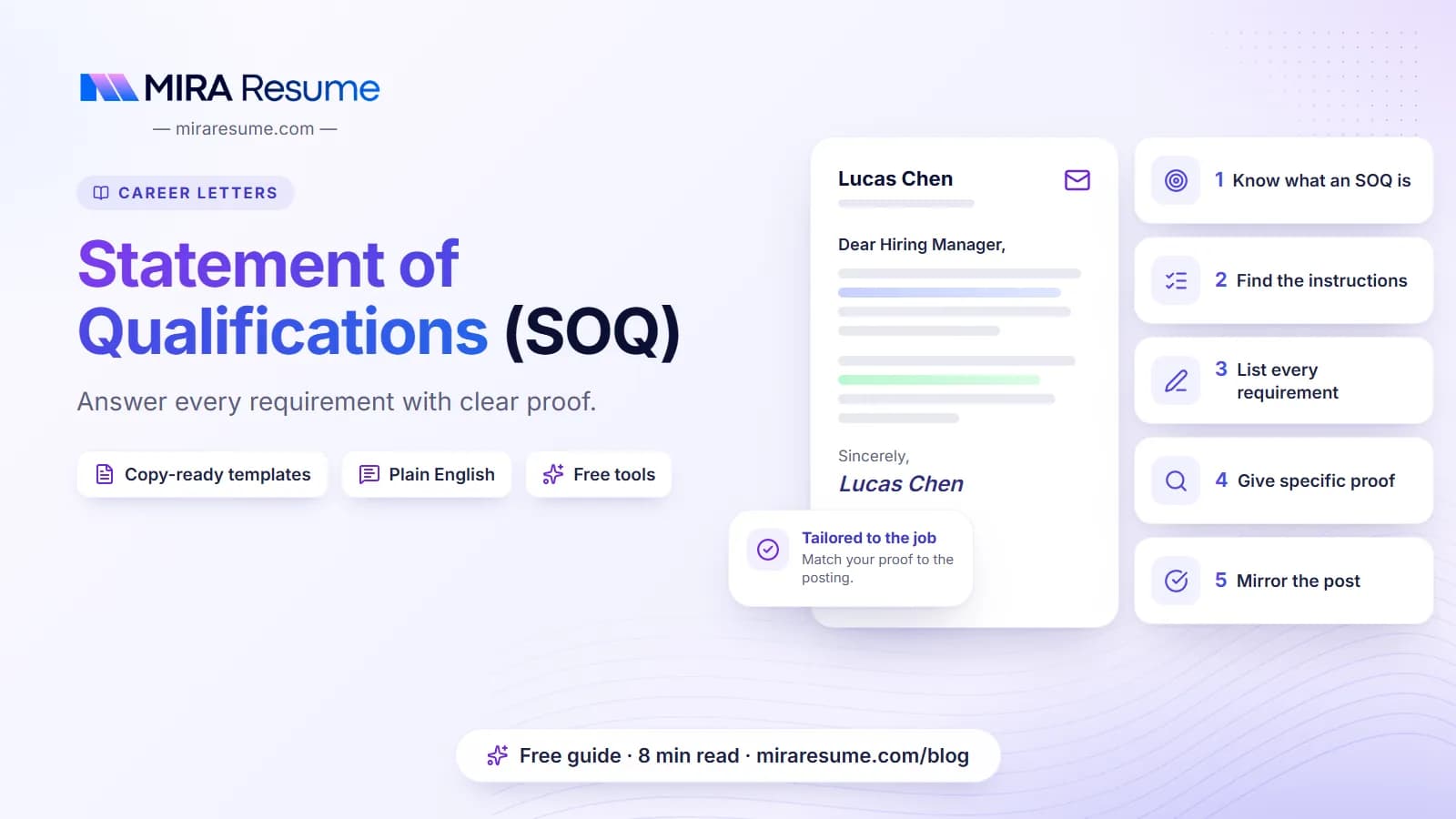
Some employers use the phrases letter of qualification or qualifying statement for a one-page letter version. It looks like a cover letter, but each paragraph answers one requirement.
Dear Hiring Panel,
I am applying for the Program Coordinator position. I meet the stated requirements as follows. First, I have five years of experience coordinating events, most recently managing 14 community events a year. Second, I tracked a $40,000 program budget with monthly summaries. Third, I write the monthly newsletter and lead volunteer orientation. I hold a bachelor's degree in communication. My resume is attached.
Thank you for your time.
Sincerely,
Maya Torres
How to write your SOQ in six steps
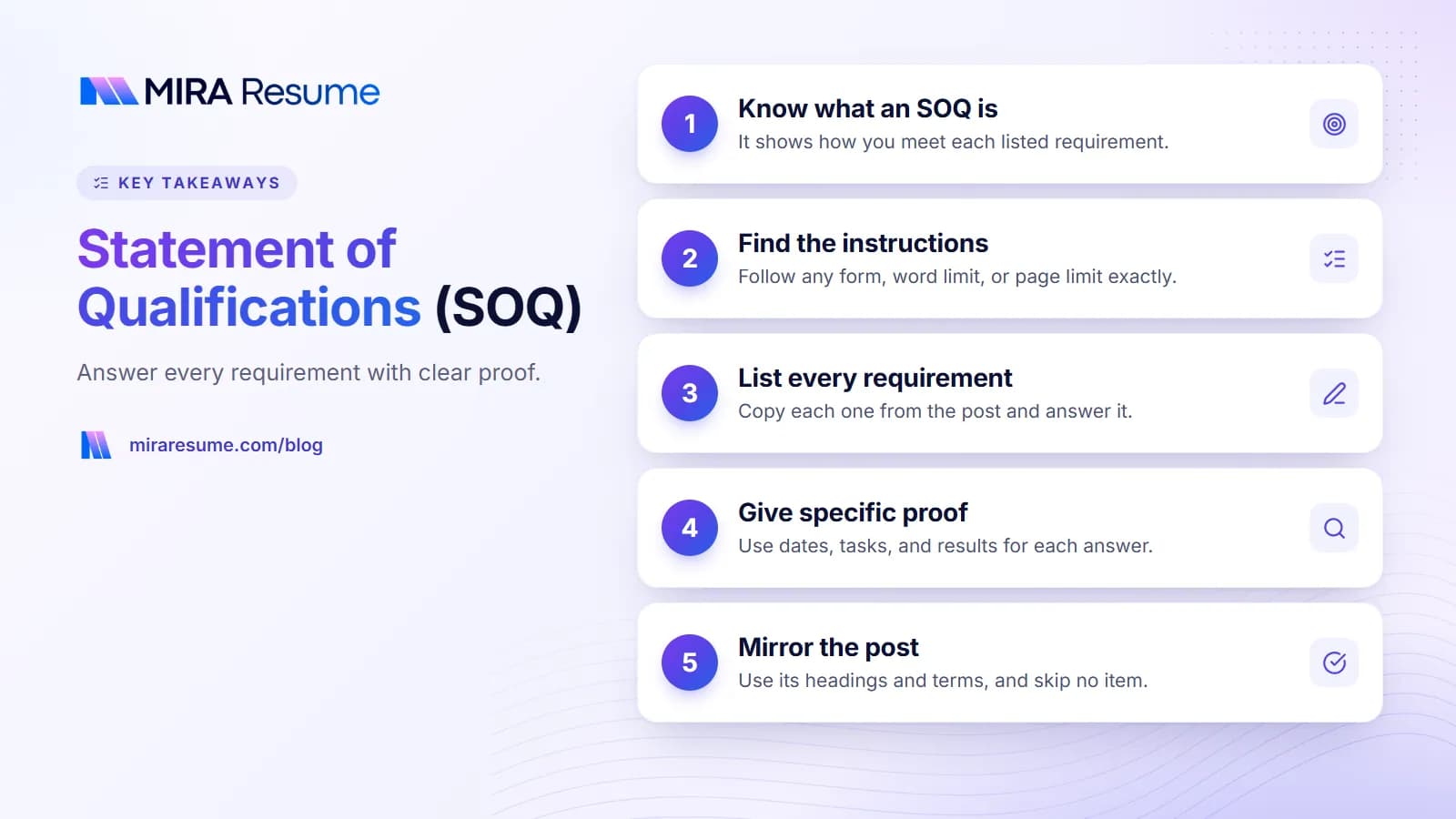
- Find the instructions. Look for a form, word limit, page limit or required questions. If they exist, follow them exactly. If you cannot tell what is required, ask the contact listed in the post.
- List every requirement. Copy each one from the post into a document, in the order they appear.
- Match your experience. For each item, write down a job, project or class that shows you meet it. Include dates.
- Write short answers. Two to five sentences each, using plain words and one clear example.
- Cover gaps honestly. If you only partly meet a requirement, show related experience instead of claiming a full match.
- Check and match. Make sure dates and titles agree with your resume, then save as a PDF unless a different format is required.
Keep a "master" list of your achievements, so each new SOQ takes less time. A strong resume helps here too. You can build one with the resume builder and test how software reads it with the ATS checker. For help with the words you use, see action verbs for a resume.
Tips to make your SOQ stronger
- Mirror the post. Use the same headings and terms where they are true. See cover letter keywords for the method.
- Give specific proof. Dates, tasks and results help the reader score your answer.
- Do not make the reader hunt. Put each requirement as a clear heading.
- Keep sentences short. Plain words are easier to score than long sentences.
- Use "I", not "we", for your own work. Make clear what you personally did.
- Do not assume. The reader may know nothing about your past employer. Explain in a few words.
- Include equivalent experience. If a degree is requested and you have comparable experience, say so only if the post allows it.
- Proofread. Errors cost more in a document that is scored.
Government and public-sector processes can be strict. Some require specific forms, signatures or separate questionnaires, and some may score responses against set criteria. Because rules differ, always check the official instructions or the agency's help contact. This article is a general guide only and does not replace official guidance.
Common SOQ mistakes
- Ignoring the instructions. A missing form or an over-length answer can cost you.
- Skipping a requirement. Address every listed item, even if briefly.
- Using vague claims. "I have strong leadership skills" proves nothing without an example.
- Copying your resume. Write answers tied to each requirement instead.
- Exaggerating. Claims may be checked at interview or by references.
- Writing one big block. Use clear headings and short paragraphs.
- Using different dates than your resume. Keep every date consistent.
- Submitting late. Deadlines for public jobs and bids are usually firm.
For other career letters, see the letter of intent format, application letter template and how to write a cover letter.