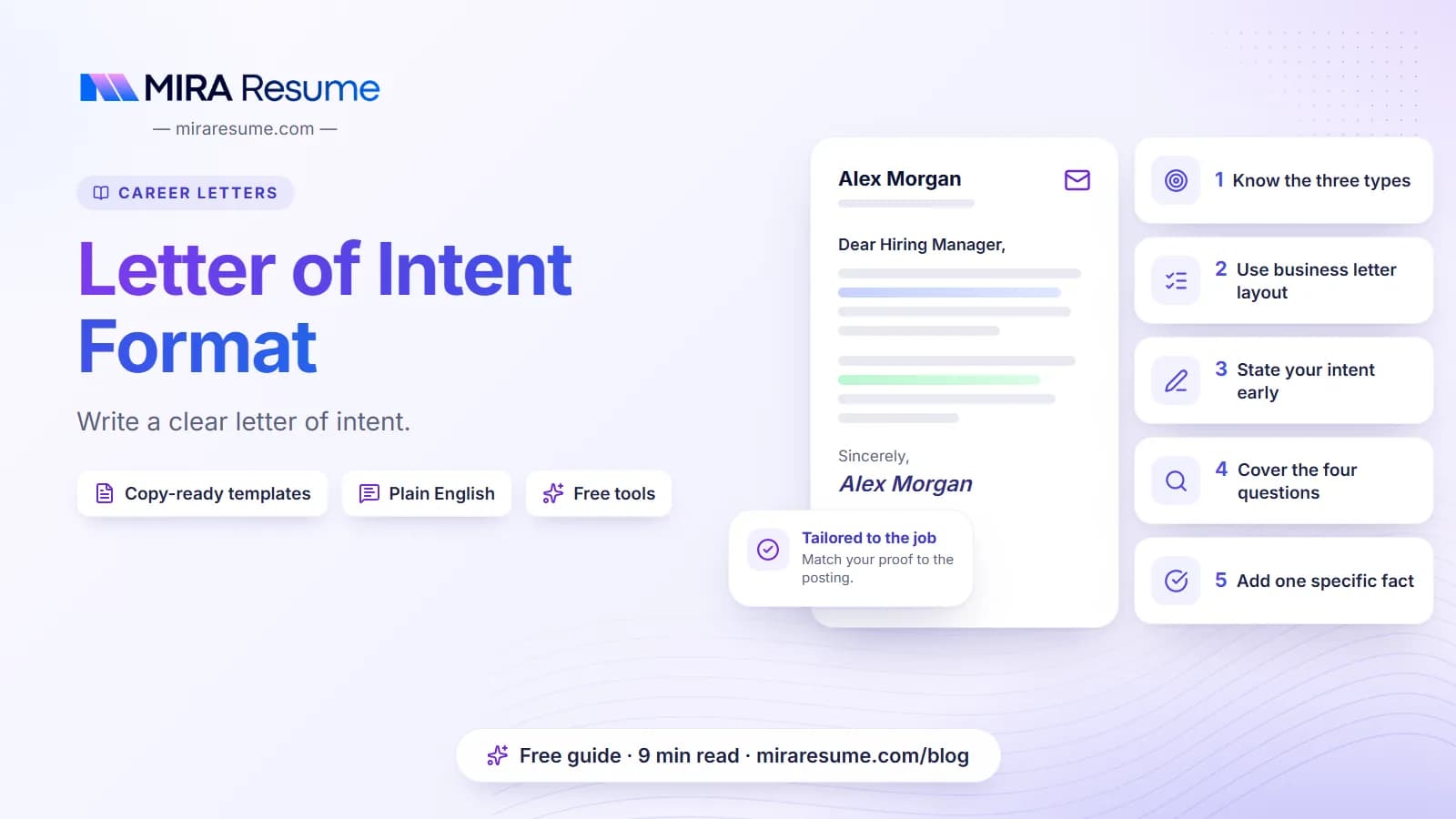

The letter of intent format is simple: a header with your details, a greeting, an opening that states your goal, a few short paragraphs that give your reasons, and a polite close. The details change depending on whether you are writing for a job, a school place or a business deal.
The word "intent" means "plan". So this kind of letter tells someone what you plan to do, and asks them to take it seriously. In hiring, it often works like a cover letter. In school and business, it can have different rules.
Below you will see what is in a letter of intent, how the three main types differ, and a plain example for each. For the closest cousin of this letter, see our guide on what a cover letter is.
General guidance only. A business letter of intent can have legal effects, so ask a qualified professional before you sign anything.
What is a letter of intent?
A letter of intent is a short, formal letter that states your plan and your interest in something. You send it before a bigger step. The reader uses it to decide whether to move on to the next stage.
You may need one in three common places:
- A job: you want to work for a company, often when no specific job is advertised.
- A school or program: you want to study, join a research group or enter a scholarship.
- A business deal: two groups want to say they plan to work together before they sign a full contract.
The letter is usually one page. It is not a full application. It says, "Here is what I want, and here is why you should talk with me."
Letter of intent vs cover letter
The two are close, and people mix them up. A cover letter goes with a resume for a specific, open job. A letter of intent for a job is sent when you want to work somewhere and there may be no posted role. It is also called a letter of interest or a prospecting letter.
| Cover letter | Letter of intent (job) | |
|---|---|---|
| When used | A role is advertised | You want to work there, often with no ad |
| Goal | Win an interview for that role | Start a conversation about a possible role |
| Focus | Match to the job description | Show your plan and fit for the company |
| Length | Half to one page | One page |
Letter of intent format: the layout, part by part
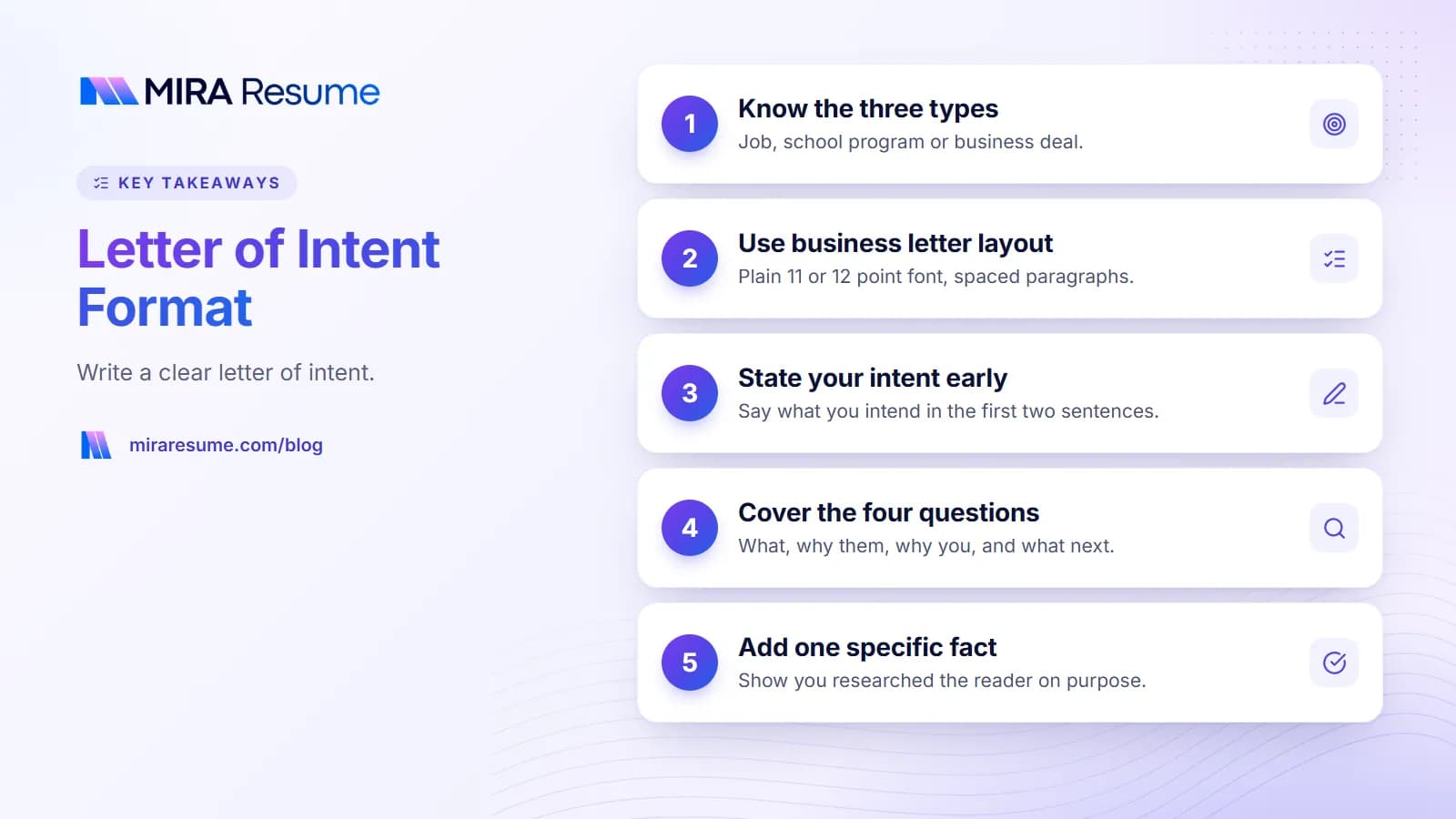
Use a standard business letter layout. Keep fonts plain, at 11 or 12 points, with space between paragraphs. Here is the order from top to bottom.
- Your contact details. Name, address or city, phone, email. A LinkedIn link is optional.
- Date. Write the full date.
- Recipient details. Their name, job title, organization and address. Find a real name if you can.
- Greeting. "Dear Ms. Alvarez," is better than "To whom it may concern."
- Opening paragraph. State your purpose in the first two sentences.
- Body paragraphs. Two or three short paragraphs with your reasons and proof.
- Closing paragraph. Say thanks and what you hope happens next.
- Sign-off. "Sincerely," then your typed name. Add a signature if you print it.
- Enclosures. If you attach a resume or papers, say so.
| Part | What it does | Typical length |
|---|---|---|
| Header | Tells the reader who you are and how to reach you | 3-5 lines |
| Opening | States your plan right away | 2-3 sentences |
| Body | Gives reasons and proof | 2-3 short paragraphs |
| Closing | Thanks the reader and sets next step | 2-3 sentences |
| Sign-off | Ends politely | 1-2 lines |
If you send it by email
Skip the postal address blocks. Write a clear subject line, such as "Letter of intent: Project Coordinator, Jordan Lee". Paste the letter into the email body and attach a PDF copy if you want to keep the layout.
What is in a letter of intent: the points to cover
Whatever the type, a good letter answers four questions in plain words.
- What do you intend to do? Name the job, program or deal.
- Why this person or group? Show you did your homework.
- Why you? Give two or three real strengths and a short proof for each.
- What happens next? Say what you would like, such as a call or a meeting.
Show, do not boast
Give facts you can check. "I managed a team of four and cut order errors by reorganizing our checklist" is better than "I am a hard worker". Use only true details, and use numbers only if you have them.
Keep the reader in mind
Think about what the reader needs. A hiring manager wants someone useful. An admissions committee wants someone who fits the program. A business partner wants clear terms. Write to that need in the first paragraph.
Words to use and words to skip
| Use | Skip |
|---|---|
| "I plan to" | "I am a passionate go-getter" |
| "I would like to discuss" | "I demand a meeting" |
| Short, clear sentences | Long, winding ones |
| One honest strength with proof | A list of adjectives |
Letter of intent for a job
Use this when you want to work somewhere, and there may be no open role to apply for. Keep it about the company, then about you.
Jordan Lee
Austin, TX | [email protected] | 555-014212 November 2026
Ms. Priya Alvarez
Operations Director
Greenfield LogisticsDear Ms. Alvarez,
I am writing to share my intent to join Greenfield Logistics as a project coordinator. I have followed your recent expansion into cold storage, and I would like to help your teams run it smoothly.
For the past three years I have coordinated shipments for a regional distributor. I built a weekly tracking sheet that our drivers and office staff both used, and it helped us find late deliveries sooner. I also trained two new coordinators.
I am organized, calm under deadlines, and comfortable working with drivers, vendors and managers. I believe these strengths would fit the work your team is doing.
I have attached my resume. May we schedule a short call to talk about whether there is a place for me? Thank you for your time.
Sincerely,
Jordan Lee
Notice what it does. It names the role, shows knowledge of the company, gives one proof point, and ends with a clear request. If you are writing for an advertised job, switch to a standard cover letter; our guide on how to start a cover letter shows strong openings.
Pair your letter with a clean resume from the resume builder, and check how it reads in the ATS checker before you attach it.
Letter of intent for graduate school or a program
Schools use this letter to see your goals and fit. Some programs call it a statement of purpose. Always follow the program's own instructions on length and topics, since they vary.
What a school letter usually covers
- The program you are applying to, and your planned area of study.
- Your background: courses, projects, work or research.
- Why this school, faculty or lab.
- Your goals after the program.
Dear Admissions Committee,
I am writing to express my intent to apply for the Master of Public Health program at Lakeshore University, with a focus on community health.
During my bachelor's degree in biology, I volunteered for two years at a neighborhood clinic. I helped run a vaccine reminder project, and I saw how small changes in communication helped more families keep appointments. That experience made me want to study how health programs are designed and measured.
Your program's partnership with local health departments is a main reason I am applying. I would like to learn from Dr. Okafor's work on community outreach, and later work for a public health agency.
Thank you for considering my application. I would be happy to provide any additional documents.
Sincerely,
Amara Nwosu
Replace names with real ones from the program's own pages. Never claim contact you have not had, and never invent a connection to a professor.
Business letter of intent
A business letter of intent says that two sides plan to make a deal, such as buying a company, forming a partnership, or renting space. It sets out the main ideas before the full contract.
This is the type where wording matters most. Some parts can be binding (meaning you must follow them) and others non-binding. Which is which depends on how the letter is written and on local law. Ask a qualified lawyer to review before you sign.
Typical items in a business letter
- Who the parties are.
- What the deal is about.
- Main terms, such as price range, dates and responsibilities.
- A statement of whether the letter is binding or not.
- Confidentiality, if both sides agree.
- A time limit for the letter.
- Signatures and dates.
Dear Mr. Okoro,
This letter shows the intent of Bright Bakery Supplies to buy flour and packaging from Okoro Mills for a twelve-month period beginning 1 January 2027.
We expect to buy about the amounts listed below, at prices to be agreed in a full supply contract. Except for the confidentiality paragraph, this letter is not a binding agreement. We hope to sign a full contract by 15 December 2026.
Please confirm if these terms match your understanding.
Sincerely,
Dana Cole
Purchasing Manager
This is a simple sample to show the style. Real agreements need accurate terms and legal review.
Comparing the three types side by side
The core format stays the same. What changes is the purpose, the reader and the level of risk.
| Job | School or program | Business | |
|---|---|---|---|
| Main goal | Start a hiring conversation | Show fit and goals | Record a plan to make a deal |
| Reader | Hiring manager | Admissions committee | Other company or owner |
| Tone | Professional, warm | Thoughtful, academic | Formal, precise |
| Length | One page | One to two pages, follow rules | One to three pages |
| Attach | Resume | Transcripts, CV if asked | Sometimes term sheet |
| Legal weight | None | None | May be partly binding |
For school and job versions, your CV or resume supports the letter. If you apply to research or academic programs, see our notes on a science CV sample. For job letters, the cover letter vs resume guide explains how the pieces fit together.
Common mistakes in a letter of intent
- Hiding the purpose. Say what you intend in the first two sentences.
- Writing "To whom it may concern." Take five minutes to find a name.
- Repeating your resume. Choose two or three points and give the story behind them.
- Going over one page without being asked.
- Using the same letter everywhere. A letter that could go to anyone feels empty. Add one fact about this reader.
- Using big words to sound smart. Plain English reads better.
- Making promises you cannot keep. Be honest about what you can do.
- Forgetting to proofread. Read it aloud, then ask a friend.
- Ignoring the rules. If a school or employer gives a format or word limit, follow it exactly.
- Skipping legal review on a business letter that includes terms.
A quick final checklist
- Is my purpose clear in the first paragraph?
- Did I use the reader's real name?
- Do I give at least one proof point?
- Is it one page and free of typos?
- Did I say what I would like to happen next?
Once your letter is sent, remember the small courtesy of following up. Our guide on how to follow up after an interview also works well for a letter that gets no reply.
Tips to make your letter stand out
Few readers see well-made letters, so small details help.
Research one specific fact
Read the organization's news page or program description. Mention one thing, such as a project, a course or a goal. It shows you chose them on purpose.
Lead with the benefit to them
Change "I want to gain experience" into "I can help your team by doing X." Your growth matters, but the reader reads for their own needs first.
Keep a master version
Write one strong base letter. Each time, change the greeting, the opening and the one specific fact. That saves time and still reads as personal.
Match your other documents
Use the same name, contact details and style on your letter, resume and online profile. Run your LinkedIn profile through the audit tool so the story matches. Our guide on how to close a cover letter gives more ideas for the last paragraph.
Save and track
Note who you sent each letter to and the date, and decide when you will follow up. A tool like the job tracker keeps this simple.