
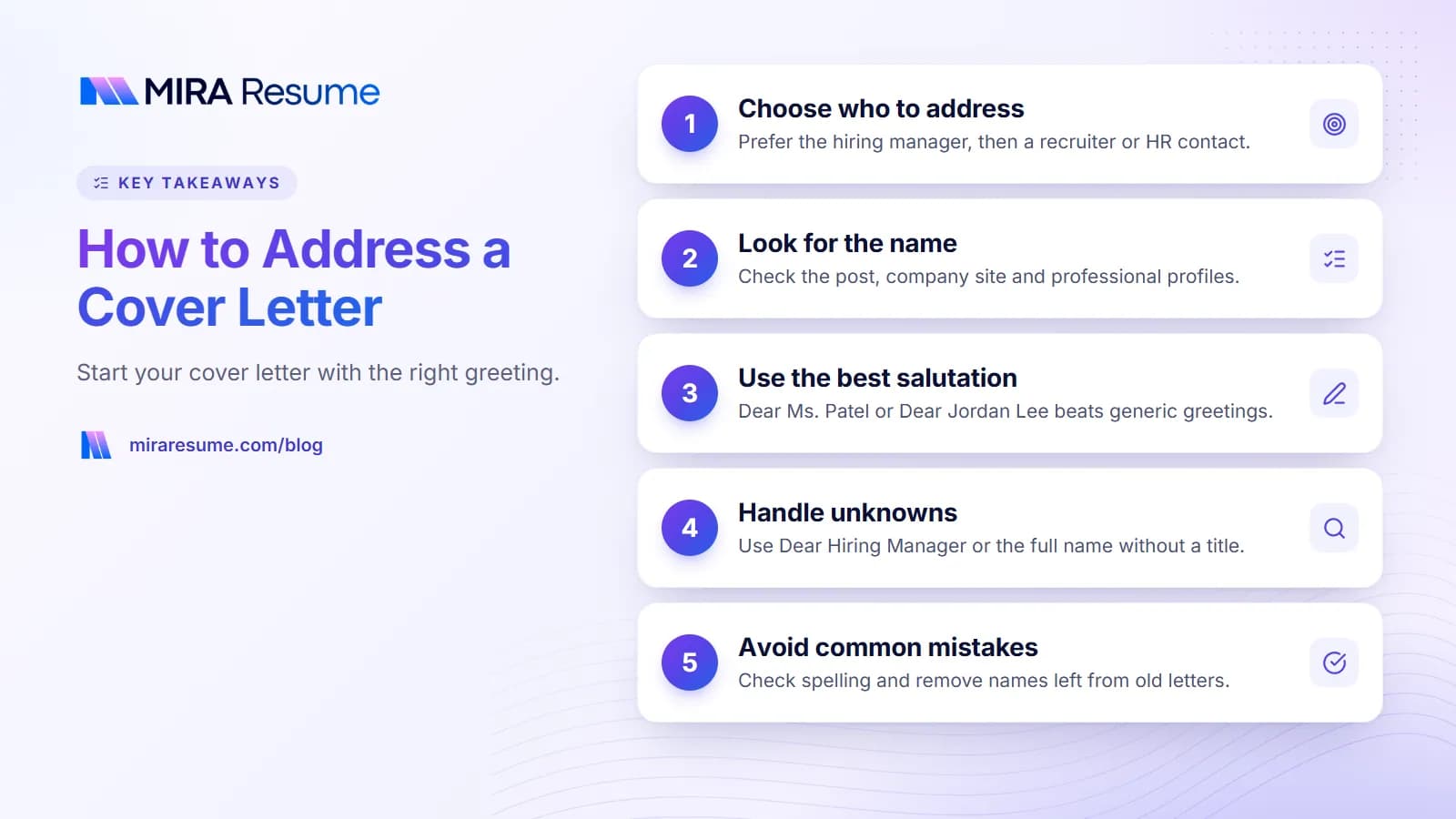
Wondering how to address a cover letter? Use the name of the person who will read it, with a title and last name ("Dear Ms. Patel,") or their full name ("Dear Jordan Lee,"). If no name is available after a short search, "Dear Hiring Manager," or "Dear [Team] Hiring Team," is polite and widely accepted.
The salutation is only one line, but it is the first words a reader sees after your header. Getting the name, title and spelling right shows care. Getting them wrong can make a strong letter look rushed.
This guide is about who to address and how to write the salutation itself: finding the name, choosing between options, handling titles and multiple readers, and punctuation. For what to write right after the greeting, see how to start a cover letter. For the contact block above it, see our cover letter header guide.
Who should you address your cover letter to?
The ideal reader is the person who will make the hiring decision, usually the manager of the team you would join. A recruiter or HR contact is the next best choice, especially if they are named in the job post.
Here is a simple order of preference:
- The hiring manager. The person you would report to.
- The named contact in the job post. Often a recruiter or HR coordinator. If the post names someone, use that name even if you think someone else is the manager.
- The head of the department. For example, the Director of Marketing for a marketing role, if you cannot identify a specific manager.
- The team or company. A greeting such as "Dear Product Design Hiring Team," when no individual can be found.
Do not worry if you are not certain you have the exact right person. A letter addressed to a real, relevant person at the company will reach the right desk. What matters most is that the name is spelled correctly and the person is plausibly connected to the role.
How to find the hiring manager's name (ethically)
Spend ten to fifteen minutes looking. That is usually enough to find a name or decide there is not one to find.
1. Read the job post closely
Check the bottom of the post, the "contact" or "apply" section, and any email address listed. Sometimes the post says "reporting to the Operations Manager", which gives you a title to search for.
2. Check LinkedIn
Search the company name plus the team or title, such as "Head of Customer Success". Look at people's current roles and locations. If the recruiter who posted the job is visible on the post, that is a good name to use.
3. Look at the company website
Team pages, About pages, press releases and blog posts often list managers and department heads by name and title.
4. Call or email reception
For smaller companies, a short, polite question works well: "Hello, I am applying for the Accounts Assistant role and would like to address my cover letter correctly. Could you tell me the name of the hiring manager?" If they decline, thank them and move on.
What not to do
- Do not guess personal email addresses or contact people through personal social accounts.
- Do not pressure reception staff or call repeatedly.
- Do not pretend to be someone else to get information.
- Do not use a name you are not confident about. A wrong name is worse than a polite team greeting.
Cover letter salutation options, ranked
Use the strongest option you can honestly support. This table runs from best to weakest.
| Salutation | Rating | When to use it |
|---|---|---|
| Dear Ms. Patel, | Best | You know the person's name and the title they use. |
| Dear Jordan Lee, | Best | You know the name but not the title or pronouns. Safe and respectful. |
| Dear Dr. Nguyen, | Best | The person uses a professional title such as Dr. or Prof. |
| Dear Hiring Manager, | Good | No name can be found. Standard and widely accepted. |
| Dear Finance Hiring Team, | Good | No name, but you know the team. A little warmer and more specific. |
| Dear Recruiting Team, | Fine | A recruiter or agency is handling the role. |
| To whom it may concern, | Dated | Only if the employer asks for it. |
| Dear Sir or Madam, | Avoid | Assumes gender and sounds stiff. |
| Hey there, / Hi folks, | Avoid | Too casual for a first contact. |
Why "To whom it may concern" is dated
It was once standard for letters to unknown readers. Today it reads as impersonal, as if you did not try to find out who would read your letter. It also feels formal in a way that clashes with modern, plain writing. "Dear Hiring Manager," does the same job and sounds like you are writing to a person.
Why "Dear Sir or Madam" is worth avoiding
It assumes the reader identifies as one of two options and sounds old-fashioned in most US workplaces. A neutral team greeting avoids both problems.
Who to address a cover letter to if there is no name
Sometimes no name exists to find. The role might be posted by a large company's careers team, or applications may go to a shared inbox. In that case, pick the most specific neutral greeting you can.
- "Dear Hiring Manager," The default. It works for almost any role.
- "Dear [Company] Hiring Team," For example, "Dear Brightwater Hiring Team,". Shows you wrote this letter for them.
- "Dear [Department] Team," For example, "Dear Customer Support Team,". Good when you know which team is hiring.
- "Dear [Job Title] Hiring Committee," Useful in schools, universities, nonprofits and public-sector roles that often hire through committees.
Is "Dear Hiring Manager" really okay? Yes. It is not as personal as a name, but no reasonable reader will hold it against you when no name was available. The rest of your letter matters far more.
Skipping the greeting
Some people leave out the salutation entirely and start with a short subject line such as "Re: Data Analyst application". This can work in an email, but in a formal attached letter most readers expect a greeting. When in doubt, include one.
When you are unsure of gender, pronouns or title
If you know the name but not how the person prefers to be addressed, use their full name with no title.
- "Dear Alex Morgan,"
- "Dear Sam Okonkwo,"
- "Dear Taylor Brooks-Chen,"
This is polite, modern and avoids guessing. Do not assume a title from a first name. Names are not a reliable guide to gender, and a wrong guess is easy to avoid.
If you do know their title
Use the one the person uses themselves, for example on their LinkedIn profile or the company website. Common choices:
- Mr. for men.
- Ms. for women. This is the standard business choice because it does not refer to marital status. Avoid "Mrs." or "Miss" unless you know the person uses it.
- Mx. a gender-neutral title some people use. Only use it if the person uses it.
Check the spelling, twice
Copy the name exactly as it appears in their own profile, including hyphens, accents and capital letters. If the person uses a shortened first name professionally, such as "Kate" instead of "Katherine", it is fine to use the name they use.
Using Dr., Prof. and other professional titles
Some readers hold titles that should appear in the salutation. Using them correctly is a quiet sign of respect.
| If the reader is | Write | Notes |
|---|---|---|
| A medical doctor or holds a doctorate and uses the title | Dear Dr. Hassan, | Common in healthcare, research and academia. |
| A professor | Dear Professor Kim, or Dear Prof. Kim, | Write "Professor" in full for a more formal letter. |
| A school principal | Dear Principal Torres, or Dear Ms. Torres, | Either is fine. Follow what the school uses. |
| A judge, military officer or elected official | Use their formal title, such as Dear Judge Alvarez, | Check the official website for the exact form. |
| Not sure if they use a title | Dear Priya Raman, | The full name is always safe. |
Do not combine titles. Write "Dear Dr. Hassan," not "Dear Dr. Ms. Hassan,". And do not add academic letters after the name in the greeting, such as "Dear Dr. Hassan, PhD,". Those belong in the inside address, if anywhere.
Addressing multiple recipients
Sometimes the post asks you to send your letter to two people, or you know a panel will read it.
- Two named people: "Dear Ms. Patel and Mr. Ruiz," or "Dear Anita Patel and Marco Ruiz,". Keep both in the same style.
- Three or more people: Use the group instead: "Dear Hiring Committee," or "Dear Search Committee,".
- A named lead plus a team: "Dear Ms. Patel and the Engineering Team,". This works when one person is clearly in charge.
Order names the way they appear in the job post. If no order is given, alphabetical by last name is a neutral choice. In the inside address, you can list each person on their own line or use just the committee name.
Email cover letters vs attached letters
The salutation works almost the same in both formats, but a few details change.
| Email (letter in the message body) | Attached letter (PDF or Word file) | |
|---|---|---|
| Salutation | Dear Ms. Patel, | Dear Ms. Patel: or Dear Ms. Patel, |
| Inside address block | Leave it out | Include it above the greeting |
| Subject line | Needed, with the job title and your name | Not needed in the letter; name the file clearly |
| Tone | Same as a letter, just shorter | Standard business letter |
If you send an email with an attached cover letter, keep the email short and use the same salutation in both. Do not write "Hi" in the email and "Dear" in the letter. Use one style throughout.
Avoid "Hi Anita," for a first application, even if the company feels casual. Once the person writes back in a relaxed style, you can match their tone in later replies.
Punctuation: colon or comma, and US vs UK style
Small punctuation choices vary by country and formality. Pick one style and use it consistently.
US style
- Colon for formal business letters: "Dear Ms. Patel:". This is the traditional US business format.
- Comma is also widely accepted and common in emails: "Dear Ms. Patel,".
- Titles take a period: Mr., Ms., Dr., Prof.
UK style
- Comma or no punctuation after the greeting: "Dear Ms Patel," or "Dear Ms Patel". A colon is unusual.
- Titles usually have no period: Mr, Ms, Dr.
- Traditional UK sign-offs follow the greeting: "Yours sincerely" after a named greeting, and "Yours faithfully" after "Dear Sir or Madam". Many writers now use "Kind regards" in both cases.
If you are applying to a US employer, either the colon or the comma is fine. Just be consistent with your closing. For sign-off choices, see how to close a cover letter.
Capitalization
Capitalize "Dear", the title, the name and each word of a team or role name: "Dear Customer Success Hiring Team,". Do not write "dear hiring manager," in lowercase.
The inside address block
In a formal attached letter, the inside address sits above the salutation and repeats who the letter is for. It should match your greeting. Here is how it looks with and without a name. The full layout of your own contact details and the date is covered in our cover letter header guide.
With a name
Anita Patel
Director of Operations
Brightwater Logistics
[Street Address]
[City, State ZIP]
Dear Ms. Patel:
Without a name
Hiring Manager
Customer Support Department
Brightwater Logistics
[City, State ZIP]
Dear Hiring Manager:
With a committee
Search Committee, Assistant Librarian Position
Eastfield Community College
[City, State ZIP]
Dear Search Committee:
The person's full name and job title go in the inside address. In the greeting, use only the title and last name, or the full name if you are unsure of title. If you do not know the street address, the company name and city are enough. For overall layout, see how to format a cover letter.
Common mistakes when addressing a cover letter
- Misspelling the name. Check it against the person's own profile.
- Leaving the wrong name from an old letter. Search your draft for every company and person name before you send.
- Guessing a title. Use the full name if you are not sure.
- Using a first name only. "Dear Anita," can feel too familiar for a first contact. Use the full name or title and last name.
- Mixing styles. A colon in the greeting and a casual sign-off, or "Hi" in the email and "Dear" in the letter.
- Using "To whom it may concern" by habit. Spend a few minutes looking for a name, or use a team greeting.
- Mismatched inside address and greeting. If the block says "Anita Patel", the greeting should not say "Dear Hiring Manager".
Quick checklist
- Did you search the job post, company site and LinkedIn for a name?
- Is the name spelled exactly as the person writes it?
- Did you use a title only if you are sure of it?
- Does the greeting match the inside address?
- Is your punctuation consistent with your closing?
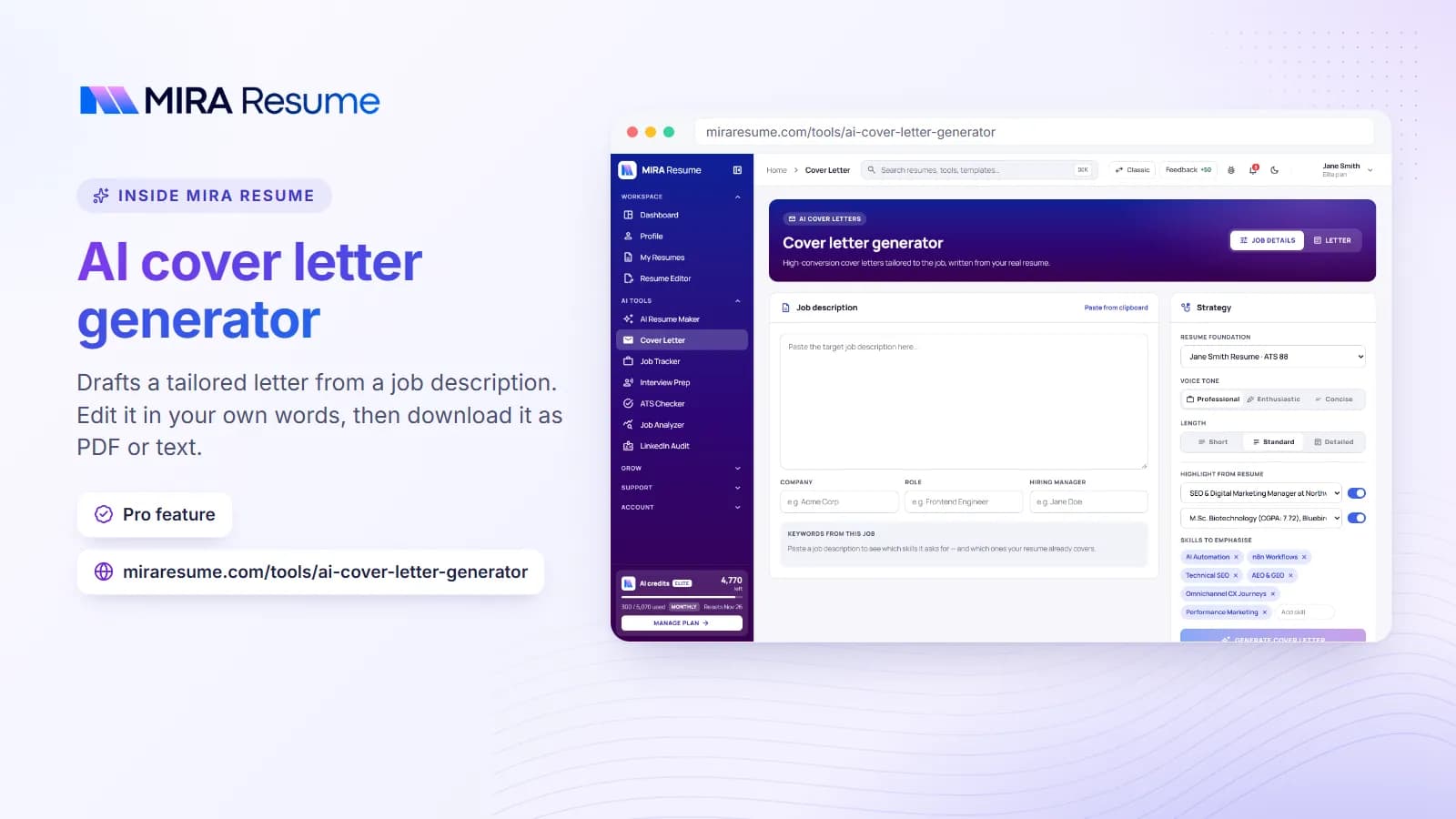
Once the salutation is set, the rest of the letter does the real work. Our guide on how to write a cover letter walks through each paragraph, and our cover letter templates and cover letter examples show complete letters. To get a tailored first draft, try the AI cover letter generator, then check the name and greeting yourself before sending.