
A teacher cover letter is your chance to show a principal what your classroom feels like before they ever visit it. Your resume lists where you taught and what you hold a license in. Your letter tells the story: how you help a struggling reader, how you talk with parents, and why this school is where you want to work.
Below you will find a simple plan, samples for a new teacher and an experienced one, tips for substitute and special education roles, and a list of mistakes to skip. Everything is in plain language so you can adapt it fast.
What principals look for in a teaching letter
Hiring teams read many letters in a short time. They look for a few clear signals. Know them before you write so each paragraph has a purpose.
| What they want to know | What to include |
|---|---|
| Are you qualified? | Your license or certification, grade level and subject, in the first paragraph. |
| How do you teach? | One real lesson, routine or project and how students responded. |
| Can you manage a class? | A short line about your routines, expectations or how you build respect. |
| Will you work well with others? | Team teaching, parent contact, or helping a colleague. |
| Do you want this school? | A detail from the school's website, program or community. |
| Do you keep learning? | Training, new tools or ideas you tried and what you learned. |
If you are unsure how long to go, read how long a cover letter should be. For teachers, one page is the safe choice.
A four-part plan for a cover letter for a teaching job
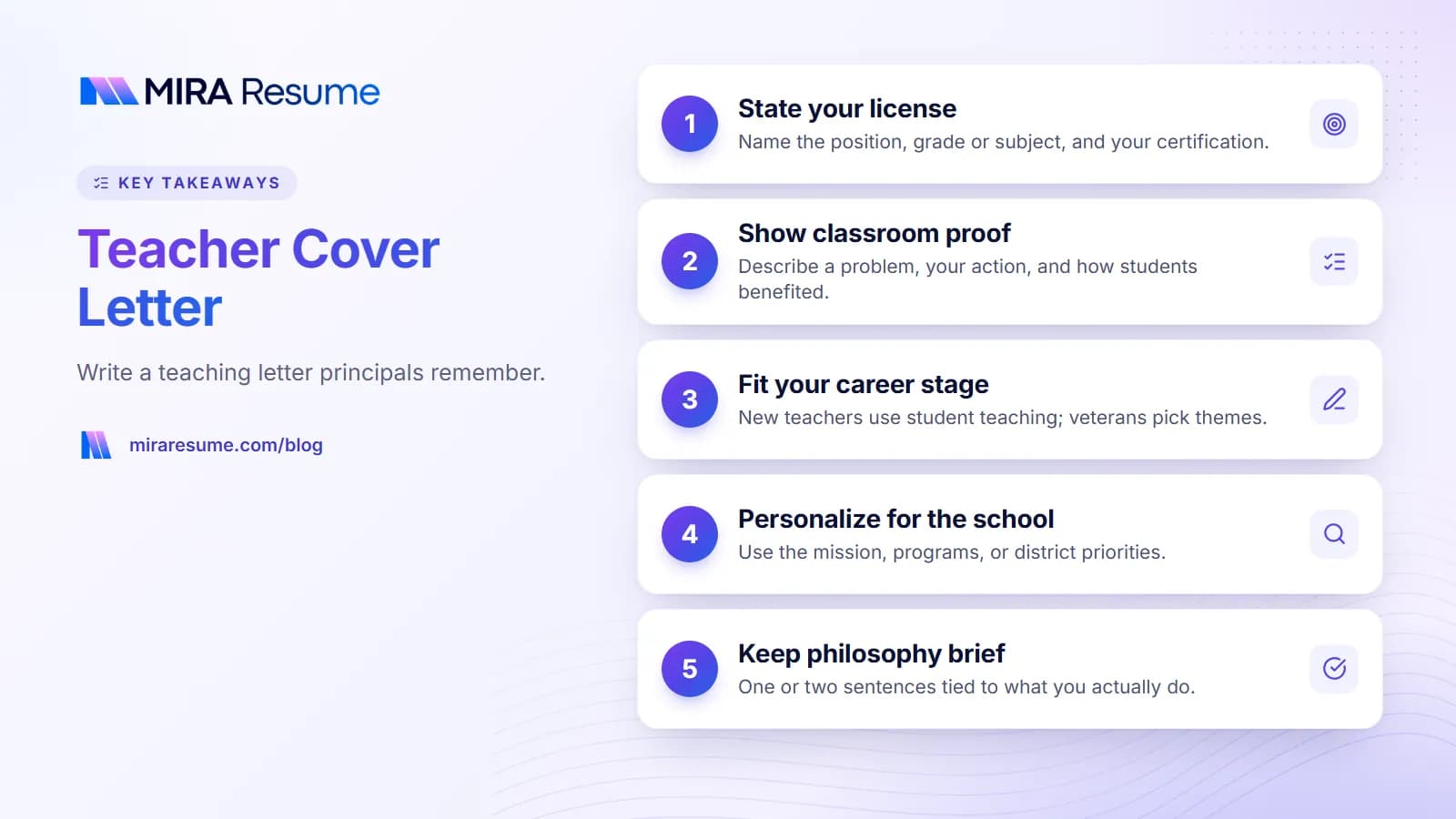
- Opening. State the position, grade or subject, and one reason you fit. Include your license if it is current. See how to start a cover letter for more opening ideas.
- Classroom proof. Describe one thing you did that helped students. Say what the problem was, what you tried and what changed. Use test scores or growth numbers only if they are accurate and you are allowed to share them.
- Fit with the school. Name something specific: a reading program, a project-based approach, a club, the school's mission or its student population.
- Close. Thank them and ask for a chance to talk. Our guide on how to close a cover letter has ideas.
Keep student privacy in mind
Never name a student or share details that could identify a child. Say "a student who was reading below grade level" instead of using a name. This shows professional judgment, which schools care about a lot.
First year teacher cover letter: sample
If you are just starting out, lean on student teaching, tutoring, camps and any work with children. Principals know you are new. They want to see you reflect, plan and learn.
Dear Principal Nguyen,
I am writing to apply for the 3rd Grade Teacher position at Maple Hill Elementary. I recently completed my elementary education degree and my student teaching, and I hold a state teaching license for grades K to 6.
During my 14-week student teaching placement in a 2nd grade classroom, I noticed that several students lost focus during whole-group reading time. I worked with my mentor teacher to try small reading groups with short, hands-on tasks. Within a few weeks, the students were more engaged and our weekly check-ins showed steady progress. I also sent a short positive note home each Friday, which helped me build trust with families early. I enjoy planning lessons that mix stories, movement and simple projects.
I was drawn to Maple Hill because of your school garden and the way it connects science to daily life. I would love to help students grow in the classroom and in the garden.
Thank you for your time. I would welcome the chance to meet and share my ideas. You can reach me at 555-0133 or [email protected].
Respectfully,
Taylor Brooks
All details above are a made-up example. Use your own honest experience. If you are short on classroom time, the advice in our cover letter with no experience guide can help you find proof outside school, such as camps, tutoring and youth programs.
Experienced teacher cover letter: sample
If you have taught for years, your letter should do more than repeat your resume. Pick one or two themes, such as raising reading levels, leading a team or using data to plan, and give a clear example.
Dear Dr. Ramirez,
I am excited to apply for the 8th Grade Math Teacher opening at Riverside Middle School. I have taught middle school math for nine years and hold a state license in mathematics for grades 6 to 12.
My focus is on helping students who feel that math is not for them. In my current school, I started a weekly "problem of the week" where students work in teams and explain their thinking out loud. Students who rarely spoke began to share ideas, and our department adopted the routine in other classes. I also lead the grade-level team, where we review common mistakes together and plan short re-teaching lessons. Parents often say they appreciate my clear updates, and I keep a simple weekly message going home.
Riverside's focus on student voice and its after-school tutoring program stood out to me. I would like to contribute by running a math help club and supporting new teachers on the team.
Thank you for considering my application. I would be glad to talk more about my approach. You can reach me at 555-0166 or [email protected].
Sincerely,
Morgan Ellis
Want to see your resume side more clearly? Our teacher resume sample shows how to lay out licenses, skills and classroom results.
Substitute and special education teacher letters
Different roles call for different emphasis. Use the table as a quick guide.
| Role | Lead with | Good proof points |
|---|---|---|
| Substitute teacher | Flexibility, calm and reliability | Following lesson plans, learning names fast, keeping the class on task, availability on short notice. |
| Special education teacher | Patience, planning and teamwork | Working with IEP teams, adapting lessons, tracking progress, keeping families informed. |
| Early childhood teacher | Warmth and play-based learning | Routines, songs, simple centers, daily notes home. |
| High school subject teacher | Subject depth and student independence | Projects, labs, discussions, college or career links. |
| ESL or language teacher | Communication and respect for culture | Scaffolded lessons, visuals, family outreach. |
Short sample for a substitute teacher
Dear Ms. Carter,
I am applying for the Substitute Teacher position with Oakdale School District. I have spent two years helping in classrooms as a teaching assistant, and I am available most weekdays on short notice.
As an assistant, I often stepped in when the main teacher was out. I followed the lesson plan, greeted students at the door, set clear expectations and left detailed notes at the end of the day. I can work with grades K to 8 and I learn school routines quickly. I stay calm when plans change.
Thank you for considering me. I can be reached at 555-0150 or [email protected].
Sincerely,
Jamie Cole
For special education, mention training in IEPs or behavior supports only if you have it, and never share private student details.
Should you include a teaching philosophy?
Some applications ask for a separate teaching philosophy. If they do not, you do not need a long one in your letter. A single sentence or two is enough, as long as it connects to something you actually do.
Weak versus strong
| Weak | Stronger |
|---|---|
| I believe every child can learn. | I believe every child can learn, so I give students more than one way to show what they know, such as talking, drawing or writing. |
| I am passionate about education. | I enjoy watching a student finally understand a hard idea, and I plan short check-ins so I can catch confusion early. |
| I create a positive classroom. | I greet every student at the door and use a short class routine to start the day, so the room feels steady and welcoming. |
The stronger lines work because they describe behavior you can see. A principal can picture the class. Avoid big claims you cannot back up, and avoid buzzwords you cannot explain in an interview.
Make the letter fit the school, not just the job
Principals can tell when a letter was sent to fifty schools. A few minutes of research makes yours feel personal.
- Read the school website. Look for the mission, programs and recent news.
- Check the district page. Some districts share priorities such as literacy, technology or community schools.
- Look at the job post. Circle repeated words such as "collaboration" or "data-driven" and respond to them with true examples.
- Know the students. If the school serves many language learners or has a strong arts program, say how your work fits.
- Use the right names. Address the principal or hiring chair if you can find the name.
If you are applying to many openings, build a base letter and swap the opening, school paragraph and one proof point. You can paste a post into the job analyzer to see which terms matter most, then draft with the cover letter tool and rewrite in your own voice. See more full letters in the cover letter examples.
Common mistakes in a teaching cover letter
- Writing about yourself only. The letter should be about students and what you do for them.
- Using a generic letter. If the school name could be swapped for any other, add detail.
- Leaving out your license. Say what you hold and for which grades or subjects.
- Naming students. Never share private student information.
- Too many buzzwords. Words like "innovative" and "dynamic" mean little without an example.
- Repeating your resume. The cover letter vs resume guide explains how they differ.
- Typos. Teachers are role models for writing. Check every line.
- Going beyond one page. Save details for the interview.
Your resume matters too. Make sure it lists certifications clearly. The article on how to list certifications on a resume shows how, and the resume builder can help you format it.
Before you send it
- Check the school name, principal name and job title.
- Confirm your license details are correct and current.
- Read the letter aloud. Does it sound like a real teacher talking?
- Remove anything that could identify a student.
- Keep it to one page and save it as a PDF unless the posting asks for another format.
- Use a clear file name such as "Taylor-Brooks-Teacher-Cover-Letter.pdf".
When interviews come, practice your stories out loud. The interview prep tool can help you rehearse, and after the meeting a short thank you letter after an interview keeps you on their mind.