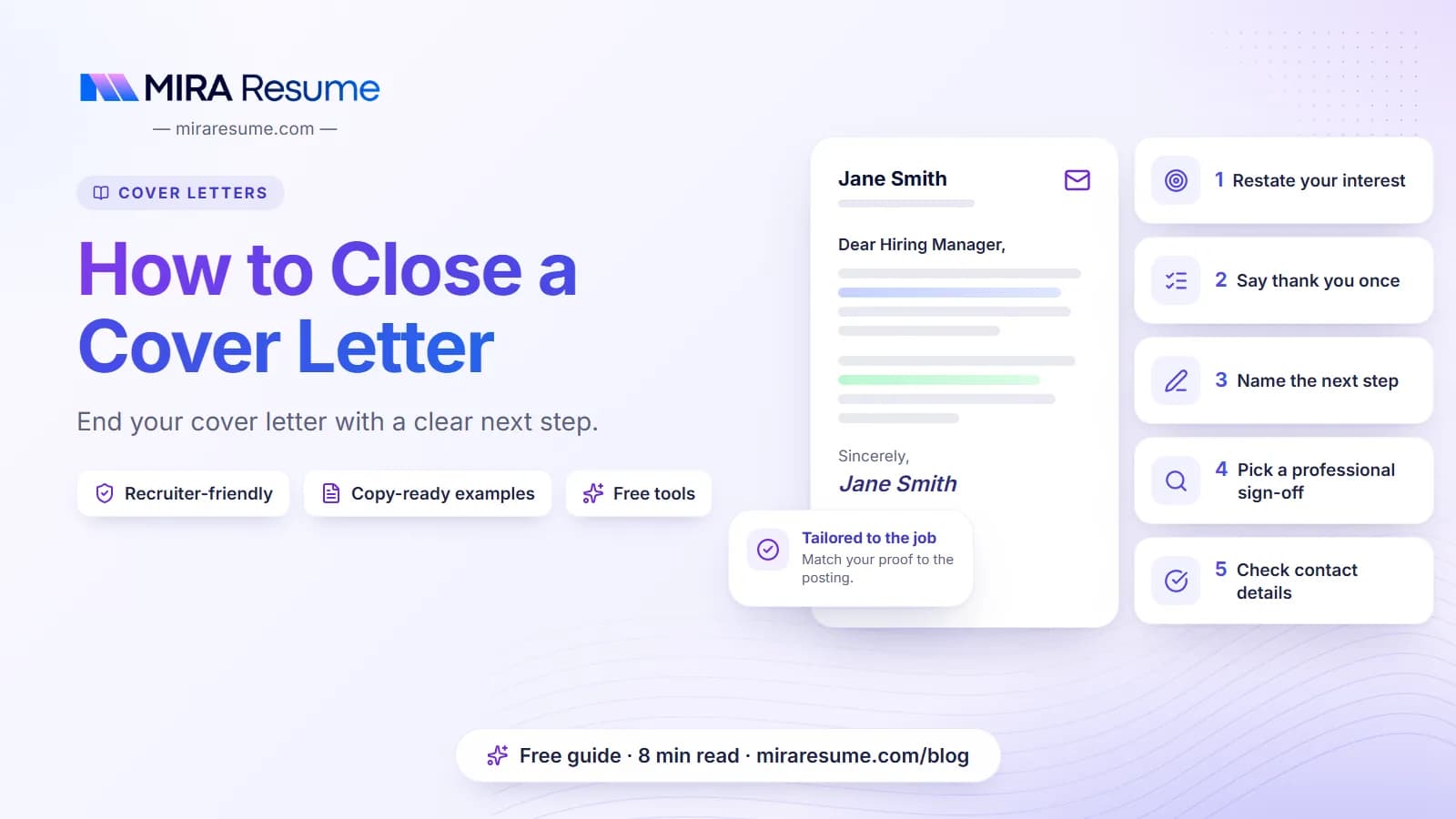

How to close a cover letter: end with a short paragraph of two or three sentences. Say once more that you want the job, thank the reader, and suggest a next step, such as a chat. Then finish with a simple sign-off like "Sincerely," and your full name.
The ending matters because it is the last thing a hiring manager reads. A weak close ("Hope to hear from you!") fades away. A clear one leaves a good final feeling and makes it easy to reply. Below you will find a simple formula, a list of sign-offs, and examples you can adapt in a minute.
A simple formula for how to close a cover letter
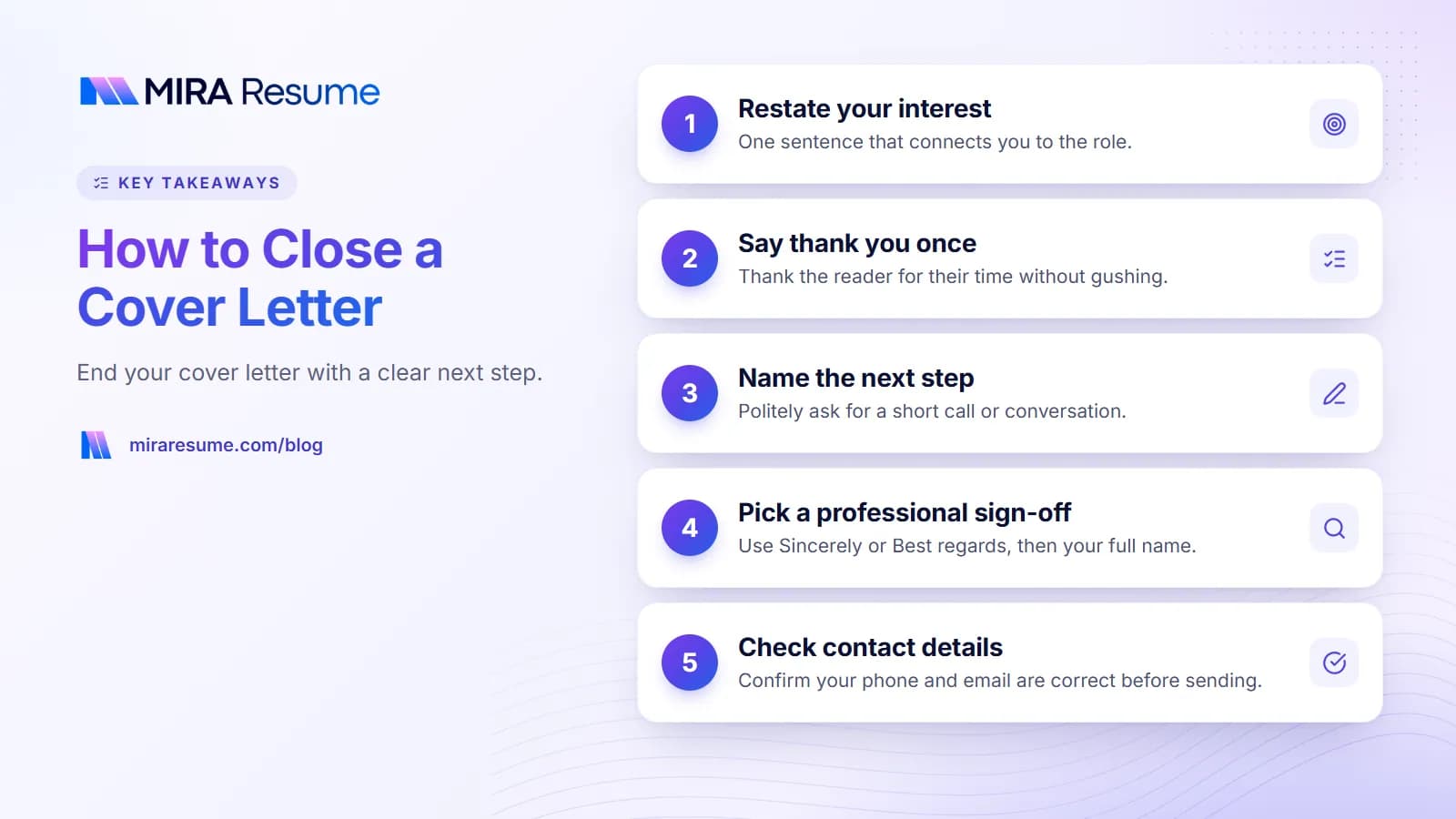
Every good closing paragraph does three small jobs. You can do all three in about 40 words.
- Restate your interest. One sentence that connects you to the role.
- Say thank you. Thank the reader for their time, without gushing.
- Name the next step. Invite a conversation, or say you will follow up.
The formula in action
I would enjoy the chance to bring my scheduling and customer-care skills to the Brightfield team. Thank you for considering my application. I would welcome a short call this week or next, and I can be reached at 555-0100 or [email protected].
That is 47 words. It repeats the fit, says thanks, and gives a way to reply. If your full letter is running long, see how long a cover letter should be.
How do you close a cover letter: sign-offs that work
Your sign-off is the short phrase before your name. Keep it professional. Here are good options and when to use them.
| Sign-off | Tone | Best for |
|---|---|---|
| Sincerely, | Classic and safe | Almost any job, especially when you know the name. |
| Best regards, | Warm and professional | Most corporate, tech and creative roles. |
| Kind regards, | Friendly and polite | Customer-facing roles and international applications. |
| Respectfully, | Formal | Government, law, education and academic jobs. |
| Yours sincerely, | Formal (British style) | When you started with "Dear Mr. Smith". |
| Yours faithfully, | Formal (British style) | When you started with "Dear Sir or Madam". |
| Thank you, | Simple and direct | Short emails or less formal workplaces. |
Avoid sign-offs that are too casual, such as "Cheers", "Thanks!!" or "Later". Also skip dramatic ones like "Yours eternally." After the sign-off, add a blank line, then type your full name. If you send a printed letter, leave space for a signature.
11 cover letter closing examples you can copy
Pick one that sounds like you and change the details. Avoid using the exact same sentence in every application, because you want each letter to feel written for that job.
Confident but polite
- I am excited about the chance to help [Company] reach its goals for [project or goal]. Thank you for your time, and I look forward to talking with you.
- My experience in [skill] matches what you are looking for, and I would be glad to explain how I can help your team. Thank you for considering me.
- I would welcome an interview to talk about how I can support [Company]. Thank you for your time and attention.
With a clear next step
- I will follow up by email next Friday to see if you need anything more from me. In the meantime, please feel free to reach me at [phone].
- I am available for a call at your convenience. Thank you for reviewing my application.
- Attached is my resume with more detail on my work in [field]. I would be glad to answer any questions.
For entry-level applicants
- I am eager to learn and ready to work hard. Thank you for taking the time to read my letter, and I hope we can talk soon.
- Thank you for considering a new graduate. I would love to show you what I can do in an interview.
For career changers
- I know I am coming from a different field, and I would appreciate the chance to explain how my [skill] carries over. Thank you for your time.
- My background in [old field] taught me [skill], and I am ready to use it in [new field]. I hope to speak with you soon.
For email applications
- Thank you for your time. My resume is attached, and I am happy to share work samples on request.
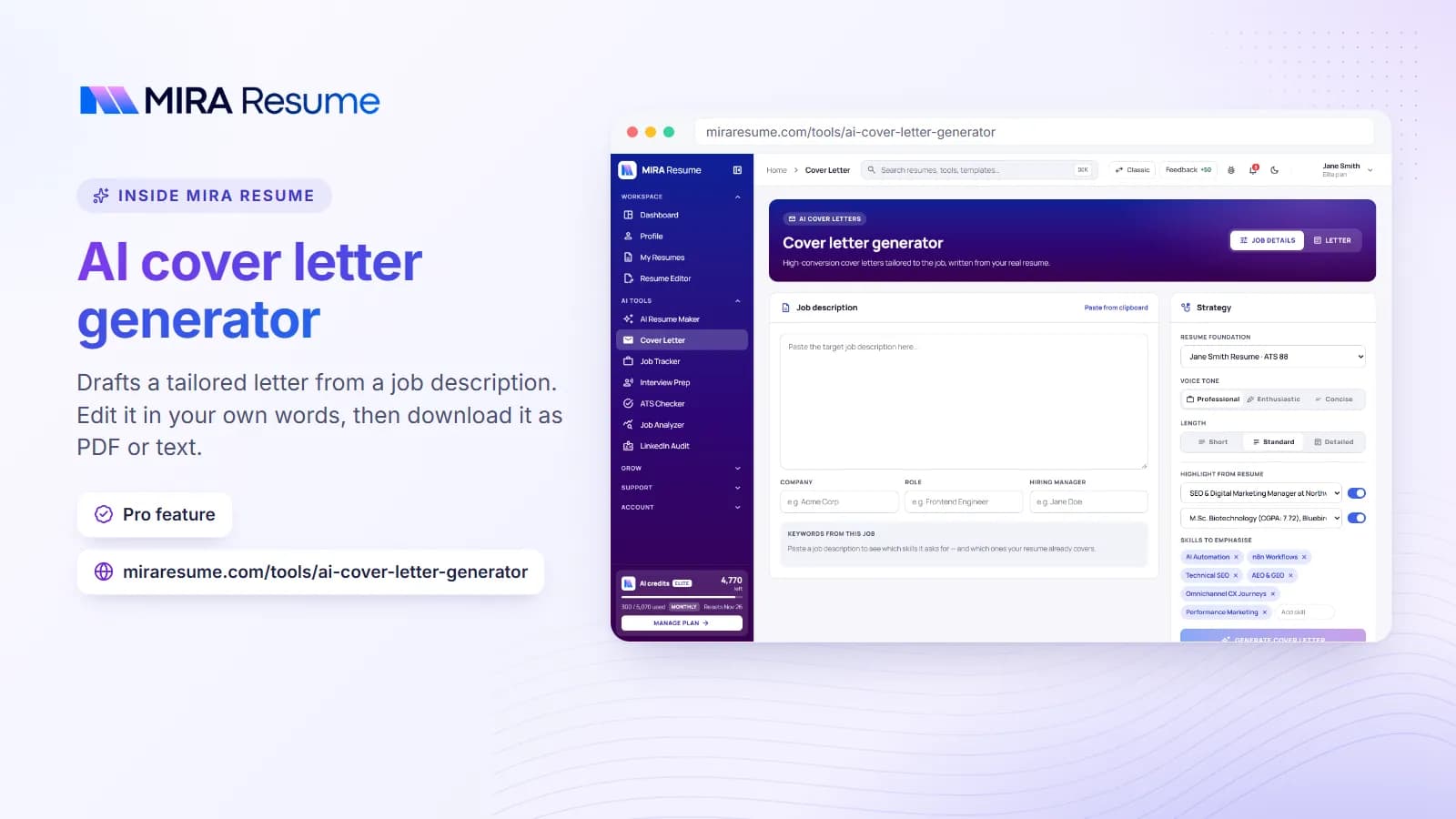
Want help drafting the full letter? The cover letter tool can write a first version that you adjust, and our cover letter examples show full letters from top to bottom.
How to end a cover letter with a call to action
A call to action is a polite request for the next step. It tells the reader what you would like to happen. Without one, the reader has to guess.
Good calls to action are specific and low pressure.
- "I would welcome a short call to talk about the role."
- "I can share a portfolio link or sample on request."
- "I will check in next week to see where things stand."
Only promise a follow-up if you will actually do it. A kind reminder one week later is normal, but do not send daily messages. Hiring managers differ, and some companies take weeks to answer.
What to avoid in a call to action
- Demands, such as "Call me as soon as you read this."
- Begging, such as "Please, I really need this job."
- Vague lines, such as "Let me know."
Once you do get an interview, finish well there too. Our guide to writing a thank you letter after an interview explains how to follow up.
What to put around the closing: signature, contact info and enclosures
The closing is more than a sentence. A tidy ending has a few small parts in the right order.
- Closing paragraph. Two or three sentences, as above.
- Sign-off. One word or short phrase with a comma.
- Typed name. Use the same name that is on your resume.
- Contact details. If your phone and email are in the header at the top, you do not need them again. If they are missing, add them under your name.
- Enclosure line (optional). On a formal printed letter you can write "Enclosure: Resume". In email, just say the resume is attached.
Make sure your name and contact details are easy to read. In an email, add a short signature with your name, phone and a profile link. Test the link before you send.
If you save the letter as a file, use a clear name like "Jane-Doe-Cover-Letter.pdf". Our Google Docs template guide shows how to export it.
Match your closing to the situation
The same ending does not suit every job. Think about who is reading and what they expect.
When you do not know the hiring manager
Keep the tone formal and the next step simple. Many readers are strangers, so a calm, clear sentence works best: "Thank you for your time. I look forward to the possibility of speaking with you." Use "Sincerely," as the sign-off.
When someone referred you
Mention the referral once near the start, then keep the ending short. You might say, "Thank you for considering my application. Jordan Lee suggested I reach out, and I would be glad to talk further." Do not name-drop in every paragraph.
When you are applying for a first job
Show energy without exaggeration. Say that you want to learn, and offer to share any school or volunteer work if they want more detail. A closing like "I would be glad to show you my class project in person" gives the reader something concrete.
When you are applying from another city or country
Add a short line about availability. For example, "I am planning to move to Denver in March and can start in April." Employers often worry about timing, and one clear sentence settles that question.
When the post says "no calls"
Obey it. Close with an invitation to reply by email: "I would be glad to answer any questions by email." Ignoring the instruction suggests you do not read carefully. If you want to build a full letter that fits the employer's request, see the Google Docs template.
| Situation | Focus of the final paragraph |
|---|---|
| Unknown reader | Polite, simple, formal |
| Referral | Mention the contact once, then invite a talk |
| First job | Willingness to learn plus an offer to show your work |
| Relocating | Start date and location in one sentence |
| No-call rule | Invite an email reply |
Common mistakes when you close out a cover letter
| Mistake | Why it hurts | Try this instead |
|---|---|---|
| "Hope to hear from you." | Passive and vague. | "I would welcome a short call next week." |
| Starting a new topic in the last paragraph | Closing should wrap up, not add new points. | Save new points for the body. |
| Too many thank-yous | Sounds nervous. | Thank the reader once. |
| Casual sign-off like "Cheers" | Feels too relaxed for a first contact. | Use "Best regards," or "Sincerely,". |
| Forgetting contact details | Makes it hard to reply. | Include phone and email once. |
| Name typed differently from resume | Looks careless to a person and can confuse systems. | Match your resume exactly. |
| Apologising ("Sorry for the long letter") | Draws attention to a flaw. | Trim the letter instead. |
Also check that your ending matches your opening. If you started with a story, you can nod back to it in the last line. For more on that, see how to start a cover letter.
Before and after: rewriting a weak closing
Seeing a weak ending fixed is the quickest way to learn. Here are three drafts and their better versions.
| Weak closing | Better closing |
|---|---|
| Thanks for reading. Hope to hear from you soon! | Thank you for reading. I would welcome a short call about the role, and my number is 555-0100. |
| I think I would be a really great fit and I am very passionate and hard-working so please consider me. | My four years in billing match the skills in your post, and I would be glad to explain how I can help your finance team. |
| Let me know if you need anything else. | If it helps, I can send two writing samples. I will check back with you next Friday. |
See the pattern? The better versions are shorter in feeling, more specific, and give the reader something to do. Tone matters too. Be warm and calm, never pushy, and never beg.
A quick checklist before you hit send
- Does the last paragraph restate your interest in one sentence?
- Have you thanked the reader once, politely?
- Is there a clear next step?
- Is the sign-off professional and followed by your full name?
- Are your phone number and email correct?
- Does the whole letter fit on one page?
- Is the company name right in every spot?
If your cover letter is solid but your resume needs work, review how a cover letter and resume fit together in cover letter vs resume. You can also check the resume itself with the ATS checker before you apply.