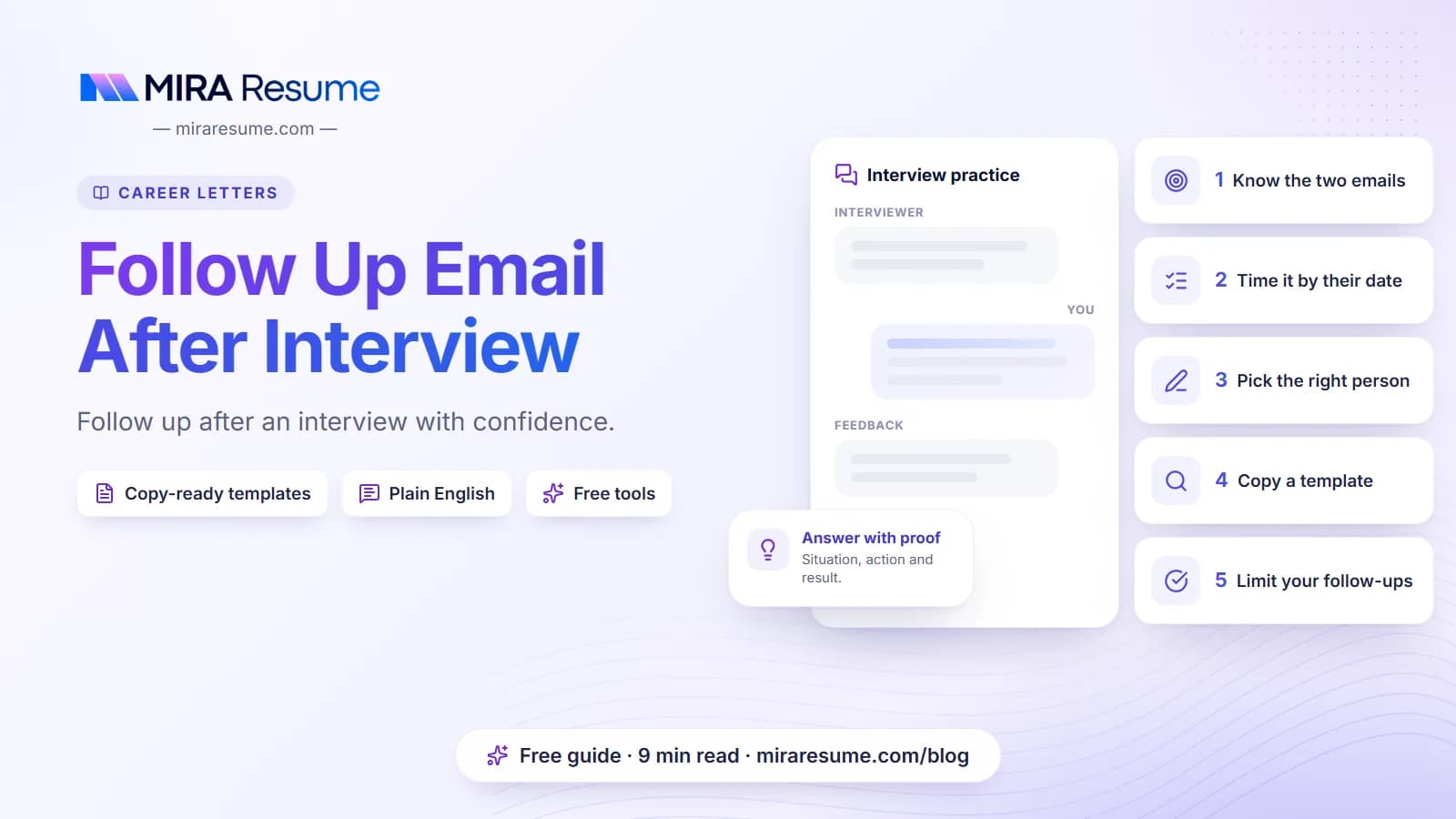

A follow up email after interview is a short, polite message that asks where the hiring process stands. You send it when the date they promised has passed, or when a week or so has gone by with no news. It keeps your name in front of them and shows you are still keen, without sounding pushy.
Waiting is hard. Most people either send nothing at all, or send three messages in three days. Neither helps. This guide gives you a simple timing plan, a few templates, and clear rules for what to say when there is still no reply.
One note before we start: a thank-you note and a status check are two different messages. This page is about the status check. If you need the thank-you, read our guide to the thank you letter after interview first.
General guidance only. Every employer works differently, so always follow any instructions the recruiter gave you.
Thank-you note or follow-up: what is the difference?
People mix these up all the time. They have different jobs, and you may need both.
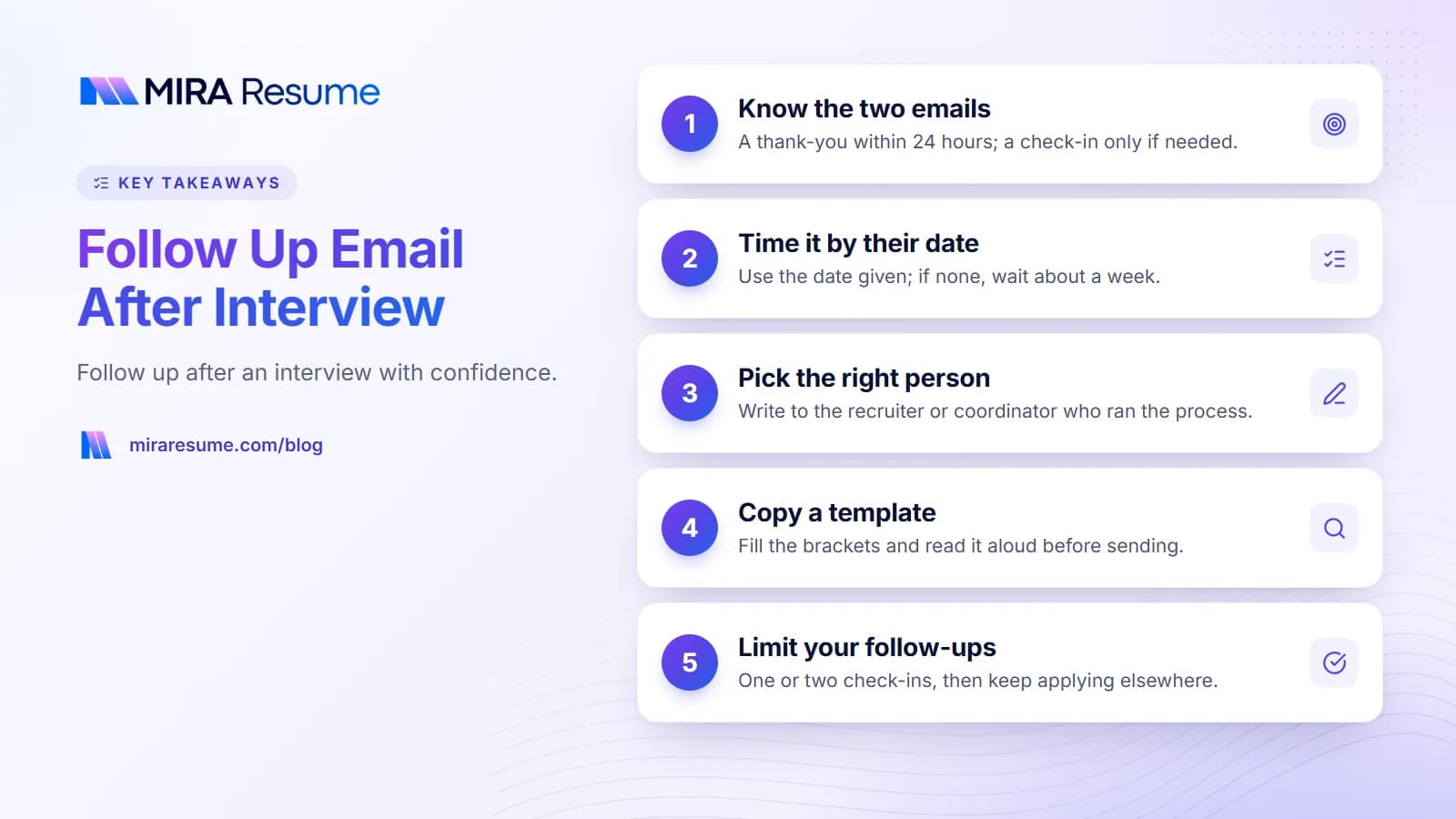
A thank-you note goes out within 24 hours. It says thanks, adds one useful point from the talk, and closes. A follow-up email goes out later, only if you have not heard back. It asks a simple question about the next step.
| Thank-you note | Follow-up email | |
|---|---|---|
| When | Within a day of the interview | After the promised date has passed |
| Main goal | Show appreciation and interest | Ask about the status |
| Length | Four to six sentences | Three to five sentences |
| Asks a question? | No | Yes, one |
| Needed every time? | Almost always | Only when you hear nothing |
If you have already sent your thank-you, do not send a second one. Your follow-up should read as a fresh, short check-in. You can mention the thank-you in one clause, but you do not need to.
How long to wait before you follow up
The best rule is simple. Use the date they gave you. If the interviewer said, "We will decide by Friday," wait until Friday has passed, then send your message the next business day.
If nobody gave a date, ask at the end of the interview: "What are the next steps, and when should I expect to hear from you?" It is a normal question. If you forgot, wait about five to seven business days.
| Situation | When to send | Tone |
|---|---|---|
| They gave you a date | The next business day after that date | Friendly and brief |
| No date given | About one week after the interview | Friendly and brief |
| You have a competing offer with a deadline | As soon as you know the deadline | Clear and honest |
| Second check-in after no reply | One to two weeks after the first | Short, calm |
| Final message | Two to three weeks after the second | Gracious, door left open |
A word about slow hiring
Hiring can be slow for reasons you cannot see. A manager may be on holiday, a budget may be waiting for approval, or another round of interviews may be running. Silence does not always mean no. That is why a calm tone matters. You are checking in, not demanding an answer.
Best day and time
There is no magic hour. A weekday morning is a sensible choice because your message lands near the top of the inbox. Avoid late Friday evening, when things get buried over the weekend.
Who should you send it to?
Send it to the person who has been managing your process. That is usually the recruiter or the hiring coordinator who set up your interview. If you only dealt with the hiring manager, send it to them.
- Recruiter or coordinator: Best first choice. They know the schedule and are used to these questions.
- Hiring manager: Fine if you have no other contact, or if the manager told you to write to them directly.
- Several interviewers: Write to one person. Do not send the same message to the whole panel.
- A generic company inbox: Use this only as a last resort, and be prepared for a slow answer.
Reply in the same email thread whenever you can. It keeps your earlier messages in view, so the reader remembers who you are and which role you mean. If you must start a new thread, put the job title in the subject line.
Subject lines that work
- Following up: [Job Title] interview
- Checking in on the [Job Title] role
- [Your Name], [Job Title] interview on [Date]
- Quick question about next steps
Keep it plain. A clear subject helps busy people sort their mail. Avoid all capital letters, lots of exclamation marks, or words like "urgent".
Interview follow up email templates you can copy
Copy a template, replace the brackets, and read it aloud once. If it sounds like something you would say to a kind stranger, it is ready.
1. The standard check-in
Subject: Following up: [Job Title] interview
Hello [Name],
I hope your week is going well. I enjoyed speaking with you on [date] about the [Job Title] role, and I remain very interested in joining [Company].
I wanted to check whether there is any update on the timeline. If you need anything more from me, such as work samples or references, I am happy to send them.
Thank you for your time.
Best regards,
[Your Name]
[Phone number]
2. When they gave you a date that has passed
Subject: Checking in on the [Job Title] role
Hi [Name],
When we spoke on [date], you mentioned that a decision would be made by [date]. I wanted to ask whether the timeline has changed.
I am still excited about the role and would be glad to answer any further questions.
Thanks very much,
[Your Name]
3. When you have another offer
Subject: [Job Title] interview: timing question
Hello [Name],
Thank you again for the interview on [date]. [Company] is my first choice, so I wanted to be open with you. I have received another offer that needs an answer by [date].
Would you be able to tell me where my application stands before then? I understand if a decision is not possible yet, and I appreciate any guidance.
Kind regards,
[Your Name]
Only use template 3 if the other offer is real. Never invent one. Hiring teams talk to each other, and trust is hard to win back.
4. The short version for a very casual workplace
Hi [Name], just checking in on the [Job Title] role. I am still very interested, and I am happy to share anything else that would help. Thanks again for your time! [Your Name]
What to do if there is still no response
Sending one message is normal. Sending four in a week is a problem. Use a small plan and then move on with your search.
- First check-in: use a template above after the promised date.
- Second check-in: wait one to two weeks. Keep it shorter than the first, and add something of value if you can, such as a link to a relevant project.
- Final note: wait a few more weeks. Thank them, say you are moving forward with other options, and say you would still like to hear from them.
- Move on: keep applying while you wait. Treat any reply as a bonus.
Second check-in example
Subject: Re: Following up: [Job Title] interview
Hello [Name],
I wanted to follow up once more on the [Job Title] position. I know hiring can take time. If the role is still open, I would love to hear about the next steps.
Thank you for considering me.
Best,
[Your Name]
Final, graceful note
Hello [Name],
I have not heard back, so I assume the team has gone in a different direction. I appreciate the time you spent with me, and I enjoyed learning about [Company]. If another suitable role opens up, I would be glad to hear from you.
Wishing you and the team all the best,
[Your Name]
This last message costs you nothing and leaves a good impression. Some people do get a reply months later, when a role reopens or a first choice declines.
| Message | Gap since last message | Goal |
|---|---|---|
| Thank-you note | Within a day of interview | Appreciation |
| First check-in | After the promised date or about a week | Ask for status |
| Second check-in | One to two weeks | Gentle reminder |
| Final note | Two to three weeks | Close the loop kindly |
Common mistakes to avoid
- Writing too soon. Checking in the day after the interview, before their deadline, can feel impatient.
- Writing too often. More than three or four messages in total moves from keen to annoying.
- Sounding upset. Lines like "I still haven't heard anything" sound like blame. Keep your tone warm.
- Asking for feedback too early. Wait for a decision before asking why. Then ask politely.
- Writing a long email. If it needs scrolling, it is too long.
- Using a vague subject line. "Hi" or "Question" can be ignored.
- Calling the main office. Unless you were told to phone, stick with email.
- Making up urgency. Do not claim another offer unless you have one.
- Typos in names. Always check spelling of the person and company.
Quick tone check
| Instead of | Try |
|---|---|
| "I'm still waiting to hear from you." | "I wanted to check whether there is an update on the timeline." |
| "Why haven't you replied?" | "I understand things may be busy right now." |
| "I need an answer today." | "Could you let me know when I can expect a decision?" |
| "Just following up again!!!" | "I wanted to follow up once more on the role." |
Interview follow up email: tips for different situations
Not every interview is the same. Here is how to adjust.
After a phone screen
Phone screens often lead to quick decisions. If you were told you would hear within a few days, wait for those days to pass, then send the standard check-in. Keep it very short.
After a panel interview
Write to the person who coordinated the day. Mention that you enjoyed meeting the whole team. Do not copy every panelist.
After a final round
This is the point where a short note carries the most weight. Restate your interest in one sentence and ask when you can expect a decision. If you have a deadline from another employer, share it honestly.
When a recruiter at an agency is involved
Write to the agency recruiter, not the employer. They are your link, and they usually get news faster than you do.
When you are still employed
Use your personal email and phone number, and say so if it matters. Do not ask a company to contact you at your current workplace.
Use the waiting time well
While you wait, do something helpful for your search:
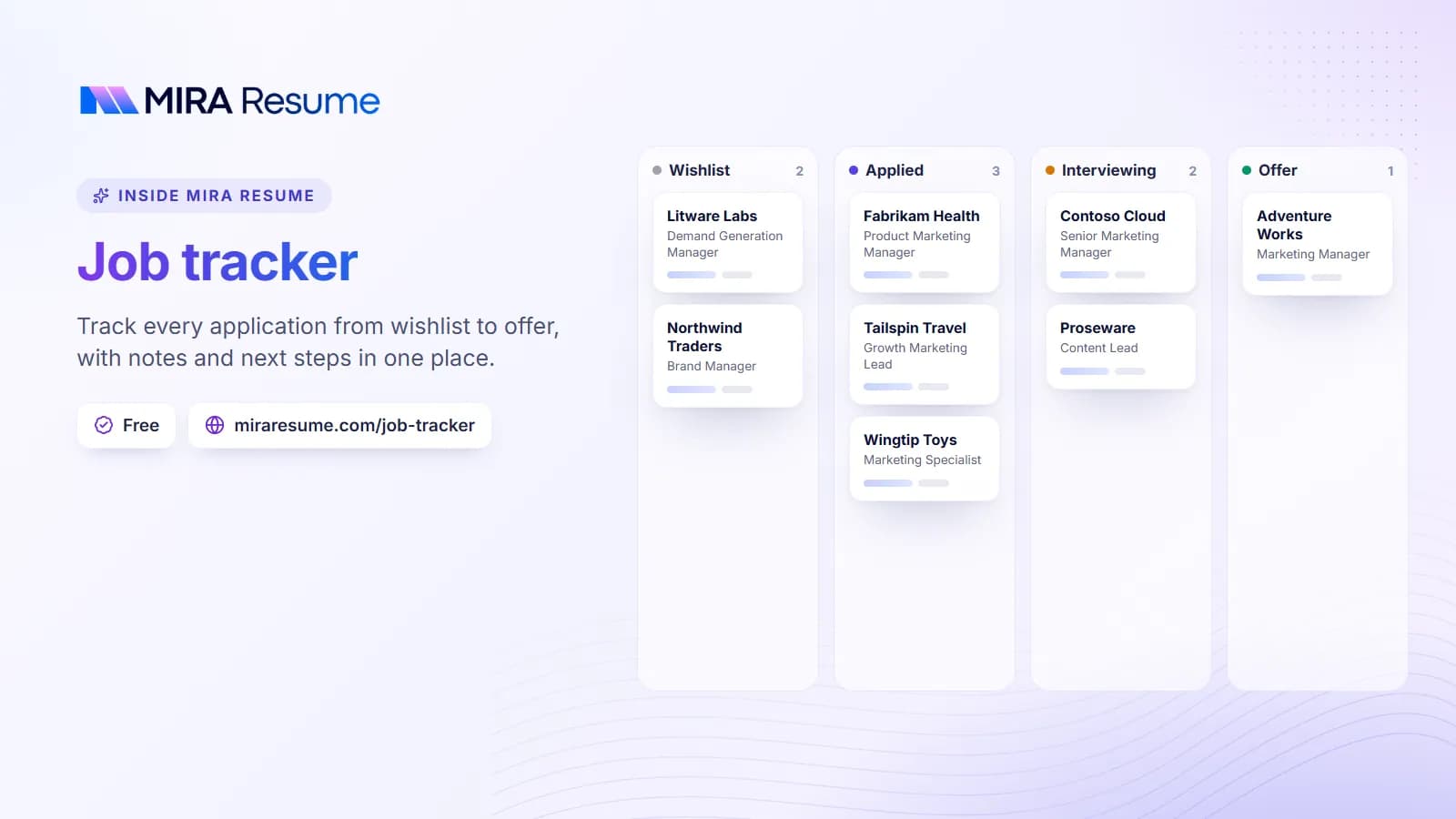
- Log the interview, dates and contacts in the job tracker so you know exactly when to follow up.
- Practice for the next conversation with interview prep.
- Refresh your documents with the resume builder, and check them with the ATS checker.
- Make sure your LinkedIn profile matches the story you told in the interview.
- Keep applying. Our guide on what a cover letter is can help with the next one.
What to do when you get a reply
Replies come in three kinds. Each has a simple next step.
They want to move forward
Reply within a few hours. Confirm any dates, thank them, and ask what to prepare. If an offer follows, take a little time to read it fully. If you later decide to leave your current job, our guide on how to resign can help.
They need more time
Thank them and ask whether it is okay to check in again on a certain date. This gives you a clear plan and shows respect for their process.
They chose someone else
Thank them for letting you know. A short, kind reply keeps the door open:
Thank you for letting me know. I appreciate the chance to interview. If you can share any feedback, I would value it, and I would be glad to be considered for future roles.
Feedback is not guaranteed, and some companies cannot share it. That is normal. Move your energy to the next application.
Whatever the answer, you showed good manners and followed a clear process. That habit pays off across a long career.