
How long should a cover letter be? Most guides suggest one page, or about 250 to 400 words. That is roughly three or four short paragraphs, plus a greeting and a sign-off. A reader should be able to finish it in about a minute.
These numbers are a guideline, not a law. Hiring managers differ, and some job posts give their own limits. But for nearly every job, a tight one-page letter beats a long one. A busy reader who sees a wall of text may skip it.
This guide shows you the right length for different situations, how to cut a long draft down, and what to keep when you have to trim. You will also get a table you can use as a quick cheat sheet.
The short answer: one page and about 300 words
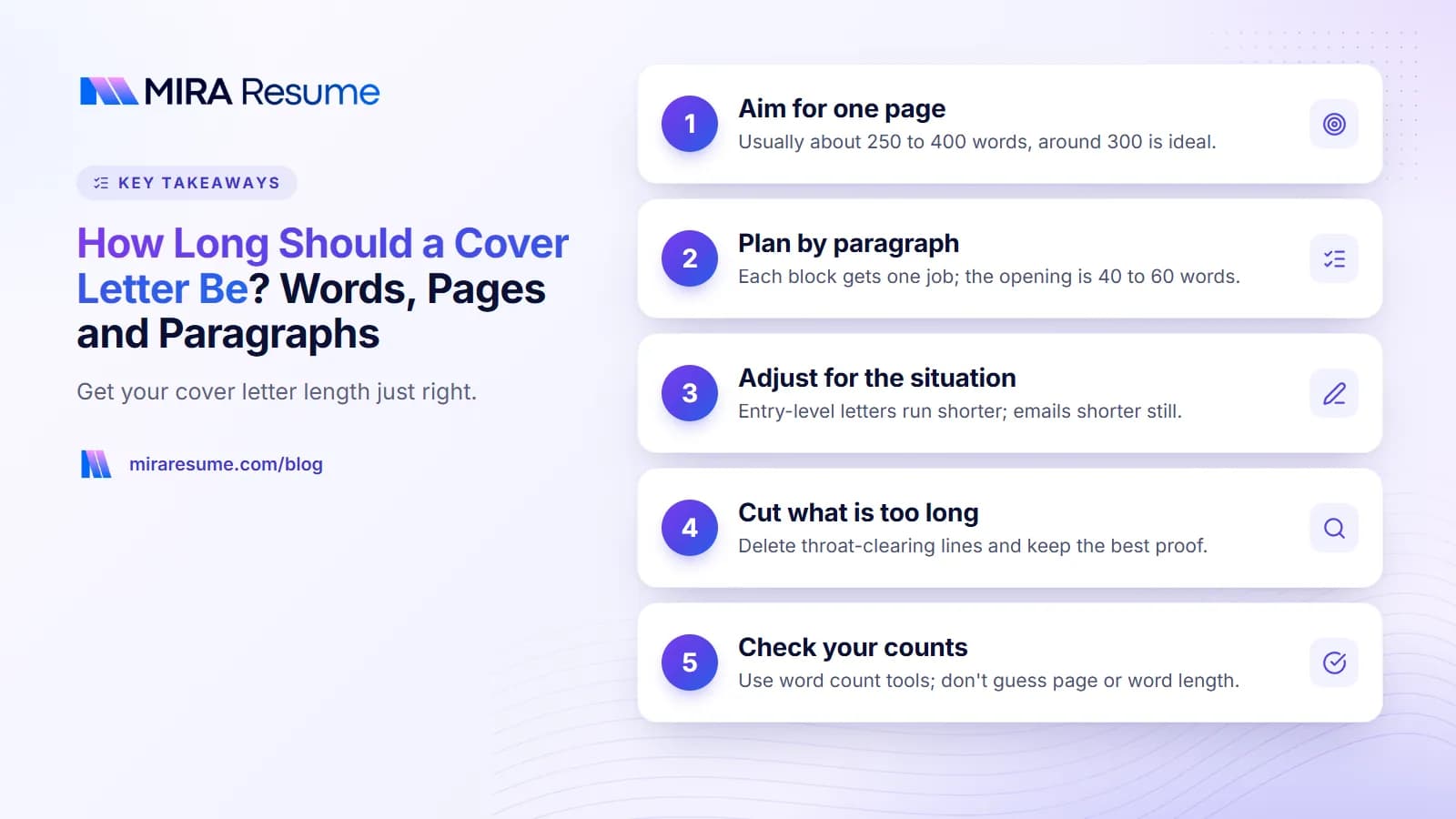
A good target is about 300 words. Many strong letters land between 250 and 400. Here is the full picture.
| Measure | Target | Notes |
|---|---|---|
| Pages | 1 page (never more than 1 for most jobs) | Half a page is fine for short, direct letters. |
| Words | 250 to 400 | Under 200 can feel thin; over 450 starts to feel heavy. |
| Paragraphs | 3 to 4 body paragraphs | Plus a greeting and a closing line. |
| Sentences per paragraph | 2 to 4 | Break up anything longer. |
| Reading time | About 1 minute | Test it by reading aloud. |
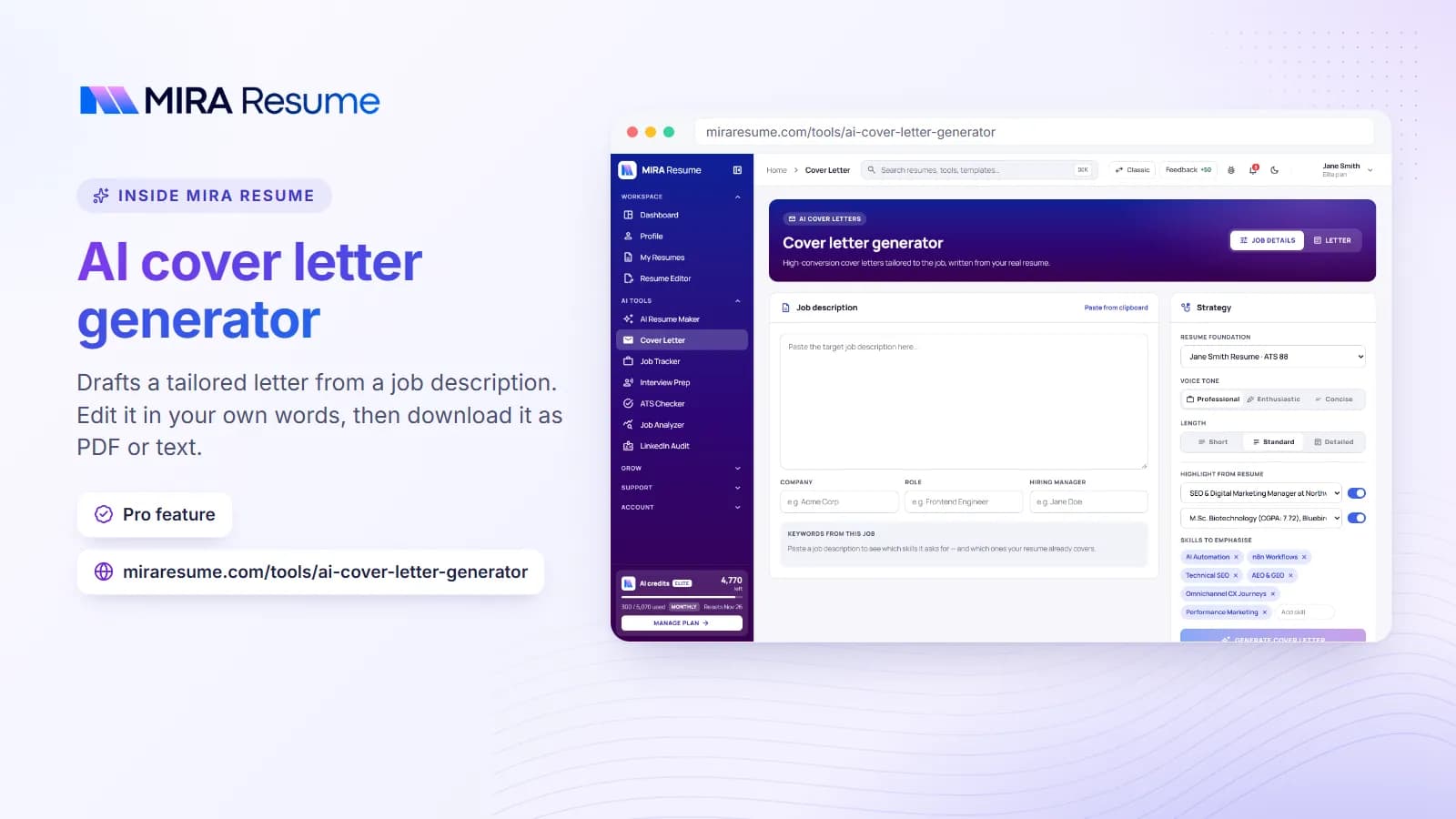
If you want a ready layout that already fits these limits, use the Google Docs cover letter template or browse our cover letter templates.
How many words should a cover letter be? A paragraph-by-paragraph plan
If you wonder how many words should a cover letter be in total, think in blocks. Each paragraph has one job, and each can be short.
- Opening (40 to 60 words). Name the job and give one strong reason you are a match. See how to start a cover letter.
- Proof paragraph (80 to 120 words). Give one or two short stories that match the job post. Use real results when you have them.
- Company paragraph (50 to 80 words). Say why this employer interests you. Be specific.
- Closing (30 to 50 words). Thank the reader and invite a reply. For ideas, read how to close a cover letter.
Add those up and you get about 200 to 310 words, plus the greeting, sign-off and your name. That fits comfortably on one page with normal margins.
A sample opening at the right size
I am applying for the Office Coordinator role at Brightfield Dental. For three years I have kept a busy front desk running smoothly, from booking to billing, and your post's focus on friendly patient care is exactly what I enjoy most.
That is 48 words. It names the job, gives experience and ties it to what the employer wants. Nothing is wasted.
How long should cover letters be for different situations?
The rule of one page works almost everywhere, but a few cases are worth noting.
| Situation | Suggested length | Why |
|---|---|---|
| Most jobs | 250 to 400 words, one page | Enough room for proof, short enough to be read. |
| Entry-level or no experience | 200 to 300 words | You have less to show, so keep it focused on skills and interest. |
| Internship | 200 to 300 words | Recruiters read many; short and clear wins. See our IT internship sample. |
| Senior or manager role | 300 to 400 words | A bit more room for scope and results, but still one page. |
| Career change | 300 to 400 words | You need space to link past work to the new field. |
| Email body as cover letter | 120 to 200 words | Emails should be shorter than a printed letter. |
| Application form text box | As the box allows | Follow any character limit exactly. |
| Academic or research jobs | Can run to 2 pages | Some fields expect more detail. Check the job post. |
When in doubt, check what the employer says. If the post asks for "a brief letter" or "no more than 300 words", obey that. Following instructions is itself a sign you can do the job.
How long are cover letters when you apply by email?
If you paste your letter into an email, keep it shorter. Think of an email as a quick note that carries your resume. Aim for 120 to 200 words, and put the key point in the first two lines.
You have two choices when emailing an application.
- Attach a letter and write a short note. The email says who you are, the job you want and that your resume and letter are attached. Three or four lines is enough.
- Use the email itself as the letter. Skip the address block and the date. Start with a clear subject line, such as "Application: Office Coordinator – Jane Doe".
Either way, write a plain subject line and use the same polite tone as a printed letter. If you are sending a thank-you message after a meeting, shorter still works best, as in our thank you letter after an interview guide.
How to cut a cover letter that is too long
Most first drafts are too long. That is normal. Use this checklist to trim without losing the good parts.
- Delete the throat-clearing. Lines like "I am writing to express my interest in the opportunity that was advertised" can become "I am applying for the Sales Associate role."
- Remove repeats from your resume. If the fact is a bullet on your resume, only keep it in the letter if you add a story or a reason. The cover letter vs resume guide explains the split.
- Keep two proof points, not five. Pick the ones closest to the job post.
- Cut adjectives. Words like "highly motivated" and "extremely passionate" take space and prove little.
- Shorten sentences. If a sentence has more than about 25 words, split it or trim it.
- Read the result aloud. Remove any line you would not say to a hiring manager in person.
Before and after
| Too long | Tight |
|---|---|
| I would like to take this opportunity to say that I am extremely excited about the prospect of joining your esteemed team. | I would be glad to join your team. |
| In my previous position, I was responsible for the management and coordination of the scheduling of staff members. | I scheduled shifts for a team of 12. |
| Please do not hesitate to contact me at any time if you require any further information. | You can reach me at 555-0100. |
What to keep when you only have a few lines
If you must squeeze everything into 200 words, protect these items first.
- The job title you want, so the reader knows what you are applying for.
- One result or strength that matches the post.
- One reason for this company. A detail shows you did more than copy and paste.
- A clear closing with a way to reach you.
You can drop the long list of duties, the school story and any general statement about "hard work". Those details belong on your resume, which you can build with the AI resume builder if you need a cleaner version.
Format matters for length too. Narrow margins and a tiny font can squeeze in more words, but they make the page harder to read. Keep the font at 10.5 to 12 points and margins near an inch.
A full sample at the right length (about 290 words)
Seeing a complete letter helps more than any rule. Here is one at a healthy length. Notice how every paragraph is short and has one clear job.
Dear Ms. Alvarez,
I am applying for the Customer Support Specialist role at Northline Home. I have spent three years answering customer questions for an online store, and I enjoy turning a worried message into a happy reply.
In my current job, I answer about 40 chats and emails a day. I wrote a set of short help articles for our most common questions, and the number of repeat questions dropped. I also trained two new teammates on our ticket system. Your post asks for someone who can write clearly and stay calm with upset customers. Those are the two things I work on every day.
I like that Northline Home offers free repair advice with every order. It shows that your team cares about customers after the sale, which is how I like to work too.
I would welcome the chance to talk about how I can help your support team. Thank you for your time. You can reach me at 555-0100 or [email protected].
Sincerely,
Sam Rivera
Why this length works
- The opening names the job and shows fit in two sentences.
- The proof paragraph uses real tasks and ties them back to the job post.
- The company paragraph is only two sentences, but it is specific.
- The closing is brief and gives contact details.
The numbers in a sample like this are only an example. Use your own true figures, or describe results in plain words if you do not track them. More full letters are in our cover letter examples.
How to check your word count and page count
Do not guess. Use the tools you already have.
- Google Docs: press Ctrl+Shift+C (Cmd+Shift+C on Mac) to open Word count. Select only the body first if you want to leave out your address block.
- Microsoft Word: look at the bottom-left of the window, or go to Review, then Word Count.
- Print preview: check that the letter ends on page one and that the signature is not stranded alone on page two.
If you are close to the limit, read the last two sentences and ask whether the letter still works without them. If it does, delete them. It is almost always easier to improve a letter by removing something than by adding something.
One more check: look at white space. A page with small gaps between paragraphs looks inviting. A page packed to the edges looks like work. White space is part of good length, even though it does not appear in the word count.
Common mistakes about cover letter length
- Going past one page. A second page suggests you cannot choose what matters.
- Writing three lines only. A very short note may look like you did not try. Give at least one real proof point.
- Telling your life story. Start with the present job fit, not your childhood.
- Repeating the resume. The letter should add context, not copy bullets.
- Ignoring instructions. If the job post sets a word limit, stay inside it.
- Shrinking the font to fit. Cut words instead.
Once your draft is the right size, run it past a second pair of eyes or paste the job post into the job analyzer to see which keywords you may have missed. Then you can write or polish the final copy with the cover letter tool.