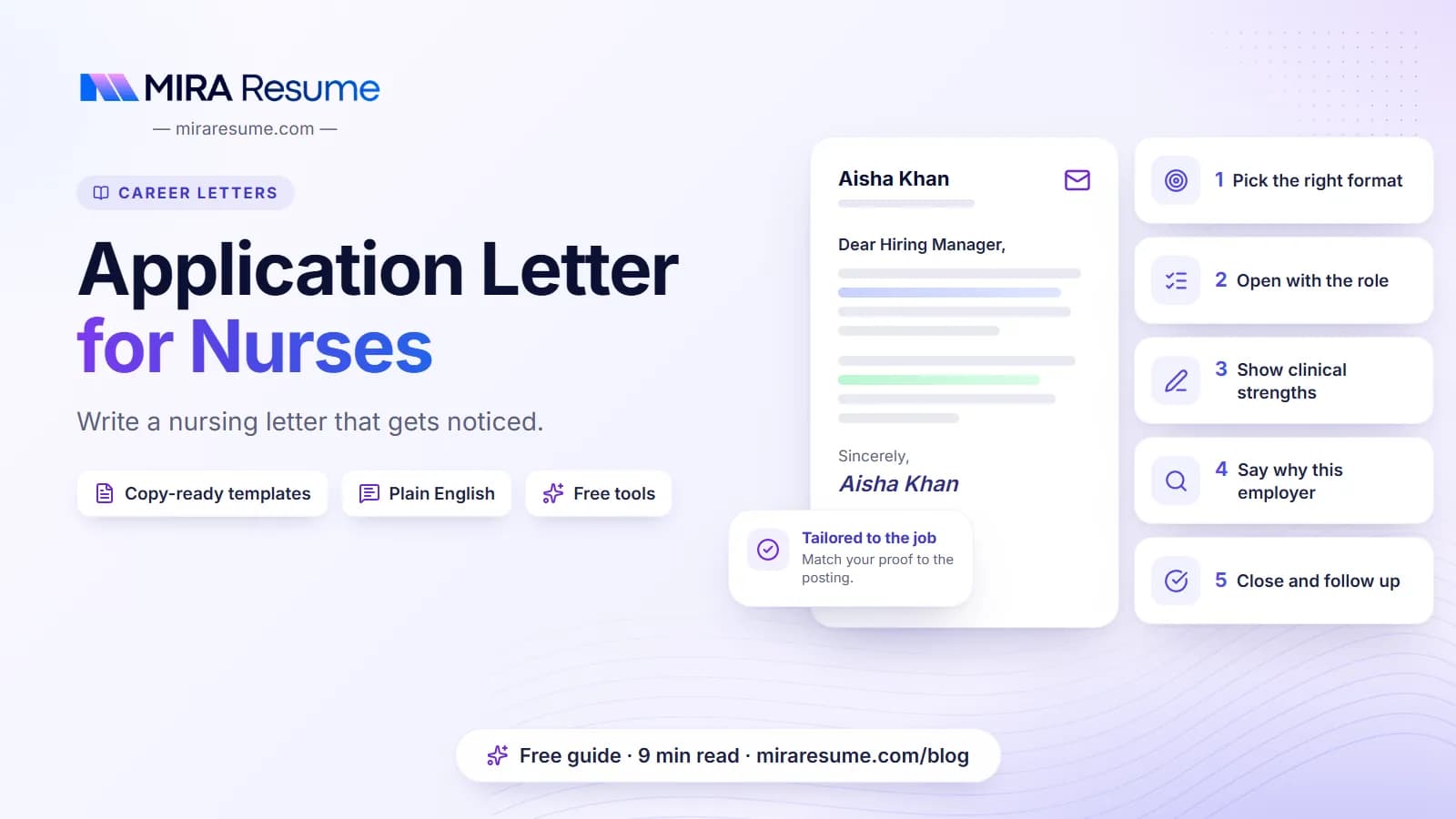

Looking for an application letter for nurses example you can follow? Here is the simple version. A nursing application letter is a one-page note that goes with your resume. It tells the hiring manager which role you want, shows your license and your care skills with real examples, and asks for an interview.
Nurse managers read many letters, so clear and honest writing stands out. You do not need fancy words. You need a calm, caring tone and proof that you can do the work safely. This guide gives you a structure, three examples, a template and a list of mistakes to avoid.
If you are applying for a registered nurse job in particular, our registered nurse cover letter page has role-specific help. This article is the general guide for all kinds of nursing roles.
Application letter or cover letter: which one does the hospital expect?
The two names are often used for the same thing, but the expected format can differ. Many hospitals and agencies, especially government hospitals, nursing councils and recruitment drives in countries such as India, the Philippines, Nigeria and Kenya, expect a formal application letter. Private hospitals in the US, Canada and Australia usually expect a shorter, more personal nursing cover letter. Read the job post first: if it names a format, a reference number or a person to address, follow it exactly.
| Feature | Formal application letter | US-style nursing cover letter |
|---|---|---|
| Typical use | Government and public hospitals, walk-in or advertised vacancies, overseas recruitment | Private hospital and clinic jobs applied for online |
| Addressing | Official title, e.g. "The Medical Superintendent" or "The Chief Nursing Officer", plus the hospital address; sometimes "Through: proper channel" for in-service staff | The nurse manager or recruiter by name, or "Dear Hiring Manager" |
| Subject line | Expected: "Subject: Application for the post of Staff Nurse (Advt. No. ...)" | Not used in a letter; only in an email subject |
| Tone | Formal and respectful ("I wish to apply", "I humbly request") | Professional but warm and direct |
| Content | Qualifications, registration number, years of experience, enclosures list | Two or three clinical stories that show fit for the unit |
| Ending | "Yours faithfully" (unnamed recipient) or "Yours sincerely" (named), with a list of enclosed documents | "Sincerely" and a request for an interview |
Formal application letter layout
[Your name]
[Address]
[Phone] | [Email]
[Date]To
The Chief Nursing Officer
[Hospital name]
[Hospital address]Subject: Application for the post of Staff Nurse (Advertisement No. [number], dated [date])
Respected Sir/Madam,
I wish to apply for the post of Staff Nurse advertised in [source] on [date]. I hold a [B.Sc. Nursing / GNM] from [college], completed in [year], and I am registered with the [nursing council] (Registration No. [number]).
[One paragraph on experience: wards, years, key duties and any special training such as BLS or ICU care.]
I have enclosed copies of my certificates and registration for your review. I would be grateful for the opportunity to attend an interview at your convenience.
Yours faithfully,
[Signature]
[Your name]Enclosures: Resume, degree certificate, council registration, experience certificate
Use the hospital's own job title and reference number exactly as printed. If you are not sure whether a formal letter or a cover letter is expected, the formal layout is the safer choice for public-sector jobs, and the cover letter style for private employers that apply online. For overseas applications, also check our guide on the letter of intent format, which some recruitment agencies ask for.
What goes in a nursing application letter
Nursing letters follow a standard business layout, but the content has a few special points. Hiring managers want to know that you are licensed, safe and a good fit for their unit.
| Part | What to include |
|---|---|
| Header | Your name, phone, email, city, and the date |
| Greeting | The nurse manager or recruiter by name when possible |
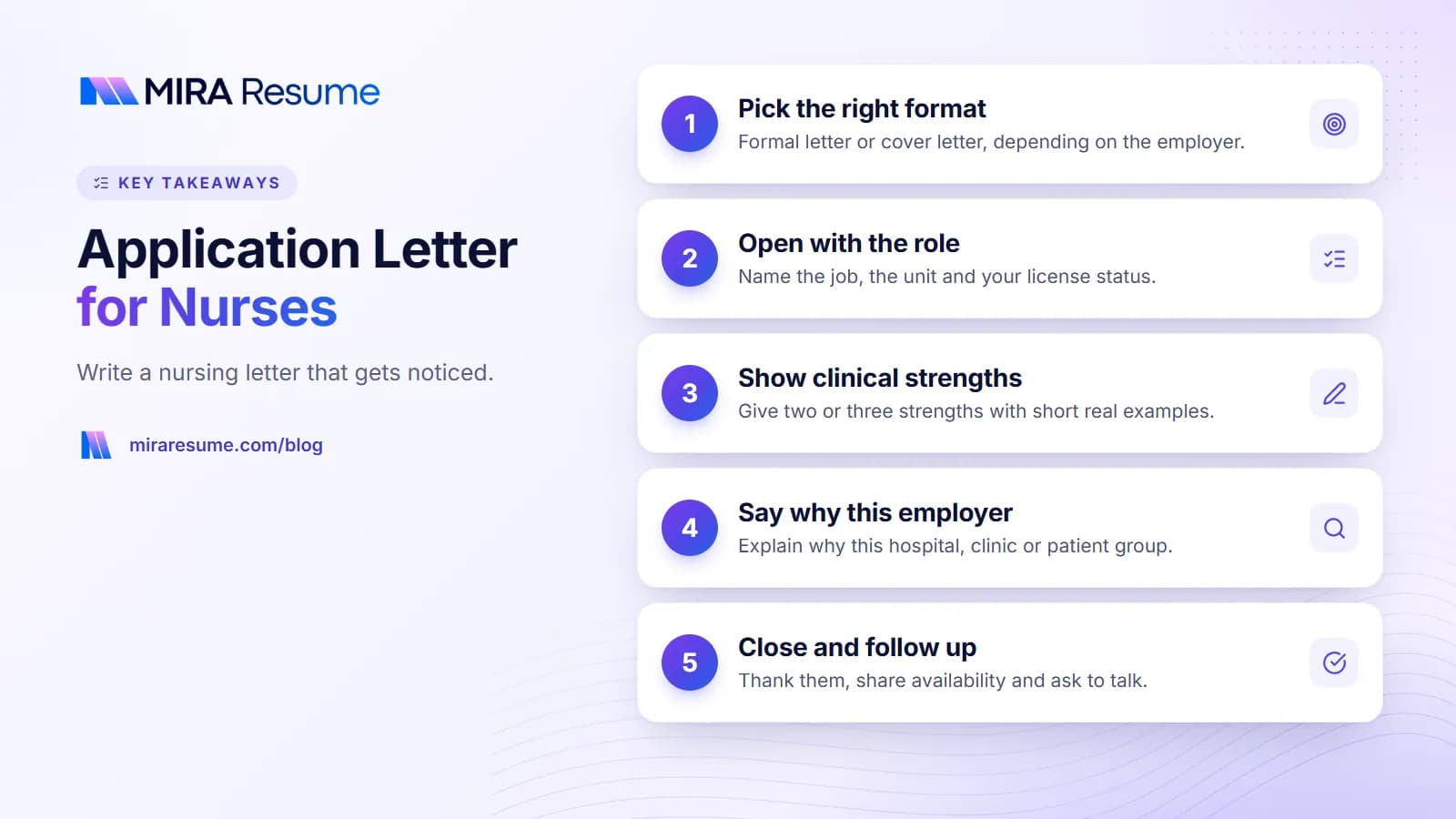
| Opening | The role, the unit, and your license status |
| Skills paragraph | Two or three clinical strengths with short examples |
| Fit paragraph | Why this hospital, clinic or patient group |
| Closing | Thanks, your availability, and a request to talk |
Details to state clearly
- License: say which license you hold or are waiting for, such as RN, LPN or LVN, and the state or region. Only list what is true and current.
- Setting and experience: mention the type of unit you have worked in, such as medical-surgical, pediatrics or emergency.
- Education and clinical hours: for new graduates, name your program and a relevant placement.
- Certifications: list those that match the job, like BLS or ACLS, if you have them.
Protect patient privacy in your examples. Never include names or details that could identify a person.
Example of application letter for nursing: new graduate
If you just finished your program, your clinical placements and your motivation carry the letter. This example is for a new graduate applying to a medical-surgical unit.
Hannah Okafor
Denver, CO | [email protected] | 555-012610 November 2026
Ms. Teresa Morgan, RN, MSN
Nurse Manager, Medical-Surgical Unit
Riverside Community HospitalDear Ms. Morgan,
I am excited to apply for the Registered Nurse position on your medical-surgical unit. I graduated in May with my Bachelor of Science in Nursing, passed the NCLEX-RN, and hold an active RN license in Colorado.
During my clinical rotations, I cared for patients on a busy medical-surgical floor for 240 hours. I learned to give medications safely using the five rights, to monitor vital signs, and to document clearly. One of my proudest moments was sitting with an anxious patient before surgery, explaining each step in simple words, and seeing them relax. My preceptor praised my calm communication and my careful charting.
Riverside's reputation for supporting new nurses through a residency program is a big reason I am applying. I am a quick learner, I ask questions when I am unsure, and I work well with a team.
My resume is attached. Thank you for your time. I would welcome the chance to discuss how I can contribute to your unit.
Sincerely,
Hannah Okafor, RN
Why it works
- It states license status in the first paragraph.
- It gives clinical hours and a short, human example.
- It shows safe habits: asking questions, careful charting.
- It names a real feature of the employer, the residency program.
Use only hours and credentials that are accurate for you. For a resume that matches, see our guide to the medical assistant resume as a model of how to present clinical skills clearly.
Example for an experienced nurse
When you have worked for several years, show growth, responsibilities and results. Keep it to what a manager needs.
Dear Mr. Alvarez,
I am writing to apply for the Charge Nurse position in the Emergency Department at Lakeview Medical Center. I have been a registered nurse for seven years, the last five in a Level II emergency department, and I hold current BLS, ACLS and PALS certifications.
In my current role, I care for a wide range of patients, from minor injuries to critical cases. I often serve as relief charge nurse, where I assign patients, support new staff and coordinate with physicians and other departments. I helped introduce a simple handoff checklist that our team adopted, and nurses told us it made shift change clearer.
I am known for staying calm during busy shifts and for helping colleagues. I take pride in clear communication with patients and their families, even in stressful moments.
Lakeview's focus on teamwork in the emergency department fits how I like to work. My resume is attached, and I would be glad to meet and talk about the role.
Sincerely,
Marcus Bell, RN, BSN
What makes this letter useful to a manager
- It tells them the specific unit and the years of experience.
- It lists certifications related to the job.
- It gives one example of improvement. Share only what you truly did.
- It shows leadership without bragging.
| Your situation | Lead with | Support with |
|---|---|---|
| New graduate | License status and program | Clinical placements, preceptor feedback |
| Experienced nurse | Years and unit type | Responsibilities, improvements, certifications |
| Changing specialty | Transferable skills | Training, shadowing, related cases |
| Returning after a break | Current license and refresher training | Recent courses, volunteer work |
Example for a nursing assistant or entry-level care role
Not every nursing application is for a registered nurse. If you are applying as a nursing assistant, aide or student nurse, the same layout applies. Focus on reliability, patient comfort and basic skills.
Dear Hiring Team,
I am applying for the Certified Nursing Assistant position at Sunrise Care Home. I completed my CNA training in August and passed my state exam. I hold current CPR certification.
During my training placement, I helped residents with bathing, dressing, eating and moving safely. I learned to take vital signs and to report changes to the nurse right away. I also spent time talking with residents, because small conversations can make a big difference in how someone feels.
I am patient, dependable and comfortable working early or weekend shifts. Sunrise's reputation for treating residents like family is why I would love to work with you.
I have attached my resume. Thank you for your time. I would welcome the chance to talk about the position.
Sincerely,
Grace Mensah
Compare with our CNA resume examples to make sure your resume and letter tell the same story.
Students who have not yet passed their exam should be honest. Say, for example, "I am scheduled to sit the NCLEX in January" and never claim a license you do not hold yet.
A nursing application letter template
Copy this template and fill in each bracket with real details. Delete any line that does not apply.
Dear [Nurse Manager's Name],
I am writing to apply for the [Job Title] position on [Unit] at [Facility]. I am a [RN/LPN/CNA] with [license status, state] and [years of experience or program]. I hold [certifications].
In my [current role or clinical placement], I [one specific duty, such as care for patients with X needs, manage Y patients per shift]. I [short example of safe, caring or team-focused work]. I am comfortable with [skills such as electronic charting, medication administration, patient teaching].
I am drawn to [Facility] because [one true reason, such as patient population, mission, residency program]. I can contribute by [what you bring: reliability, clear communication, willingness to learn].
My resume is attached. Thank you for your time. I would welcome the chance to discuss the role and am available for [shift types].
Sincerely,
[Your Name, credentials]
[Phone] | [Email]
Phrases that sound natural
- "I take pride in clear communication with patients and their families."
- "I am comfortable working as part of a care team."
- "I follow safe medication practices and document carefully."
- "I am open to feedback and keen to keep learning."
Pick phrases that are true for you, and back each with an example. A single true example is stronger than five general claims.
Tips for a stronger nursing letter
Match the unit
Read the posting closely. A pediatric unit values patience with children and families. An emergency department values speed and calm. A home-care agency values independence. Use words from the posting when they honestly describe you.
Show soft skills through short stories
Nursing needs empathy, teamwork and communication. Do not just list these. Show one moment, in a sentence or two, where you used them. Keep patient details private.
Mention your schedule and flexibility
Many units need nights, weekends or rotating shifts. If you are open to these, say so. If not, do not promise. Honesty prevents trouble later.
Make your resume match
Your letter and resume should agree on dates, titles and credentials. Build a clear one with the resume builder and test it in the ATS checker, since many hospitals screen applications with software. Our guide on skills to put on a resume can help with the clinical and soft skills section.
Keep length in check
Stay under one page. See how long a cover letter should be for more on length.
| Do | Do not |
|---|---|
| State license and certifications clearly | Claim a license you do not hold |
| Give one patient-care example with no private details | Share patient names or identifying details |
| Name the unit and facility | Send a letter that could go anywhere |
| Use a warm, steady tone | Use heavy medical jargon |
| Proofread for dates and spelling | Rely only on spell check |
Common mistakes in nursing application letters
- Leaving out license details. Managers need to see this fast.
- Writing "I love helping people" and stopping there. Everyone says this. Add proof.
- Sharing private patient information. It is a serious breach. Keep every example anonymous.
- Overstating skills. If you have not done a procedure independently, do not imply that you have.
- Copying a sample word for word. Managers can tell. Use samples for structure only.
- Using the wrong facility name. If you reuse a letter, double-check names and units.
- Forgetting certifications that matter. BLS or ACLS may be required for the job.
- Being too long. A manager may read many letters in a day.
- Ending without a request. Say you would like to discuss the role.
A brief checklist before sending
- Is the job title and unit correct?
- Is my license status clear and accurate?
- Do I give two real examples of care or teamwork?
- Have I protected patient privacy?
- Is the letter on one page and free of typos?
After you apply: next steps
Hospitals can take weeks to respond because of background checks, credential verification and interview schedules. Stay organized and patient.
- Track each application. Note the date, the unit and who to contact. The job tracker is built for this.
- Prepare for interviews. Nursing interviews often include scenario questions. Practice out loud with interview prep.
- Send a thank-you. After each interview, send a note within a day. See the thank you letter after interview guide.
- Follow up if you hear nothing. Wait until the promised date, then use our follow up email after interview templates.
- Update your profile. Check that your LinkedIn shows the same license and experience as your resume.
For more on general letter structure, read what a cover letter is and how to start a cover letter. Good luck. Nursing teams need people who care, and your letter is your first chance to show that you do.