Coming soon
CV Formats by Country

Resume Format in Singapore: What to Include, What to Leave Out, and a Sample

Resume format Singapore guide: section order, why NRIC numbers and photos stay off, work pass and salary lines, a fresh graduate version and a sample.

Mira Resume Editorial Team · Career content team Published Updated 11 min read
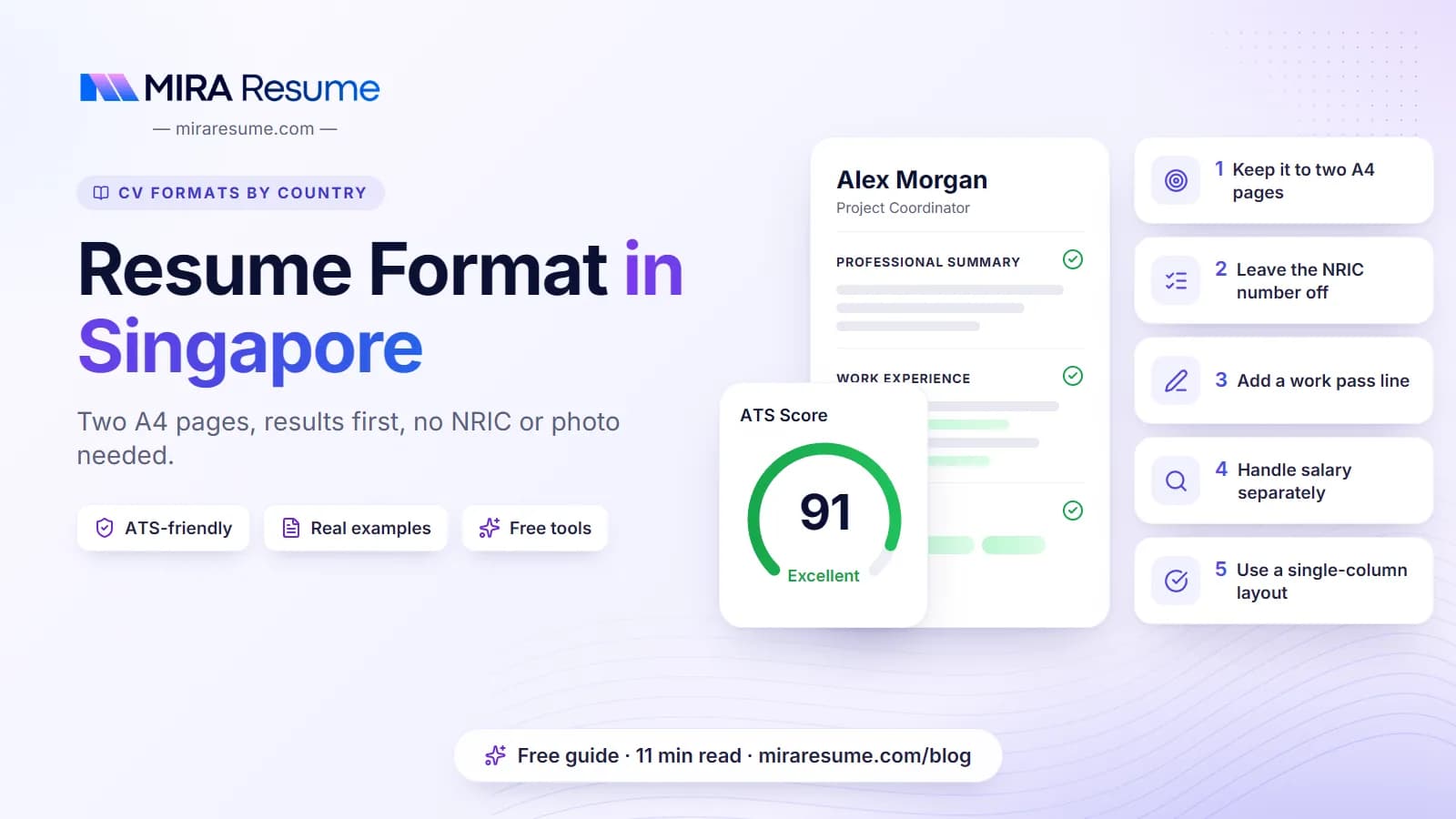
Resume Format in Singapore: cover image for the Mira Resume guide, with an example resume and the 5 main points

Getting the resume format Singapore employers expect right is mostly about restraint. A strong Singapore resume is one or two A4 pages, written in clear English, and focused on results rather than personal details. You do not need a photo, your date of birth or your NRIC number. What you do need is a clean layout, a short summary, achievement-led bullet points and, if you are not a Singapore Citizen or Permanent Resident, a plain line about your work pass status.

This guide covers the section order, what to include and what to leave out (and why), how to handle expected and last drawn salary, a fictional sample you can adapt, a version for fresh graduates, and a final checklist. Conventions vary by employer and industry, so always treat the job advertisement as the final word.

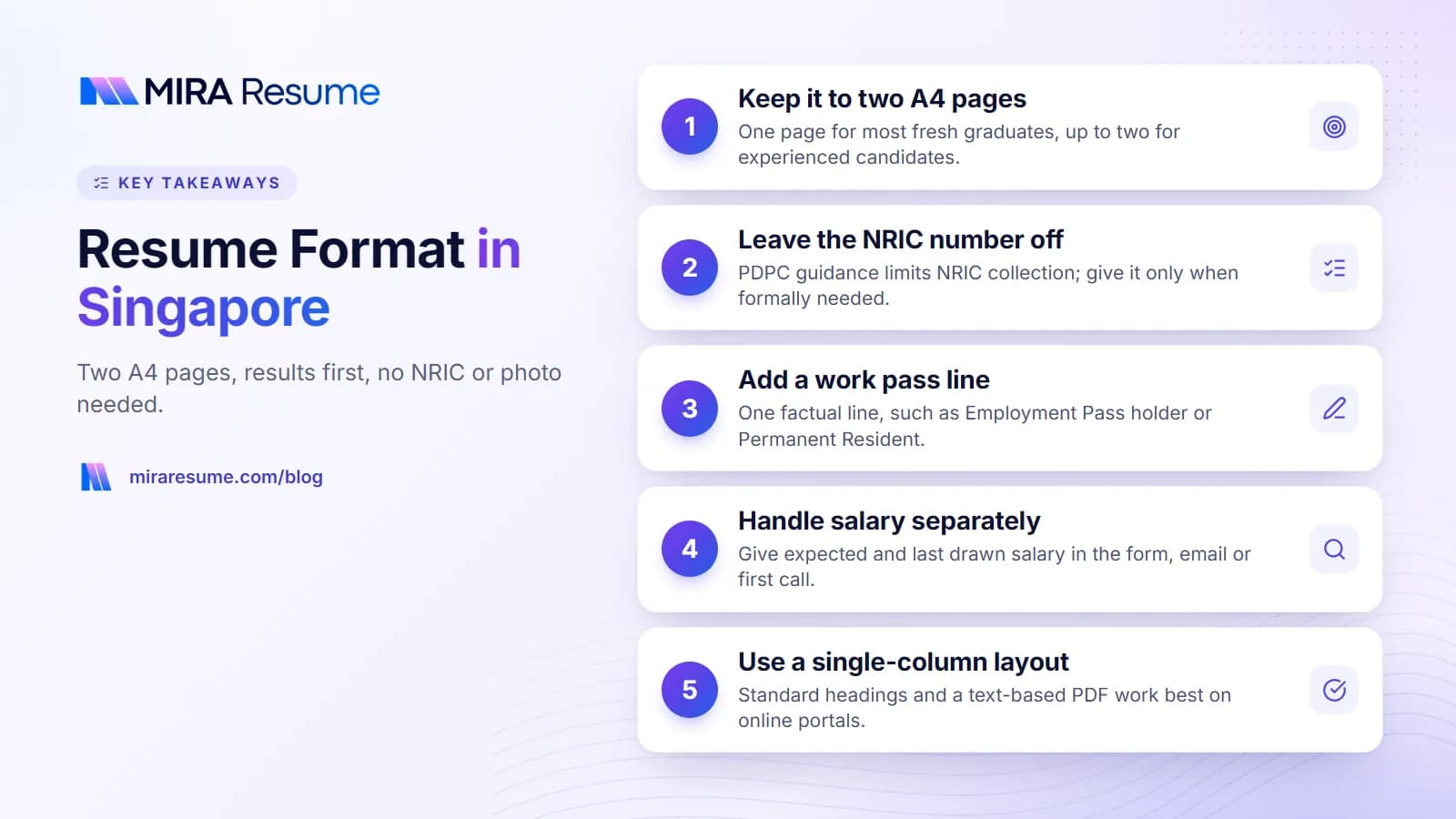
Key takeaways: 1. Keep it to two A4 pages; 2. Leave the NRIC number off; 3. Add a work pass line; 4. Handle salary separately; 5. Use a single-column layout
Key takeaways from this guide.

Singapore resume basics at a glance

People in Singapore use both words, resume and CV, and most recruiters treat them as the same document for private-sector jobs. So if you are searching for a CV format for Singapore, the advice below applies just the same. Academic and research roles are the main exception: universities and research institutes may ask for a longer CV that lists publications, grants and teaching.

ElementCommon practice in Singapore
What it is calledResume or CV, used interchangeably for most jobs
LengthOne page for most fresh graduates; up to two pages for experienced candidates
Paper sizeA4
Language and spellingEnglish; British spelling (organise, colour) is common, but consistency matters more than which you pick
Date formatMonth and year, for example Mar 2022 – Present
PhotoNot expected; leave it out unless the advert asks for one
File typePDF with selectable text, or .docx if the portal asks for it
ToneDirect and factual, with numbers wherever you have them

If you are unsure how long yours should be, our guide to how many pages a resume should be explains how to decide. For dates, see resume date format, and pick one style for the whole document.

Personal details: what to include and what to leave out

Your header should help a recruiter contact you, and very little else. Include your full name, a Singapore mobile number with the +65 country code, a professional email address and, if you have one, a LinkedIn URL. A general location such as "Tampines, Singapore" is enough; your full home address is not needed. If you go by an English name as well as your given name, you can show both, for example "Tan Wei Ling (Rachel)".

Why your NRIC number does not belong on a resume

Singapore's Personal Data Protection Commission (PDPC) has issued advisory guidelines on NRIC and other national identification numbers, which took effect on 1 September 2019. In general terms, they say organisations should not collect, use or disclose NRIC numbers (or similar numbers, such as passport and FIN numbers) unless the law requires it or it is necessary to verify a person's identity to a high degree of accuracy. A resume that you send to many employers and agencies is not the place for it. If an employer needs your NRIC number later, for example when preparing an employment contract, they will ask for it through their own process.

Photo, age, race, religion and marital status

Older Singapore resumes sometimes listed date of birth, race, religion, marital status and a passport-style photo. Today these details are usually left out. The Tripartite Guidelines on Fair Employment Practices, promoted by the Tripartite Alliance for Fair and Progressive Employment Practices (TAFEP), ask employers to recruit on merit and to avoid asking for details such as age, race, gender, religion, marital status and family responsibilities on application forms unless there is a clear job-related reason. Singapore has also passed a Workplace Fairness Act, which is expected to come into force at a later date. These rules and guidelines are aimed at employers rather than candidates, but they explain why most recruiters do not expect these details, and why leaving them out is the safer choice. This is general information, not legal advice.

DetailInclude?Why
Full nameYesUse the name you will use at work
Mobile (+65) and emailYesRecruiters often call or message first
LinkedIn URLRecommendedLets recruiters check your history quickly
Area or districtOptionalHelps with commute questions; full address not needed
NRIC numberNoPDPC guidance limits its collection; give it only when an employer formally needs it
Date of birth or ageUsually noFair employment guidance discourages employers from asking for it
PhotoUsually noNot expected unless the advert asks
Race, religion, marital statusNoNot relevant to merit-based hiring
Nationality or work pass statusYes, if you are not a Citizen or PRTells the employer whether a pass application is needed

Work pass status: one plain line for foreigners and PRs

Many Singapore employers want to know early whether hiring you will need a work pass. You can save everyone time with one factual line under your contact details. Keep it short and general, for example:

  • "Singapore Permanent Resident"
  • "Employment Pass holder | Available with one month's notice"
  • "Currently in Singapore on a Dependant's Pass"
  • "Malaysian citizen | Will require work pass sponsorship"

Singapore Citizens can add "Singapore Citizen" or leave the line out; both are fine. Work passes such as the Employment Pass and S Pass are applied for by the employer, and the eligibility rules and criteria are set and updated by the Ministry of Manpower (MOM). Do not describe eligibility, salary thresholds or your chances on your resume. State your current status honestly, and check MOM's official website or ask the employer about anything beyond that. This is not immigration advice.

Expected salary, last drawn salary and notice period

Recruiters in Singapore often ask for your last drawn salary and your expected salary, and many application forms and recruitment agencies include fields for both. You do not have to put either on the resume itself. A sensible approach:

  • Keep salary off the resume unless the advert asks for it in the document. Give it in the application form, the cover email or the first call.
  • If you include it, use one line at the end, under "Additional information", such as "Expected salary: negotiable" or a monthly range in SGD.
  • Be accurate about your last drawn salary. Some employers ask for payslips later, so never round up.
  • State your notice period. A line such as "Availability: one month's notice" is common and useful, because notice periods vary from contract to contract.

If you want to explain your expectations or a career move, a short cover letter or email is a better place than the resume. Research typical pay for your role before you name a figure.

This order works for most private-sector roles in Singapore. It is also a good starting point if you are building your own resume template for Singapore applications.

OrderSectionWhat to put in it
1HeaderName, +65 mobile, email, LinkedIn, area, and a work pass line if relevant
2Professional summaryThree or four lines: your role, years of experience, strongest skills and one result
3Key skills8 to 12 skills that match the advert, such as tools, systems and methods
4Work experienceReverse chronological; title, company, dates and three to six achievement bullets per role
5EducationDegree, diploma or Nitec, institution and year; grades if strong or recent
6Certifications and trainingProfessional certificates, and WSQ or SkillsFuture courses if relevant to the role
7National Service (optional)If you have served: vocation, rank and dates, most useful early in your career
8LanguagesEnglish plus any others, with an honest level
9Additional informationAvailability, notice period and, if you choose, a salary line

Experienced candidates keep work experience near the top. Fresh graduates often move education above experience, as shown further down. For a general walkthrough of layout choices, see how to format a resume, and compare layouts in the best resume format.

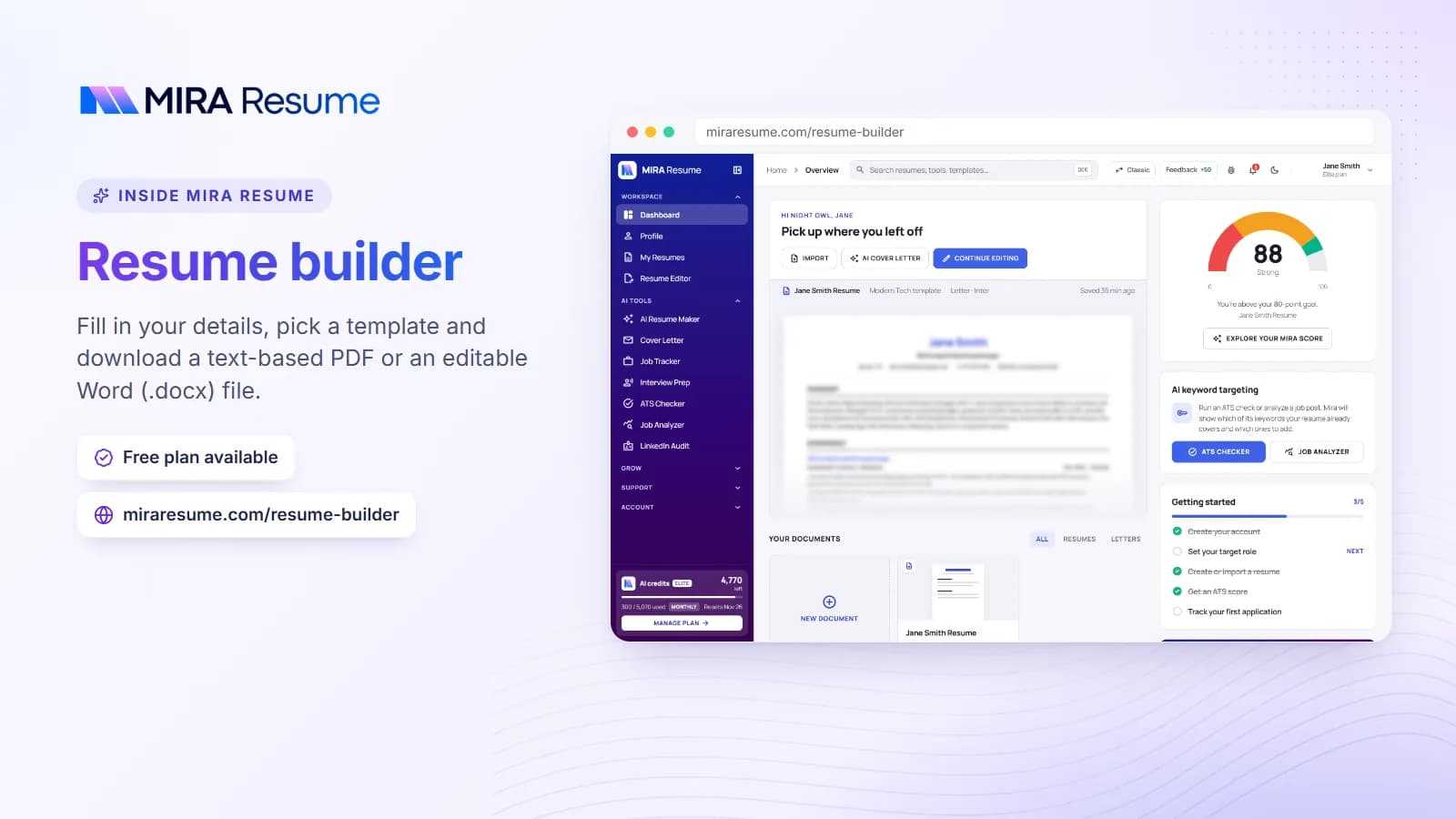
Screenshot of the Mira Resume resume builder (Fill in your details, pick a template and download a text-based PDF or an editable Word (.docx) file.)
Screenshot: Resume builder: Fill in your details, pick a template and download a text-based PDF or an editable Word (.docx) file.Try it

Singapore resume sample: header, summary and one role

Here is a short Singapore resume sample. The name, company and figures are made up to show the structure; replace them with your own details.

Rachel Lim Hui Wen
Operations Executive | +65 9xxx xxxx | [email protected] | linkedin.com/in/rachel-lim-example | Bedok, Singapore
Singapore Citizen | Availability: one month's notice

Professional summary
Operations executive with five years of experience in third-party logistics, managing warehouse workflows and vendor schedules for regional e-commerce clients. Known for cutting order errors through better processes and clear reporting. Skilled in SAP, Excel and Power BI.

Senior Operations Executive, Harbourline Logistics Pte Ltd (fictional), Singapore | Apr 2022 – Present

  • Coordinate daily outbound shipments for six e-commerce clients across Singapore and Malaysia.
  • Redesigned the pick-and-pack checklist, cutting order errors by 30% over two quarters.
  • Built a weekly Power BI dashboard that the regional manager uses to plan staffing.
  • Trained four new executives on standard operating procedures and the warehouse system.

Notice the pattern in each bullet: an action verb, what you did, then a result or a sense of scale. Our resume summary examples and resume bullet points guides have more phrasing ideas.

Resume format Singapore fresh graduate version

A fresh graduate resume in Singapore is usually one page. Because your work history is short, your education and practical experience do most of the work.

  • Put education first. List your degree or diploma, institution and graduation year. Add your GPA or honours classification if it is strong, plus relevant modules or a final-year project.
  • Treat internships as real jobs. Give each one a title, company, dates and two to four bullets with outcomes.
  • Use co-curricular activities (CCAs) well. Leadership roles in clubs, hall committees, competitions or volunteering show initiative. Describe what you organised or achieved, not just your membership.
  • Add National Service if it helps. If you served, a line with your vocation, rank and any leadership or technical courses can show responsibility.
  • Keep older results short. O-Level and A-Level grades are usually not needed once you have a diploma or degree, unless the employer asks for them.

Fresh graduate example (fictional)

Marcus Goh | +65 8xxx xxxx | [email protected] | Jurong West, Singapore
Education: Bachelor of Business Administration (Honours), a local university, 2026. Final-year project: pricing study for a fictional bubble tea chain.
Internship: Marketing Intern, Lumen Retail Pte Ltd (fictional) | May – Aug 2025. Planned three social media campaigns and grew the brand's Instagram following by 1,200 in ten weeks.
CCA: Vice-President, Entrepreneurship Club. Led a team of 12 to run a two-day student startup fair.

For more ideas, see our entry-level resume examples and how to list education on a resume.

ATS, MyCareersFuture and online applications

Many large employers and recruitment agencies in Singapore use applicant tracking systems (ATS) to collect and sort applications. These systems read text, so a simple layout is the safer choice:

  • Use one column and standard headings such as "Work Experience" and "Education".
  • Avoid text inside images, layout tables, skill bars, and contact details placed only in headers or footers.
  • Save as a text-based PDF or a .docx file, whichever the portal prefers.
  • Use the exact wording of the advert for skills and job titles, where it honestly describes your experience.

Common places to find roles include MyCareersFuture, the Singapore government's national jobs portal, as well as LinkedIn, JobStreet, Indeed and company career sites. Under MOM's Fair Consideration Framework, many employers must advertise a vacancy on MyCareersFuture for a set period before applying for certain work passes, so it is worth checking there. See MOM's website for the current rules.

Before you apply, run your file through our ATS checker and compare it with the advert using the job description analyser. If you want help spotting matching roles, Mira Scout scores new openings against your resume. To understand what happens behind the scenes, read how ATS works.

Applying to Singapore from abroad

Singapore attracts applicants from Malaysia, India, the Philippines, Indonesia and much further away. A few adjustments help a local recruiter read your resume quickly:

  • State your location and plans. For example: "Based in Kuala Lumpur, relocating to Singapore; available to start within six weeks."
  • Explain your status honestly. Use the work pass line described above and let the employer advise on the pass.
  • Give context for overseas employers. A few words such as "a regional bank with 2,000 staff" help a recruiter who does not know the company.
  • Write qualifications in full. Give the full degree name rather than local abbreviations.
  • Drop home-country extras. Photos, date of birth, religion and family details that are common in some countries are not expected in Singapore.

If you are moving from a neighbouring market, our guides to the Malaysian resume format, the Philippine resume format, the Indonesian CV format and the Indian resume format show what to change. A short relocation cover letter can explain your move. You can browse every country guide in our CV formats by country hub.

Do's and don'ts for a Singapore resume

DoDon't
Keep it to one or two A4 pagesSend a five-page life history for a mid-level role
Lead with a summary and achievementsOpen with an objective that only says what you want
Use numbers: volumes, savings, team sizeInflate titles or results; employers often check references
State your work pass status plainlyGuess at pass eligibility or claim a pass you do not hold
Give salary details in the form or emailPut your full NRIC number on the resume
Use a plain, single-column layoutRely on graphics, photos or multi-column designs for online portals
Write "References available on request", or list them if the advert asksAdd referees' phone numbers without asking them first

For more on referees, see references on a resume.

Final checklist before you send

  • One or two A4 pages, with fresh graduates aiming for one.
  • Header with your name, +65 number, email, area and, if relevant, a work pass line.
  • No NRIC number, photo, date of birth, race, religion or marital status unless the employer specifically asks.
  • A summary of three or four lines that matches the role.
  • Reverse-chronological experience with at least one result in each role.
  • Consistent dates (Mar 2022 – Present) and one spelling style throughout.
  • Availability or notice period stated; salary handled in the form or email.
  • Saved as a text-based PDF and named clearly, such as Rachel-Lim-Resume.pdf.
  • Checked against the advert with an ATS scan.

When you are ready, start in our resume builder or choose a clean, single-column layout from the resume templates. Both let you download a PDF that suits Singapore employers and their online portals.

Frequently asked questions

How long should a resume be in Singapore?

Most experienced candidates in Singapore use one to two A4 pages, and fresh graduates usually keep to one page. Recruiters often screen many applications quickly, so put your most relevant experience and results on the first page. Senior candidates with long careers can stay at two pages by summarising older roles in a line or two each.

Should I put my NRIC number on my resume?

No. Singapore's PDPC advisory guidelines generally say organisations should not collect NRIC numbers unless the law requires it or they need to verify your identity with a high degree of accuracy. A resume sent to many employers does not need it. If an employer needs your NRIC later, for example for a contract, they will ask through a formal process. This is general information, not legal advice.

Do I need a photo on my resume in Singapore?

Usually not. Photos are not expected on most Singapore resumes, and fair employment guidance encourages employers to recruit on merit rather than appearance. Leave the photo out unless the job advertisement specifically asks for one. A clean header with your name, contact details and, if relevant, your work pass status is far more useful to a recruiter.

Should I include my expected salary on my resume?

You do not have to. Many Singapore employers and agencies ask for last drawn and expected salary, but they usually collect it in an application form, an email or the first call. If you do include it, add one line at the end, such as Expected salary: negotiable, or a monthly range in SGD. Always state your last drawn salary accurately.

What resume format should a fresh graduate in Singapore use?

Use a one-page, reverse-chronological layout with education at the top. Include your degree or diploma, your GPA or honours if strong, and a relevant project. Then list internships with results, leadership roles in CCAs, and National Service if you served. Finish with skills, languages and availability, and keep the design single-column so it works on online portals.

How should foreigners show work pass status on a Singapore resume?

Add one factual line under your contact details, such as Singapore Permanent Resident, Employment Pass holder, or Will require work pass sponsorship. Do not describe eligibility rules or salary criteria, because the Ministry of Manpower sets and updates them and the employer usually makes the application. Check MOM's official website or ask the employer for details.

Found this useful? Share it

Send it to a friend who is job hunting, or save it for later.

Read this guide with AI

Get a plain-language summary and help applying it to your own resume. Pick an assistant; it opens with this article and a ready prompt.

Back to CV Formats by Country hub

All articles