Coming soon
Stealth Job Search

How to Look for a Job While Employed (Without Burning Out)

How to look for a job while employed: a realistic weekly plan, where to search, quiet resume and LinkedIn updates, interviews around work, and when to resign.

Mira Resume Editorial Team · Career content team Published Updated 10 min read
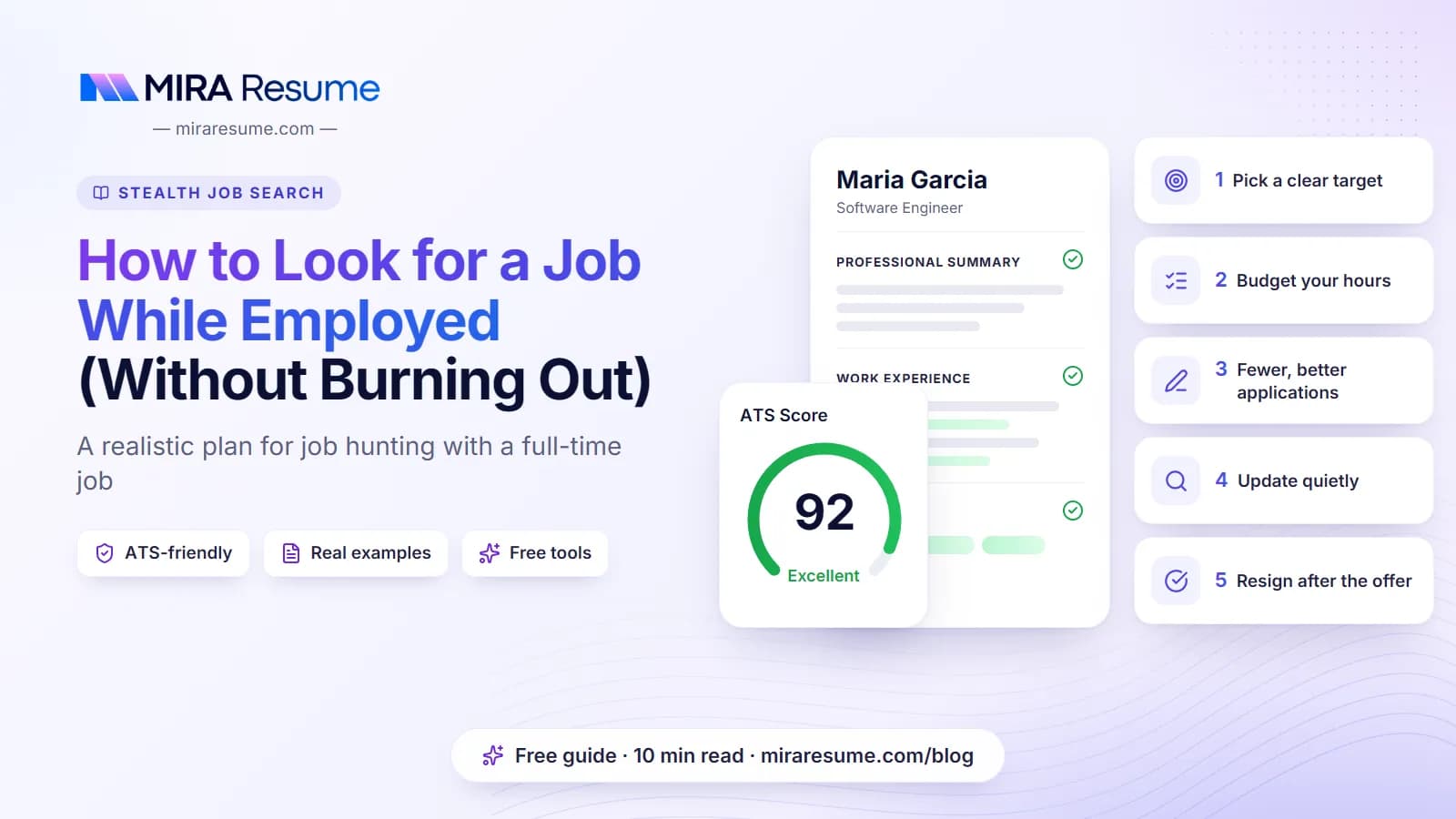
How to Look for a Job While Employed (Without Burning Out): cover image for the Mira Resume guide, with an example resume and the 5 main points

Knowing how to look for a job while employed comes down to two things: protecting your time and protecting your privacy. You already have a full-time job, so your search has to fit into evenings, weekends and the odd lunch break. And you want your current employer to hear about your move from you, on your schedule, not from a stray LinkedIn notification.

The good news is that job hunting while employed is often more effective than searching after you quit. You have income, leverage and the freedom to be picky. This guide gives you a realistic weekly plan, the best places to search, a way to send fewer but stronger applications, and the steps for updating your resume, networking, interviewing and finally resigning without burning bridges.

If you want the bigger picture on keeping things private, start with our stealth job search guide. If you are not sure it is fine to look at all, read is it okay to look for a job while employed first.
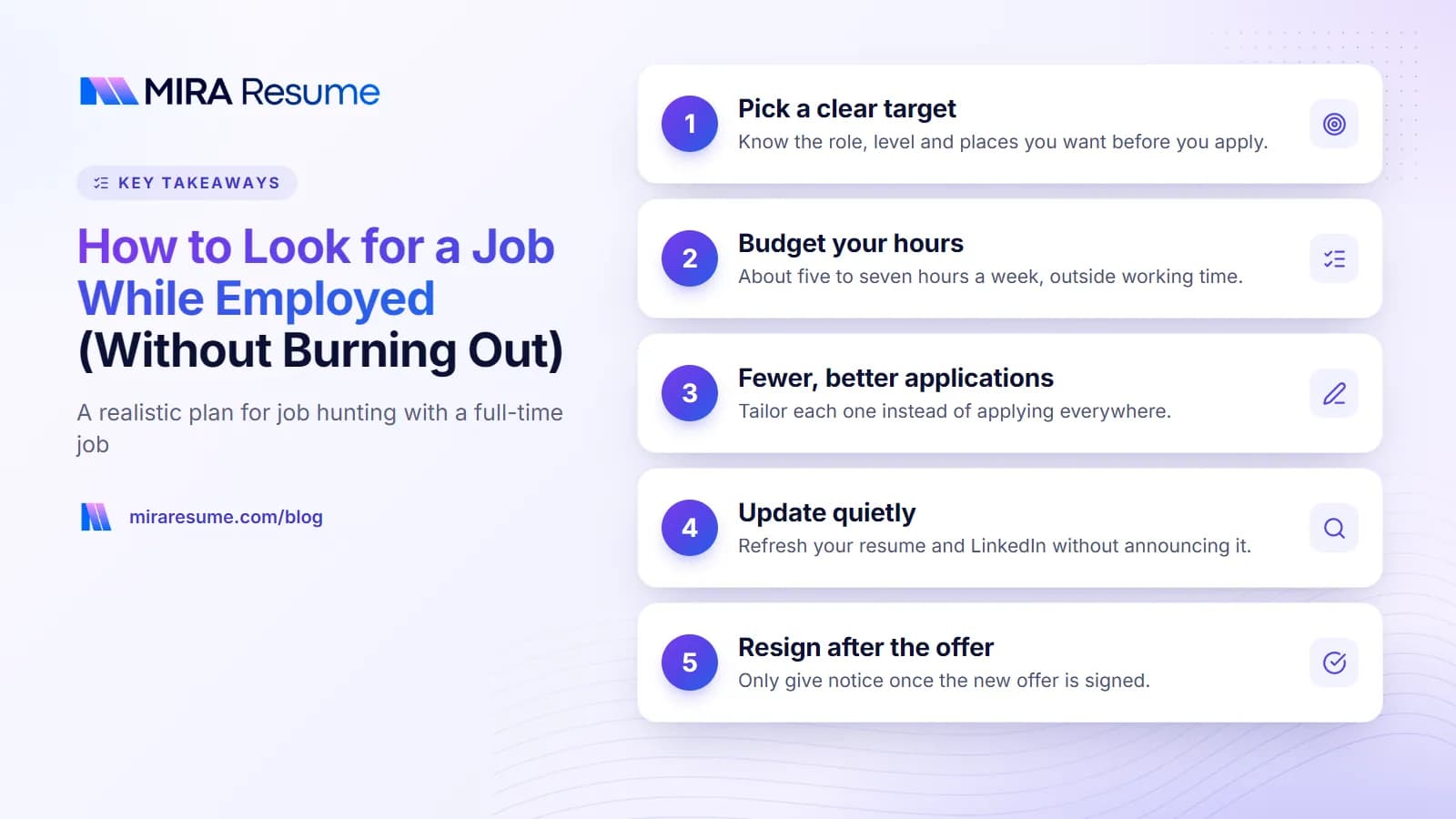
Key takeaways: 1. Pick a clear target; 2. Budget your hours; 3. Fewer, better applications; 4. Update quietly; 5. Resign after the offer
Key takeaways from this guide.

Start with a clear target

The biggest time-saver in a job search while employed is knowing exactly what you are looking for. A vague search burns whole evenings on job boards. A clear one lets you scan a list of new roles in minutes and move on.

Write short answers to these questions before you open a single listing:

  • Role: Which one or two job titles fit you best?
  • Level: The same level, or a step up?
  • Pay: What is the lowest offer you would accept, and what is your target?
  • Location: Office, hybrid or remote? Which cities? For many readers in India this might be Bengaluru, Hyderabad, Pune or remote. For readers in the US it might be one metro area or remote only.
  • Deal-breakers: Long commutes, heavy travel, night shifts, or a type of company you do not want to join.
  • Why you are leaving: One honest sentence. It keeps your search focused, and it becomes your interview answer later.

Keep this list somewhere you will see it. When a role misses most of it, skip it without guilt. Every application you do not send is an evening you get back.

Budget your time: a realistic weekly plan

The hardest part of working out how to look for a new job while working full time is time. Most people can sustain a few focused hours a week without burning out. Five to seven hours, spread across short sessions, is a reasonable starting point. Adjust it to your energy, family duties and how urgent the move is.

All of this happens on your own time and your own device. Searching during work hours or on a work laptop is the most common way people get found out, and it can break company policy. Our guide on whether your employer can see your browsing history explains why.

DayTimeTask
Monday30 to 45 minutes, eveningScan new listings against your target list and shortlist 3 to 5 roles
Tuesday60 minutes, eveningTailor your resume for your top 1 or 2 roles and apply
Wednesday30 minutes, early morning or lunch away from your desk, on your own phone and mobile dataSend 2 networking messages or follow-ups
Thursday60 minutes, eveningA second round of tailored applications, or interview practice
FridayOffRest. A tired search produces weak applications
Saturday90 minutesBigger tasks: company research, mock interviews, LinkedIn updates
Sunday15 minutesReview your tracker and plan the coming week

That adds up to roughly five to six hours. In a week with a big deadline at work, cut it back to the Monday scan and the Sunday review. Keeping the habit going matters more than any one week.

Ways to make the hours count

  • Batch similar tasks. Scanning, tailoring and networking use different kinds of focus. Do one kind per session.
  • Set a timer. A 45-minute limit stops job boards from swallowing your evening.
  • Let listings come to you. Use job alerts and matching tools rather than searching from scratch every day.
  • Keep a master resume. Tailor copies of it instead of rewriting from zero.
  • Use one tracker. A single list of every application saves you from double-applying or forgetting a follow-up.

Where to search when you have a day job

When your time is limited, search where the useful roles are and skip the endless scrolling.

Company career pages

Make a list of 20 to 30 companies you would like to work for and check their careers pages once a week. Many employers list every open role on their own site, and some roles appear there before they reach the big job boards.

Job boards, with privacy turned on

Large boards such as LinkedIn and Indeed, and in India sites such as Naukri, are useful for volume. Before you upload a resume or make a profile searchable, check its privacy settings. Many boards let you keep your profile private or hide it from specific companies, including your current one.

Matching tools

Mira Scout finds jobs that fit your resume and brings them to you, so you spend your few hours applying rather than hunting. Our Mira Scout guide explains how matching works and where the jobs come from.

Stealth Mode, for shared spaces

If you search on a commute or in a shared home, Stealth Mode shows real job listings in a page that looks like an ordinary spreadsheet, and pressing Esc twice switches to a decoy budget sheet. It changes what is visible on your screen. It does not hide your browsing from your employer's network, proxy or monitoring software, so still use your own device and network.

Referrals and recruiters

A referral from someone you know at a company is often the fastest way past the first screen. Recruiters can also help, as long as you give them clear rules: personal contact details only, no calls at work, and no resume sent anywhere without your approval.

Send fewer, better applications

When time is short, quality beats volume. A handful of well-matched, tailored applications usually does more for you than dozens of generic ones, and each application you skip is one less chance for your search to leak.

Pick roles you actually fit

Aim for jobs where you meet most of the must-have requirements. A quick comparison of your resume with the posting tells you whether it is worth your evening. Our guide to the job match score explains what a match percentage can and cannot tell you.

Tailor the top third of your resume

Recruiters and applicant tracking systems pay close attention to your summary, skills and first few bullets. Rewrite those for each role, using words from the posting that honestly describe your work. Our list of resume keywords shows how to pick them without stuffing.

Check before you send

Run each tailored version through the ATS checker to catch missing keywords and formatting problems. It takes a few minutes and saves you from silent rejections.

Add a short cover letter when it helps

Some roles still expect one. Keep it to three short paragraphs. The AI cover letter generator can give you a first draft to edit.

ApproachTime per applicationTypical result
Generic resume, many rolesLowFew replies, more noise to track, more places your resume sits
Tailored resume, well-matched rolesMediumBetter reply rate per application, fewer but stronger interviews
Referral plus tailored resumeMedium to highOften the strongest start, and the most private
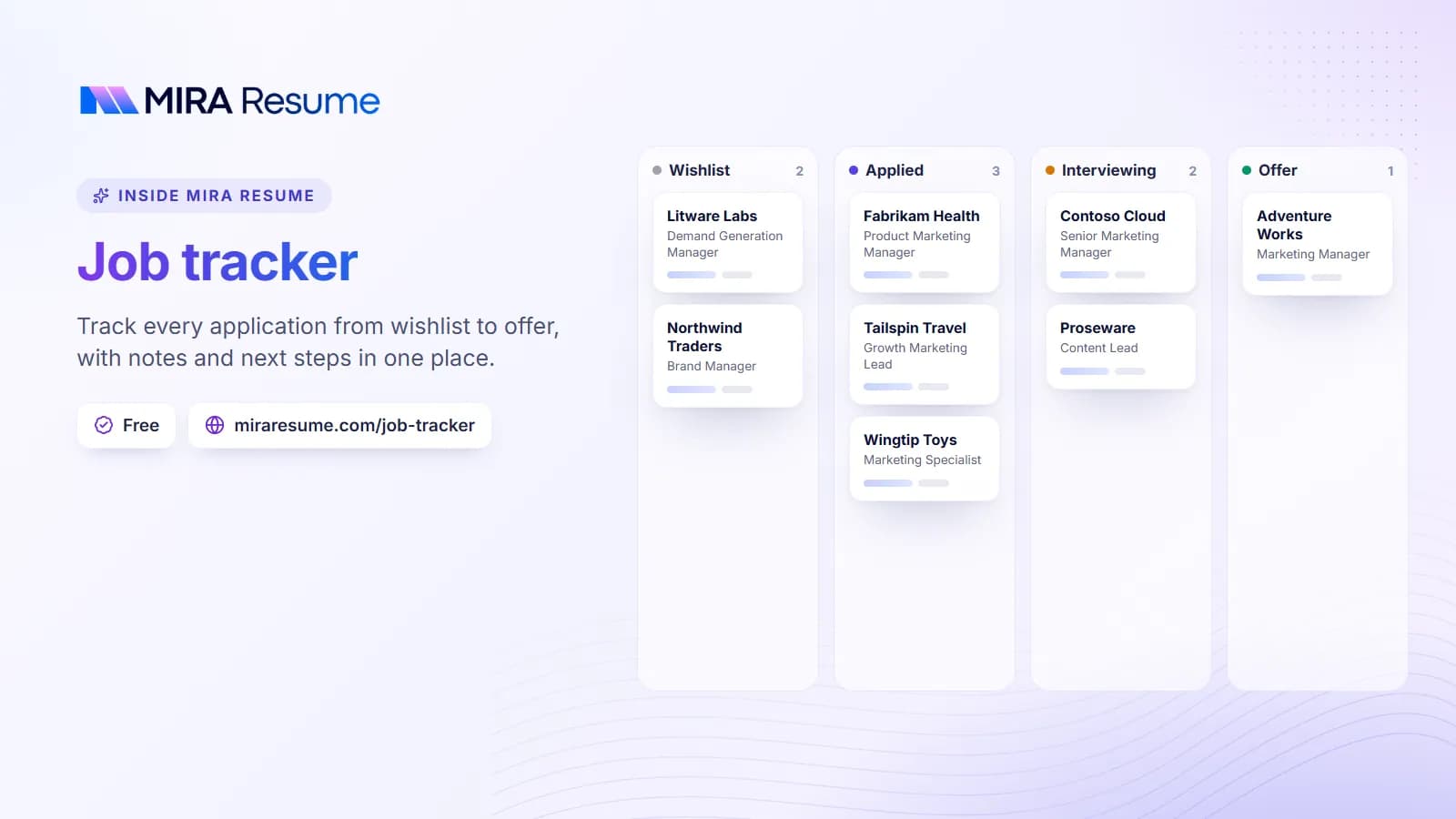
Illustration of the Mira Resume job tracker: Track every application from wishlist to offer, with notes and next steps in one place.
Illustration: Job tracker: Track every application from wishlist to offer, with notes and next steps in one place.Try it

Update your resume and LinkedIn quietly

A sudden makeover is one of the classic giveaways of job searching while still employed. Spread the work out and do it away from work systems.

Your resume

  • Work on it only on your personal device, and store it in a personal account, not a work drive or work email.
  • Build or refresh it with the resume builder. Our guide on how to update your resume covers what to change first.
  • Use your personal email address and phone number in the header.
  • Leave out confidential details such as client names under NDA, unreleased products or internal figures you are not allowed to share.

Your LinkedIn profile

  • Before editing, check the setting that controls whether some profile changes are shared with your network.
  • Make changes in small steps over a week or two rather than all on one evening.
  • Avoid headlines like "Looking for new opportunities" while you are employed.
  • If you use Open to Work, choose recruiters only. LinkedIn says it takes steps to hide this from recruiters at your current company, but it cannot guarantee complete privacy. See how to hide Open to Work from your current employer.
  • Run your profile through the LinkedIn profile audit so you know which changes matter most, then make only those.

Network without announcing it

Many good roles come through people, and networking can be done quietly. You do not need to announce anything. You need a few honest, private conversations.

  • Former colleagues who have moved to other companies are the safest place to start.
  • College alumni working at your target companies are often happy to talk.
  • Professional communities, meetups and online groups in your field.
  • Friends and family who work at companies on your list.

Ask for information, not a job. People are more relaxed about a 15-minute chat than a referral request, and a good chat often leads to a referral anyway.

"Hi Priya, hope things are going well at [Company]. I'm quietly starting to think about my next step, and your team's work on [area] looks interesting. Would you be open to a 15-minute call next week? I'd appreciate keeping this between us for now."

Do not network with people at your current employer about leaving, and be careful in small industries where everyone knows everyone. One clear line, such as "I'd appreciate keeping this between us," is usually enough.

Fit interviews around your working hours

Interviews are the hardest part to keep quiet, because they need blocks of time during the working day. A little planning goes a long way.

SlotWorks well forWatch out for
Early morning, before workPhone screens and video callsRunning late for your own job afterwards
Lunch breakShort callsFind a private place away from the office; never take the call at your desk
End of the dayVideo interviews, or in-person meetings nearbyLeave on time without fuss on those days
Leave day or half dayFinal rounds, on-site visits, assessmentsGroup several interviews into one day where you can
WeekendOccasional, if the company offers itAsk politely; the worst answer is no

When you need time off, keep the wording short and true: "I have an appointment on Thursday afternoon" or "I need to take a personal day." You do not owe more detail, and you should not invent illnesses or emergencies. Honest and vague is far safer than detailed and false.

Most recruiters understand that you are employed. It is fine to ask, "Do you have anything before 9 or after 6?" or to request a video call for early rounds. For more, read how to interview while employed, practise with interview prep, and send your thank-you from your personal email using our follow-up email after interview examples.

Stay productive at your current job

Your current job is still your job. Your performance now shapes your reference, your final review and how your exit goes. It also protects you if the search takes longer than you hoped.

  • Keep your output steady. Meet deadlines and keep showing up to meetings prepared.
  • Do not check out. Coasting is one of the clearest signs that someone is leaving.
  • Keep the search off the clock. No job boards, applications or recruiter calls during work hours.
  • Tell no one at work. Not even a close work friend, until you have resigned.
  • Do not take files. Copying company data to use in your search or new job can create serious problems.
  • Watch your mood. Complaining more than usual, or suddenly going quiet, can be noticed.

Our guide on how to hide your job search from your employer goes deeper on devices, calendars and the small habits that give people away.

Keep track of every application

When you apply around a full-time job, it is easy to forget who you spoke to and when. A simple tracker solves this: company, role, date applied, contact, stage, next step and follow-up date. Our job search spreadsheet template gives you a ready-made layout. If you search with Stealth Mode while signed in to a free account, jobs you save or mark as applied sync to the Mira Job Tracker.

When and how to resign

Do not resign until you have a written, signed offer with a start date. Where possible, wait until background checks are complete too. Then follow these steps:

  1. Check your notice period. In many US jobs, two weeks is a common custom. In India, notice periods of 30, 60 or 90 days are common, and some employers allow a notice buyout. Agree your start date with the new employer with this in mind.
  2. Tell your manager first, in person or on a call, before anyone else at work hears.
  3. Follow with a short written notice the same day. Our two week notice letter template gives you the wording.
  4. Hand over your work properly and stay professional to your last day. In India, a smooth exit also makes it easier to get your relieving letter.

Our full guide on how to resign from a job covers counteroffers, exit interviews and what to do if you cannot give full notice. Rules on notice vary by country, state and contract, so check yours; this is general information, not legal advice.

Frequently asked questions

How many hours a week should I spend job searching while employed?

For most people, five to seven focused hours a week is sustainable alongside a full-time job. Split it into short sessions on weekday evenings plus one longer block on the weekend. Steady effort matters more than intensity. If work is busy, it is better to send a few well-tailored applications than to rush many generic ones.

Should I tell my boss I am looking for a new job?

Usually not until you have a signed offer and are ready to resign. Telling your manager early can change how you are treated, and in at-will jobs it can put your role at risk. There are exceptions, such as a very supportive manager or a move you have already discussed together, but most people keep the search private.

How do I schedule interviews while working full time?

Ask for early morning, lunch or end-of-day slots, request video calls where possible, and save leave days for final rounds or on-site visits. When you need time off, keep it short and honest, such as saying you have an appointment. Avoid inventing illnesses or emergencies, and try to group several interviews into the same day.

Can I use my work laptop to apply for jobs?

It is best not to. Work laptops, phones and networks are often managed and may be monitored, so your employer may be able to see job sites you visit or files you save. Using company equipment for a job search can also break policy. Use your own device, your home Wi-Fi or mobile data, and a personal email address.

When should I resign after getting a job offer?

Wait for a written, signed offer with a clear start date, and ideally for any background checks to finish. Then check your notice period, tell your manager first, and follow up with a short written notice. In the US two weeks is a common custom, while in India notice periods of 30 to 90 days are common, so plan around yours.

How long does it take to find a job while employed?

It varies a lot by field, level, location and the job market. Because you are searching part time and can be selective, plan for it to take a few months rather than a few weeks. That is fine, since you are still earning. Keep a steady weekly routine, track every application, and review what is working every few weeks.

Found this useful? Share it

Send it to a friend who is job hunting, or save it for later.

Read this guide with AI

Get a plain-language summary and help applying it to your own resume. Pick an assistant; it opens with this article and a ready prompt.

Back to Stealth Job Search hub

All articles