Coming soon
Stealth Job Search

How to Interview While Employed: Scheduling, Excuses and Video Calls

How to interview while employed: when to book interviews, what to tell your boss, video calls on your own device, references and checks without a tip-off.

Mira Resume Editorial Team · Career content team Published Updated 13 min read
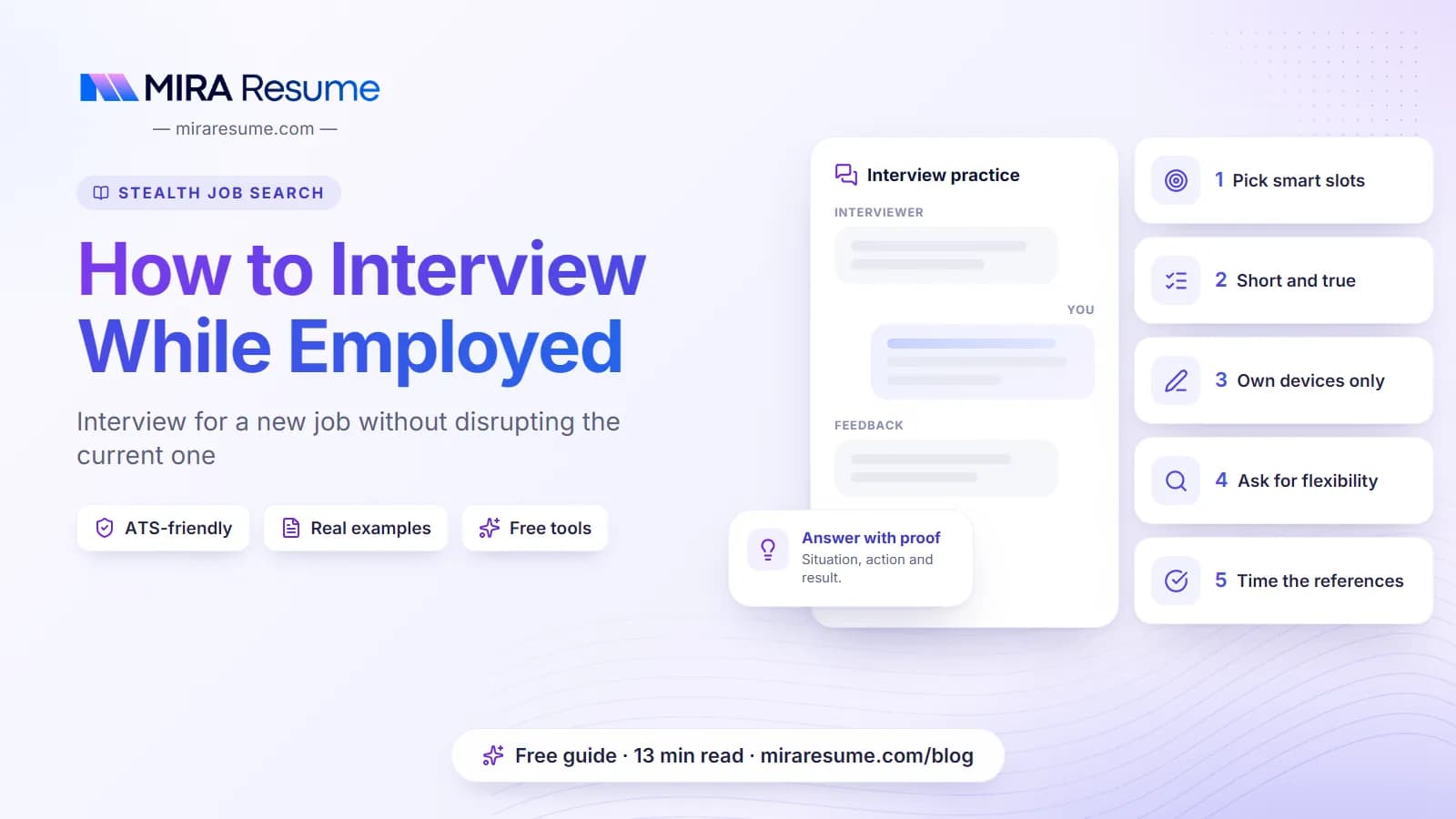
How to Interview While Employed: cover image for the Mira Resume guide, with an example resume and the 5 main points

If you are working out how to interview while employed, the short answer is this: book interviews outside your core hours where you can, take proper leave when you cannot, use your own phone and laptop, and keep what you tell your manager honest but brief. Hiring teams interview people who already have jobs all the time, so asking for an early or late slot is completely normal.

The hard part is rarely the interview itself. It is the logistics: getting away for an hour, taking a video call without a colleague walking past, arriving at the office in a suit when you usually wear jeans, and fitting three or four rounds into a few busy weeks. This guide covers each of those, with a scheduling table, scripts you can copy, and the right timing for references and background checks.

It is part of our stealth job search series. If you are still deciding whether to look at all, read is it okay to look for a job while employed first.

General guidance only. Leave rules, notice periods and background checks vary by employer and country, so check your contract and company policy.
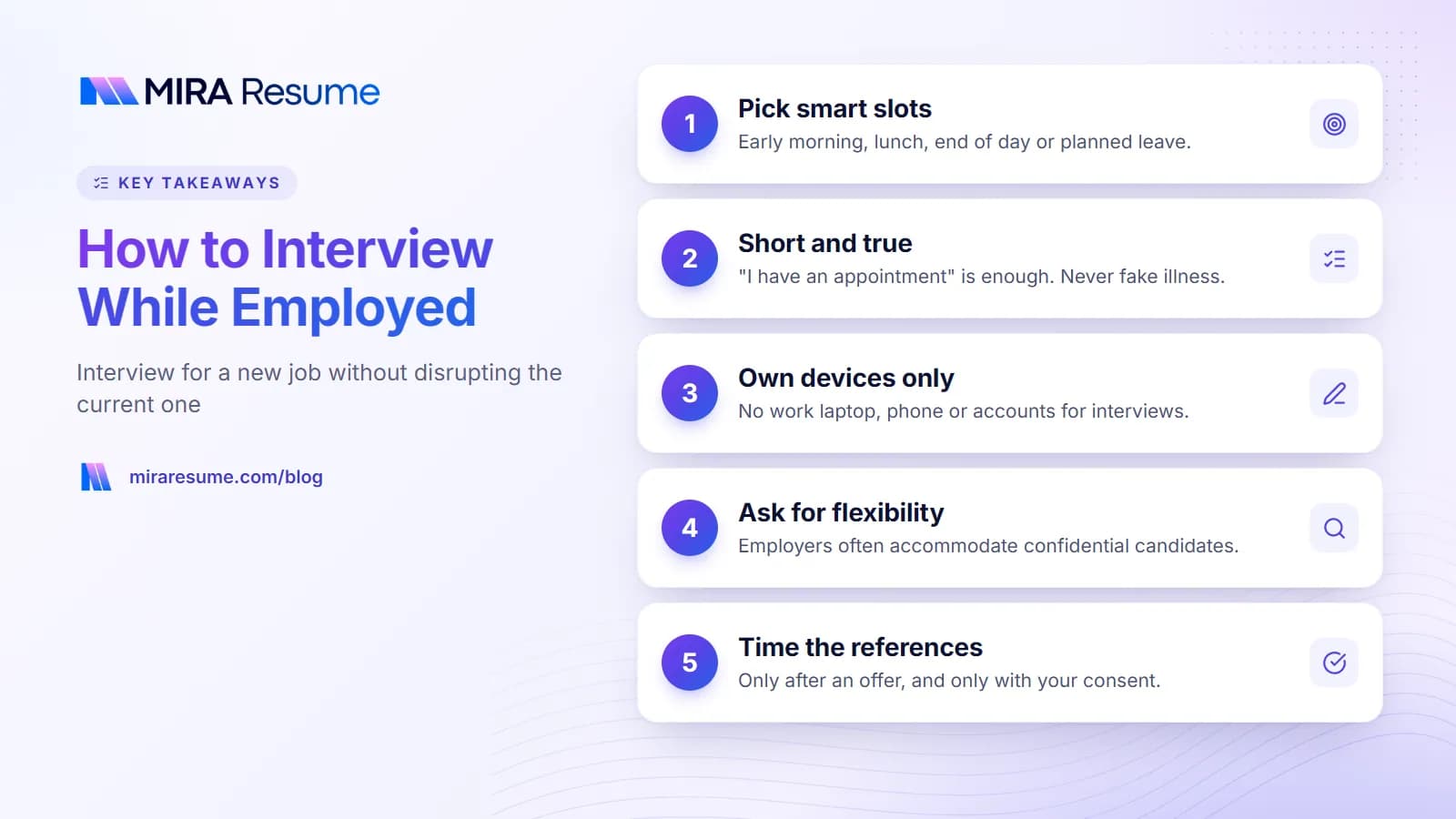
Key takeaways: 1. Pick smart slots; 2. Short and true; 3. Own devices only; 4. Ask for flexibility; 5. Time the references
Key takeaways from this guide.

Ground rules before you book anything

A few habits keep a quiet search quiet. They also keep you on the right side of your current employer, which matters because that employer is still paying you and may one day be a reference.

  • Interview on your own time. Use leave, a lunch break, or the hours before and after work. Do not take interviews in the middle of a workday while you are being paid to work.
  • Use your own devices and accounts. Personal phone, personal email, personal laptop, and home broadband or mobile data. Never a work laptop, work email or work video account.
  • Be honest but brief. You do not owe your manager the reason you need time off. You do owe them the truth. "I have an appointment" is both.
  • Keep doing good work. Your current job is your safety net. A sudden drop in effort is a bigger giveaway than any calendar entry.
  • Tell almost no one. Not your closest work friend, not the team chat. News travels faster than you expect.

If you have not set up the rest of your search yet, our guide on how to look for a job while employed covers resumes, profiles and applications. This page picks up from the moment a recruiter asks, "When are you free?"

How to schedule an interview around work

The best slot depends on your hours, your commute and how flexible your team is. These are the usual options when you need to schedule an interview around work.

SlotBest forProsCons
Early morning, before workPhone screens, video calls, in-person rounds near your officeNo leave needed; you are fresh; rarely clashes with meetingsNot every company offers early slots; arriving late at work can still be noticed
Lunch breakShort phone screens and 30-minute video callsUses time that is already yoursTight; hard to find a private spot; in-person rounds rarely fit
End of dayVideo calls and in-person rounds close to workEasy to leave on time; no rush to get backYou may be tired; the interviewer may be winding down too
Half-day leaveIn-person rounds, assessments, longer technical interviewsProper time to travel, change and focusUses leave; frequent half-days start to form a pattern
Full day offFinal rounds, onsite panels, interviews in another cityNo clock-watching; you can group several meetingsUses more leave; many teams need notice
Remote or work-from-home dayVideo interviewsNo commute, a private room, your own setupIt is still work time, so you need leave or a genuine break; easy to get pulled into a work call

How to ask for the slot you need

Recruiters ask "What times work for you?" because they expect you to have limits. Give them two or three concrete windows rather than "anytime".

Thanks for getting in touch. I am currently working full time, so early mornings before 9:30 or evenings after 6:00 are easiest for me. I could also do Thursday afternoon if we book it a few days ahead. Would any of those work for the team?

That last line matters. Leave booked a few days ahead looks like any other planned day off. Disappearing at short notice is what draws attention.

Spread rounds out sensibly

Two interviews in one week can be planned leave. Five afternoons off in a fortnight starts to look like a pattern. If a process has several rounds, use the tips in the section on multiple rounds below.

Time zones can help

If you are interviewing with a team in another country, the time difference can work in your favour. An evening slot in Bengaluru, for example, can be a morning slot for a team in New York. Always confirm the time zone in writing, and put the meeting in your personal calendar in your own local time.

What to say when you need time off for an interview

Search online for excuses for job interview time off and you will find long lists of invented stories: a sick child, a burst pipe, a family emergency. Skip all of them. You do not need an excuse. You need a short, true sentence and your normal leave process.

Honest wording that works

  • "I have an appointment on Tuesday morning, so I will be in at 11."
  • "I need to take a personal day on Friday."
  • "I am taking a half-day on Wednesday afternoon for a personal matter."
  • "I will be out from 2 to 4 tomorrow. My calendar is blocked and I will catch up after."

All of these are true. An interview is an appointment, and leave is yours to use. In most workplaces you do not have to explain why you are taking planned leave, whether your company calls it PTO, annual leave, casual leave or earned leave. Apply for it through the usual system, the same way you would for any other day off.

What not to say

Say thisNot thisWhy
"I have an appointment.""I have a doctor's appointment." (when you do not)A specific lie is easy to trip over when someone asks how it went.
"I am taking a personal day."Calling in sickUsing sick leave when you are not ill can breach company policy and damages trust if it comes out.
"I will be out for a personal matter.""There is a family emergency."Invented emergencies invite sympathy, follow-up questions and guilt.
Nothing moreA long, detailed storyOver-explaining is one of the most common giveaways.

If your manager asks directly

Sometimes a manager will ask, "Is everything all right?" You can keep things private without lying: "Everything is fine, thanks. It is a personal thing and I would rather keep it private." If they push, repeat it calmly. You are not obliged to share the details of personal appointments, and most reasonable managers will drop the subject.

Phone interviews and video interviews while working

Taking a phone interview at work

Try not to take a phone interview at work at all. Open-plan floors, glass meeting rooms and corridor conversations are all easy to overhear. If a recruiter can only offer a slot during working hours:

  • Take it on your lunch break, away from the building: your car, a quiet park bench, a corner of a nearby cafe, or a library.
  • Use your personal phone, and give recruiters your personal number, never your desk line.
  • Carry earphones, a charged phone, a notepad and the job description.
  • If a call comes at a bad moment, let it go to voicemail and ring back. "Sorry I missed you, I was in a meeting" is honest and perfectly normal.

A video interview while working from home

A video interview while working remotely feels easy. It also has the most ways to go wrong.

  • Use your own laptop or phone. Not the work laptop, even for "just one call". Company devices are often managed and monitored, and you do not want an interview link in your work browser. Our guide on whether your employer can see your browsing history explains why.
  • Use a personal account. Join with your personal email, not your work Microsoft Teams, Zoom or Google account. Check the display name before you click Join.
  • Use your own network. Home broadband or mobile data, not the company VPN.
  • Take leave or a real break. Working from home is still working. Block the time, set your work status honestly, and do not take an interview while you are supposed to be online for your team.
  • Pick a private room. Close the door, tell anyone at home, and check what is behind you. A company hoodie, a branded mug or a whiteboard full of your team's projects should be out of shot.
  • Silence work notifications. Shut the work laptop so a chat ping does not sound halfway through an answer.

Quick setup checklist

  1. Open the link ten minutes early on the device you will actually use.
  2. Camera at eye level, light in front of you rather than behind.
  3. Earphones with a microphone, for clear sound and privacy.
  4. Job description, your resume and two or three questions within reach.
  5. Phone on silent, work laptop closed.

Dress-code tells and other small giveaways

Colleagues rarely notice an appointment. They do notice a suit.

  • Change on the way. If your office is casual and the interview is formal, carry a blazer or shirt in a bag and change at a gym, a cafe restroom or in the car.
  • Ask what people wear. Many companies are more relaxed than you expect. "What do candidates usually wear for interviews there?" is a fair question for a recruiter, and the answer may save you the change.
  • Split the difference. Smart trousers with a plain shirt or kurta can pass in both places. Add the jacket only when you arrive.
  • Dress fully for video. You may need to stand up or fetch something. Match the standard you would wear in person for that company.

Other tells to watch

  • Calendar entries. Never write "Interview" or the other company's name on your work calendar. Use "Personal" or "Out", and keep the details in your personal calendar only.
  • Work email. Always give recruiters your personal address, so no invite lands in your work inbox.
  • Whispered calls. Ducking into the stairwell with your phone is noticed. Call back later from somewhere private.
  • Profile changes. A sudden burst of LinkedIn updates can be spotted. See how to hide Open to Work from your current employer.
  • The office printer. Print your resume at home or not at all.
  • Job sites at your desk. Search at home, on your own device. Our guide on how to hide a job search from your employer covers the rest.
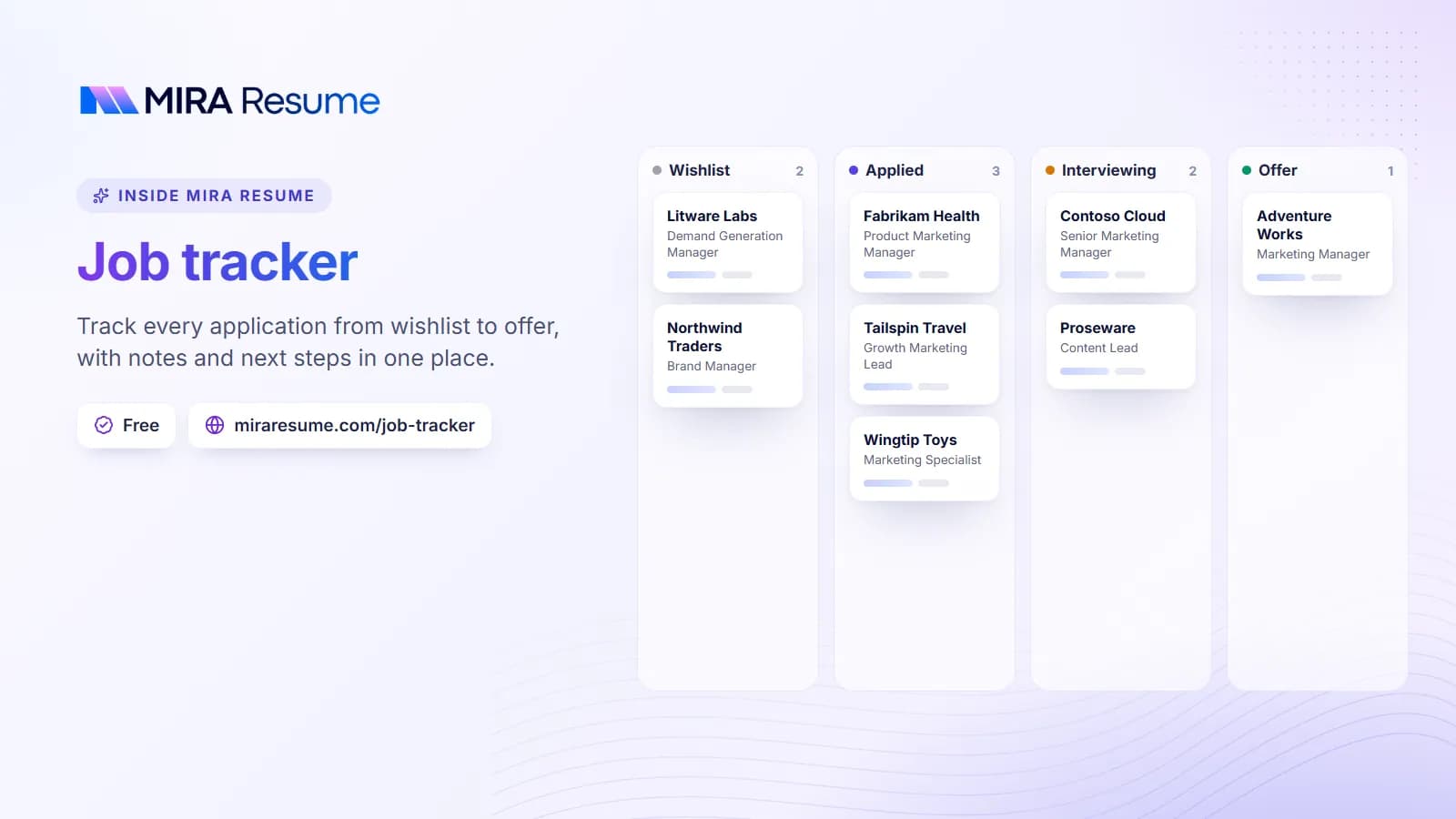
Illustration of the Mira Resume job tracker: Track every application from wishlist to offer, with notes and next steps in one place.
Illustration: Job tracker: Track every application from wishlist to offer, with notes and next steps in one place.Try it

Handling several interview rounds

Many hiring processes have several steps: a recruiter screen, a hiring manager call, a skills test or technical round, a panel, and sometimes a final chat with a senior leader. Each one needs time, and that is the real challenge of learning how to interview while working full time.

RoundTypical length (varies)Easiest way to fit it in
Recruiter screen15 to 30 minutesEarly morning or lunch, by phone
Hiring manager call30 to 60 minutesBefore or after work, by video
Skills test or take-home taskA few hoursAn evening or weekend
Technical or case round60 to 90 minutesHalf-day leave or a late slot
Panel or onsiteHalf a day or moreA planned day off, booked ahead
Final or leadership chat30 to 45 minutesAn early or late video call

Six ways to keep the load manageable

  1. Ask for the full process at the start. "Could you walk me through the stages and roughly how long they take?" Then you can plan leave in advance instead of scrambling.
  2. Group the later rounds. Ask whether panel interviews or back-to-back meetings can happen on one day. Many teams are happy to do this for a candidate who is currently employed.
  3. Keep short calls outside hours. Use early and late slots for screens, and save your leave for the long rounds.
  4. Do take-home tasks on your own time. Evenings and weekends, on your own laptop. Never use work files, code or data, even as a starting point.
  5. Limit how many processes are live. With a full-time job, two or three processes at the late stages is usually plenty. Beyond that, your leave, energy and current work all suffer.
  6. Keep a simple log. Round, date, interviewer names, what you discussed and the next step. A job search spreadsheet template makes this quick.

Asking the new employer for flexibility and confidentiality

You are allowed to ask. Hiring teams know that strong candidates are often busy in a current job, and a polite request shows that you take your commitments seriously.

What to ask for

  • Interview times outside your working hours.
  • Video rather than in-person for the early rounds.
  • Back-to-back meetings on one day for the final stage.
  • Contact through your personal email and mobile only.
  • No contact with your current employer, for references or anything else, until you have accepted an offer and resigned.

A script you can adapt

I am very interested in this role. As I am currently employed, I would appreciate it if we could keep my application confidential and contact me only on this email and number. Early morning or evening slots are easiest for me. For the later rounds, I am happy to take a day off if we can group the meetings together.

If you are working through an agency, the same points apply. Our guide to a confidential job search explains how to brief recruiters so nothing is sent without your say-so.

A company that refuses any flexibility and insists on short-notice daytime interviews is also telling you something useful about how it treats people's time.

References and background checks: get the timing right

This is where many quiet searches are exposed. The fix is to agree the order of events before anyone picks up the phone.

References

  • Offer references from former managers, colleagues who have moved on, or senior people from earlier jobs.
  • Ask each person first, and tell them your search is confidential.
  • If the new employer wants to speak to your current manager, ask for that to happen only after a written offer and after you have resigned.

Our guide to references on a resume explains whether to list them and how to prepare the people you choose.

Background checks and employment verification

Many employers run a background check or employment verification once an offer is made. Practices differ by country and company:

  • In the US, checks commonly follow a conditional offer, and employment verification may involve contacting past employers.
  • In India, background verification is often handled by a third-party agency and may include contacting your current or previous employers, sometimes before you join and sometimes after.

Ask the recruiter plainly: "Will you contact my current employer as part of verification? If so, could that wait until after I have accepted and given notice?" Recruiters hear this request often, and some employers can verify your current role with documents such as payslips instead.

Do not resign until you have a written offer and understand any conditions attached to it. A verbal yes is not yet a job.

Prepare so every interview counts

When your time is limited, preparation is what makes each hour off worthwhile.

  • Practise out loud. Run through common questions with Mira's interview prep tool the evening before a call.
  • Have a clean answer to "Why are you leaving?" Keep it forward-looking. "I am looking for more ownership of client projects" works far better than a complaint about your manager. Never share confidential details about your current company.
  • Prepare your own questions. Our list of questions to ask in an interview will help.
  • Know your notice period. They will ask. Notice periods in India are often 30 to 90 days, while two weeks is a common courtesy in the US. Check your contract for the exact terms.
  • Follow up from your personal email. Send a short thank-you note the same day, and use our follow-up email guide if you hear nothing.

Keep searching on your own devices

Between interviews you will keep looking at new roles. Do it on your own phone or laptop, on your own time. If you search on a train, in a cafe or on a laptop you share at home, Mira Resume's Stealth Mode shows real job listings inside a page that looks like an ordinary spreadsheet, with a neutral file name in the browser tab. Press Esc twice and it jumps to a decoy budget sheet.

Be clear about what it does. Stealth Mode changes what is visible on your screen. It does not hide your browsing from your employer's network, proxy or monitoring software. Use your own device and your own network.

After the offer: leave on good terms

Once you have a signed offer and any checks are cleared, tell your manager in person or on a call first, then confirm in writing. Our guides on how to resign from a job and the two weeks notice email walk you through it.

Work your notice period well and hand over properly. The manager you kept your search from is likely to be a reference one day, and a smooth exit protects that relationship. You interviewed quietly and professionally; finish the same way.

Frequently asked questions

What should I tell my boss when I need time off for an interview?

Say something short and true, such as "I have an appointment" or "I am taking a personal day", and book the time through your normal leave process. You do not need to say what the appointment is. Avoid inventing illnesses or emergencies, because a specific lie is easy to trip over and can breach company policy.

Can I do a video interview on my work laptop?

It is best not to. Work laptops are often managed by your employer and may be monitored, and joining from a work account can expose your name or meeting details. Use your own laptop or phone, a personal email address and your home or mobile connection. Close the work laptop so no notifications interrupt you.

How do I interview while working full time with little leave left?

Use early mornings, evenings and lunch breaks for phone screens and short video calls. Ask the employer to group later rounds into one day, and do take-home tasks in the evening or at the weekend. If your company offers unpaid leave, that is another honest option. Limit how many processes you run at once.

Should I tell the new employer that my search is confidential?

Yes. Tell the recruiter early that you are currently employed and would like your application kept confidential. Ask them to contact you only on your personal email and phone, and not to approach your current employer until you have accepted an offer and resigned. This is a common, reasonable request.

Will the new company contact my current employer?

It may, through references or employment verification, usually after an offer. Ask the recruiter how and when verification happens and request that any contact with your current employer waits until you have accepted and given notice. Offer references from former managers in the meantime, and never resign before you hold a written offer.

How many interviews can I take before my employer gets suspicious?

There is no fixed number. What colleagues notice is a pattern: frequent short-notice absences, smarter clothes, whispered calls. Book leave a few days ahead, keep short calls outside working hours, group later rounds together, and keep doing good work. Planned, occasional time off rarely draws attention.

Found this useful? Share it

Send it to a friend who is job hunting, or save it for later.

Read this guide with AI

Get a plain-language summary and help applying it to your own resume. Pick an assistant; it opens with this article and a ready prompt.

Back to Stealth Job Search hub

All articles