Job Match Score Explained: How Mira Scout Rates Every Job Against Your Resume
How the Mira Scout job match score works: the five weighted parts, a worked sample, honest ways to raise your score, and why no AI model reads each job.
Mira Resume Editorial Team · Career content team Published Updated 7 min read
Mira Resume Editorial Team
Career content team · Updated
In this article
Every job Mira Scout shows you carries a number from 0 to 100. That job match score answers one question: based on what your resume says and what the posting shows, how closely does this job fit what you are looking for? It is not a prediction of whether you will be hired, and it is not a grade of your resume.
This guide explains exactly how the number is built, walks through a worked sample, shows how to raise your score without bending the truth, and explains why we chose fixed rules over running an AI model on every job. The same scorer powers the resume check that AI assistants can call through the Mira Resume MCP server.
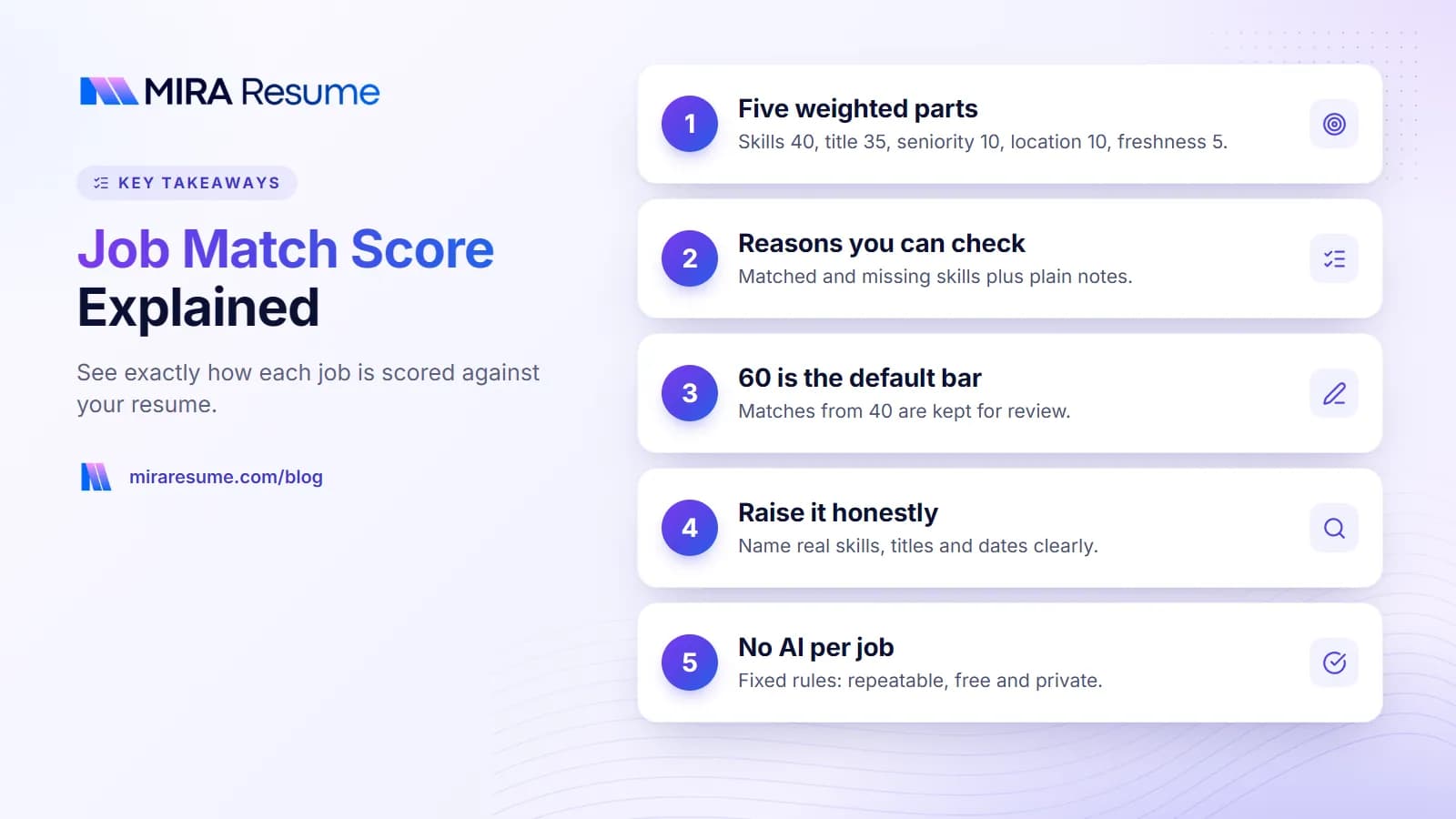
Key takeaways from this guide.
What the score is made of
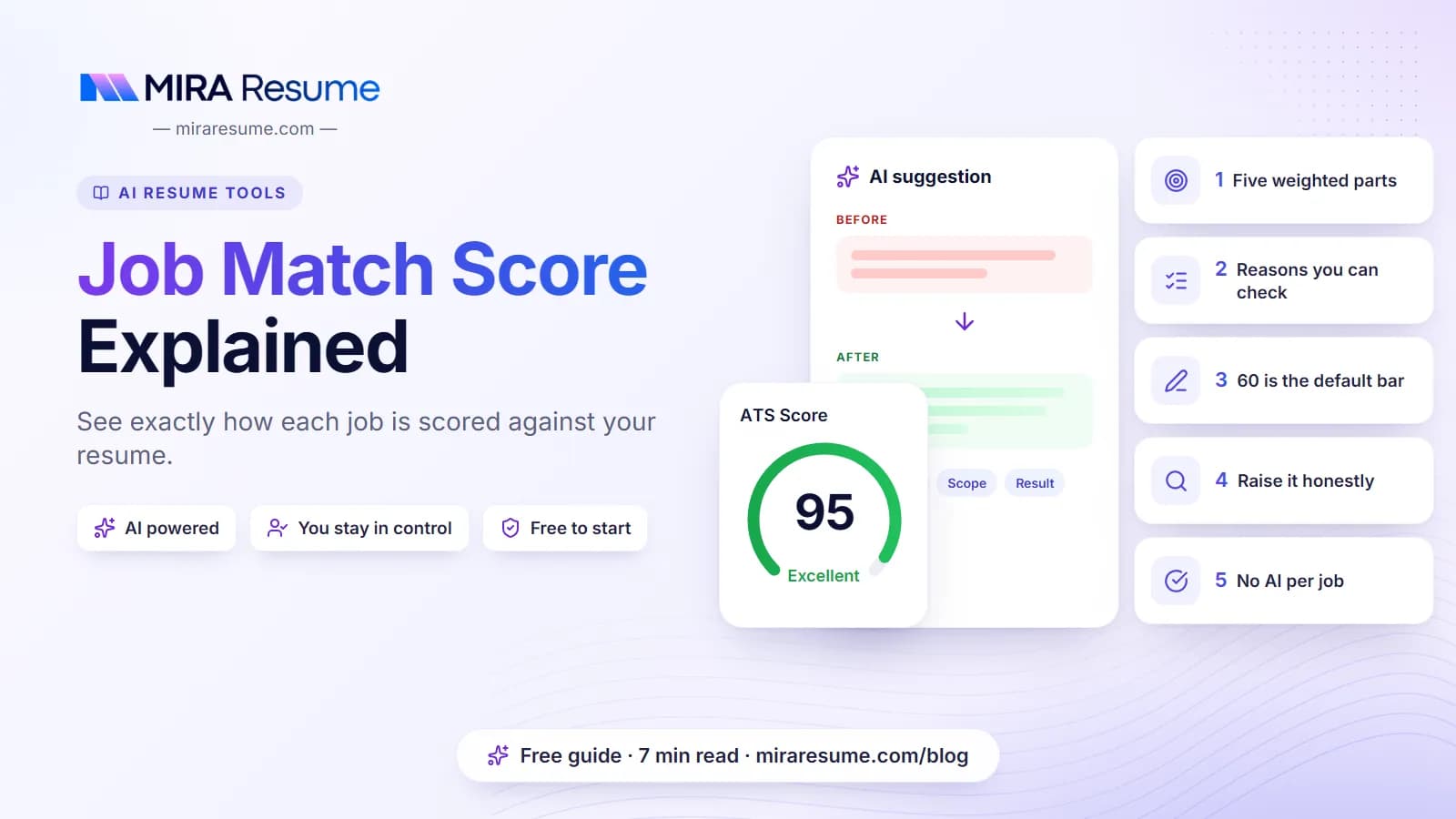
The score adds up five parts. Each part has a fixed maximum, and the maximums add up to 100.
Skills fit, 40 points. How many of the skills the posting mentions also appear on your resume, and how many of your main skills appear in the posting.
Title fit, 35 points. How close the job title is to your target titles.
Seniority, 10 points. Whether the level and years asked for fit your experience.
Location and workplace, 10 points. Whether the place and the remote, hybrid or on-site setup match your settings.
Freshness, 5 points. How recently the job was posted.
Skills and title together make up three quarters of the score, which is deliberate: what you do and what you are called matter far more than whether a posting is two days or five days old.
How the 100 points of a Mira Scout job match score are weighted
Maximum points for each part of the score
Skills fit: 40 pts - Posting skills found on your resume, and your top skills found in the postingTitle fit: 35 pts - Job title against your target titlesSeniority: 10 pts - Years and level asked for against your experienceLocation and workplace: 10 pts - Your cities, country and remote, hybrid or on-site preferenceFreshness: 5 pts - Newer postings score higher
Skills fit 40 pts
Title fit 35 pts
Seniority 10 pts
Location and workplace 10 pts
Freshness 5 pts
Source: Mira Scout scoring rules, 16 November 2026.
View as table
Item
Max points
Skills fit
40 pts
Title fit
35 pts
Seniority
10 pts
Location and workplace
10 pts
Freshness
5 pts
How each part is scored
Part
Max
How it is measured
What scores well
Skills fit
40
Skills are recognised with a dictionary of about 535 skills. Most of the weight is the share of the posting's skills found on your resume; the rest is how many of your top skills the posting mentions. Postings that name very few skills get a neutral middle value instead of a harsh one.
A resume that names the tools and methods you really use, in the words postings use
Title fit
35
Your target titles, or your resume's target role and recent job titles, are compared with the job title. An exact phrase scores full points; a matching role noun (analyst, engineer) with some shared words scores part; common synonyms such as developer and engineer count. A big level mismatch, such as senior against entry, reduces it.
Two to four realistic target titles in your settings
Seniority
10
If the posting asks for a number of years, it is compared with the years on your resume. Otherwise the job's level (intern, entry, mid, senior) is compared with your experience. Levels you pick in settings take priority.
Clear dates on every role
Location and workplace
10
Up to 5 points for the work type you prefer and up to 5 for the place: your listed cities, your country, or a remote role. If you set a salary minimum and the listed pay in your country is below it, 3 points come off.
Honest location and work type settings
Freshness
5
5 points if posted within a day, then 4, 3, 2 and 1 as the posting ages up to 30 days; 0 after that.
Nothing to do: new jobs arrive every day
Each match also lists up to eight matched skills, up to six missing skills and short notes such as "Asks for 4+ years; you have about 5 years." Those reasons are the most useful part of the score, because they tell you what to check.
A worked example (sample numbers)
This is a sample we calculated by hand with the published weights, to show how the parts combine. Your own numbers will differ. The person has about five years of experience, a target title of "Data Analyst", a preference for hybrid work and Bengaluru as their city.
Part
Job A: Senior Data Analyst, hybrid, Bengaluru, posted 2 days ago
Job B: Product Analyst, on-site, Pune, posted 20 days ago
Title fit (35)
35: the exact phrase "data analyst" is in the title
18: same role noun, but "data" is missing
Skills fit (40)
29: the resume has 6 of the 8 skills mentioned, and 4 of the person's top 6 skills appear
13: 3 of 9 skills, and 2 of the top 6 appear
Seniority (10)
10: asks for 4+ years, the resume shows about 5
4: asks for 7+ years, two short
Location and workplace (10)
10: hybrid as preferred, in a listed city
4: on-site, and Pune is not a listed city
Freshness (5)
4: two days old
1: twenty days old
Total
88
40
Job A would be near the top of the list and in the daily email. Job B would be kept, because matches from 40 are stored, but it would sit below the default minimum of 60 and stay out of the digest. The reasons would point the person to the gap that matters most: the posting's skills and years, not the date.
Sample: points by part for Job A (total 88)
Hand-calculated sample from the worked example; not real user data
Title fit35 ptsTitle fit: 35 pts - of 35
Skills fit29 ptsSkills fit: 29 pts - of 40
Seniority10 ptsSeniority: 10 pts - of 10
Location and workplace10 ptsLocation and workplace: 10 pts - of 10
Freshness4 ptsFreshness: 4 pts - of 5
Illustrative only. Maximums: skills 40, title 35, seniority 10, location and workplace 10, freshness 5.
View as table
Item
Points
Title fit
35 pts
Skills fit
29 pts
Seniority
10 pts
Location and workplace
10 pts
Freshness
4 pts
What happens with the score
Matches from 40 are kept. Anything lower is not stored, so your list is not cluttered with poor fits.
Your minimum decides the digest. The default is 60. Only new matches at or above it are emailed, if you turn on the daily email digest.
Best first. The list is sorted by score, and you can filter new, saved and dismissed matches.
Daily, plus "Run now". Matching runs once a day automatically, and you can run it yourself up to three times a day after changing settings or your resume.
Hard filters come before the score. Jobs with a term you excluded, companies on your skip list, on-site jobs when you want remote only, and office-based jobs in a country other than yours are removed rather than scored low.
The same score also appears as the Match % column in Stealth Mode, the spreadsheet-style job search, on Pro, Elite and Lifetime.
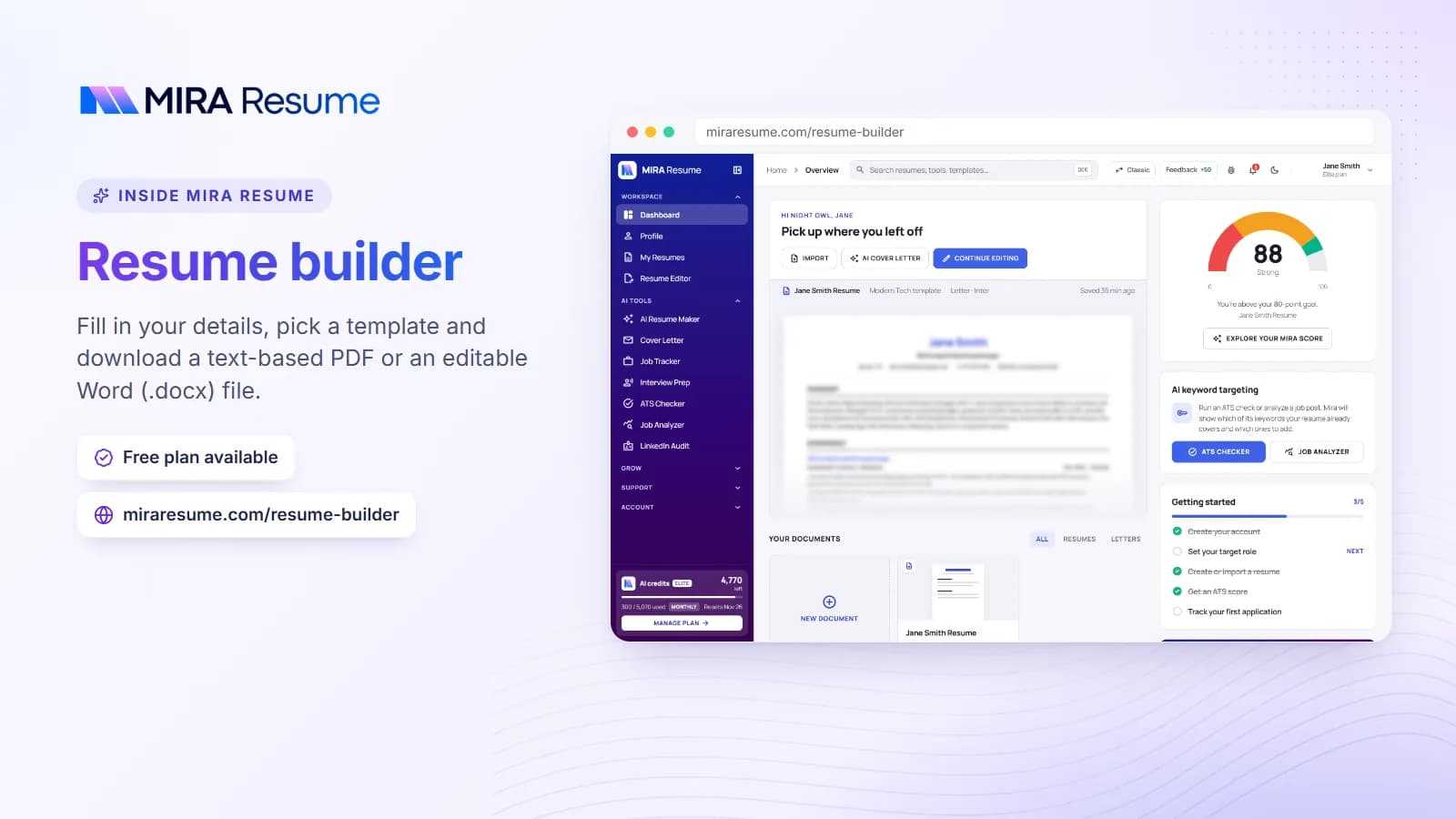
Screenshot: Resume builder: Fill in your details, pick a template and download a text-based PDF or an editable Word (.docx) file.Try it
How to raise your job match score honestly
The score rewards a resume that states clearly what you have really done. That is also what recruiters reward, so there is no conflict between the two.
Name your real skills precisely. "Built dashboards in Power BI with DAX" beats "reporting tools". A skills section near the top helps both the scorer and a human reader. See our guide to resume keywords.
Set realistic target titles. Two to four titles you would actually accept, including common variants. This alone often moves the title part the most.
Date every role. Clear start and end dates let the seniority part compare your years correctly.
Tell it where you will work. Add your cities and work type, so suitable jobs get full location points.
Read the missing skills as questions. If you have used a missing skill, add it in context in a bullet. If you have not, leave it off; the score is not worth an awkward interview.
Do not paste the posting's keywords into your resume in white text or a hidden list. It does not help with recruiters, and one who spots it will likely treat it as a red flag. Our guide to AI resume screening explains why.
Why there is no AI model reading each job
It would be easy to send every job and your resume to a language model and ask for a score. We chose not to, for four reasons.
Reason
What it means for you
Repeatable
The same resume and job always give the same score, so a change in the number means something changed
Explainable
Every point comes from a rule we can describe, with matched and missing skills you can check
Free and fast
Thousands of jobs can be scored for every member every day without spending AI credits
Less data shared
Your resume is not sent to an AI provider just to rank jobs
AI still has a place, after the ranking. Planned application kits will use AI, and credits, to help tailor a resume and cover letter for a job you have chosen. Mira Scout also stores job cards rather than full descriptions: a short snippet of up to 280 characters and a list of terms used only for matching, with a link to the full posting on the source site.
What the score cannot tell you
Whether you will get an interview. Hiring depends on the applicant pool, the team and timing, none of which the score sees.
Things your resume does not say. If a strength is not written down, the scorer cannot see it, and neither can a recruiter skimming for ten seconds.
Culture, pay fairness or growth. Read the posting, the company's pages and reviews for those.
Fit for a career change. Transferable skills often use different words, so a career changer's scores run lower. Our guide to a career change resume shows how to bridge that language.
Use the same score from your AI assistant or code
The same scorer is available as check_resume_against_job on the Mira Resume MCP server and as POST /resumes/{id}/match on the REST API, for Pro and Elite members. Paste any posting, and you get the score, the breakdown, matched and missing skills and notes, with no AI credits used. For a pasted job, location and freshness use neutral values. Our guide to tailoring a resume with Claude shows how to use it as a referee while an assistant suggests edits. Mira Scout itself launches on 27 November 2026; see the Mira Scout page for the details.
Frequently asked questions
What is a good job match score?
In Mira Scout, 60 is the default minimum for your daily digest and a sensible bar for jobs worth reading closely. Scores in the 70s and 80s usually mean the title, skills and level line up well. Matches between 40 and 59 are kept so you can review them, but they often have a clear gap.
Is the job match score calculated by AI?
No. It is calculated with fixed, published rules: title fit, skills fit, seniority, location and workplace, and freshness. That keeps it repeatable, explainable and free to run on every job every day. AI is reserved for later steps, such as planned application kits, which will use credits.
Why is my score low when I am qualified?
Usually because your resume does not say it in words the posting uses, the job title differs from your target titles, or your dates make your experience look shorter. Read the matched and missing skills and the notes under the match. Fix only real gaps, such as a skill you have but never listed.
Does adding keywords to my resume raise the score?
Adding skills you genuinely have, written clearly, raises the skills part and helps recruiters too. Adding skills you do not have might raise the number but will hurt you in interviews, and hidden keyword lists are easy for a recruiter to spot. The score is meant to reward clarity, not stuffing.
Can I check my score for a job Mira Scout did not find?
Yes, on Pro and Elite. The check_resume_against_job tool on the Mira Resume MCP server, or POST /resumes/{id}/match on the REST API, scores any pasted posting with the same rules. Location and freshness get neutral values for pasted jobs, so the title and skills parts carry most of the result.
How often are scores updated?
Matching runs once a day for every active member, and you can press Run now up to three times a day after changing your settings or resume. New jobs are collected from company boards and feeds throughout the day, so each run can bring new matches and updated freshness points.
Found this useful? Share it
Send it to a friend who is job hunting, or save it for later.