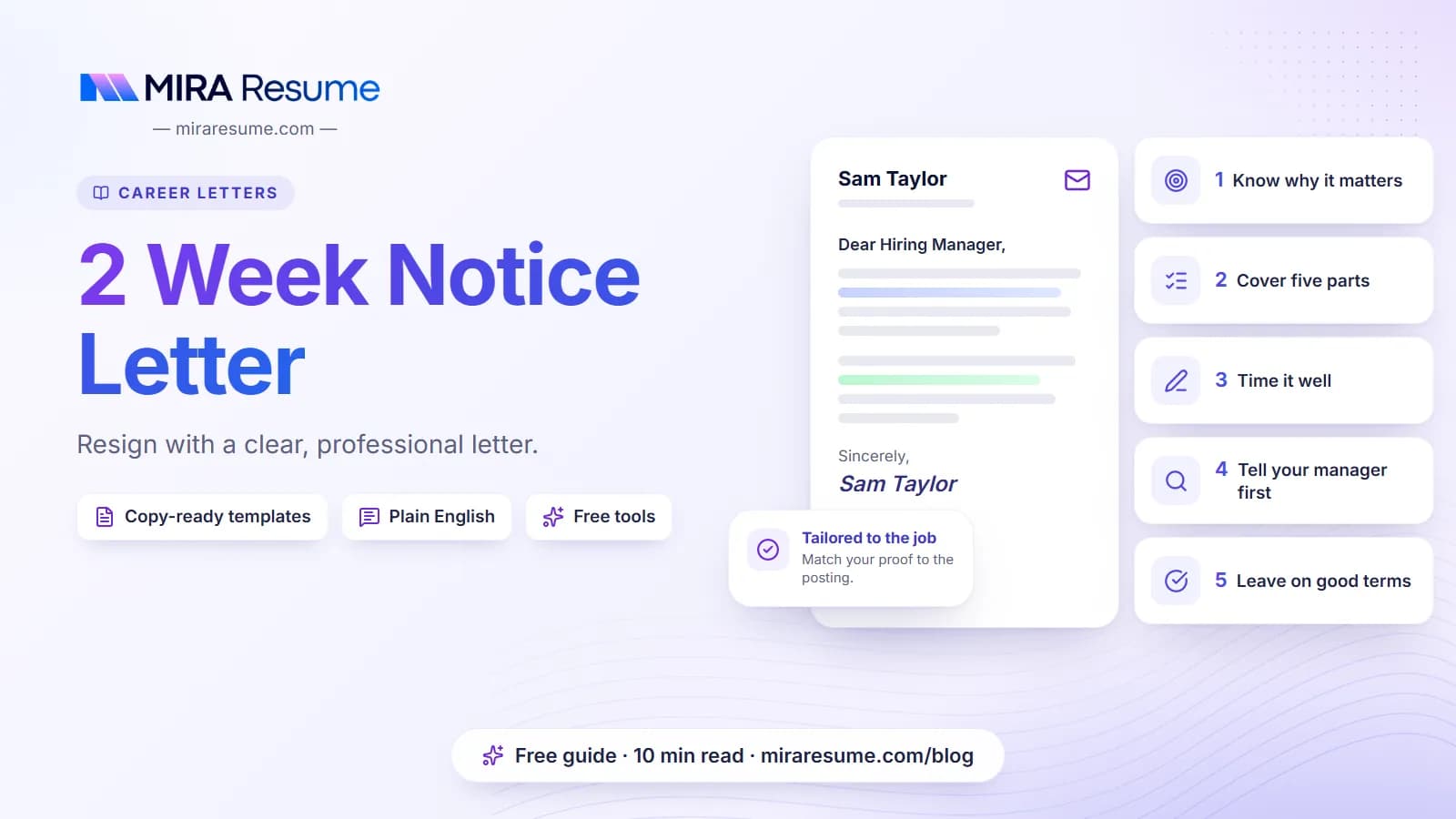

A 2 week notice letter is a short written note that tells your employer you are leaving and gives your last day of work. It is usually one page or less. It has no big explanations and no complaints. Its job is simple: make your exit clear, polite and easy to act on.
Many people stress about this letter more than they need to. The good news is that the format is almost always the same. You say you are resigning, you give a date, you say thanks, and you offer to help. That is the whole letter.
Below you will find a plain template, three examples you can adapt, a checklist of what to include, and advice on timing. If you only need the wording for a message sent by email, see our guide to the two weeks notice email. If you are still deciding how to approach the whole conversation, start with how to resign from a job.
This is general guidance, not legal advice. Employment rules differ by country, state and contract, so check your own contract and local labor rules before you set a last day.
What a 2 week notice letter is and why people use it
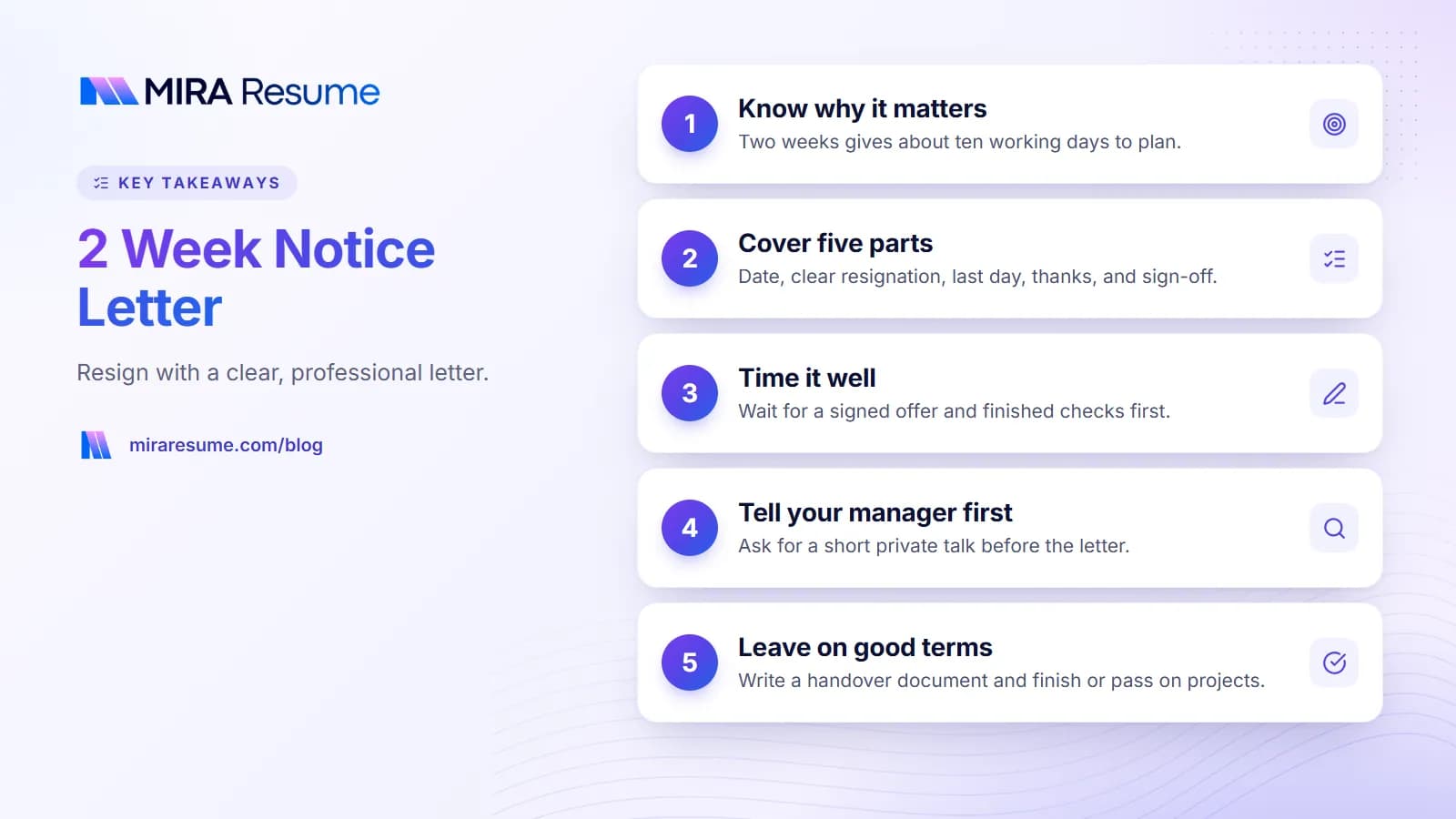
A two week notice is a courtesy. It gives your employer about ten working days to plan for your absence. In many workplaces, especially in the United States, it is the normal custom for resigning from a job. In other places the required notice may be shorter, longer, or set by law or contract.
The letter itself is a written record. It shows the date you told the company and the last day you plan to work. That record can help both sides. Your employer knows when to arrange final pay and benefits paperwork. You have proof that you gave notice in a professional way.
Is two weeks required?
Not always. Two weeks is a custom in many places, not a universal rule. Some contracts ask for one month or more. Some roles, such as senior or specialist jobs, expect longer. Some at-will jobs have no required notice at all. Read your offer letter or employee handbook first. If you cannot find the rule, ask HR in a calm, neutral way.
Letter or conversation first?
Tell your manager in person or by video call first when you can. The letter comes right after, or at the same meeting. A letter should never be the way your boss finds out. We cover the order of steps in our guide on how to resign from a job.
| Item | What it means | Where to check |
|---|---|---|
| Notice period | The time between telling your employer and your last day | Contract or offer letter |
| Last day | The final day you will actually work | You choose, within the notice rules |
| Final pay | Wages, unused time off and other money owed | Handbook, local labor rules |
| Benefits end date | When health cover or similar benefits stop | HR or benefits portal |
What to include in a basic 2 week notice letter
A good letter has five small parts. You do not need more. Adding more only creates more chances for confusion.
- The date of the letter. This is the day you hand it in.
- A clear statement that you are resigning. Use words like "I am resigning from my position as..."
- Your last day. Write the full date, such as "Friday, 6 November". Do not write only "two weeks from today".
- A thank you. One sentence is enough. Be honest and keep it short.
- An offer to help. Say you will help finish projects and train a replacement.
What to leave out
- The name of your new employer, unless you want to share it.
- Your new salary or title.
- Complaints about your boss, pay or coworkers.
- Long stories about why you decided to go.
- Anything you would not want read out in a meeting.
Do you need to explain why you are leaving?
No. A reason is optional. If you want to add one, keep it positive and brief, for example "to take a new opportunity" or "to move closer to family". If you leave for a difficult reason, the letter is not the place to discuss it. You can talk about it in an exit interview if you choose to.
Format basics
Use a plain business letter layout. Put your name and the date at the top, then the manager's name, then the message. Use a normal font such as Arial or Calibri at 11 or 12 points. Sign it if you print it. Save a copy as a PDF for your own records. If you want to see how clean documents should look, our resume templates use the same simple, readable style.
Two week notice template you can copy
Here is a basic 2 week notice letter. Replace the words in brackets with your own details. Keep it to one short page.
[Your Name]
[Your Address or Email]
[Date]Dear [Manager's Name],
Please accept this letter as formal notice that I am resigning from my position as [Job Title] at [Company Name]. My last day of work will be [Last Day Date].
Thank you for the opportunity to work here. I have learned a lot and I appreciate your support.
During my remaining time, I will do my best to finish my current tasks and help prepare my work for a smooth handover. Please tell me how I can help most.
Sincerely,
[Your Name]
How to customize it in two minutes
- Change "formal notice" to "my notice" if your workplace is casual.
- Add the name of a project you want to finish before you leave.
- Add one line about future contact if you are leaving on good terms, such as "I hope we stay in touch".
- If your contract sets a different notice period, use that number and say so in the letter.
Template for a very short letter
Dear [Name],
I am resigning from my role as [Job Title], effective [Date]. Thank you for everything. I will help with the handover over the next two weeks.
Best regards,
[Your Name]
The short version is fine when your relationship with the manager is neutral and you have already spoken in person. For more situation-based wording, see our resignation letter samples.
Three 2 week notice letter examples for different people
The right tone depends on your workplace. These three two weeks notice examples show how the same letter changes slightly.
Example 1: Friendly and warm
Dear Priya,
I am writing to let you know that I am resigning from my role as Customer Support Specialist. My final day will be Friday, 20 November.
Working with this team has been a highlight of my career so far. Thank you for trusting me with new tasks and for your patience while I learned. I would be glad to document my daily processes and train a teammate before I go.
Warm regards,
Daniel Okafor
Example 2: Formal and brief
Dear Mr. Alvarez,
Please consider this letter my formal resignation from the position of Financial Analyst at Northfield Partners. In line with my contract, my last working day will be Monday, 2 November.
I will complete my open reports and prepare a handover note for the team. Thank you for the opportunities I have had here.
Yours sincerely,
Hannah Lee
Example 3: Neutral, when the job was hard
Dear Sam,
This is my notice that I am resigning as Warehouse Associate. My last day will be Friday, 13 November.
I will use my remaining shifts to finish my assigned tasks and help train anyone who needs it. Thank you for the time I spent here.
Regards,
Marcus Reed
Notice the pattern. Each letter states the role, gives a date, shows thanks, and offers help. None of them criticizes the company, even when the writer may have had problems.
| Tone | Best when | Key words to use |
|---|---|---|
| Warm | You like your team and manager | "Thank you", "glad to help", "stay in touch" |
| Formal | Large company or legal-style workplace | "Formal resignation", "in line with my contract" |
| Neutral | The job was stressful or you want to stay brief | "This is my notice", "last day will be" |
When to give notice and how to choose your last day
Timing matters as much as wording. A good plan protects your new job, your references and your final paycheck.
Wait until the new job is certain
Do not hand in notice until you have a signed offer and have finished any checks the new employer requires, such as background or reference checks. An offer that is not final can still change. If you resign too early you could be left without work.
Count your days carefully
Two weeks usually means ten working days. Choose the date, write it out, and make sure it fits any company rule. If your notice starts on a Monday, your last day is normally the Friday of the following week. Some employers ask you to count from the day after you give notice. Check and confirm with HR.
Think about the calendar
- Check for pay dates. If your final pay arrives on a fixed day, you may want your last day to fall just before or after it.
- Check benefits. Some health benefits end on the last day of the month, so a few extra days could matter.
- Check unused time off. In some places it is paid out, in others it is not.
- Check busy periods. If you can help through a big project, it builds goodwill.
What if your employer asks you to leave sooner?
This can happen. Some companies ask you to go the same day, especially in sensitive roles. Ask politely whether you will be paid through the notice period. Rules differ by place, so check the contract and local labor rules.
| Situation | What usually works |
|---|---|
| You have a start date at the new job | Work back from it and leave a few days of rest |
| Your contract says one month | Give the longer notice, or negotiate in writing |
| You are in a probation period | Check whether shorter notice applies |
| Your employer says leave today | Ask about pay for the notice period |
How to deliver the letter
How you hand it over is part of the message.
- Ask for a short private meeting. Use a calm line such as "Do you have ten minutes today? I want to talk about my plans."
- Say it clearly. For example: "I have accepted another role, and I want to give you two weeks notice. My last day will be the 6th."
- Hand over the letter or send it straight after. Email a copy to your manager and, if your company asks, to HR.
- Listen. Your manager may ask questions about the handover. Stay helpful and short.
- Keep a copy. Save the PDF and the email in a personal place, not only on a work device.
Printed or email?
Either is acceptable in most workplaces. A printed and signed letter feels formal. An email is faster and leaves a time-stamped record. If you send it by message, see our separate guide to the two weeks notice email for subject lines and tone.
What if a counteroffer comes?
Your employer may offer more pay or a new title to keep you. Think carefully before you answer. Ask yourself why you wanted to leave, and whether money alone fixes it. You can say "Thank you, I need time to think." More on this is in our guide on how to resign from a job.
Common mistakes to avoid in a two week resignation letter
- Writing it before you tell your manager. A letter is not a replacement for a conversation.
- Using vague dates. "In two weeks" is unclear. Write the exact date.
- Venting. Even a true complaint can harm your reputation. Letters are saved in your file for years.
- Making it too long. More than one page makes it feel like a speech.
- Forgetting to offer help. A single line about the handover is worth a lot.
- Burning bridges. You may want a reference from this manager later. Stay kind.
- Sending it from a work email only. Keep a personal copy in case you lose access.
- Quitting before the new job is final. Wait for a signed offer.
Quick quality check
| Question | Good answer |
|---|---|
| Is the last day a real date? | Yes, written in full |
| Is it under one page? | Yes, usually under 150 words |
| Would you be fine if everyone read it? | Yes |
| Does it offer help with the handover? | Yes |
What to do in your last two weeks
The letter is only the start. How you spend the notice period shapes what people say about you later.
At work
- Write a simple handover document. List open tasks, key contacts, login locations (not passwords) and where files live.
- Finish or pass on any project that is close to done.
- Say goodbye to clients and teammates in a friendly message.
- Ask for written references or a LinkedIn recommendation while people still remember your work.
- Return equipment on time and ask for confirmation.
For your career
This is the best time to save your wins. Write down numbers, projects and results from the job while they are fresh. Then update your documents:
- Add your new role to your resume with the help of our AI resume builder, or edit the layout in the resume builder.
- Refresh your profile with a quick LinkedIn audit.
- If you are still searching, keep your applications in one place with the job tracker.
Showing a promotion or a clear result is easier when you write it down before you forget it. Our guide on how to show a promotion on a resume can help.
Protect your personal items
Remove personal files and photos from work devices. Do not take company data, client lists or private documents. Check your contract about what you can keep.