
Looking for a sample thank you letter after interview day? Here is the quick version. Send a short message within 24 hours. Thank the person for their time, mention one specific thing you talked about, say again why you are a good fit, and finish with a polite closing. Keep it to 100 to 150 words.
A thank-you note is not magic, and it will not fix a poor interview. Hiring managers differ, and some barely notice it. But it is polite, it keeps your name in front of the team, and it gives you one more chance to add a point you forgot.
This guide gives you six templates (email and print), clear timing rules, and advice on what to say if you met several people or if the interview went badly.
When to send a thank you letter for a job interview
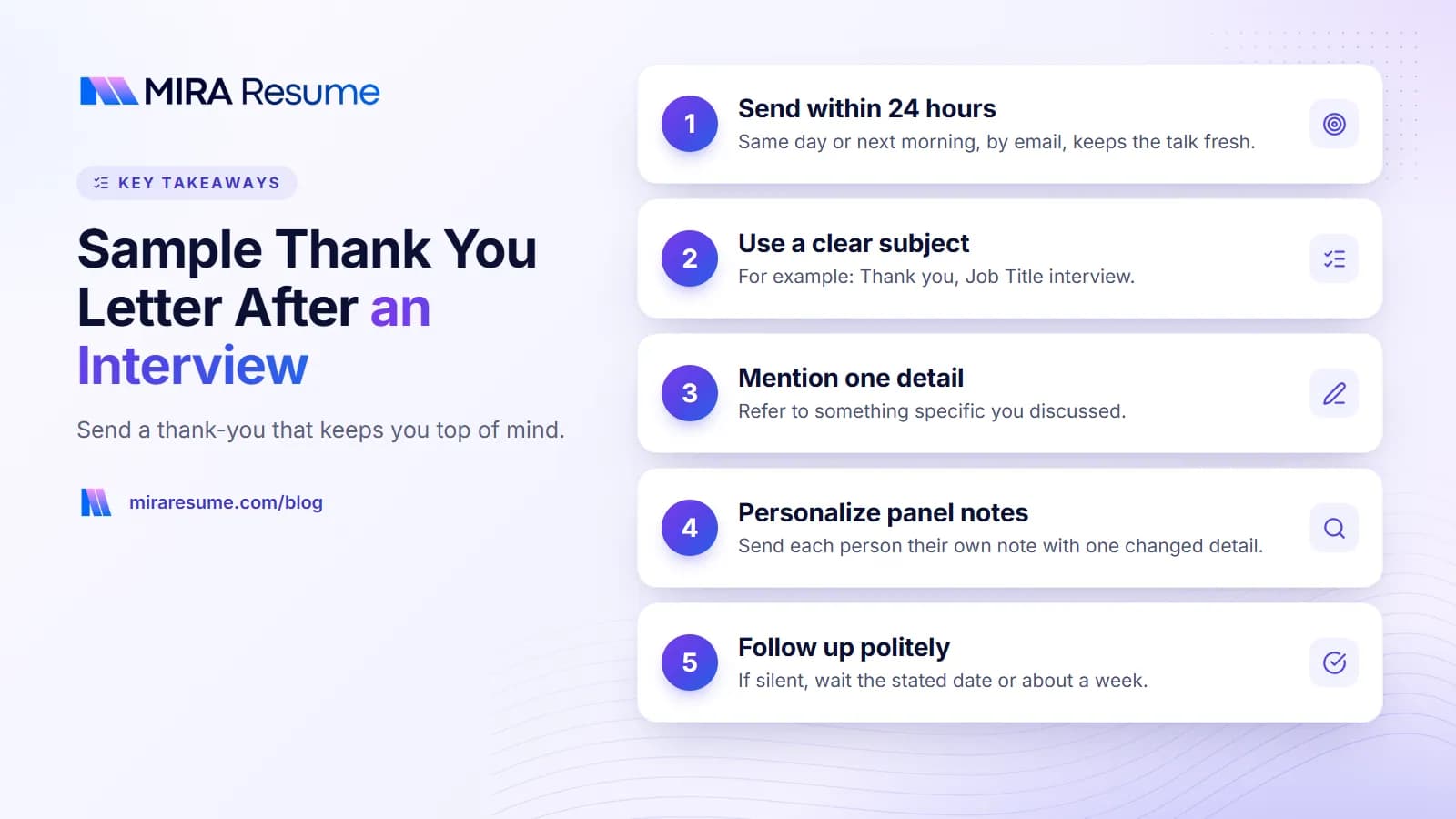
Send your note within 24 hours, ideally the same day or the next morning. The conversation is still fresh for both of you.
| Situation | Best timing | Best format |
|---|---|---|
| Normal interview | Within 24 hours | |
| Decision expected soon (a day or two) | The same day | |
| Interview on a Friday | Friday evening or Monday morning | |
| Panel with several people | Within 24 hours; one note to each person | Email, slightly different for each |
| Formal or traditional field (law, academic) | Email first; a printed note is optional | Email, optionally mailed card |
| Phone or video screening | Same day | Short email |
Email is the safest choice for most jobs because it arrives fast. A handwritten card can be a warm extra in some fields, but it should never replace email if timing matters.
What to include in an interview thank you letter
A good note is short and has four parts. Think of it as a very small version of a cover letter. If you want a refresher on that style, read what is a cover letter.
- A clear subject line. For email, use something like "Thank you – Marketing Coordinator interview".
- A thank you. Name the role and the date or setting of your talk.
- One specific detail. Mention something you discussed, such as a project, a challenge or a shared interest. This proves you listened.
- A reminder of your fit. One sentence linking your skills to what they need.
- A polite closing. Offer to answer questions and say you look forward to next steps.
How to write a thank you letter after an interview: a quick formula
Thank + detail + fit + next step. If your note has those four pieces, it is complete. Anything more is probably extra.
Template 1: standard thank you email after an interview
Use this when you met one person and the talk went well.
Subject: Thank you – [Job Title] interview
Dear [Mr./Ms. Last Name],
Thank you for taking the time to meet with me on [day] about the [Job Title] role. I enjoyed learning about [specific topic, such as how the team plans its quarterly launches].
Our conversation made me even more interested in the position. My experience with [skill or result] seems a good match for [challenge or goal they mentioned], and I would be glad to help with that.
Please let me know if I can share anything else. I look forward to hearing about next steps.
Best regards,
[Your Name]
[Phone]
This one is about 110 words. Replace the bracketed parts with true details from your interview. If you do not remember a specific topic, check your notes right after the interview. A short note taken in the car or on the train is worth the effort.
Template 2 and 3: panel interviews and short screening calls
Template 2: thank you to a panel
Send each person their own note and change one detail in each. Do not copy and paste the exact same message to everyone, because panel members often talk to each other.
Subject: Thank you – [Job Title] interview
Dear [Name],
Thank you for meeting with me yesterday. I appreciated your question about [topic] and the chance to explain how I handled [situation].
Speaking with you and the team confirmed that I would like to join [Company]. I believe my background in [skill] can help with [goal].
Thank you again for your time.
Sincerely,
[Your Name]
Template 3: after a short phone or video screening
Subject: Thanks for speaking today
Hello [Name],
Thank you for the call this afternoon about the [Job Title] role. I appreciated hearing more about the day-to-day work and the team.
I remain very interested and would be glad to move to the next step. My resume is attached again in case it helps.
Best,
[Your Name]
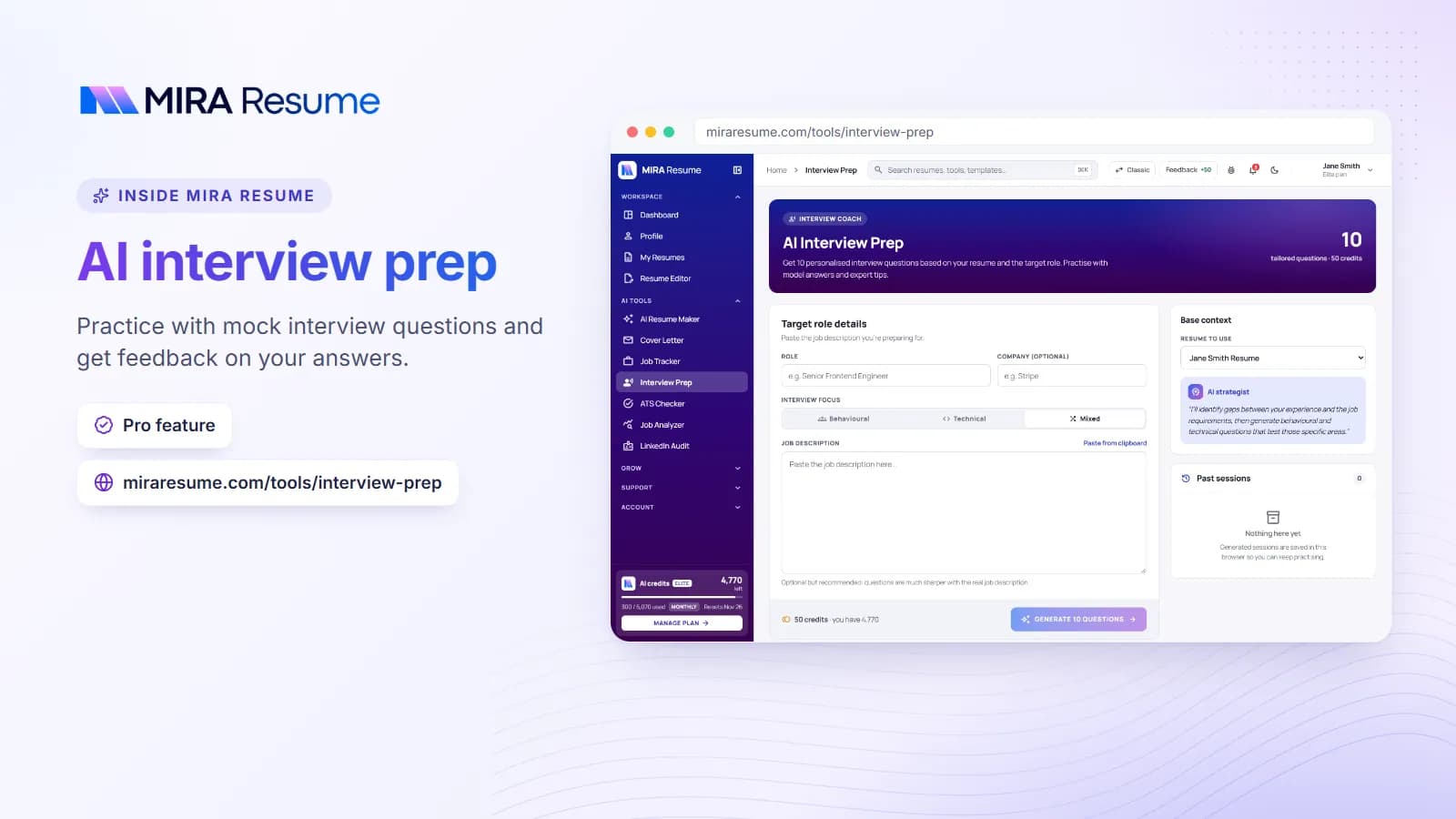
Keep screening-call notes shorter. If you want to prepare for the next round, our interview prep tool can help you practise answers.
Template 4 to 6: special situations
Template 4: you forgot to mention something
Dear [Name],
Thank you for meeting with me on [day]. After our talk, I realised I did not mention that I also [relevant skill, such as managed a similar budget or used the software you listed]. I wanted to share it because it connects to what you described about [need].
I appreciate your time and look forward to hearing about the next steps.
Sincerely,
[Your Name]
Template 5: the interview did not go perfectly
Do not make excuses. Be brief, positive and honest. If you stumbled on a question, you can give a clearer answer in one or two lines.
Dear [Name],
Thank you for your time on [day]. I have been thinking about your question on [topic]. A clearer answer is that [short, honest improved answer].
I remain very interested in the [Job Title] role and appreciate the chance to learn about your team.
Kind regards,
[Your Name]
Template 6: a printed or mailed note
[Date]
Dear [Mr./Ms. Last Name],
Thank you for speaking with me on [day] about the [Job Title] role at [Company]. I enjoyed our talk about [topic], and I left the interview even more excited about the position.
I believe my [skill] and my experience in [area] fit your needs. Please contact me at [phone] if I can supply anything else.
Sincerely,
[Your Name]
If you send a printed note, mail it the same day and still send an email so the message arrives in time.
Do's and don'ts for a thank you letter to your interviewer
| Do | Don't |
|---|---|
| Send within 24 hours | Wait a week |
| Keep it to about 100 to 150 words | Write a long essay |
| Mention something specific you discussed | Use a copy-paste message with no details |
| Check names, titles and spelling | Guess the spelling of a name |
| Link your skills to a stated need | Repeat your whole resume |
| Use a plain subject line | Use all caps or exclamation marks |
| Offer to share more information | Ask about salary, benefits or holidays |
| End with a polite next step | Pressure them for an answer |
The tone should be warm and professional, just like in your cover letter. For wording ideas, see our guide on how to close a cover letter, which has examples that also work at the end of a thank-you note.
Subject lines and small details that make your note look polished
The small parts of a thank-you email often get skipped, but they make the message easy to open and easy to find later.
Good subject lines
- Thank you – Customer Support Specialist interview
- Thanks for meeting with me today
- Following up on our conversation, [Your Name]
Avoid vague lines like "Hi" or "Thanks!!!". A clear subject line lets the interviewer find your message among many.
Details to check before you hit send
- The name. Spell it as it appears in their email signature.
- The job title. Use the same words as the job post.
- Your signature. Add your full name and phone number so replying is simple.
- Your email address. Use a professional one, with your name in it.
- Attachments. Do not attach anything unless you promised it.
- Tone. Read it aloud. It should sound like you on a good day.
Take notes during the interview
The easiest way to write a specific thank-you note is to jot down two or three details right after you leave: a project they mentioned, a problem they want solved, a name of someone you met. Those notes give you concrete material, and they also help you prepare for a second round. If you want to practise before the first interview, try our interview prep tool.
What to do if you do not hear back
Waiting is hard. Here is a calm plan.
- Read what they told you. If the interviewer said "we will decide by next Friday", wait until that date passes.
- If no date was given, wait about a week. Then send a short follow-up.
- Keep it polite. Something like, "I wanted to check in on the [Job Title] role. I remain interested and am happy to share anything else you need."
- Follow up once or twice, not daily. Too many messages can hurt your chances.
- Keep applying. A pending interview is not a job offer. Continue to apply and refresh your resume with the AI resume builder if needed.
Timelines differ widely by company, so a slow reply does not always mean a no. If you decide to move on, you can look at our plans to see what tools can speed up your search.
Common mistakes in interview thank-you letters
- Typos in the interviewer's name. Copy it from their email or business card.
- Using a joke or slang. Stay friendly but professional.
- Making it all about you. Thank them first, then connect to their needs.
- Adding attachments that were not asked for. Unless you are sharing a promised sample, skip them.
- Forgetting the people you met. If you met three people and thank one, the others may notice.
- Waiting until you are sure you want the job. Send it anyway; you can always decline later.
Keep your documents consistent too. The name and phone on your note should match your resume and your cover letter. If you want a quick refresher on how the three fit together, read cover letter vs resume.