
What is a resume? It is a short document that sums up your work experience, skills, and education for one purpose: to show an employer you could do a job well. Most resumes are one page long, sometimes two. You send it with a job application, and the reader uses it to decide whether to invite you to talk.
If you are new to job hunting, this page is your starting point. You will learn the purpose of a resume, what each part does, how a resume differs from a cover letter and a CV, and what a simple sample looks like. By the end you will know what to write first and what to leave out.
Resume meaning in plain words
The word comes from French and means "summary". That is the best way to think of it. A resume is a summary of what you have done and what you can do, written for a specific reader.
Three ideas explain most of it:
- It is short. A hiring manager may have many applications to read, so the page has to be quick to scan.
- It is about facts. Job titles, dates, skills, tools, and results. Opinions and long stories belong elsewhere.
- It is made for one goal. Each version should point at the job you are applying for.
People also type "whats a resume" when they hear the word at school or at a job centre for the first time. The answer is the same: it is your work summary on paper. You do not need years of experience to have one. School projects, volunteering, and part-time work can all fill a first resume. Our guide to the first job resume shows how.
What is the purpose of a resume?
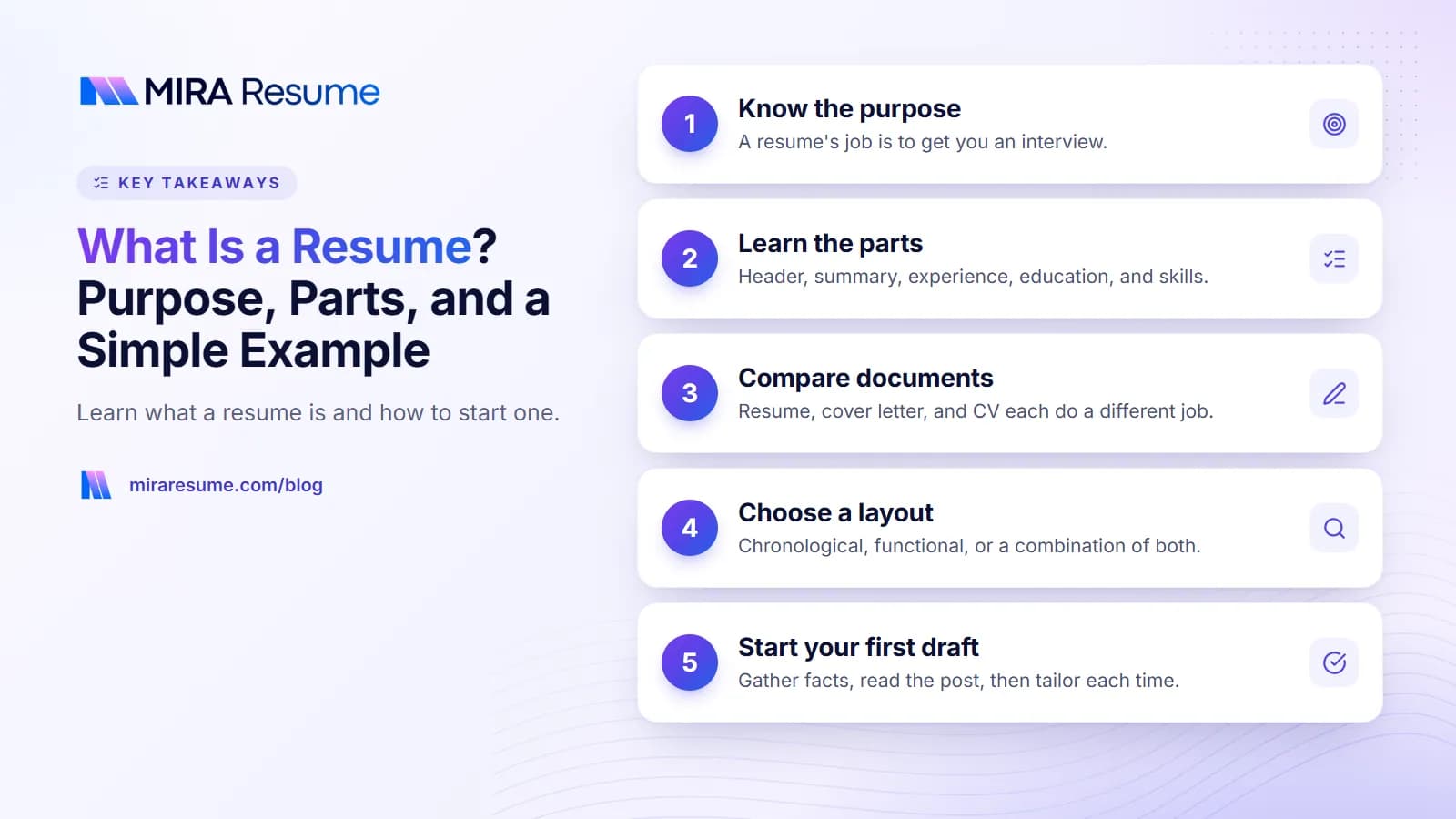
The purpose of a resume is to get you an interview. It does not need to get you the job by itself. It only needs to make the reader think, "This person looks like a fit. Let's talk."
To do that, a resume has to do four things:
- Show you are qualified. The reader should see within seconds that you meet the main requirements.
- Prove it with evidence. Results, numbers, and named tools are stronger than general claims.
- Be easy to read. Clear headings, short bullets, and a clean layout.
- Pass the first screen. Many companies use software to store and sort applications, so your file should be readable by machines too. See how an applicant tracking system works for the basics.
Employers also use resumes for later steps. Interviewers often have yours in front of them and pick questions from it. So everything on the page should be something you can talk about with ease.
What are the parts of a resume?
Most resumes use the same building blocks. Some are required and some are optional.
| Part | What it contains | Needed? |
|---|---|---|
| Header | Name, phone, email, city, optional LinkedIn link | Yes |
| Summary or objective | 2 to 4 lines about who you are and what you offer | Optional |
| Work experience | Job title, employer, dates, and bullet points of results | Yes, if you have any |
| Education | School, degree or course, and year | Yes |
| Skills | Tools, languages, and abilities | Yes |
| Extras | Certifications, volunteering, projects, awards | Optional |
For wording on the optional top section, see our resume summary examples. If you are not sure which extras are worth including, read things to put on a resume.
What to leave off
You do not need your age, marital status, a full home address, or a photo for a job in the United States, Canada, or the UK. You also do not need to write "References available on request". Leave out jobs from long ago that do not help your case.
A simple resume example
Here is a short sample so you can see how the parts fit together. Every name and number is made up for the example.
Daniel Okoye
Austin, TX | 555-010-2244 | [email protected]Summary
Retail associate with 3 years of experience in busy stores. Skilled in cash handling, stock counts, and helping customers find the right product.Experience
Sales Associate, Greenfield Market, Austin, TX (2023 to present)
- Serve about 80 customers per shift at the register and on the floor
- Count and restock shelves each morning, keeping the aisle stock accurate
- Trained 4 new hires on the till systemEducation
High School Diploma, Westlake High School (2022)Skills
Point-of-sale systems, inventory counts, customer service, Spanish (conversational)
That is about 100 words, yet it answers the main questions: who is this person, what have they done, and what can they do? For more complete samples by job type, browse our resume examples.
Resume vs cover letter vs CV
New job seekers often ask, "what is a resume and a cover letter, and do I need both?" They are two different documents that work as a pair.
| Document | Format | Job |
|---|---|---|
| Resume | Lists and short bullets, 1 to 2 pages | Shows your facts at a glance |
| Cover letter | Short letter in full sentences, under one page | Explains why you want this job and why you fit |
| CV | Longer record, or the local word for a resume | Lists your full career and, in academic work, research |
Use a cover letter when the job post asks for one or when you want to explain something a resume cannot, such as a career change. Our guides on what a cover letter is and the difference between a cover letter and a resume cover this in detail. For the CV question, see what a CV is and CV vs resume.
Types of resumes and which one to choose
You can arrange a resume in three common ways.
- Chronological. Lists jobs from newest to oldest. It is the most common, and it works well when your work history is steady and related to the job.
- Functional or skills-based. Groups your abilities first and keeps the job list short. It can help career changers, but some readers prefer to see dates and titles clearly. See our guide to the skills-based resume.
- Combination. Starts with a skills block, then lists jobs from newest to oldest. A good middle path for people with some gaps or a change of direction.
If you are unsure, begin with chronological. It is simple, familiar, and easy for software to read.
How to start your first resume
Follow these steps and you will have a solid draft in about an hour.
- Gather your facts. List jobs, volunteer work, school projects, clubs, and courses with dates.
- Read the job post. Note the skills and tools it names most. These are your guide words.
- Pick a clean template. A simple, single-column layout is easiest to read. Browse the resume templates to see options.
- Write your bullets. Start with a strong verb and add a result or a clear fact. Our list of action verbs for resume bullets can help.
- Add your skills. Include ones you can honestly use at work. Our page on skills to put on a resume shows how to choose.
- Proofread. Read it out loud. Ask someone else to check it as well.
- Save as PDF. A PDF keeps the same layout on every device.
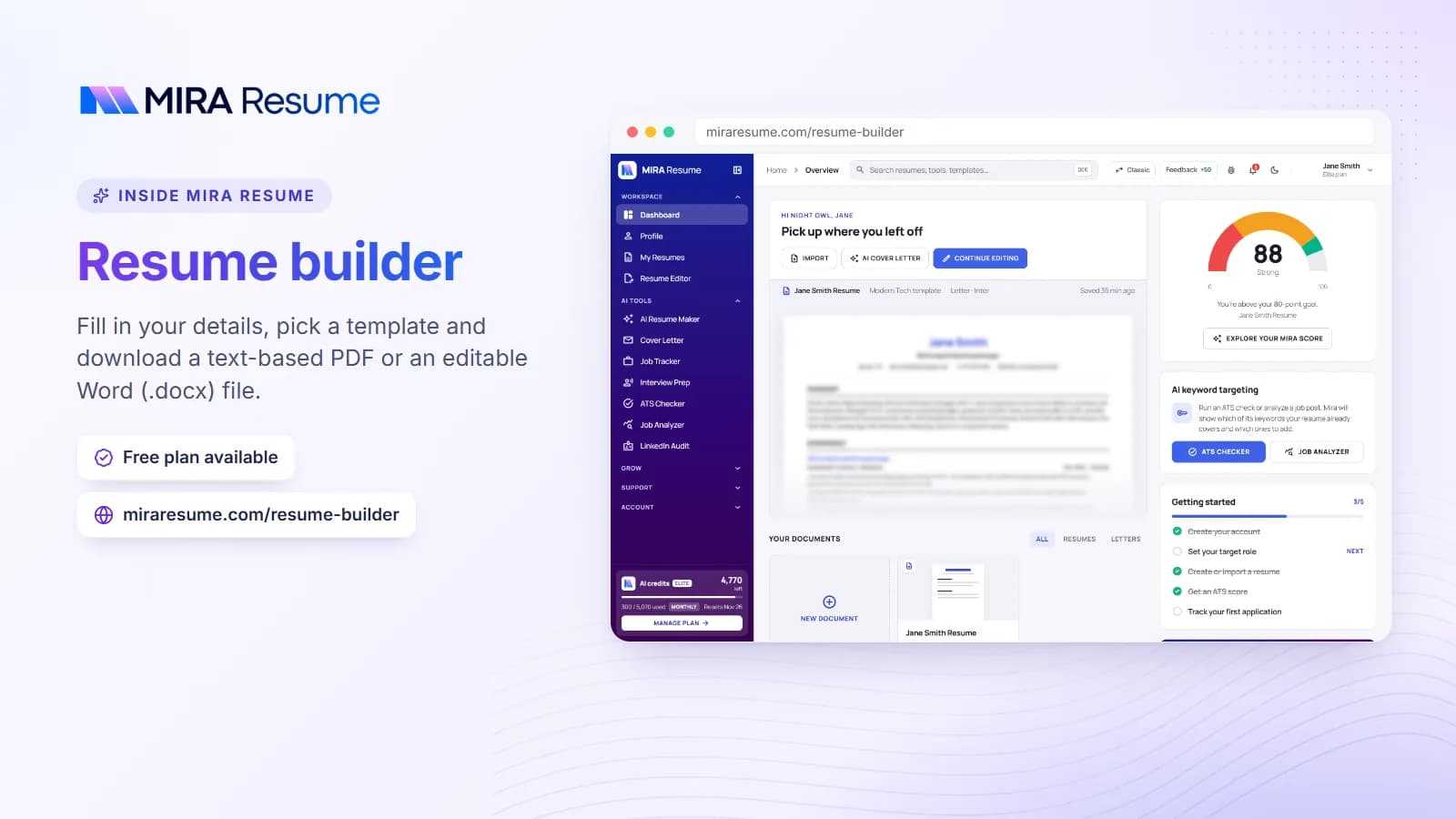
The resume builder lets you fill in each part in order and download a PDF when you are done.
How long should it be?
One page is right for most people with under ten years of experience. Two pages can work when you have a long, relevant career. More detail is in how many pages a resume should be.
Who reads your resume, and what do they look for?
Knowing the reader makes the writing easier. Your resume may be seen by three kinds of readers, often in this order.
- Software. Many employers store applications in a system that reads your file and turns it into searchable text. A clean layout and plain headings help it read your details correctly.
- A recruiter or hiring manager. This person scans the page quickly. They look for your job titles, the dates, and whether your skills match the post. Make those easy to spot near the top.
- An interviewer. If you reach this stage, someone reads closely and picks topics to ask about. Every bullet should be something you can explain in your own words.
Write for all three. Use plain words and standard headings such as "Experience" and "Education" for the software. Put your strongest facts first for the quick scan. Keep every line honest for the interviewer.
What a reader wants to learn in the first seconds
- Who are you, and how can I contact you?
- What job do you do now, or what did you do last?
- Do you have the skills and tools this role needs?
- Have you finished the right training?
- Is the page tidy and free of mistakes?
If your page answers those five questions fast, it is doing its job.
A quick resume checklist
Use this list before you send anything.
| Check | Good sign |
|---|---|
| Contact details | Correct phone and a simple professional email |
| Length | One page, or two for a long career |
| Order | Newest job first, strongest facts near the top |
| Bullets | Start with a verb and show a result or a fact |
| Fit | Uses words from the job post where they are true |
| Look | One column, one common font, plenty of white space |
| File | PDF with a clear name |
A resume is never really finished. Each time you apply, review it again. Update your job list, swap in new results, and trim older items. Our guide on how to update your resume shows how to keep it fresh without starting over.
Common resume mistakes beginners make
- Listing duties, not results. "Responsible for cleaning" is weak. "Cleaned and restocked 6 tables per shift" is clearer.
- Sending the same resume to every job. Change the top lines and skills to match each post.
- Writing too much. If a bullet runs over two lines, cut it.
- Using a silly email address. Create a simple one with your name.
- Using fancy graphics. Icons, photos, and skill bars may not be read by software. Keep it plain.
- Making things up. Employers check facts. Keep every claim true.
- Skipping keywords. If the post says "inventory counts", use that exact phrase if it fits your work. See resume keywords for how.
When your draft is done, run it through the ATS checker to see how a scanner reads the file and where it might trip.