
Action verbs for resume bullets are words that show what you did, such as "managed", "built", "trained", or "reduced". A strong verb at the start of a bullet makes your work clear in one glance. A weak start, like "responsible for", tells the reader about a duty but not about what you actually did.
Below is a long list of strong words, sorted by the kind of work you do. You will also see before-and-after examples, a table of weak phrases to replace, a short guide to tense, and the mistakes that make verb-heavy resumes sound false. Pick words that are true and plain. A simple, accurate verb always beats a fancy one.
Why action verbs matter on a resume
A resume bullet point has limited space. The first word sets the tone, so it should earn its place. Strong verbs help in three ways:
- They show action. "Organized a food drive" shows more than "Was part of a food drive".
- They are short. One verb replaces a phrase like "was in charge of".
- They are easy to scan. A reader can run an eye down the left edge and see what you did.
Verbs also help software. Resume scanners compare your words to a job posting. Using verbs that appear in the posting, where they truly describe your work, helps your resume match. Read more about this in how ATS works.
How to build a strong bullet point
A simple formula works well for most bullets:
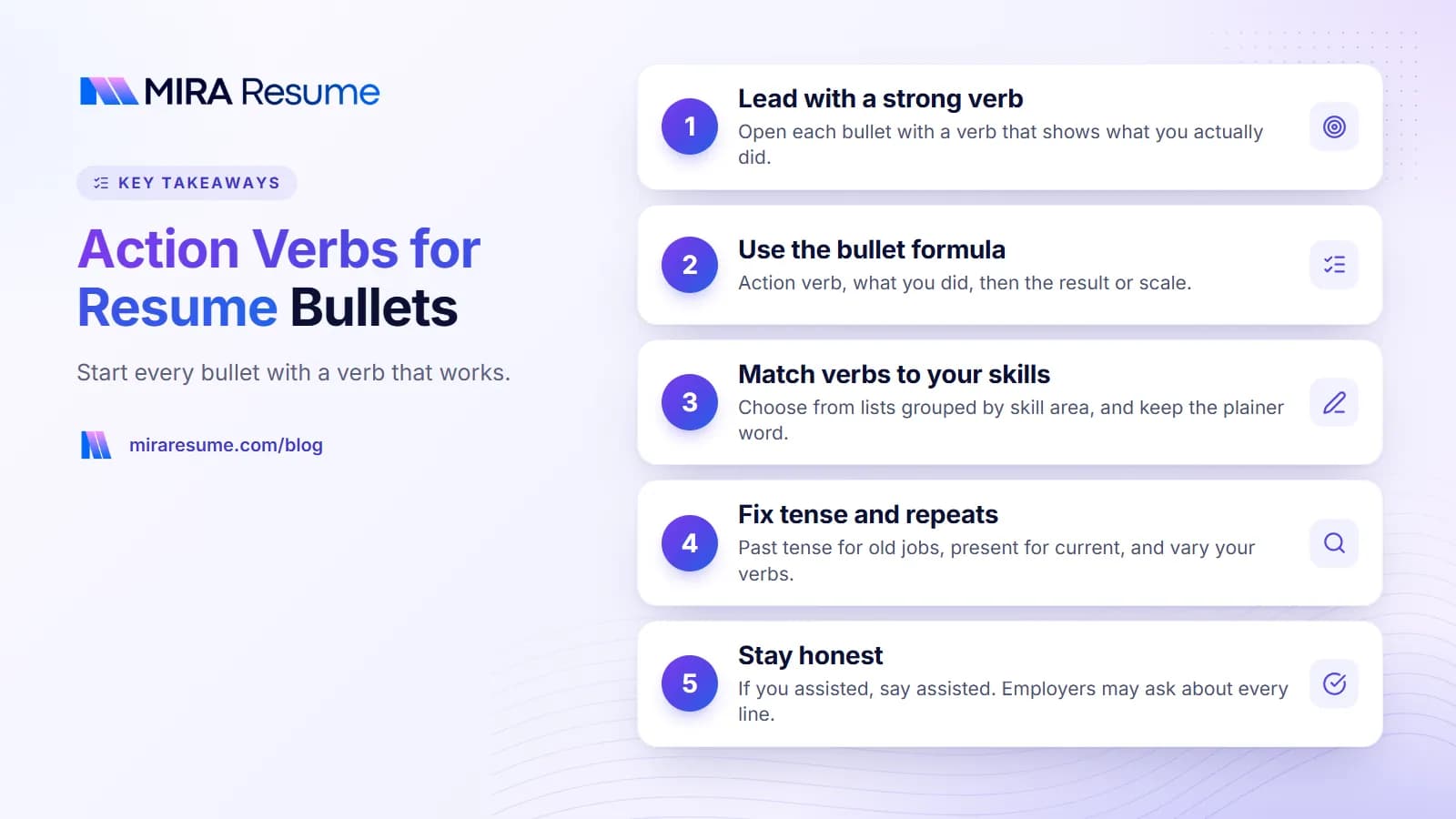
Action verb + what you did + result or scale
For example: "Trained 12 new cashiers on the register system, cutting checkout errors in the first month."
Tips
- Start each bullet with a different verb when you can.
- Add a number, such as a count, a time saved, or a size, if you know it.
- If you do not have a number, add a fact such as who you helped or what changed.
- Keep each bullet to one or two lines.
Our AI bullet enhancer can suggest sharper wording for your bullets. Review each suggestion and keep only what is accurate.
Strong action verbs for resume writing, by skill area
Choose words that match what you really did. Where a verb has a similar meaning to another, pick the plainer one.
Leadership and management
Led, directed, supervised, coordinated, managed, guided, oversaw, mentored, coached, delegated, organized, headed, appointed, hired, scheduled, motivated, launched, steered, chaired, represented.
Communication and teaching
Presented, wrote, explained, trained, taught, briefed, advised, edited, interviewed, facilitated, informed, translated, negotiated, persuaded, answered, clarified, demonstrated, instructed, moderated, published.
Analysis and research
Analyzed, calculated, audited, researched, reviewed, evaluated, measured, tracked, forecasted, compared, investigated, identified, tested, mapped, assessed, examined, surveyed, diagnosed, verified, reconciled.
Creating and building
Built, designed, created, developed, drafted, produced, engineered, programmed, crafted, assembled, established, formed, shaped, composed, prototyped, wrote, illustrated, constructed, introduced, installed.
Improving and fixing
Improved, reduced, increased, streamlined, simplified, repaired, upgraded, corrected, resolved, restored, strengthened, boosted, cut, saved, modernized, revised, refined, replaced, updated, accelerated.
Service and support
Served, assisted, supported, helped, handled, resolved, welcomed, responded, processed, guided, advised, cared for, coordinated, delivered, addressed, maintained, escalated, followed up, greeted, enrolled.
Sales and business growth
Sold, generated, negotiated, closed, grew, expanded, pitched, secured, won, prospected, converted, renewed, partnered, marketed, promoted, targeted, acquired, upsold, launched, retained.
Money, data, and operations
Budgeted, balanced, reconciled, processed, tracked, recorded, allocated, invoiced, purchased, inventoried, scheduled, shipped, stocked, logged, filed, planned, reported, monitored, entered, sorted.
For those who want more role-specific wording, our resume examples show verbs used in real job bullets across many fields.
Before and after: weak phrases replaced with strong verbs
| Weak phrase | Stronger bullet |
|---|---|
| Responsible for answering customer calls | Answered 60+ customer calls per shift and resolved most on the first try |
| Duties included making schedules | Scheduled 15 staff members across two shifts, avoiding overtime gaps |
| Helped with the monthly report | Compiled the monthly sales report and sent it to managers by the 3rd |
| Worked on a team to improve the website | Redesigned the checkout page with two teammates, shortening it to three steps |
| Was in charge of new employee training | Trained 10 new hires on safety and equipment in their first week |
| Dealt with complaints | Resolved customer complaints by phone and email, escalating the rare serious cases to a manager |
| Did the filing and data entry | Entered 200 invoices a week into the accounting system with no missed deadlines |
Notice that some bullets use numbers and some use facts. Both work, as long as the information is true and you can explain it. If you are not sure how many bullets to keep, see how many pages a resume should be.
Resume verbs by career situation
If you have little or no experience
Use verbs that fit school, volunteering, clubs, and projects: organized, volunteered, tutored, collected, researched, presented, planned, prepared, assisted, completed, earned, contributed, practiced, learned, joined. For example: "Organized a bake sale that raised funds for a school trip."
If you need help with the top of your page too, see our resume objective examples.
If you are changing careers
Pick verbs that show skills you can carry over: coordinated, trained, planned, analyzed, resolved, communicated, tracked, adapted, supported. Pair them with a plain description of the work so the reader can see the link to the new field.
If you are a manager
Choose verbs that show how you guided others, not just that you did tasks: led, mentored, hired, restructured, aligned, delegated, set goals for, coached, resolved conflicts in. Show results for the team, not only for you.
Quick reference by job type
| Job area | Useful verbs |
|---|---|
| Healthcare | Assessed, administered, documented, monitored, educated, triaged |
| Teaching | Taught, planned, assessed, differentiated, mentored, adapted |
| Software and IT | Built, debugged, deployed, maintained, automated, resolved |
| Food service | Prepared, served, plated, stocked, trained, balanced |
| Office and admin | Scheduled, filed, coordinated, drafted, tracked, organized |
| Warehouse | Loaded, picked, packed, inspected, operated, counted |
Copyable bullet examples using strong verbs
Use these as models. Swap in your own tasks, tools, and numbers. If a figure is not true for you, remove it or replace it with a plain fact.
Customer service and retail
- Resolved billing questions for 40 customers a day by phone and chat.
- Trained 6 seasonal staff on returns and the cash register.
- Reduced end-of-day cash drawer mistakes by double-checking counts with a partner.
Office and administration
- Scheduled meetings and travel for a team of 8 using a shared calendar.
- Drafted weekly status emails and filed records so they were easy to find.
- Updated the supplier contact list and removed 50 outdated entries.
Software and IT
- Built a reporting page in JavaScript that replaced a manual spreadsheet task.
- Resolved an average of 20 help desk tickets a day for office staff.
- Automated a nightly backup check, saving about 30 minutes of daily work.
Healthcare
- Monitored vital signs and documented changes for up to 6 patients per shift.
- Educated patients and families on medication schedules before discharge.
- Coordinated with pharmacists and doctors to clear order questions promptly.
Management
- Led a team of 14 across two locations and set clear weekly goals.
- Hired and onboarded 5 team members, then coached each one through the first 90 days.
- Simplified the shift schedule, ending last-minute swaps for most of the team.
Our staff accountant resume and teacher resume sample guides show full pages that use verbs like these in real context.
A 5-minute method to rewrite a whole job section
If you have a long list of duties, try this routine for each job.
- List what you did. Write every task you can recall, in any order, without worrying about wording.
- Circle the top four. Pick those that match the job you want now. Check the posting.
- Add a verb. Start each task with a strong, accurate verb from the lists above.
- Add the proof. Add a number, a size, a time frame, or a clear outcome.
- Trim it. Cut filler words until each bullet fits in one or two lines.
- Read it aloud. If it sounds like something you would say to a friend about your work, it is ready.
Take a before-and-after view. Before: "Responsible for the front desk and various tasks." After: "Greeted 80 visitors a day, signed in guests, and routed calls to the right team." The second version uses real tasks, fits the role, and tells the reader what you can do.
Past tense or present tense?
The rule is easy:
- Use past tense for jobs you no longer hold: "Managed", "Built", "Trained".
- Use present tense for your current job: "Manage", "Build", "Train".
Some people write everything in past tense, even for their current role, and that is fine too. What matters is being consistent within each job. Do not mix "managed" and "manage" in the same list.
Keep verbs in the same form across bullets. A list that begins with verbs of the same type reads cleanly, while a list that jumps between "Responsible for", "Managing", and "Led" feels messy.
Words to avoid and common mistakes
- Using the same verb again and again. If you find five "managed" bullets, swap in "coordinated", "oversaw", or "led" where they are accurate.
- Choosing a big verb that overstates your role. If you assisted, say assisted. If you led, say led. Employers may ask you about every line.
- Relying on "responsible for". It describes a duty, not an action.
- Using vague verbs. "Worked on", "dealt with", and "handled" tell little. Add the thing you did.
- Using buzzwords with no proof. A line such as "Spearheaded synergy" tells nothing. Say what changed.
- Forgetting results. A verb alone is not enough. Add what happened because of your work.
- Cramming too many verbs. Quality matters more than variety.
Verbs to use with care
Words like "spearheaded", "pioneered", "revolutionized", and "transformed" sound big. Use them only when your role truly fits. Otherwise, "led", "started", or "improved" are safer and clearer.
Using action verbs with the rest of your resume
Verbs work best when the rest of the page supports them. Your resume summary should name your field and strongest proof. Your skills list should match the tools and abilities that your bullets show. And the layout should be clear, as in our simple resume format.
Once you have rewritten your bullets, run your resume through the ATS checker against a real job posting. It can show which words from the posting your resume already uses and which ones are missing. Then add any missing words only where they truly describe what you did.