
What is a skills-based resume? It is a resume that leads with your skills and proof of what you can do, rather than with a long list of past jobs in date order. Your work history is still there, but it is shorter and sits lower on the page.
People use this style when their job titles do not tell the right story. That might be because they are changing careers, have gaps in their history, or have done many short jobs. It is also called a functional resume or a focused resume, although these names do not always mean exactly the same thing.
This guide explains each format in simple terms, shows a sample layout, lists the pros and cons, and tells you which version to pick. We also point out one risk with a fully skills-only resume that many writers skip.
Skills-based resume, functional resume and combination resume explained
These words overlap, so here is a clear way to sort them out.
| Format | What leads the page | Work history | Best for |
|---|---|---|---|
| Chronological | Jobs in date order, newest first | Main focus | Steady careers in one field |
| Functional (pure skills) | Skill groups with examples | Very short, often just titles and dates | Rare cases with big gaps or a drastic change |
| Combination (hybrid) | Skills section first, then job history | Full but kept short | Career changers, mixed backgrounds |
| Focused (targeted) | Whatever fits one specific job | Trimmed to match | Anyone applying for a clear goal |
What most people mean by "skills-based"
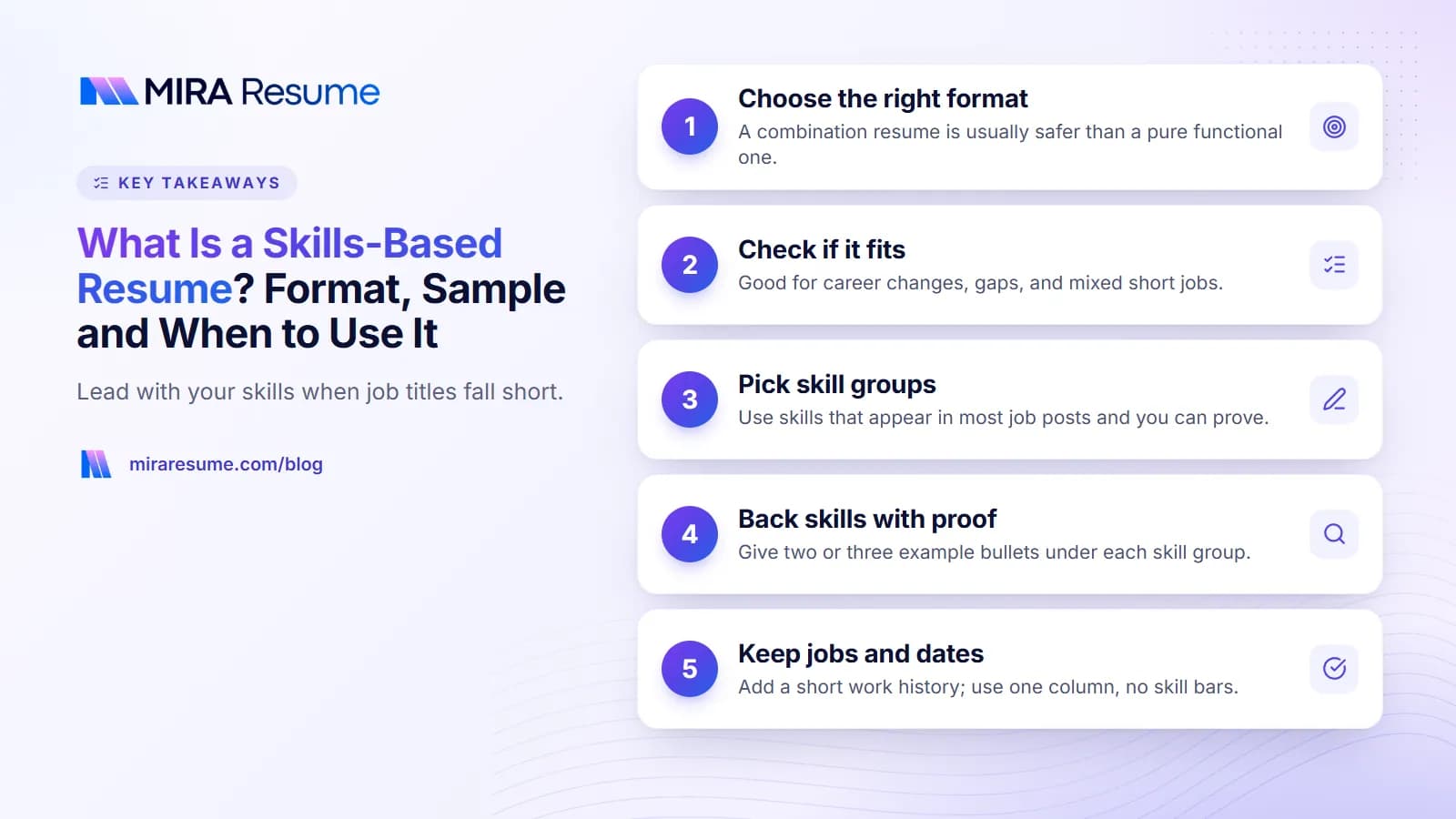
In most career advice, a skills-based resume is a combination resume. It has a strong skills section near the top, backed by examples, and then a brief work history. That is the version we recommend for most people.
What is a focused resume?
A focused resume is a resume that is aimed at one kind of job. Everything on the page, including the summary, the skills and the bullets, supports that goal. Anything that does not help is cut. You can use this idea with any format. It is more of a habit than a layout.
For the standard date-order layout, see our chronological resume template.
When a skills-based resume makes sense
It is not for everyone. It can help in these cases:
- Career change. Your past titles do not match the new job, but your abilities do.
- Employment gaps. You want the reader to see your abilities before they see the dates.
- Many short or mixed jobs. Freelance, contract or seasonal work can look scattered in a date list.
- First job or return to work. You have skills from school, volunteering, family care or projects.
- Skills gained outside a job. Self-taught skills, military training or community work count.
It is usually a poor fit when:
- You have a clear, steady path in the same field. A date-order resume shows growth best.
- The employer asks for a specific format.
- Your skills are the same as every other applicant's and you have no proof to show.
An honest warning about pure functional resumes
Some recruiters dislike resumes that hide dates and employers, because it can look like the writer is trying to cover something up. Some hiring software also expects to see jobs with dates, and may read a skills-only page poorly. That is why a combination format, with a full, honest work history below the skills, is often the safer choice. We cannot say how every employer will react, but keeping your history visible removes the doubt.
Skills-based resume format: the layout to follow
Here is a clear skills based resume template in order from top to bottom.
| Order | Section | What goes in it |
|---|---|---|
| 1 | Contact details | Name, city, phone, email, LinkedIn |
| 2 | Summary | 2 to 3 lines naming your target role and strongest abilities |
| 3 | Key skills | 3 or 4 skill groups, each with 2 to 3 bullets of proof |
| 4 | Work history | Title, employer, dates, one or two short lines per job |
| 5 | Education and training | Degrees, courses, certificates |
| 6 | Extras | Volunteering, languages, projects (optional) |
How to pick your skill groups
- Read three job posts for the role you want.
- Write down the skills or duties that show up in all or most of them.
- Mark the ones you can truly do and can prove.
- Group them under clear names, such as Customer Service, Project Coordination, or Data and Reporting.
Keep group names plain. Hiring software and busy people both look for familiar words. For help choosing, read skills to put on a resume.
Keep the file simple
Use one column, a regular font, standard bullets and no skill bars or graphs. Rating yourself with stars tells the reader nothing. A short example does.
A skills-based resume sample you can adapt
This example is made up. It shows a retail worker moving toward an office coordinator role.
Sam Rivera
Phoenix, Arizona | 555-010-3302 | [email protected]
Summary
Organized team member with six years in busy retail settings. Strong at scheduling, record keeping and clear communication. Looking to move into an office coordinator role.
Key skills
Organization and scheduling
- Built the weekly shift schedule for a team of twelve.
- Kept stock and delivery records accurate in a shared spreadsheet.
Communication
- Answered customer questions in person and by phone every day.
- Wrote short notes and updates for the store manager.
Software and tools
- Used spreadsheets, email and a point-of-sale system daily.
- Completed an evening course in Microsoft Excel.
Work history
Shift Lead, Desert Outfitters, Phoenix, 2022 to 2026
Sales Associate, Desert Outfitters, Phoenix, 2020 to 2022
Cashier, Corner Grocery, Phoenix, 2018 to 2020
Education
High school diploma, Westside High School, 2018
Excel Basics certificate, Community Learning Center, 2025
Notice that all jobs and dates are still visible. The skills section simply tells the reader first what Sam can do for them. If your work history is short, see our guide on how to list high school on a resume.
How to write strong skill bullets
A skill with no proof is just a claim. Back each group with a real example.
Use this simple pattern
Action word, what you did, and the result or the scale. If you do not have a result, the scale alone helps.
| Weak line | Better line |
|---|---|
| Good at communication | Explained returns policy to about 40 customers a day in a calm, clear way |
| Team player | Covered shifts for coworkers and helped train two new hires |
| Detail oriented | Checked daily cash totals and found and fixed counting mistakes |
| Computer skills | Built a spreadsheet to track weekly orders |
Do not invent numbers. If you are unsure of a figure, use "about," or describe the task without a number. Our list of action verbs for a resume can give you better starting words.
Match the job post
Use the same names the employer uses for the same skills, as long as they are true for you. This helps both a human and any search tool find you. To see how that software works, read how an ATS works.
Write the summary last
Once the bullets exist, your summary is easy: name the role you want, then your top two or three abilities. For examples, see resume summary examples.
Pros and cons of a skills-based resume
| Pros | Cons |
|---|---|
| Puts your best abilities in front of the reader | Some recruiters distrust resumes that hide dates |
| Helps career changers explain the link to a new field | Harder for software to match skills to jobs and dates |
| Softens the look of gaps and short jobs | Needs real examples, or it looks empty |
| Lets you group scattered experience | Takes more thought to write |
| Works for first jobs and return-to-work | Not ideal for a steady, climbing career |
You can reduce the cons by choosing the combination style, keeping all jobs listed with dates, and giving each skill a short proof line.
Skills-based resume vs other formats at a glance
If you like the idea but your work history is strong, a plain date-order layout may be better. If your background is academic, a CV may be the right form; see the CV vs resume guide. If you want a layout that is quick and simple, see the simple resume format.
Which format should you choose? A quick guide
Answer these questions to find your best fit.
- Is your work history steady and in the same field as the job? If yes, use a date-order layout.
- Are you changing fields? Use a combination layout with a skills section on top.
- Do you have a gap of a year or more? A combination layout lets you show skills first, but keep every job and date visible.
- Are you a student or first-time applicant? Lead with education, projects and skills, then add any work.
- Does the job post ask for a certain format? Follow it.
| Your story | Best format | Reason |
|---|---|---|
| Teacher moving into corporate training | Combination | Teaching skills carry over, but titles differ |
| Parent returning after several years | Combination | Skills lead, dates stay honest |
| Software developer with steady promotions | Date order | Growth is the story |
| Recent graduate with internships | Date order or combination | Depends on how relevant the internships are |
| Freelancer with many short projects | Combination | Group projects by skill |
Mixing in a target role
Whichever you pick, tune it to the job. Change your summary and the order of your skill groups so the strongest match comes first. That is the focused resume habit in action. It takes a few extra minutes and is often the most valuable edit you can make.
Explain the change in words
A resume has little room for a story. If you are changing careers, a short cover letter can say why in two or three honest sentences. See our cover letter templates to get started.
Common mistakes with skills-based resumes
- Hiding your work history. Leaving out employers or dates raises questions. Show them.
- Listing soft skills with no proof. Words like hard-working and motivated need an example.
- Too many skill groups. Choose three or four that match the job.
- Using skill bars or ratings. They are hard to read and tell nothing.
- Copying the job post word for word. Use the same terms where true, but write your own examples.
- Adding skills you do not have. You may be asked to show them.
- Using a fancy layout. Columns and boxes can confuse hiring software. Keep it plain.
- Forgetting the cover letter. A letter can explain a career change in plain words. See how to write a cover letter with no experience.
Build and check it
You can browse our resume templates for plain layouts that suit a combination format, or use the resume builder to place your skills and history in order. Run the finished file through the ATS checker to make sure the text reads clearly.