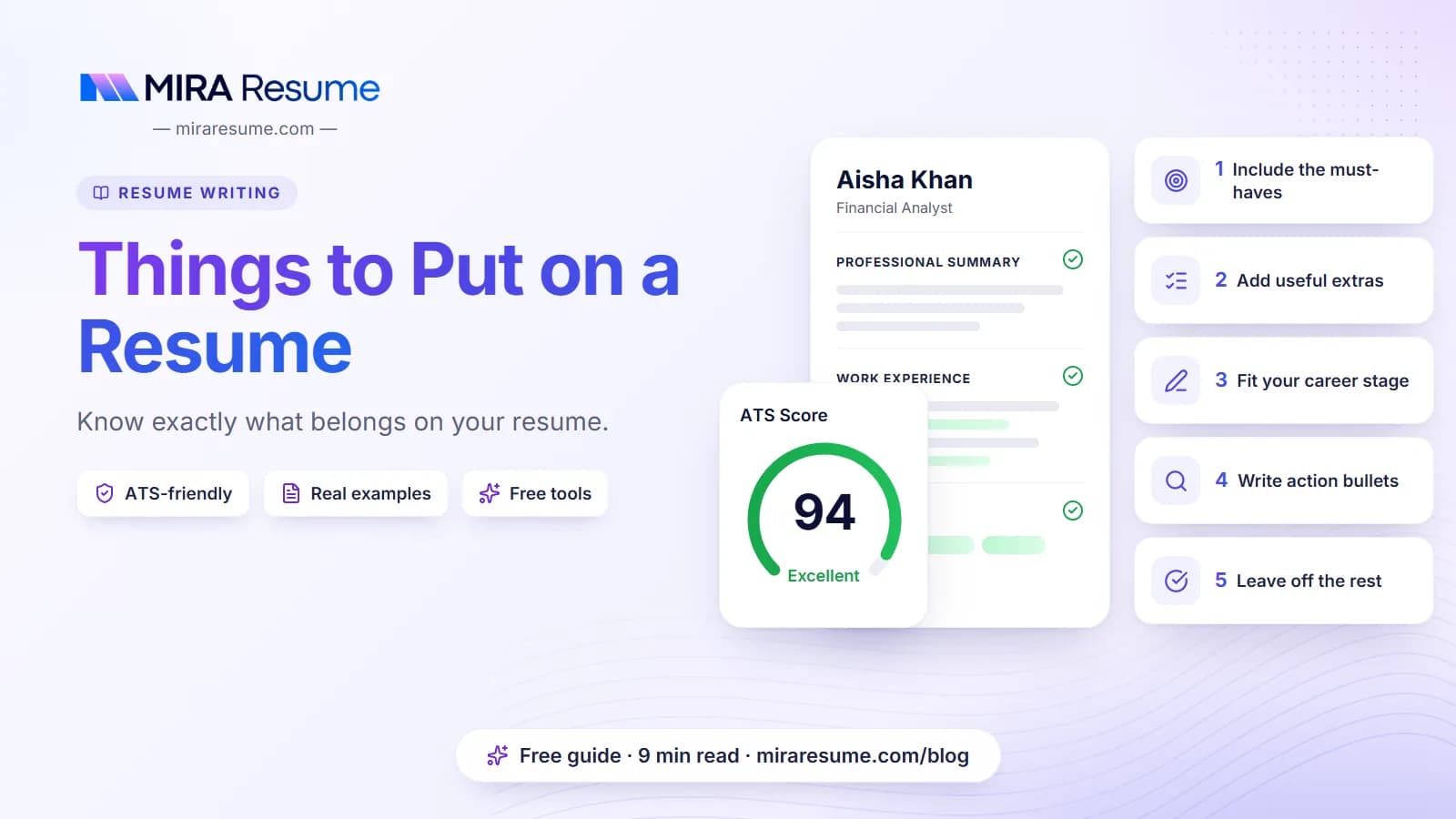

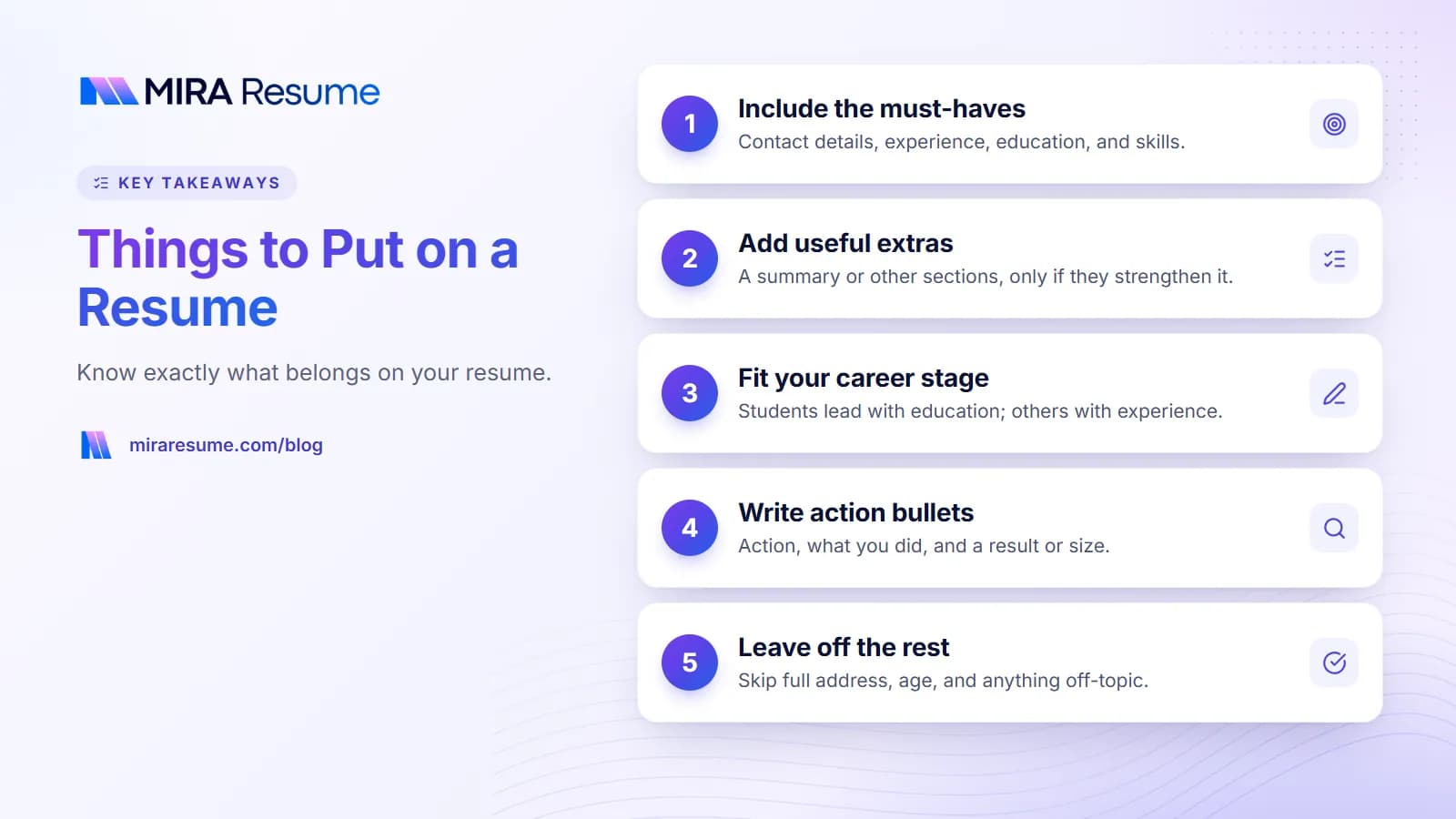
The main things to put on a resume are your contact details, a work history with results, your education, and a short list of skills that match the job. A summary, certifications, projects and volunteer work are useful extras when they help your case.
If you have ever stared at a blank page wondering what should be on a resume, this guide is for you. You will get a clear checklist of required and optional sections, a table showing which ones fit your career stage, examples of well-written lines, and a list of things you should leave off. Take what helps and skip what does not. No resume works for every employer, so let the job posting guide your final choices.
The must-have things to put on a resume
These four parts belong on nearly every resume, whatever your field.
1. Contact details
Include your full name, phone number, professional email, and your city and state or region. A street address is not needed. Add a link to your LinkedIn profile if it is up to date; our guide to putting LinkedIn on a resume shows how.
2. Work experience
List your jobs from newest to oldest. For each one, give the job title, the company, the city and the dates. Add bullets that show what you achieved, not just what you were told to do. Work from the last 10 to 15 years is usually enough.
3. Education
Give the degree or program, the school, and the year you finished. If you are still studying, write the expected date. If you have more than a few years of work history, you can leave off your GPA.
4. Skills
Add a short list of skills and tools the job asks for, such as software, languages, equipment or methods. For ideas, see skills to put on a resume and our page on good skills to put on a resume.
Optional sections that can help
Add these only if they make your resume stronger and you have room.
- Professional summary: two to four lines at the top that show who you are and what you offer. See what a resume summary is.
- Objective: a better fit for students and career changers; read resume objective examples.
- Certifications and licenses: proof of training that the job values. See how to list certifications on a resume.
- Projects: useful for students, developers, designers and anyone with little paid work.
- Volunteer work: especially good when it shows leadership or fills a gap.
- Awards: include them if they relate to the job and you can explain them in a few words.
- Languages: list them with a level, such as "Spanish (fluent)".
- Publications or presentations: common in research, teaching and technical roles.
Whether to add a references section is a common question. The short answer is usually no; see references on a resume.
What should be on a resume at your career stage
The right mix depends on how much you have done. Use this table as a starting point.
| Career stage | Lead with | Good extras |
|---|---|---|
| Student or teen | Education, then activities | Volunteering, clubs, school projects, part-time work |
| Recent graduate | Education, internships | Projects, coursework, certifications |
| Early career (1 to 5 years) | Work experience | Skills, certifications, short summary |
| Mid-career (5 to 15 years) | Summary, work experience | Key results, licenses, tools |
| Senior or manager | Summary, leadership results | Budgets, team size, boards, publications |
| Career changer | Summary, relevant skills | Courses, projects, volunteer work |
If you are young or just starting out, the guides on putting high school on a resume and on skills-based resumes can help you decide what to lead with.
How to write the work experience section
This is where most readers spend their time, so make each line count. Start each bullet with a strong action word, say what you did, and show the result if you can.
Here is a simple pattern: action + what you did + result or size.
| Plain duty | Better bullet |
|---|---|
| Answered phones | Answered 60+ calls a day and routed urgent issues to the right team |
| Responsible for inventory | Counted and restocked 400 items weekly, keeping shortages low |
| Helped train staff | Trained 8 new hires on the register and refund process |
| Worked on social media | Posted 4 times a week and grew followers from 800 to 1,500 |
Only use numbers you can explain. If you do not have a number, describe the scope: who you served, how often, or which tools you used. For fresh opening words, browse our list of action verbs for resume writing.
For more ways to turn a plain duty into a result, the AI bullet enhancer can suggest rewrites that you then check and edit for truth.
What to include on a resume if you have little experience
You can still fill a strong page without a long job history. Think about where you have used the skills an employer wants.
- School work: a group project, a research paper, a club you led.
- Volunteering: food drives, tutoring, event help, animal shelters.
- Informal jobs: babysitting, lawn care, selling crafts online, helping a family business.
- Self-study: online courses, coding practice, a small website you built.
- Activities: sports teams, band, student council.
Example lines
Treasurer, Robotics Club (2025 to 2026): Tracked a $1,200 budget and posted monthly updates for 25 members.
Volunteer Tutor, City Library: Helped 6 students a week with reading and homework.
Teens and first-time job seekers can also see resume for teens for more help.
Things to leave off a resume
A short, focused resume beats a long, crowded one. Cut anything that does not help you get this job.
| Leave off | Why | Do this instead |
|---|---|---|
| Full street address | Not needed and a privacy risk | City and state only |
| Age, marital status, religion | Not relevant to your ability and often not allowed to be asked | Leave out |
| "References available on request" | Assumed; wastes a line | Prepare a separate list |
| Salary history | Can weaken your position | Discuss pay later |
| Jobs from over 15 years ago | Often less relevant | Summarize in one line if important |
| Unrelated hobbies | Takes up room | Keep only if job-related |
| Casual email address | Looks unprofessional | Use name-based email |
| Lies or stretched facts | Easy to be found out and costly | Be honest and specific |
In some countries photos and personal details are standard on a CV. In the US and Canada, they are usually left off. When in doubt, check local norms. Our CV vs resume page explains the differences.
Match what you include to the job
The best things to put on a resume are the things the employer cares about. Read the job posting and make a quick list:
- Underline the skills and tools it names.
- Mark the duties that appear more than once.
- Check each against your own history.
- Move the best matches higher on the page.
- Cut or shorten items that do not relate.
This does not mean copying the posting. It means choosing which true parts of your story to show first. Tools can help here. The job analyzer compares a posting with your resume, and our resume keywords guide shows how to spot the words that matter.
A final checklist
- Contact details are current and professional.
- Jobs are in reverse order with dates.
- Each recent job has bullets with results.
- Skills match the posting.
- Education is accurate.
- Length fits the page goal (see how many pages a resume should be).
- Layout is clean (see how to format a resume).
Common mistakes when choosing what to include
- Listing duties, not results. "Responsible for sales" says little. "Sold 40 service plans a month" shows value.
- Adding everything. Every job you ever held does not need a place. Pick what supports your goal.
- Leaving out volunteer or project work when you need it. If paid history is thin, this work fills the gap honestly.
- Using the same resume for every job. A small edit to the summary and skills takes minutes and helps.
- Hiding gaps instead of explaining them. A short, honest line is better. See resume with gaps in employment.
- Ignoring the rest of your application. A resume often goes with a cover letter; see what a cover letter is.
When your sections are ready, you can drop them into the resume builder and check the result with the ATS checker.
A sample resume outline using all the right parts
Here is how the pieces come together on one page for someone with a few years of experience.
JORDAN LEE
Seattle, WA | 555-0123 | [email protected] | linkedin.com/in/jordanleeSUMMARY
Inventory coordinator with 4 years of experience in retail and distribution. Keeps counts accurate and shelves full for stores with up to 20,000 items.WORK EXPERIENCE
Inventory Coordinator, Pacific Supply Co., Seattle, WA, 2023 to Present
- Counted and reconciled stock for 20,000 items each month, keeping variance low
- Trained 6 new team members on the scanner and receiving steps
Stock Associate, Harbor Market, Seattle, WA, 2021 to 2023
- Restocked 300 items per shift and spotted damaged goods before they reached shelvesEDUCATION
Diploma, Lincoln High School, 2021SKILLS
Inventory counts, RF scanner, Excel, receiving, shippingCERTIFICATIONS
Forklift Operator Certification, 2024
Every part earns its place: it is short, focused and related to the job. No photo, no hobbies and no reference line were needed.
How to change the order
If you are a recent graduate, move education above experience. If you are changing careers, put a skills section above your work history. If a license is required, put it right after the summary. The rule is to put the item that best proves you can do the job near the top.
Want a ready-made design for this layout? Browse the resume templates and pick one with a single column.
How to decide if something belongs on your resume
When you are unsure about an item, ask three questions:
- Does it relate to this job? If the answer is no, it probably belongs elsewhere.
- Does it show a result or a skill? A fact that proves something beats one that only fills space.
- Could I talk about it for a minute in an interview? If not, leave it off.
If you answer yes to all three, include it. If you answer yes to two, include it in a short form. If you answer yes to one or none, skip it. This simple test keeps your resume focused and short, which readers appreciate.