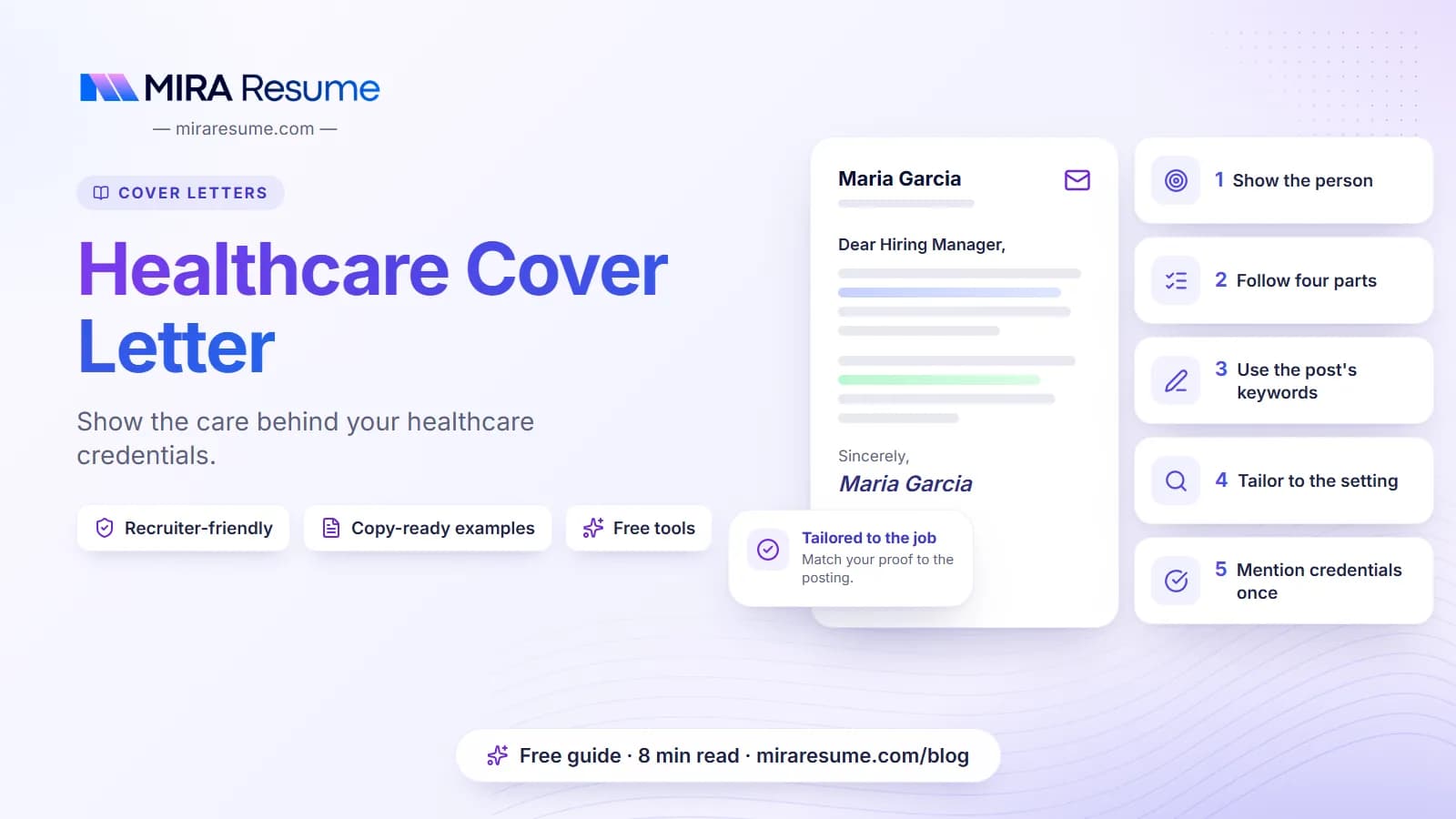

A healthcare cover letter is your chance to show what a resume cannot: how you treat people, how you think under pressure and why you chose this work. Hiring managers in clinics, hospitals and care homes read many letters that sound alike. A short, specific, honest one stands out.
This guide works for clinical roles, such as aides, assistants and technicians, and for office roles, such as scheduling and records. You will find a four-paragraph structure, three samples, a keyword table and a list of common mistakes. Replace every [bracket] with your own true details.
What a healthcare cover letter should do
Your resume lists credentials, dates and duties. Your letter explains the person behind them. In healthcare, employers want to feel safe handing you patients, records and responsibility. A good letter helps them feel that.
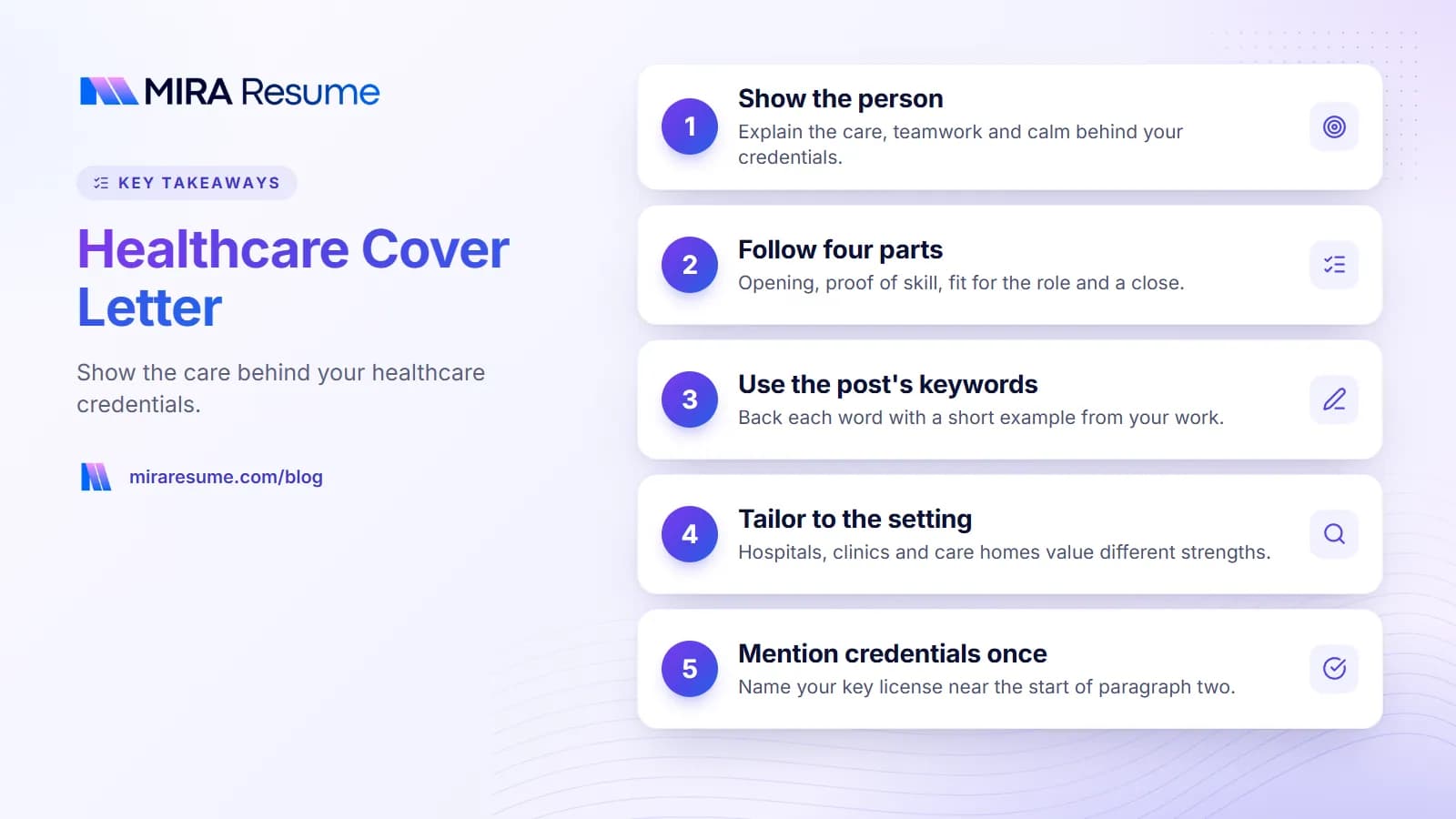
It should do four things:
- Show you understand the role and the setting
- Give one or two true examples of your work
- Show how you work with patients and teams
- Make it easy to say yes to an interview
Keep it to one page, three to four short paragraphs, in plain words. If you are new to cover letters, start with how to write a cover letter and what to include in a cover letter.
Never share private information
Do not include patient names, case details or anything that could identify a person or a facility's private matters. You can say "I helped a family understand the discharge steps" without any names. Privacy is part of the job, and the letter is your first chance to show you respect it.
Healthcare cover letter structure that works
Use this four-part plan. Each part can be two to four sentences.
- Opening: State the role, the facility and a brief reason you are interested. Mention a real detail, such as a unit, a service or a value the facility shares.
- Proof of skill: Give an example with a task, a setting and a result. Add your license or certification here if it is central.
- Fit with patients and team: Show how you communicate, stay calm and work with others. Keep it concrete.
- Close: Say you would like to talk, mention your attached resume and thank the reader.
Place a clean header at the top with your contact details. Our cover letter header guide shows the correct order, and how to format a cover letter covers spacing. For opening lines, see how to start a cover letter, and for endings, how to close a cover letter.
Cover letter examples for healthcare roles
Each sample is illustrative. Use the shape and your own facts. Delete any line that is not true for you.
Example 1: Experienced clinical role
Dear [Hiring Manager Name],
I am applying for the [Job Title] position at [Facility]. I have worked as a [current title] at [current facility] for [X] years, caring for about [number] patients per shift on a [unit type] unit. I admire [Facility] for [specific, true reason], and I would like to bring my experience to your team.
In my current role, I record vital signs and observations in [EHR system], report changes to nurses right away and give clear handoffs at shift change. When our unit started using [new process], I helped [number] coworkers learn it, which helped [result you can support].
Patients and families often feel worried, so I try to explain what is happening in plain words and to listen first. I also value working in a team, and I am used to covering for coworkers and asking for help when I need it.
I would welcome the chance to talk about how I can support your patients and staff. My resume is attached. Thank you for your time.
Sincerely,
[Your Name]
Example 2: Entry-level or new graduate
Dear [Hiring Manager Name],
I am a recent graduate of [Program] at [School], and I am excited to apply for the [Job Title] role at [Facility]. During my clinical placement at [site], I completed [number] hours helping with [tasks] under supervision.
I learned to take accurate vital signs, document in [system or practice system], and follow infection control steps. I also worked as a [previous job], where I learned to stay calm with upset customers and to work as part of a team.
I am reliable, I take feedback well and I am ready to learn from your staff. I would be grateful for an interview. My resume is attached.
Sincerely,
[Your Name]
Example 3: Non-clinical healthcare office role
Dear [Hiring Manager Name],
I am writing to apply for the [Job Title] position at [Clinic]. I have [X] years of experience in scheduling, insurance details and patient check-in, using [software].
At [current employer], I schedule about [number] visits a day and confirm details with patients to reduce missed appointments. I handle private records carefully and follow office privacy rules.
I enjoy helping nervous patients feel welcome at the front desk, and I like keeping the office running smoothly for providers. I would be glad to discuss how I can help your clinic. Thank you for considering me.
Sincerely,
[Your Name]
More short samples that work for care roles appear in our nursing application letter example and the customer service cover letter guide, which suits front desk and patient services.
Healthcare cover letter keywords and what they prove
Use the post's own words where they are true. Then back each word with a short example, so the letter never sounds like a list.
| Keyword | What the reader wants to know | How to show it |
|---|---|---|
| Patient care | Can you care for people kindly and safely? | Name the setting and a daily task |
| Teamwork | Will you support coworkers? | A small example of helping on a busy shift |
| Communication | Can you explain things clearly? | A time you shared information in plain words |
| Accuracy | Will you chart and record correctly? | Your system and your checking habit |
| Infection control | Do you follow safety steps? | One line about routines you follow |
| Privacy | Will you protect patient information? | A sentence on privacy training or habits |
| Flexibility | Can you work shifts and adjust? | Your availability and any shift experience |
For more on picking words, see cover letter keywords. Your letter and resume should share the same key terms, since many employers read both. Learn how that process works in how ATS works.
How to tailor the letter to the setting
Different places value different strengths. A few small changes show you understand the job.
| Setting | Lean on | Example sentence |
|---|---|---|
| Hospital | Pace, teamwork, safety | I am used to a busy [unit] where handoffs and clear notes matter. |
| Clinic | Patient flow, scheduling | I help patients move smoothly from check-in to their visit. |
| Long-term care | Patience, relationships | I enjoy getting to know residents and their routines. |
| Home health | Independence, reliability | I can work on my own, plan my day and document each visit. |
| Lab or pharmacy | Accuracy, procedure | I double-check labels and follow each step in order. |
Show you know the employer
Spend ten minutes on the facility's website. Look for a service line, a community program or a stated value. One honest sentence about it tells the reader you did your homework. Avoid empty praise that could apply to any employer.
Pair it with a strong resume
The letter and resume work as a pair. Read our healthcare resume guide for credentials and bullets, and see role guides such as the registered nurse resume and CNA resume examples.
Licenses, certifications and requirements
If a license or certification is key to the job, mention it once in the letter, near the start of the second paragraph. For example: "I hold an active [license name] in [state] and a current [basic life support] card." Do not list every course. Your resume has room for that.
Requirements differ by state, role and employer, and rules may change. Check your state board and the job post, and never claim a credential you do not hold. If something is in progress, say so clearly and give the expected date. See how to list certifications on a resume for resume wording.
Health, vaccines and personal details
Do not discuss your own health, family or immigration status in the letter. If the employer needs proof of vaccines, background checks or work authorization, they will ask during hiring. Keep the letter about your skills, your care and your fit.
Opening and closing lines you can borrow
The first and last lines are the hardest to write. Try these starting points, then rewrite them in your own voice.
| Part | Line to adapt |
|---|---|
| Opening, experienced | I am applying for the [Job Title] role at [Facility]. After [X] years caring for patients in [setting], I want to join a team that [true detail about the employer]. |
| Opening, new graduate | As a recent [Program] graduate with [number] clinical hours, I am eager to start my career as a [Job Title] at [Facility]. |
| Opening, career changer | After [X] years in [old field], I am moving into healthcare because [honest reason], and I have completed [training] to prepare. |
| Closing, simple | Thank you for your time. I would welcome the chance to meet and talk about how I can support your team. |
| Closing, with availability | I am available for [shifts] and can start on [date]. Please contact me at [phone] or [email]. |
Check the tone
Read your letter out loud. If a sentence sounds like something you would never say to a coworker, simplify it. Warm and clear beats formal and stiff. Short sentences also help readers who skim between tasks.
Save and send it right
Export the final letter as a PDF and name the file with your name and the role. Send it with your resume in the same email or upload. If the job asks for a different file type or form, follow its instructions exactly. Some employers also ask for references, but wait until they request them.
Common healthcare cover letter mistakes
- Copying a template. Readers can tell. Add real details about you and the employer.
- Using only buzzwords. Words like passionate and caring are cheap. Show a small action instead.
- Repeating the resume. Add something new: the why, a short story or the fit.
- Revealing private details. Leave out names and case facts.
- Writing too long. One page, 250 to 350 words.
- Spelling errors. Spell medical terms, facility names and titles correctly.
- Forgetting to proofread the greeting. Check names and titles twice.
When you are ready, browse cover letter templates and cover letter examples to build your final PDF. If you want help with your resume too, the resume builder and ATS checker can help you finish the package. After an interview, send a note using our thank you letter after interview guide.