
If you are looking for CNA resume examples, here is the short answer: put your state certification near the top, list the kinds of care you give every shift, and use numbers to show how much you handle. Nursing homes, hospitals, and home care agencies often hire fast, and the people reading your file are busy.
A certified nursing assistant resume does not need to be long or fancy. It needs to be clear, honest, and easy to scan. Below you will find a full sample, a table of duties and skills, lines you can adapt, and tips for a beginner CNA resume when you have little paid experience.
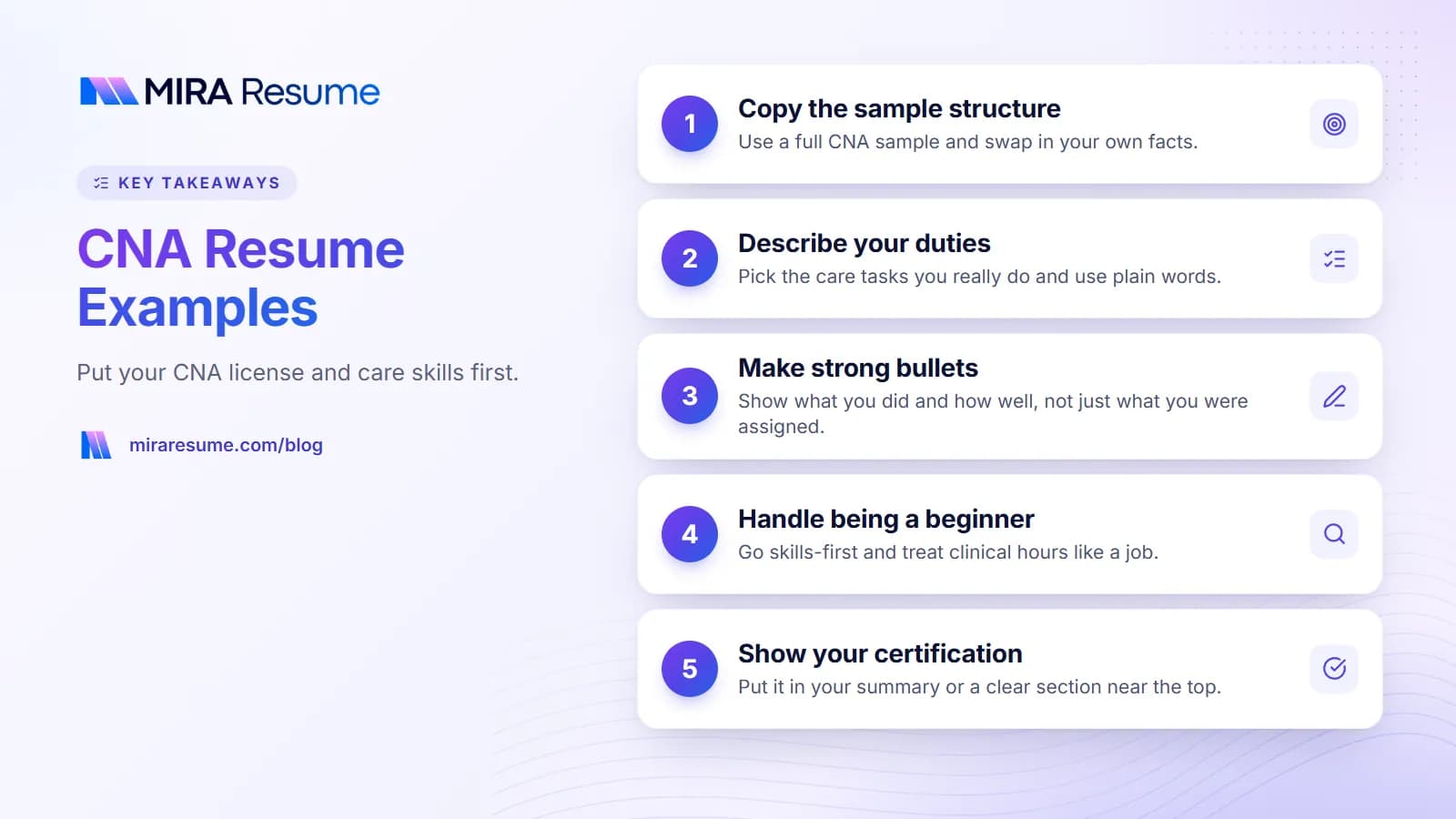
A complete CNA resume sample to copy
This sample uses made-up details. Keep the structure and swap in your own facts.
Taylor Morgan, CNA
City, State | 555-555-0123 | [email protected]Summary
Certified nursing assistant with 4 years of experience in long-term care. Caring, dependable, and trained in daily living support, vital signs, and safe patient transfers. Seeking a night-shift role at a hospital.Certifications
Certified Nursing Assistant, State Nurse Aide Registry (state, license number if you wish, expiration year)
CPR/BLS, valid through yearExperience
Certified Nursing Assistant, Example Care Center, City, State, 2022 - Present
- Provided daily care for 10 to 12 residents per shift, including bathing, dressing, feeding, and toileting
- Measured and recorded vital signs, reporting changes to the charge nurse promptly
- Repositioned and transferred residents with lifts and gait belts to lower fall and skin breakdown risks
- Documented care in the electronic record at the end of each taskEducation
State-approved nursing assistant training program, Example Community College, 2022Skills
Activities of daily living | Vital signs | Patient transfers | Infection control | Dementia care | Charting | Compassionate communication
Why this layout works
- The certification is visible in the first screen.
- Bullets name real care tasks and the scale of the work.
- The skills list repeats the words job posts use, so it helps both readers and search tools.
Want to see how other jobs are laid out? Our resume examples collection covers many roles, and our registered nurse resume guide is a good next step if you plan to move up.
CNA duties and skills for your resume
Use this table when you write a CNA description for your resume. Pick the tasks you really do, and use the plain words in the middle column.
| Care area | Duties to describe | Skill keywords |
|---|---|---|
| Daily living support | Bathing, dressing, grooming, feeding, toileting | Activities of daily living (ADLs), personal care, hygiene |
| Monitoring | Taking temperature, pulse, breathing rate, blood pressure; noting changes | Vital signs, observation, reporting changes |
| Mobility and safety | Moving and repositioning, helping with walking, preventing falls | Patient transfers, gait belt, fall prevention, range of motion |
| Comfort and emotional care | Talking with residents, helping with activities, supporting families | Compassion, dementia care, patient dignity, communication |
| Clean and safe environment | Changing linens, cleaning equipment, following hand-washing steps | Infection control, sanitation, PPE |
| Records and teamwork | Charting, shift reports, helping nurses | Documentation, HIPAA, teamwork, shift handoff |
Soft skills that deserve proof
Words like "caring" and "dependable" show up on every resume. Prove them instead. Examples: "Perfect attendance for 12 months," "Requested by families to care for residents with memory loss," or "Trained three new aides on lift safety." Only write these if they are true.
Skills not to forget
- Languages you speak (name them)
- Experience with special groups: dementia, rehab, hospice, children
- Equipment: mechanical lifts, glucometers, oxygen set-up, if your training and role allow
For help deciding what else to add, read skills to put on a resume.
Turn CNA duties into strong bullet points
A duty tells what you were assigned. A strong bullet tells what you did and how well. Here are before-and-after examples. The numbers are illustrations, so use your real ones or skip them.
| Duty-style line | Stronger bullet |
|---|---|
| Assisted residents with bathing | Bathed and groomed up to 8 residents per shift while protecting privacy and keeping them comfortable |
| Took vital signs | Recorded vitals for 12 residents each morning and alerted the nurse when readings were outside set limits |
| Moved patients | Transferred residents using lifts and gait belts with no reported falls on my assignment during a 6-month stretch |
| Kept records | Charted meals, fluids, and care tasks in the electronic system before the end of each shift |
| Talked to families | Gave families clear updates on mood and appetite and passed concerns to the nurse the same day |
| Worked weekends | Covered weekend and holiday shifts, helping keep staffing steady during short-staffed weeks |
A simple formula
Action word + care task + size or setting + result or purpose. Example: "Repositioned residents every two hours to help prevent pressure sores."
Our action verbs for resume guide has plenty of starting words. To polish what you wrote, the AI bullet enhancer can offer cleaner versions, which you should check for accuracy.
Be careful about privacy
Never include resident names or private health details. Describe the type of care, not the person.
Beginner CNA resume: what to write when you are new
If you just finished training, you can still make a strong file. Use a skills-first layout and treat your clinical hours like a job.
What to include
- Certification status: If you passed your state exam and are on the registry, say so. If you are waiting, write "Exam scheduled for month, year."
- Clinical hours: List the facility, the dates, and the tasks you practiced.
- Related experience: Home care for a family member (describe truthfully), volunteering, childcare, retail, or food service all show reliability and people skills.
- CPR/BLS: Include the date or expiry.
Sample beginner summary
Newly certified nursing assistant who completed 100 hours of supervised clinical training in a long-term care facility. Skilled in vital signs, patient transfers, and daily living support. Reliable, patient, and eager to learn on a busy team.
Change the hours to match your program. State training rules differ, so use your own numbers.
Entry-level vs. experienced differences
| Feature | Beginner CNA | Experienced CNA |
|---|---|---|
| Main proof | Training, clinical hours, reliability | Years of care, caseload size, specialties |
| Section order | Summary, Certifications, Clinical Experience, Skills | Summary, Experience, Certifications, Skills |
| Summary tone | Eager, trained, ready to learn | Dependable, skilled, mentors new aides |
| Extra detail | Languages, volunteer work, school awards | Training new CNAs, charge nurse trust, unit types |
If you are applying with little experience, our cover letter with no experience article shows how to add a short note that explains your goals.
CNA certification and education: how to list them honestly
In the United States, nursing assistants usually complete a state-approved training program and pass a competency exam to be listed on their state's nurse aide registry. Hours, exam rules, and renewal steps differ by state, so check your state's requirements and the employer's.
How to write it
- Use the name your state uses, for example "Certified Nursing Assistant (CNA)."
- Add the state, the year you were certified, and the expiration date if you know it.
- Many people leave off the certificate number on public job boards. Add it if the application asks.
Other credentials worth listing
- CPR or Basic Life Support (BLS)
- Specialized training, such as dementia care or restorative nursing, from a recognized provider
- First aid
- Any state endorsements, if you moved
Education
A high school diploma or equivalent is common. If you are in nursing school, say so, with your expected graduation year. It shows growth and may make employers more interested in keeping you.
Never list a certification you do not currently hold. If yours lapsed, be honest, and explain how you plan to renew.
Match your CNA resume to different settings
The core skills are the same everywhere, but the focus changes. Use the job post to guide your top lines.
Nursing homes and long-term care
Stress relationships, patience, and long-term skin and mobility care. Mention dementia care and families.
Hospitals
Stress speed, accuracy, and teamwork. Mention patient turnover, vitals, and working with nurses and techs.
Home health and private duty
Stress independence, safety awareness, and light housekeeping or meal prep when you did those.
Rehab and hospice
Rehab: movement support and encouragement. Hospice: comfort, quiet communication, and emotional strength.
Keep a master resume with all your tasks, then copy it for each job and keep only the lines that fit. Our how ATS works guide explains why matching the job post's wording matters for search.
CNA summary examples you can adapt
The summary is the first thing a manager reads. Keep it to two or three lines, name your certification, and add one fact that proves you are dependable. Here are three models. Replace the details with your own.
For long-term care
Compassionate certified nursing assistant with 6 years in a skilled nursing facility. Experienced in memory care, safe lifts, and daily living support. Known for steady attendance and calm communication with families.
For hospital work
Certified nursing assistant with 2 years on a medical-surgical unit. Skilled in vital signs, patient transport, and quick reporting to nurses. Comfortable with fast-paced shifts and team handoffs.
For home health
Certified nursing assistant providing one-on-one home care for older adults. Skilled in personal care, meal support, medication reminders where allowed, and clear notes for family members. Reliable, patient, and trusted to work independently.
What makes a summary work
- It names the title the employer uses.
- It includes one number or setting, such as years or unit type.
- It sounds like a real person, not a list of adjectives.
For more ideas, see our resume summary examples or the resume objective examples if you are just starting.
Shift and schedule details
Care jobs run around the clock, so availability matters. If you can work nights, weekends, or double shifts, write it in your summary or at the end of your resume. Employers value this because short staffing is a common challenge in care settings.
Physical demands and honesty
The work involves lifting, standing, and moving quickly. You do not need to describe this in detail, but never claim you can do tasks you cannot do safely. If the post lists physical requirements, be sure you can meet them or ask about accommodations during the interview.
Add proof of reliability
Staff who show up and stay are valuable. If you can, mention years with one employer, a perfect attendance record, or being asked to train new aides. Those lines often say more than a long list of skills.
Common mistakes on a CNA resume
- Hiding your certification. Put it in your summary or a clear section near the top.
- Writing only "caregiver." Use the title the employer uses, such as "Certified Nursing Assistant," if that was your role.
- Sharing patient information. Leave names and details out.
- Listing tasks outside your scope. Only list work your certification and role allowed.
- Leaving out gaps without a reason. You do not need a long explanation. A short line, such as "Family caregiving, 2023," is enough.
- Using columns and graphics. A plain one-column file is safer for hiring software.
- Spelling errors in medical words. Have a friend read it.
Finish strong: check and send your CNA resume
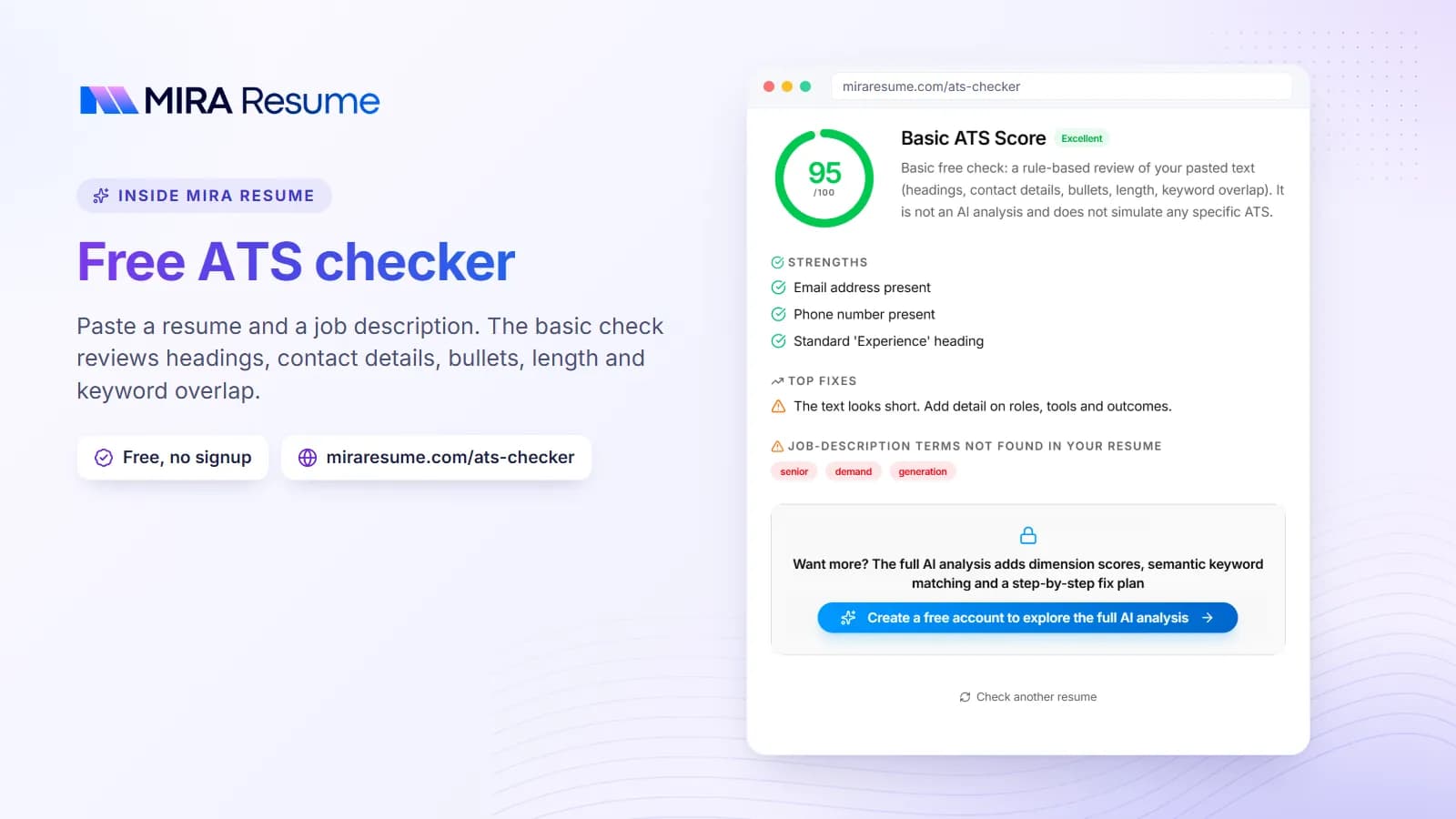
Before you apply, read the job post and mark the care tasks and shifts it names. Add your true matches to your summary and skills. Then run your file through the free ATS checker to catch layout problems and missing keywords.
If you want a clean starting layout, the AI resume builder can set up sections that read well on any system. If you already have experience in other service work, our customer service resume guide may help you phrase transferable skills.
No resume can promise a job, but a clear, truthful one makes it easy for a busy manager to say, "I want to talk to this person."