
What to include in a cover letter is a short list: your contact details, a greeting, the job you want, proof that you can do it, a reason you chose this company and a polite close. That is all a good letter needs. Everything else is extra.
Many people wonder what goes on a cover letter because they fear leaving something important out, or they add too much. This guide gives you a nine-part checklist, shows what each part looks like, and lists what to leave out. It ends with a quick final check you can run before you send.
If you want the full writing process, read how to write a cover letter. This page focuses on the parts.
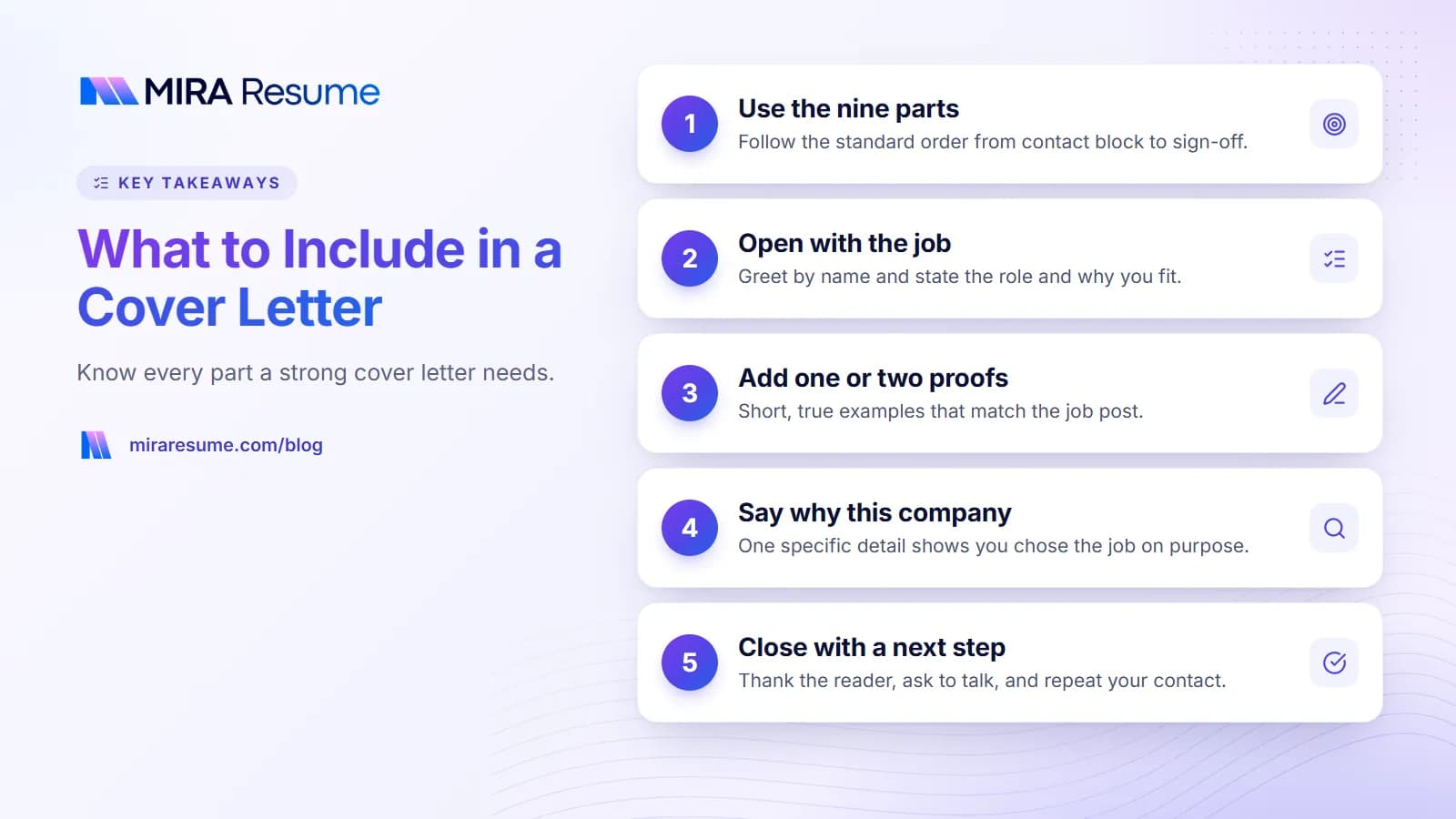
The nine components of a cover letter
These are the components of a cover letter, in the order they appear on the page.
| # | Component | What it contains | Required? |
|---|---|---|---|
| 1 | Contact block | Your name, city and state, phone, email | Yes |
| 2 | Date | Full date, such as October 23, 2026 | Yes for attached letters |
| 3 | Employer details | Name, title, company, address | Optional |
| 4 | Greeting | "Dear Ms. Alvarez," | Yes |
| 5 | Opening | The job title and your best reason to be considered | Yes |
| 6 | Proof paragraph | One or two short stories that match the post | Yes |
| 7 | Company paragraph | One honest reason you want this employer | Strongly advised |
| 8 | Closing | Thanks and a clear next step | Yes |
| 9 | Sign-off and name | "Sincerely," and your full name | Yes |
Parts 1 to 4 and 9 are the frame. Parts 5 to 8 are the content, and they are where your letter wins or loses. The next sections go through each part with examples.
What should be in a cover letter header
The header gives the reader a way to reach you. Keep it plain and match your resume.
- Full name. Use the same form you use on your resume.
- City and state. A full street address is not needed unless the job requests it.
- Phone number. One number you answer.
- Professional email. Something like [email protected], not a nickname.
- Optional link. A portfolio or professional profile if it helps. See how to put LinkedIn on a resume.
Jane Doe
Denver, CO | 555-0100 | [email protected]
Then add the date, and if you know the hiring manager, their name and company. For a full layout, read how to format a cover letter.
The greeting and opening: what goes on a cover letter first
Your greeting should name a person if possible. Check the job post, the company website or a professional networking page for the hiring manager or team lead. If you cannot find a name, "Dear Hiring Team," is a safe choice.
Your opening paragraph must contain two things:
- The exact job title you are applying for (and the company name).
- One strong reason you are a match, in plain words.
I am applying for the Medical Office Assistant role at Lakeside Family Clinic. I have three years of front-desk experience in a busy clinic, and I enjoy helping patients feel calm and informed.
Do not waste this paragraph on "I am writing to express my interest in...". For more opening ideas, see how to start a cover letter.
What a cover letter should contain as proof
Proof is what makes your letter more than a list of claims. Include one or two short examples of work that match what the job post asks for.
What counts as proof
- A result: "Cut wait times by moving check-in online."
- A scope: "Managed the schedule for a team of 12."
- A skill in action: "Trained two new hires on our billing software."
- A school or volunteer project, if you are early in your career.
- A credential that the job asks for, such as a license. See how to list certifications on a resume.
Proof in a sentence
At my current clinic, I check in about 60 patients a day and created a one-page checklist that cut missing forms at the start of visits. Your post asks for someone accurate with scheduling software, and I use it all day.
Use numbers only when they are true. If you do not track numbers, describe the change in plain words. For the story pattern, see the STAR method for your resume.
What to include about the company and why you want the job
One short paragraph about the employer is among the most valuable parts of your letter, and the one people skip most often. It shows you chose this job on purpose.
Look for one specific thing: a product, a service, a value, a recent project, the way the team serves customers or patients. Then say, in one or two sentences, why it matters to you.
Lakeside's focus on same-week appointments stands out to me. Short waits make a real difference to patients, and I would like to help your team keep that promise.
You may also include why you are leaving or changing fields, but only if it helps your case, and always in a positive way. Never speak badly about a past employer.
If you are applying to a role in a field you have not worked in before, this is where you link your past skills to the new field. Our transferable skills examples can help you choose what to mention.
The closing and call to action
Every letter needs a clear end. Include three small things:
- Thanks. A short thank-you for the reader's time.
- A next step. Say you would welcome a conversation.
- Contact details. Repeat your phone or email, even though they are in the header.
Thank you for your time. I would welcome the chance to talk about how I can help your team. You can reach me at 555-0100 or [email protected].
Sign off with "Sincerely," or "Best regards," followed by your name. For more phrases, read how to close a cover letter. After sending, you can follow up politely. See follow-up email after an interview if you have already met.
Extra items you may include in special cases
Some situations call for one more line or two. Add these only when they apply.
| Situation | What to add | How much space |
|---|---|---|
| Job post asks for salary expectations | A range or "negotiable", only if requested | One sentence |
| Job post asks for availability or start date | When you can start, or notice period | One sentence |
| You are relocating | Your move date and city | One sentence |
| Employment gap | A short, honest reason and what you did | One to two sentences. See gaps in employment |
| Career change | Skills that carry over, plus a step you took | A short paragraph |
| Referral | The name of the person who referred you, with their permission | One sentence in the opening |
| Work authorization | Only if the post asks or it is important to the role | One sentence |
| Portfolio or samples | A link in the header or closing | One line |
Do not include information that is not asked for and does not help, such as age, marital status or a photo. Hiring teams do not need that in a letter.
What not to include in a cover letter
Knowing what to leave out is as useful as knowing what to add.
- Your whole work history. That is what your resume is for. See cover letter vs resume.
- Negative remarks about a past employer or manager.
- Excuses or apologies such as "I know I do not have much experience, but...".
- Personal details not tied to the job, such as family status.
- Salary demands unless the post asks for them.
- Clichés like "team player", "hard worker" and "go-getter" without proof.
- Long paragraphs of duties. Choose two or three proof points.
- Anything untrue. Every line must be something you can talk about in an interview.
- Images, logos and graphics. They add nothing and may break software.
If you are unsure whether a line earns its place, ask: does it help the reader decide to talk to me for this job? If not, cut it.
A cover letter with every part labeled
Here is a complete letter with each component marked in brackets. Remove the labels in your own version.
[Header] Jane Doe | Denver, CO | 555-0100 | [email protected]
[Date] October 23, 2026
[Greeting] Dear Ms. Nair,
[Opening] I am applying for the Patient Coordinator role at Summit Health Group. I have worked at a clinic front desk for three years, and I like helping patients feel calm and informed.
[Proof] I check in about 60 patients a day and handle insurance questions at the desk. I made a one-page checklist for new patients that reduced missing forms at the start of visits. Your post asks for someone friendly, accurate and good with scheduling software, which describes my daily work.
[Company] Summit's focus on same-week appointments stands out to me. Short waits matter to patients, and I would like to help your team keep that promise.
[Closing] Thank you for your time. I would welcome a chance to talk about the role. You can reach me at 555-0100 or [email protected].
[Sign-off] Sincerely,
Jane Doe
More full letters are in our cover letter examples. Shorter ones are in short cover letter examples, and you can see how the words match the post in cover letter keywords.
Final checklist and common mistakes
Checklist before you send
- Contact details are correct and match your resume.
- The job title and company name are right everywhere.
- The opening names the job and a reason you fit.
- One or two true proof points match the job post.
- There is one specific line about the company.
- The closing thanks the reader and invites a reply.
- The letter fits on one page. See how long a cover letter should be.
- No typos, placeholders or unrelated details.
- Saved as a PDF with a clear file name.
Common mistakes
- Leaving out the job title in the opening.
- Writing only about what you want from the job.
- Using the same letter for every employer.
- Forgetting contact details at the close.
- Adding unrelated personal information.
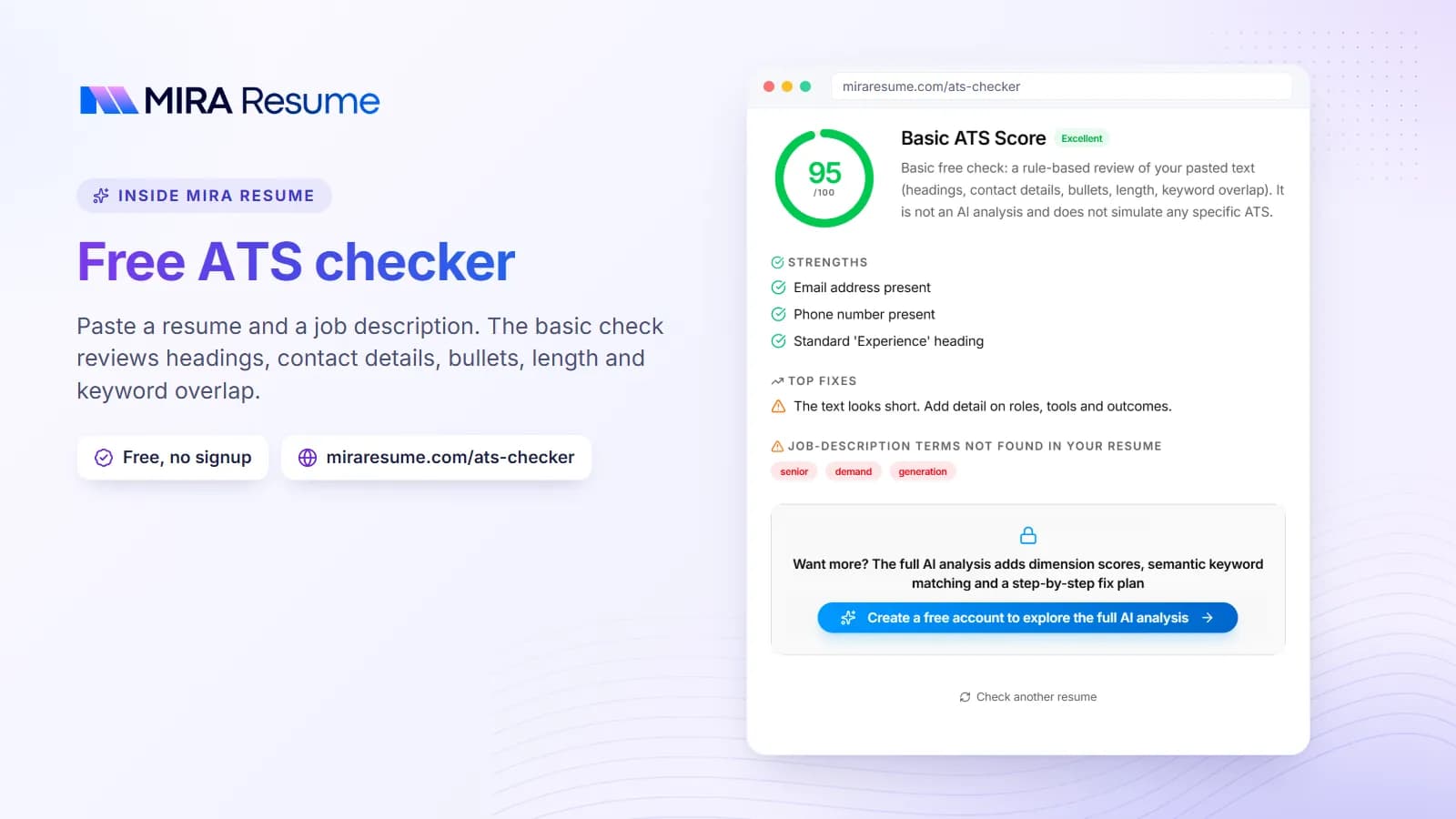
When your letter is ready, make sure your resume is just as strong. Test it with the ATS checker and, if you need a cleaner version, try the AI resume builder.