
Wondering how to list certifications on resume pages so employers actually notice them? Give the full certification name, the group that issued it, and the date you earned it. Then place it where it will be seen: in its own section for most people, or near the top if the job requires it.
This guide covers where certifications go, the exact format to use, and what to do with courses that are in progress, expired, or only loosely related. You will also find a table of ready-made examples, tips for a certification in a CV, and a list of mistakes to avoid. As always, only list what you truly hold, and follow any instructions in the job posting.
How to list certifications on resume: what to include
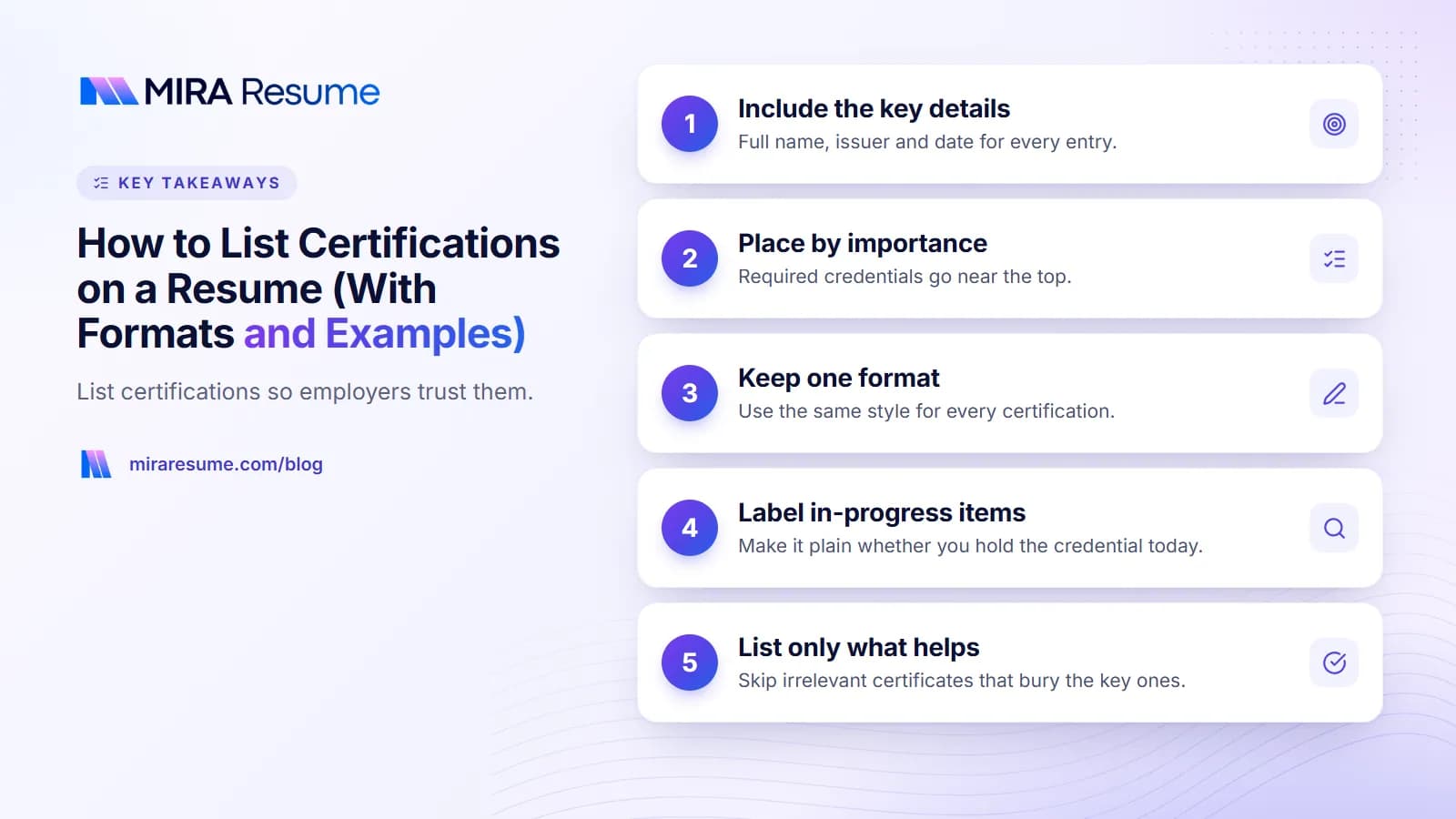
A reader should be able to tell at a glance what you earned, who gave it to you, and whether it is current. Include these parts:
- Full name of the certification, spelled the way the issuer spells it.
- Issuing organization, such as a board, school, company or professional group.
- Date earned, or the expiry date if it has one. A year is often enough.
- License or credential number, if the field expects it (common in nursing, teaching and trades).
- Location or state, for licenses that are state specific.
Spell out abbreviations once. Write "Certified Nursing Assistant (CNA)" so both the full phrase and the short form can be found.
Where to put certifications on a resume
Where you place a certification depends on how much it matters for the job.
| Situation | Where to place it | Why |
|---|---|---|
| Required by law or the posting (RN, CDL, PMP) | Near the top: in the summary and a certifications section | It is a first filter for the job |
| Helpful but not required | Separate "Certifications" section after skills or education | Shows extra effort without taking over the page |
| Only one or two items | In the education or skills section | Avoids an almost empty section |
| Many certifications | Group by type and list the top 4 to 6 | Keeps the page focused |
| Little work history | Above or just below education | Training can carry more weight |
Add it to your name line when it is a title
If a credential is part of your professional title, you can place it after your name: "Maria Lopez, RN" or "Jordan Smith, PMP". Do this only for credentials that are standard in your field.
For help choosing what else deserves space, see our checklist of things to put on a resume.
How to put certifications on resume: formats you can copy
Pick one format and keep it the same for every entry.
Format 1: Name, issuer, date
Project Management Professional (PMP), Project Management Institute, 2025
Format 2: Name, date, then a note
Certified Nursing Assistant (CNA), State of Ohio, 2024 (License No. 123456)
Format 3: Grouped in two columns of text, one line each
CPR and First Aid, American Red Cross, valid through 2027
Forklift Operator Certification, OSHA-compliant employer training, 2025
Here is how common types look when they are written well:
| Type | Example line |
|---|---|
| Professional | Certified Public Accountant (CPA), State Board of Accountancy, 2023 |
| Technical | CompTIA A+, CompTIA, 2025 |
| Healthcare | Basic Life Support (BLS), American Heart Association, valid through 2027 |
| Software or cloud | AWS Certified Cloud Practitioner, Amazon Web Services, 2025 |
| Trades | Commercial Driver's License (CDL) Class A, State of Texas, 2022 |
| Teaching | Secondary Education Teaching License, Math 6 to 12, State of Oregon, 2024 |
| Online course | Google Data Analytics Certificate, Coursera, 2025 |
These are samples. Use the exact names and details from your own documents.
Certification in a CV: what changes
A CV is longer than a resume and is common in academic, medical, scientific and international job searches. If you want to learn more, read CV vs resume.
For a certification in a CV, you have more room, so you can:
- List every relevant license and board certification, with dates and numbers.
- Use headings such as "Licensure and Certification", "Professional Development" or "Training".
- Put the most important credential first, not just the newest one.
- Include the renewal date when it matters to the employer.
Even on a CV, skip trivial items, like a one-hour webinar certificate, unless the job calls for it. See also science CV sample for a full layout.
Certifications in progress, expired or unfinished
Honesty matters most here. Make it plain whether you hold the credential today.
In progress
You may list a certification you are working toward, as long as you label it clearly.
Certified Associate in Project Management (CAPM), Project Management Institute, exam scheduled for March 2027
Google UX Design Certificate, Coursera, in progress, expected completion December 2026
Expired
If it has lapsed, you can leave it off, or keep it with an honest note if it still shows relevant training: "CPR certification (expired 2024; renewal scheduled)". Never show an expired license as current.
Started but not finished
If you did not finish, you can mention the coursework instead of the certification: "Completed 3 of 5 courses in the Data Analytics program". Do not imply you finished.
Very old certifications
Some do not expire, but the skills may be dated, such as an old software version. If the tool is no longer in use, consider leaving it off.
Which certifications are worth listing?
You do not need to list every certificate you ever received. Choose ones that help you win this job.
| List it when... | Leave it off when... |
|---|---|
| The job posting names it | It has nothing to do with the role |
| It shows a skill you need to prove (for example, a tool or safety rule) | It is a short, general attendance certificate |
| It is issued by a recognized group or school | You cannot remember the issuer or date |
| It is current and valid | It is expired and no longer meaningful |
| You have limited work history and want to show initiative | It crowds out stronger experience |
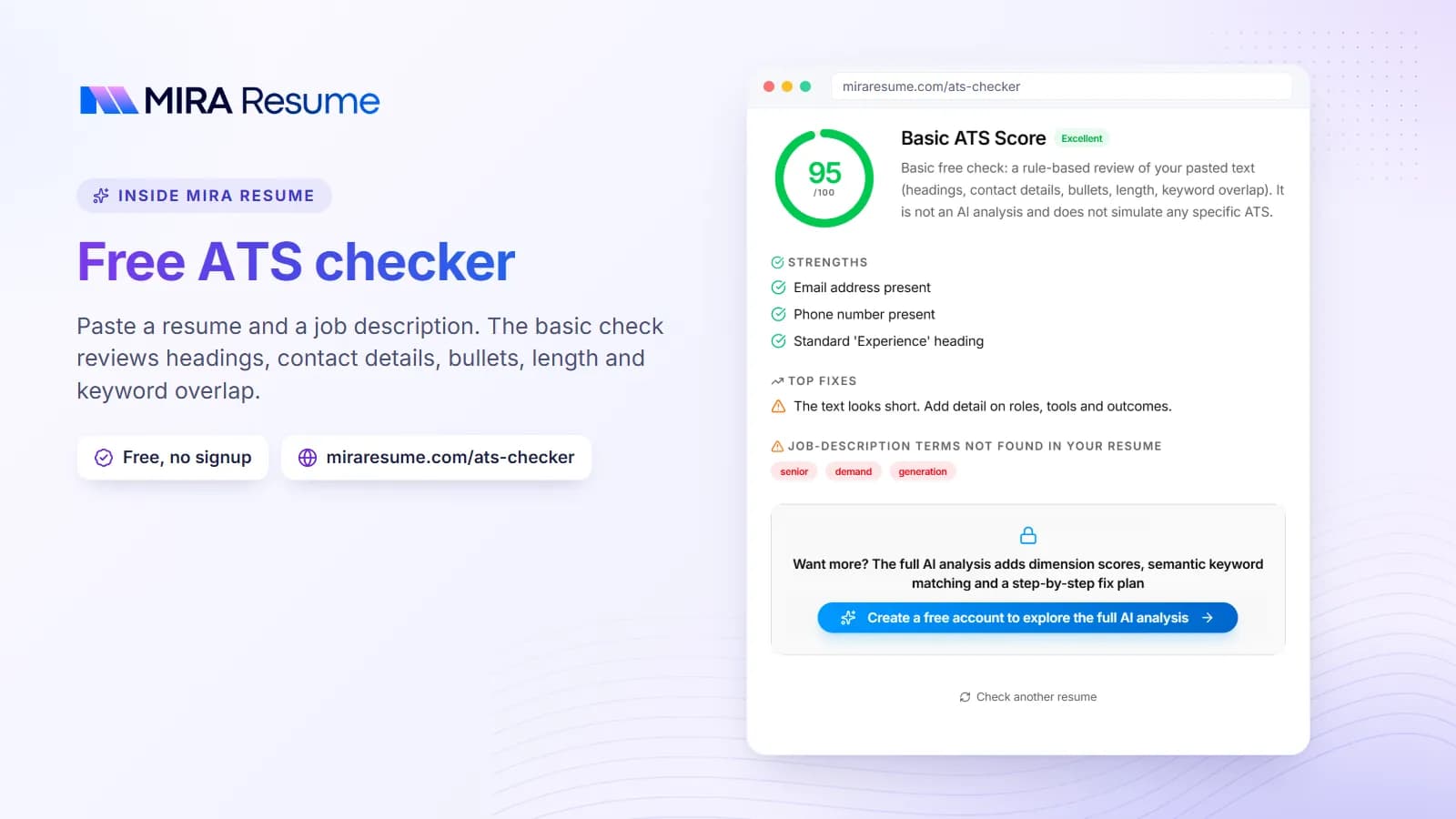
Certifications can also supply good keywords. If the posting says "PMP preferred", your resume should say "PMP" in plain text. Our guide to resume keywords explains how to spot terms like this. You can also test your document with the ATS checker.
Show the value of a certification in your bullets
A certification line proves you passed a test. A bullet shows what you did with the knowledge. If space allows, tie them together.
| Certification | Bullet that uses it |
|---|---|
| OSHA 10-Hour | Led weekly safety talks for a crew of 12 and logged zero reportable incidents in 2025 |
| Google Analytics certification | Built monthly traffic reports that helped the team shift budget toward the best-performing pages |
| Food Handler card | Followed temperature and cleaning logs for a kitchen serving 200 meals a day |
| Six Sigma Green Belt | Mapped the returns process and removed two steps, cutting handling time |
Only write results that are true. For ways to start such bullets, browse action verbs for resume, or use the AI bullet enhancer to draft options you can edit.
Common mistakes when listing certifications
- Leaving out the issuer. "Excel certificate" is vague. Say who issued it.
- Listing everything. Ten small certificates can bury the two that matter.
- Using only abbreviations. Write the full name once.
- Using different formats. Keep dates, names and order consistent.
- Hiding the required one. If the job needs a license, mention it near the top.
- Presenting in-progress as complete. Always label it.
- Including license numbers where they are not needed. Add them only if your field expects it, and avoid personal ID numbers.
- Forgetting to renew. Check dates before you apply.
Once your certifications are in order, review the whole page with how to format a resume, and build your document in the resume builder.
Examples of a full certifications section
Seeing a whole section helps you picture the finished page. Here are three short examples for different jobs. Change the details to fit your own records.
Healthcare worker
LICENSES AND CERTIFICATIONS
Registered Nurse (RN), State of Florida, License No. 1234567, active through 2027
Basic Life Support (BLS), American Heart Association, valid through 2027
Advanced Cardiac Life Support (ACLS), American Heart Association, valid through 2027
Office or finance worker
CERTIFICATIONS
Microsoft Office Specialist: Excel, Microsoft, 2025
QuickBooks Online Certification, Intuit, 2024
Warehouse or driver
CERTIFICATIONS
Forklift Operator Certification, 2025
Commercial Driver's License (CDL) Class B, State of Georgia, 2023
OSHA 10-Hour General Industry, 2025
Each line follows the same order: the name, the issuer, and the date. That steady pattern makes the section quick to scan. If your certifications are the main reason you are qualified, as with many trade and health roles, you can also place two or three of the best ones in your summary line, such as "Forklift-certified warehouse associate with 3 years of experience".
Not sure how the rest of your page should look? Our CNA resume examples and medical assistant resume guides show certifications in the context of full resumes.
Online courses, badges and short certificates
Online learning is common, and it can help, especially when you are changing fields or have little work history. But not all certificates carry the same weight. Think about how an employer will see each one.
- Graded, multi-week programs from known schools or companies are usually worth listing.
- Short badges for a single lesson or a few hours are better grouped into one line, such as "Coursework: Excel formulas, data cleaning, basic charts".
- Company-specific training counts when the tool or process matches the new job.
- Free certificates are fine if they teach a skill the posting asks for. Be factual and do not overstate them.
When you list a course, write what you learned, not just the title. For example: "Google Data Analytics Certificate, Coursera, 2025. Practiced cleaning data in spreadsheets and SQL and building simple dashboards." Keep this to one line if space is tight.
If you are new to the job market, you can also place relevant training in a section called "Training and Courses". It signals effort and makes your resume more complete. Our guide for skills-based resumes shows how to center a page on abilities rather than a long job list.
Keep your certifications honest and up to date
Employers can often check licenses and certifications with the issuing group, and some will do so before an offer. Treat the section as a statement of fact.
- Match names and dates to your certificate or online record.
- Put a reminder in your calendar for renewal dates.
- Remove anything that has lapsed unless you note it clearly.
- Keep digital copies of each certificate in one folder so you can share them quickly.
A tidy, true section builds trust, and trust is what a resume is for.