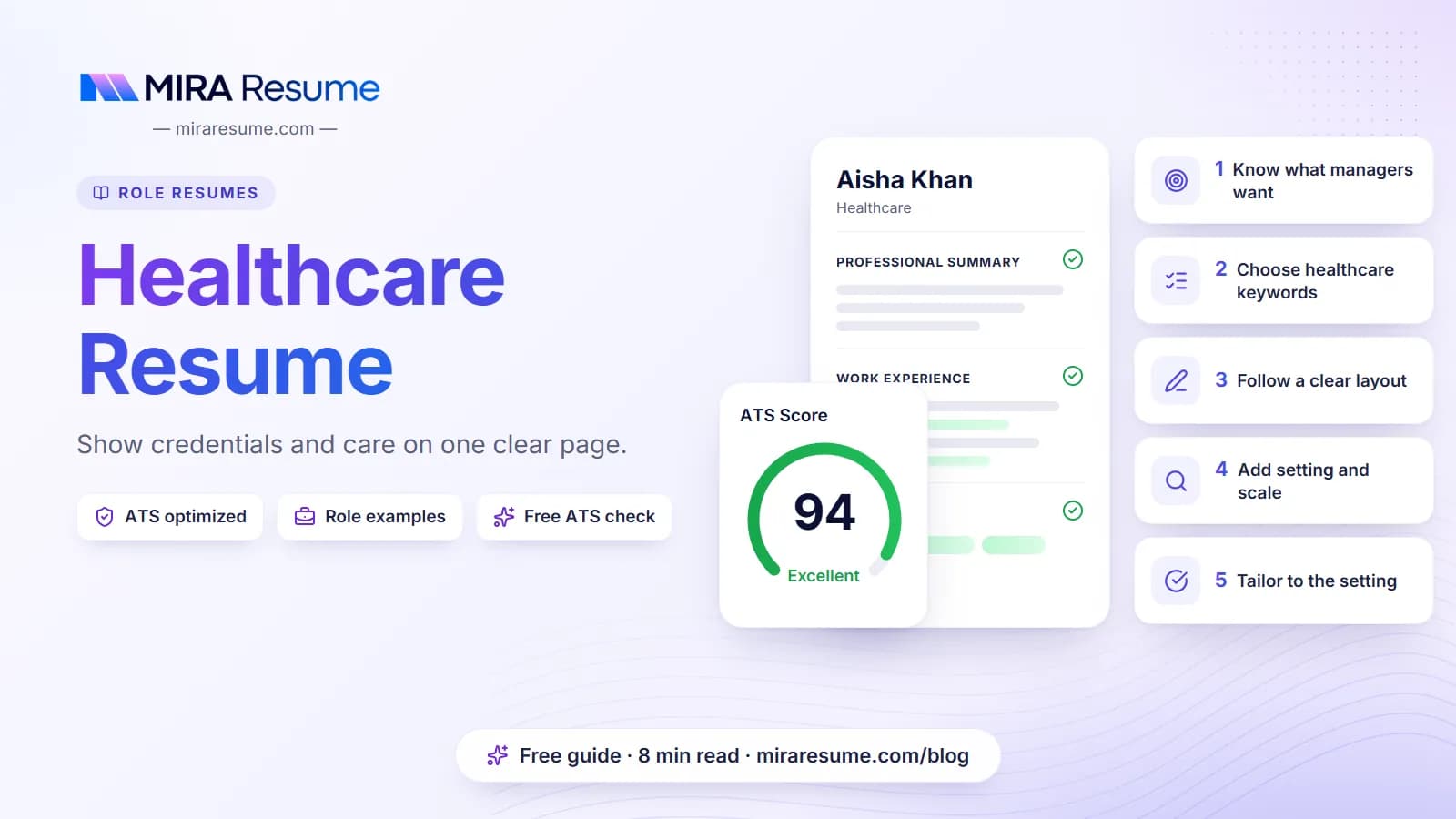

A healthcare resume has to do two jobs at once. It must show hiring managers that you are qualified and safe, with the right license, training and record. It must also show that you care for people, work well in a team and can handle pressure. Strong resumes do both with clear facts, not flowery words.
This guide fits many roles, from aides and assistants to technicians, therapists and office staff. For nursing, you will also find specific pages linked below. Every example uses [brackets] for details you fill in with your own true information.
What hiring managers want to see on a healthcare resume
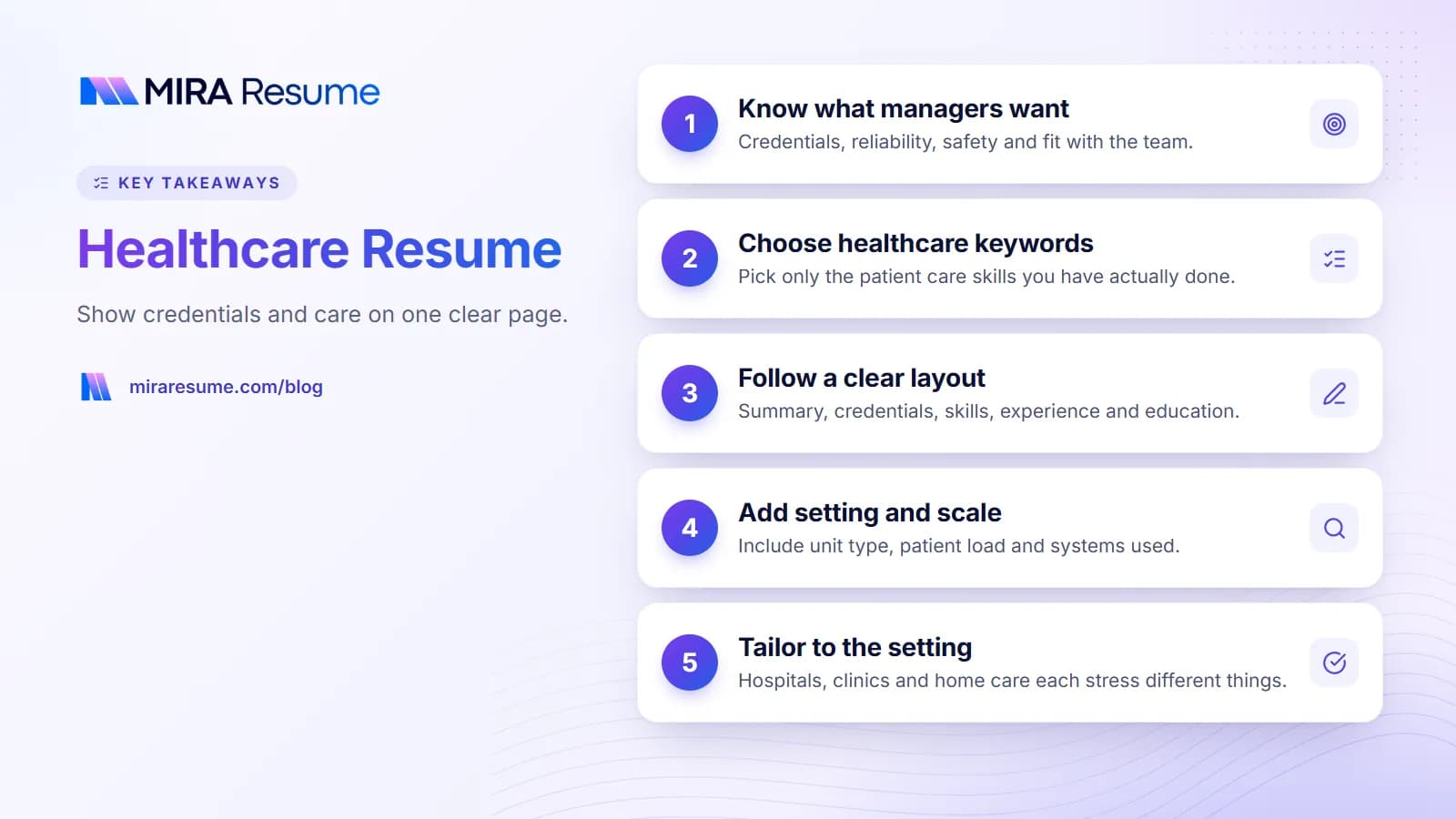
Hospitals, clinics, nursing homes and home care agencies all hire with the same worries in mind: safety, reliability and fit with the team. The first screen is often done by software or by a busy recruiter who looks for a few key items.
- Your credentials: license, registration or certification, with status and state if relevant
- Your setting: hospital, clinic, long-term care, home health, lab or office
- Your scale: patient load, unit size, beds, appointments or records handled
- Your systems: electronic health record (EHR) tools and other software
- Your habits: accuracy, teamwork, communication and care
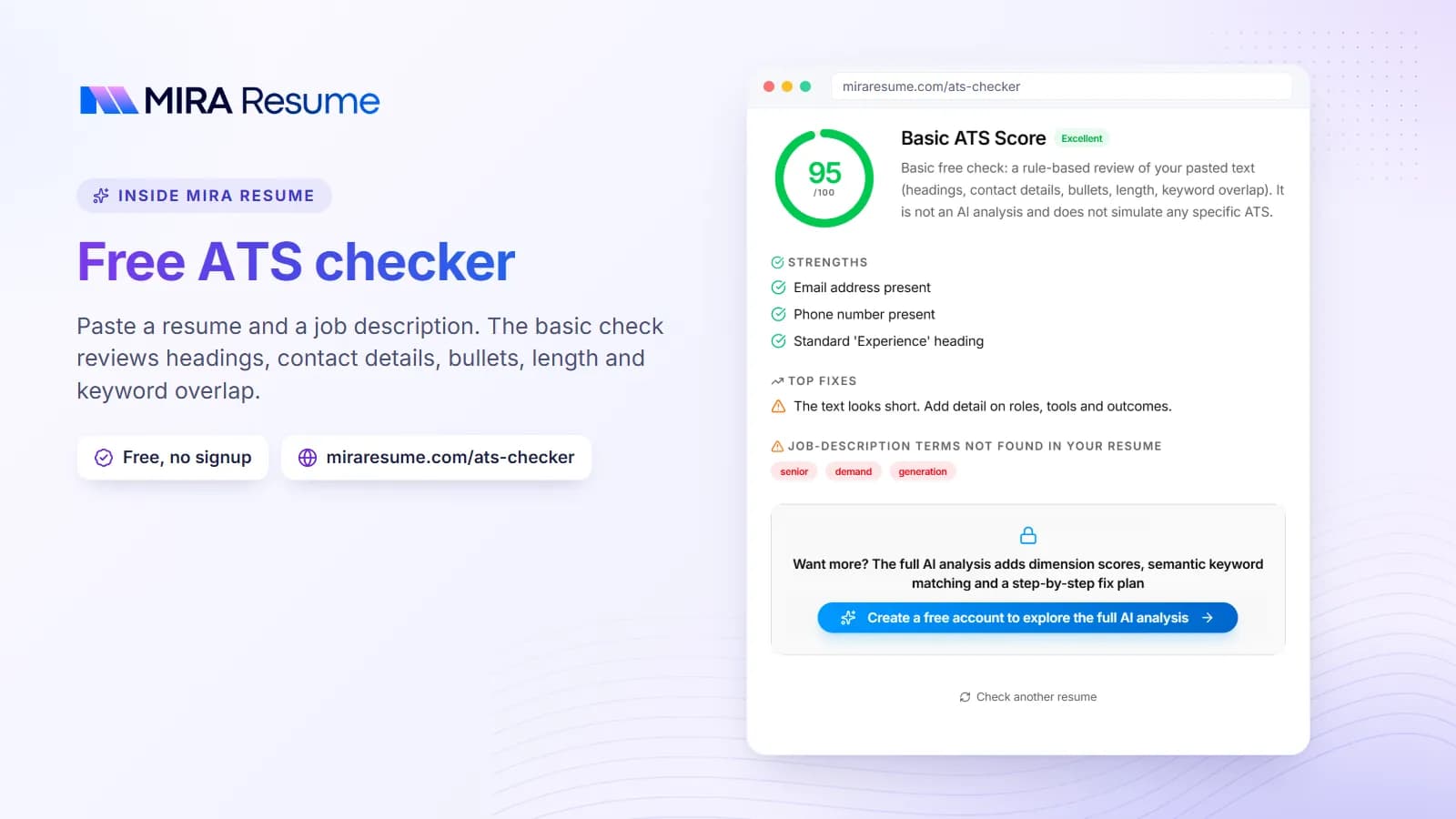
Keep the page to one column. Use plain headings like Licenses and Certifications, Experience and Education. If you need help with layout, read how to format a resume, and test your file with the ATS checker.
Clinical and non-clinical roles
Clinical roles involve direct care, such as aides, assistants, technicians and nurses. Non-clinical roles include front desk, billing, scheduling, records and administration. Both can use the same layout, but the keywords differ. Read the post and mirror its language where it is true for you.
Healthcare resume skills and keywords
Use this table as a menu. Pick only what you have done. Healthcare employers may verify credentials, so honesty is essential.
| Area | Example keywords | Best place on resume |
|---|---|---|
| Patient care | Vital signs, patient intake, mobility help, infection control, bedside care | Experience bullets |
| Clinical support | Specimen collection, sterilizing equipment, preparing rooms, assisting providers | Experience bullets |
| Records and systems | EHR, charting, scheduling software, coding basics, billing | Skills line and bullets |
| Safety and rules | Privacy rules, safety checks, infection prevention, incident reports | Skills line and bullets |
| Communication | Patient education, family updates, handoff notes, teamwork | Summary and bullets |
| Languages | Bilingual with a second language you can use in care | Skills line |
Soft skills matter, but show them with evidence, such as a calm handoff during a busy shift. For more on balance, see good skills to put on a resume and transferable skills examples.
Specific roles with their own guides
If you are applying for a specific job, check our pages for the registered nurse resume, LPN resume, CNA resume examples, medical assistant resume, phlebotomist resume and pharmacy technician resume.
Sample healthcare resume layout
Use this order. Move education to the top if you are a recent graduate.
[Your Name], [Credential if you hold one]
[City, State] | [Phone] | [Professional email]
Summary
[Role] with [X] years in [setting]. Experienced in [two main duties] and [EHR system]. Known for calm, clear communication with patients and teams.
Licenses and Certifications
[License or certification name], [State if applicable], [Status], [Expiration or year]
[Basic life support or similar course], [Provider], [Year]
Experience
[Job Title], [Facility] | [City] | [Dates]
- [Action verb] [care or support task] for [number] patients per [shift or day]
- [Action verb] [system or process] to [result]
Education
[Degree or program], [School], [Year]
Put licenses and certifications near the top, because they are often the first filter. Include only credentials that are current or clearly marked in progress with an expected date. Rules for which credentials are needed vary by state, role and employer, so check your state board and the job post.
Healthcare resume bullet points: before and after
Healthcare duties can sound alike on paper. Add the setting, the scale and the result. Never include patient names or private details. Use only what you can share.
| Weak bullet | Stronger bullet |
|---|---|
| Cared for patients | Provided daily care for [number] residents on a [type] unit, including [tasks], and reported changes to [role] |
| Took vital signs | Recorded vital signs for about [number] patients per shift in [EHR system] and alerted nurses to abnormal readings |
| Helped with scheduling | Scheduled about [number] appointments a day in [software], reducing wait times through [method] |
| Kept records | Updated patient charts in [EHR] with careful attention to accuracy and privacy rules |
| Worked with a team | Shared handoff notes with [number] team members at each shift change to support continuity of care |
| Cleaned equipment | Followed infection control steps to prepare [number] rooms or tools each [shift], meeting [facility] standards |
Choose verbs like monitored, documented, assisted, coordinated, educated, and trained. Our action verbs for resume page has a longer list.
Entry-level vs experienced healthcare resume
| Part | Entry-level | Experienced |
|---|---|---|
| Top of page | Summary, then education and training | Summary, then licenses and work history |
| Proof | Clinical hours, externships, volunteering, skills labs | Patient load, units, systems, mentoring |
| Skills | Core care tasks, CPR or similar course, EHR practice | Specialty skills, leadership, process improvement |
| Length | One page | One to two pages |
Entry-level example bullets
- Completed [number] clinical hours at [facility], assisting with [tasks] under supervision
- Practiced charting in [EHR training system] and completed [privacy training course]
- Volunteered [number] hours at [organization], helping [number] patients or visitors per shift
Entry-level seekers can also use entry-level resume examples and resume with no experience for ideas, and the new grad nurse resume if you just finished nursing school.
Experienced example bullets
- Trained [number] new staff on [process or system], helping them reach independence in [timeframe]
- Led a [unit or team] change to [process], helping reduce [issue] over [period]
- Served as charge or lead on [shift type], coordinating [number] staff and [number] patients
Healthcare administration and office roles
Not every healthcare job is hands-on. Billing, scheduling, records and front desk staff keep the system running, and they are in demand. Their resumes should emphasize accuracy, privacy and software.
- Show the systems: EHR, scheduling tools, billing or coding software.
- Show the scale: appointments per day, claims per week or records per month.
- Show the rules: privacy, insurance steps, documentation standards.
Sample bullet: "Verified insurance details for about [number] patients a week and fixed [type of error] before claims went out." If you work at a front desk, see the receptionist resume examples guide and administrative assistant resume for related wording.
Tips for career changers
If you are coming from retail, hospitality or customer service, lead with transferable skills: calm communication, safety awareness, teamwork and reliability. Add any new training you have completed. A skills-based resume format can help if your work history looks unrelated.
Licenses, certifications and education: how to list them
Healthcare employers verify credentials, so list them clearly. Use full names and avoid shortcuts that could confuse a reader.
- Name of the license or certification
- Issuing body or state, if relevant
- Status (active, in progress) and expiration or year
- License number only if the employer asks for it
Requirements differ by state, role and employer, so check your state board and the job post for what you need. Do not list a credential you do not hold. If it is in progress, write the expected date. See how to list certifications on a resume and how to list education on a resume.
Where to put short courses
Courses like basic life support, first aid or privacy training go in the same Licenses and Certifications section. If you have many, list the three most relevant and cut older or unrelated ones. Do not add anything with a lapsed date unless you mark it clearly.
One complete healthcare resume example
Here is a full sample for a patient care assistant. It is illustrative, so replace every bracket with your own facts and delete any line that is not true for you.
[Your Name]
[City, State] | [Phone] | [Professional email]
Summary
Patient care assistant with [X] years in [long-term care or hospital]. Helps patients with daily needs, records vital signs and reports changes quickly. Comfortable with [EHR system] and a busy shift.
Licenses and Certifications
[Certification name], [State], Active, [Year]
Basic Life Support, [Provider], [Year]
Experience
Patient Care Assistant, [Facility] | [City] | [Month Year] to Present
- Cared for about [number] patients per shift, helping with [mobility, meals, hygiene] and comfort
- Recorded vital signs in [EHR system] and told the nurse right away about changes
- Gave clear handoff notes to the next shift, supporting steady care
- Followed infection control and privacy rules every day
Education
[Program name], [School], [Year]
The page works because it names the setting, the daily load, the system and the habit of speaking up. It does not use private details, and it keeps each bullet to one or two lines.
How to adapt it
- For a lab or technician role, swap care tasks for specimen handling, equipment checks and quality steps.
- For therapy support, show session support, equipment setup and progress notes.
- For a records or billing role, show accuracy, privacy and software.
Tailor your resume to the care setting
The same job title can look very different in different places. Show the reader that you understand their setting.
| Setting | What matters most | Words and proof to include |
|---|---|---|
| Hospital | Fast pace, teamwork, safety | Unit type, shift pattern, rapid response help, handoffs |
| Clinic or doctor office | Patient flow, scheduling, procedures | Appointments per day, rooming, intake, supplies |
| Long-term care | Daily care, patience, relationships | Resident count, routines, mobility help, family contact |
| Home health | Independence, reliability, travel | Caseload, care plans, driving, documentation |
| Lab or pharmacy | Accuracy and procedures | Sample volume, checks, equipment, quality steps |
Copy the job post's own words for tasks you truly performed. If you are unsure which words matter, read resume keywords and how ATS works.
Cover letter and follow-up
A short letter can set you apart, especially for roles that value communication. Our how to write a cover letter guide covers the steps. After an interview, a brief thank-you is polite and easy; see thank you letter after interview.
Keep your own health and privacy in mind
Do not include personal health details or photos on your resume. List only information that helps the employer judge your work. If an employer needs proof of vaccination, background checks or other screening, they will ask during hiring, and rules differ by state and facility.
Common healthcare resume mistakes
- Leaving out credentials. Many screens start with them. Put them near the top.
- Sharing private data. Never add patient names, case details or facility secrets.
- Duty lists with no setting or scale. Add the unit type, patient load or system.
- Vague soft skills. "Compassionate" is hard to prove, so show it through a specific action.
- Old formatting. Photos, columns and graphics can break ATS reading. Plain text works.
- Not updating dates. Make sure expiry dates and current roles are correct.
- One version for all jobs. Adjust keywords for hospital, clinic, home care or office roles.
When you are ready, use the resume builder and a clean template from resume templates. You can also check your final PDF with the resume checker.