
A career change resume has one hard job: help a reader see that your past work fits a new field. Hiring managers skim, and they will not do the connecting for you. You must point to the skills that carry over, show proof, and make your new goal clear in the first few lines.
This guide explains how to pick a layout, write a summary or objective, rewrite old bullets in the language of the new field and avoid common traps. You will find examples, a skills-mapping table and a before and after table. All examples use [brackets] for your own details.
Start with a clear target
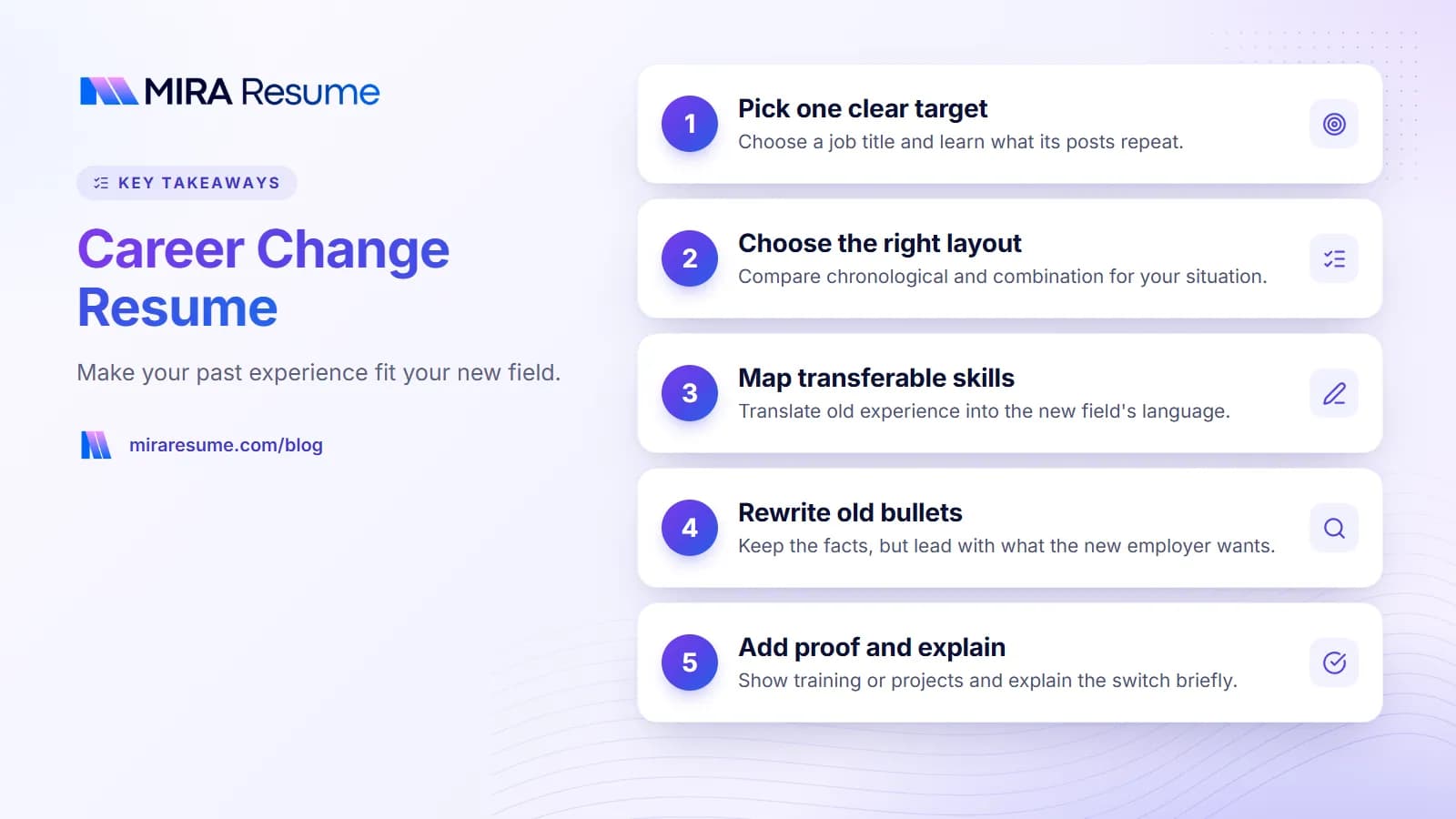
You cannot write a resume for "something different". Pick one job title, or a small family of them, and write for that. Then read two or three job posts and list the skills and tasks they repeat. Those become your guide.
Ask yourself three questions:
- What does the new job do every day?
- Which of those tasks have I done before, even in another setting?
- What proof can I show: results, projects, courses or volunteer work?
If you cannot answer the second question, you may need more training or a stepping-stone role. That is normal. Courses, certificates and small projects can bridge the gap, and you can show them on your resume.
Check the change is realistic
Some changes are easy, such as teacher to corporate trainer. Others need licenses or degrees, such as moving into nursing or law. Check your state, country and employer rules for any required license or training, and be honest on your resume about what you have completed and what is in progress.
Pick the best layout for a career change resume
Layout can help or hurt a career change. Compare your options.
| Layout | Best when | Watch out for |
|---|---|---|
| Chronological | Your recent jobs already show some of the needed skills | Old titles can distract the reader |
| Combination (hybrid) | Your skills fit better than your titles | Skills need real proof |
| Skills-based | You have short or mixed history | Dates should still appear |
For most career changers, a hybrid layout works best: a strong summary, a skills and achievements section tied to the new job, a short work history and a training section. See our guides on the combination resume template, skills-based resume and functional resume template.
Avoid hiding your dates. A purely functional layout can look like you are hiding something. Keep it simple and honest, and format with one column and clear headings. See how to format a resume for the basics.
Career change resume summary and objective examples
The top of your page matters most for a career change. A short summary or objective states your target, your main strengths and why you fit. Use two to three lines.
Summary examples
Customer-focused retail manager with [X] years leading teams and solving problems. Moving into customer success with training in [tool or course]. Strong in coaching, reporting and clear communication.
Teacher with [X] years designing lessons and explaining hard ideas simply. Seeking a corporate training role, with experience in curriculum design, workshops and measuring learning.
Operations coordinator with [X] years in logistics. Now moving into project management, with a [certificate] and experience running schedules, budgets and teams of [number].
Objective examples
An objective works well when you have little direct experience. Keep it specific.
Motivated [old role] seeking an entry-level [new role] position. Brings [skill 1], [skill 2] and recent training in [course]. Eager to apply [strength] to help [type of team] succeed.
Detail-oriented professional transitioning from [old field] to [new field]. Built [project] using [tool] and completed [course]. Looking to grow with a team that values learning.
For more wording ideas, see resume summary examples and resume objective examples. Do not claim a title you have not held. Say what you are moving toward, and what you can already do.
Map your old skills to the new job
Transferable skills are the heart of a career change, but listing them is not enough. You have to translate them into the new field's language. Use this table to map what you did to what the new employer wants.
| Old experience | Transferable skill | New field language |
|---|---|---|
| Teacher: planned lessons, tracked student progress | Training design and measuring results | Instructional design, learning assessment, onboarding |
| Retail manager: handled complaints, ran schedules | Customer care and team coordination | Customer success, account support, operations |
| Server: handled busy tables, took payments | Fast service and accuracy under pressure | Client service, order handling, sales support |
| Administrative assistant: calendars, travel, reports | Planning, organization, reporting | Project coordination, operations support |
| Nurse: assessed patients, documented care | Detail, communication, safety checks | Quality, compliance, clinical research support |
Be honest. Translate your language, not your facts. A teacher did not manage a sales team, but a teacher did train groups, track results and adapt plans. Use transferable skills examples and good skills to put on a resume for more ideas.
Add keywords from the job post
Copy the exact skill names from the post when they are true for you, and place them in your summary, skills section and bullets. Learn the basics in resume keywords and how ATS works.
Rewrite old bullets for the new field
The same task can read very differently depending on the words. Keep the facts, change the framing, and lead with the part the new employer cares about.
| Old bullet | Rewritten for the new field |
|---|---|
| Taught fifth-grade math to 28 students | Designed and delivered [number] lessons for groups of [number], adjusting content based on [assessment results] |
| Managed store of 15 employees | Led a team of [number], set weekly priorities, and coached staff to meet [goal] |
| Answered customer calls at a bank | Resolved about [number] customer questions a day, documenting each case in [system] to support follow-up |
| Scheduled staff and ordered supplies | Planned schedules and budgets for [number] people, keeping spending within [budget type] |
| Wrote reports for my manager | Analyzed [data] in [tool] and presented findings that guided [decision] |
Use the STAR idea: situation, task, action, result. Our guide on the STAR method for resumes shows how to build these lines. Start with action verbs, see action verbs for resume, and only use numbers you can support.
Show training, projects and volunteer work
When you lack direct experience, proof of effort matters. Add a section for training, projects or related volunteer work. Keep it short and relevant.
- Courses and certificates: name, provider, year. See how to list certifications on a resume.
- Projects: a one-line description, tools and a result. A link helps if the work is public.
- Volunteer work: a role that uses the new skills. See how to put volunteer work on a resume.
- Freelance or side work: list it as real work with dates and results.
A sample hybrid career change resume
[Your Name]
[City, State] | [Phone] | [Email] | [Profile URL]
Summary
[Old role] with [X] years of experience, moving into [new role]. Skilled in [skill 1], [skill 2] and [skill 3]. Completed [training] and built [project].
Key Skills and Achievements
[Skill group 1]
- [Rewritten bullet from old job]
[Skill group 2]
- [Project bullet]
Work History
[Title], [Employer] | [Dates]
[Title], [Employer] | [Dates]
Training and Projects
[Course], [Provider], [Year]
[Project name], [Tools], [Result]
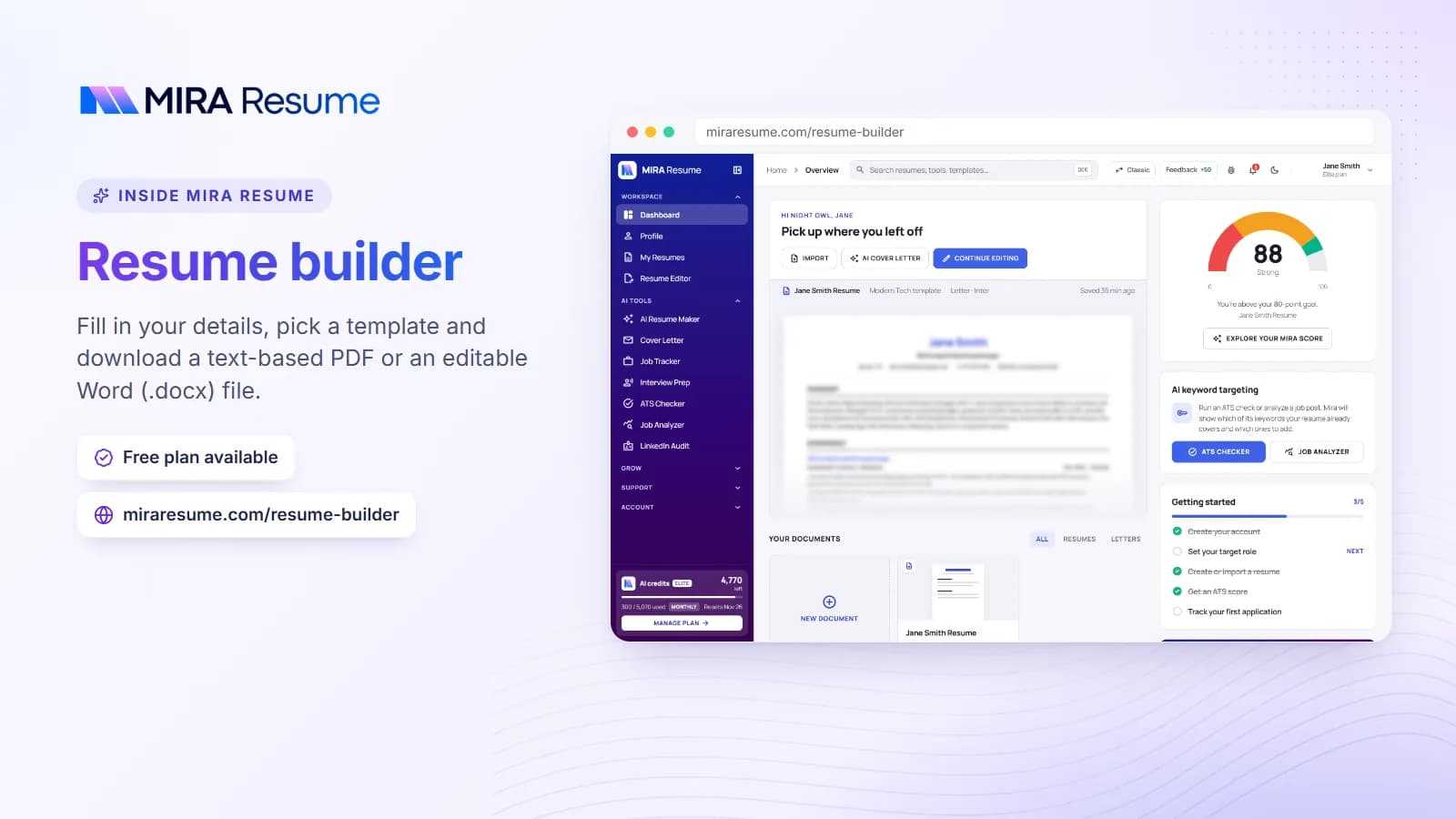
Build the layout in our resume builder, or browse resume templates and resume examples for ideas.
Explain the change without apologizing
Employers may wonder why you are switching. A confident, brief answer helps. You can put it in your summary, your cover letter or your interview talk.
Use this simple pattern: what you did, what drew you to the new field, and what you have done to prepare.
After [X] years in [old field], I became interested in [new field] when [honest reason]. Since then I have completed [course] and built [project], and I am ready to bring my [skills] to this role.
Avoid these phrases
- "I know I have no experience, but..."
- "I just need a chance..."
- "I hated my last job..."
Stay positive and forward-looking. A short cover letter helps tell the story; see how to write a cover letter. If you have gaps from time off for study or family, a calm one-line note is enough; see resume with gaps in employment.
Networking helps
Career changers often find jobs through people. Talk to those already working in your target field, ask what they look for and ask for feedback on your resume. A friendly note to a company you like can open doors, see letter of interest for a job.
A 90-minute plan to finish your draft
Career change projects feel big, so break them into small blocks. Here is a plan you can follow in one evening or over a weekend.
- Minutes 0 to 15: choose your target title and save three matching job posts.
- Minutes 15 to 30: highlight repeated skills and tasks in the posts.
- Minutes 30 to 50: list every past task that matches, from jobs, school, volunteering and side projects.
- Minutes 50 to 70: rewrite the best ten tasks as bullets with a verb, a method and a result.
- Minutes 70 to 85: write your summary and arrange sections in the hybrid order.
- Minutes 85 to 90: save as a PDF and read it out loud once.
Then ask one person who works in the new field to look at it. A single honest comment, such as "this sounds like a teacher, not a trainer", can save you weeks. Revise, test with the ATS checker and send. Keep a copy of every version so you can tailor quickly for each application, and read how to update your resume for upkeep tips.
Stay patient and keep learning
Most career changers send many applications before they get a reply. That is normal, and it does not mean your plan is wrong. Keep learning, keep a list of what you have applied for and adjust your resume as you learn what the field values. Small wins, such as a first interview or a helpful chat with a professional, are signs of progress.
Common career change resume mistakes
- No clear target. A general resume for many fields helps no one.
- Leading with old titles. Lead with the skills that match the new job.
- Using old-field jargon. Translate it into words the new reader knows.
- Hiding dates. Always show a timeline.
- Listing duties, not results. Show what changed because of your work.
- Claiming skills you do not have. Be ready to prove each one in an interview.
- Making it too long. Cut anything that does not support the new target.
When it is ready, check it with the ATS checker and resume checker. The AI resume builder can help you rephrase old bullets, but review every line and keep only what is true.