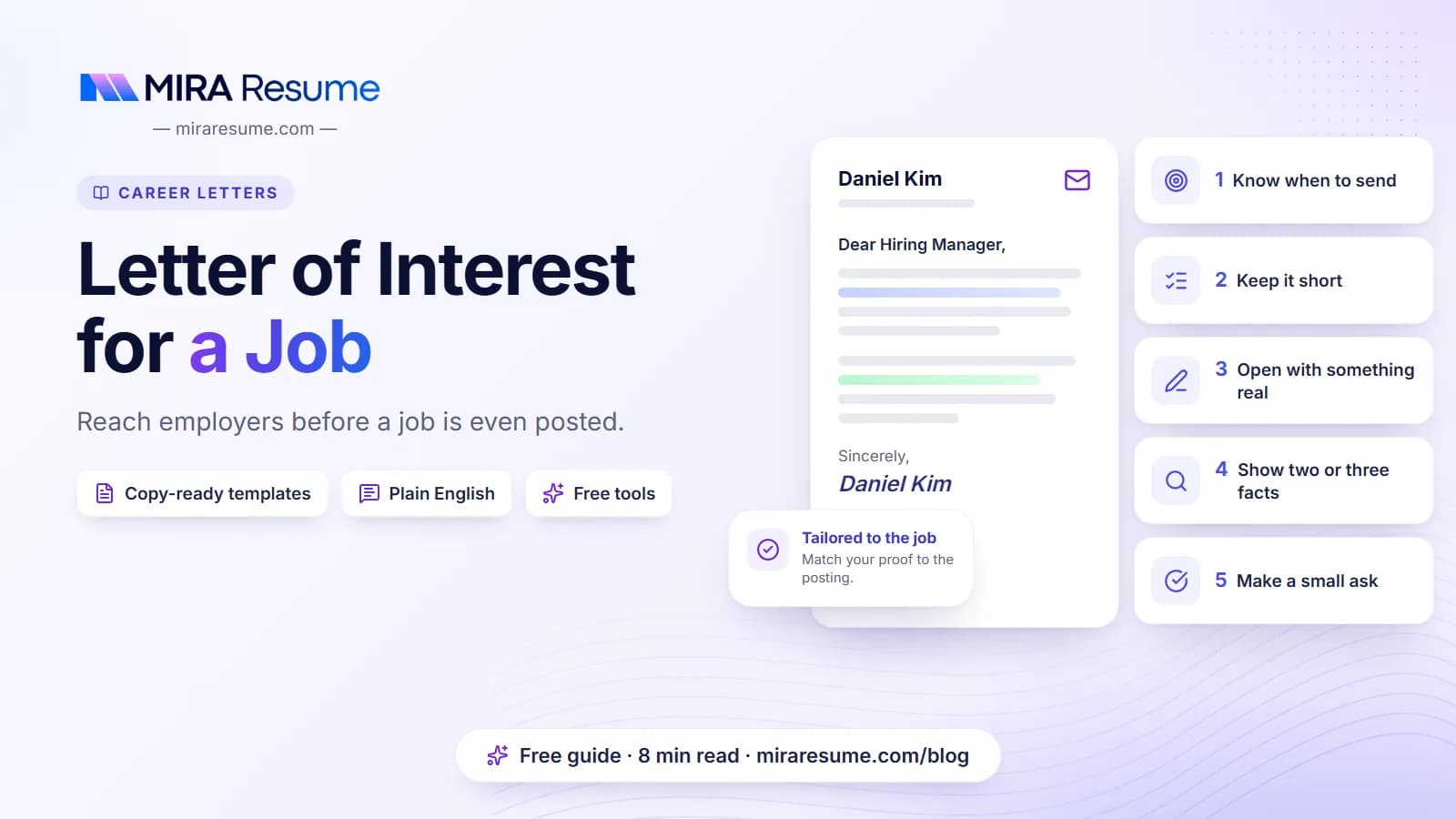

A letter of interest for job openings that are not yet posted is a short note that says, in plain words, "I like what you do, here is how I could help, and I would like to be considered." It is different from a cover letter, which answers a listed job. It is also different from a letter of intent, which is a formal statement of plan.
This guide shows when to send one, how to write it in five short paragraphs, and what to attach. You will also find three samples, including one for an internship. Replace every [bracket] with your real details.
What a letter of interest is, and when to send one
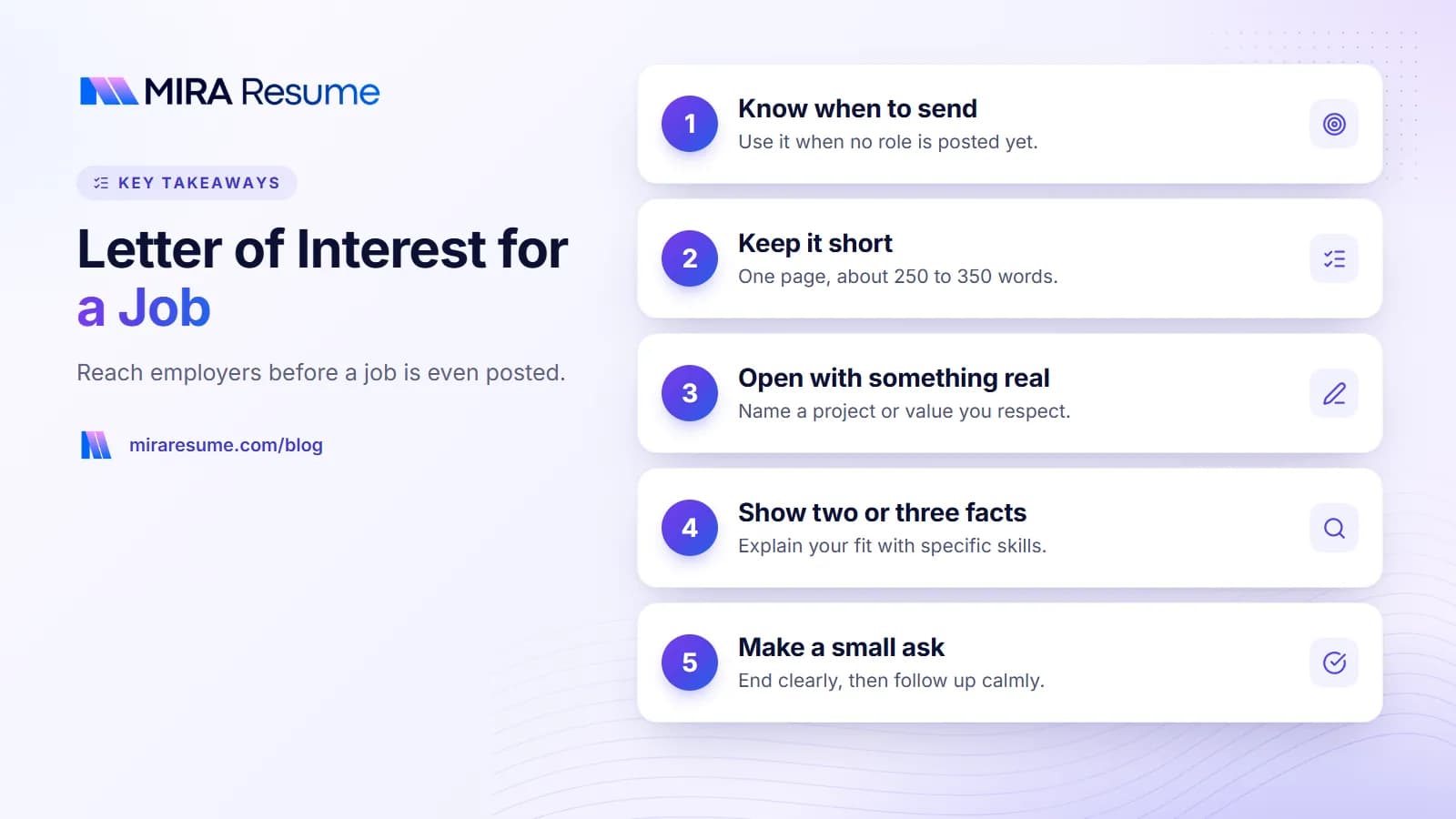
Many jobs are filled without ever being posted, or are posted only after someone leaves. A letter of interest lets you introduce yourself before that happens. It also works when a company you admire has no open role today but may have one soon.
Send one when:
- You want to work at a specific company or school and see no matching opening.
- You met someone at an event or through a contact who said to reach out.
- You want to ask about internships, part-time work or seasonal work.
- You are changing fields and want to ask about entry points.
Do not send one when a job is posted. In that case, write a standard cover letter. Our guides on how to write a cover letter and cover letter vs resume explain the difference.
Letter of interest vs cover letter vs letter of intent
| Letter | When you use it | Main goal |
|---|---|---|
| Letter of interest | No job is posted, or you want to ask about future roles | Start a conversation and be remembered |
| Cover letter | You are applying for a listed job | Show you fit that job |
| Letter of intent | You are stating a plan, such as a school plan or a formal commitment | Share your purpose and plans; see letter of intent format |
The terms overlap in daily speech, so check what the reader asks for. A short, specific note is welcome in most cases.
How to write a letter of interest for employment
Keep it to one page, and aim for 250 to 350 words. Use five short parts.
- Opening. Say who you are, why you are writing and why this company. Name something real about them, such as a project, product or value you respect.
- Your fit. Give two or three facts about your skills and results that match their work.
- What you offer. Say the kind of role you want and how you could help.
- The ask. Request a short conversation or ask to be considered for future roles.
- Close. Thank them, say your resume is attached and share your contact details.
Find a real person to address. Look at the company website or professional networks for the hiring manager, department head or recruiter. If you cannot find a name, read how to start a cover letter for safe greetings.
Research before you write
- Read the company's about and news pages.
- Note one recent project, product, or goal.
- Check the team page to find the right person.
- Look at past job posts to see the language they use for roles like yours.
The research shows effort. Even one specific line can set your letter apart from a copy-paste message.
Format details
Use a simple business format with your contact details, the date, the reader's name and company, a greeting, short paragraphs and a sign-off. Our guide to how to format a cover letter covers spacing and fonts, and the same rules apply here.
Letter of interest for job sample (general)
Use this as a pattern and replace the brackets with true details.
Dear [Hiring Manager Name],
I am writing to share my interest in joining [Company] as a [type of role]. I have followed your work on [specific project or product] and admire how your team [specific thing you respect].
For the past [X] years, I have worked as a [job title] at [employer], where I [key duty] and [result you can support]. I am comfortable with [skill or tool] and enjoy [type of work].
I understand you may not have a posted opening right now. If a role in [department or area] opens, I would be glad to be considered. I would also welcome a short call to learn how your team works and where I could help.
My resume is attached. Thank you for your time. You can reach me at [phone] or [email].
Sincerely,
[Your Name]
Notice the structure. It is short, it names the company's work, it gives one proof point and it makes a small ask. Large asks, such as "Please hire me", put pressure on the reader. A request for a short chat is easier to say yes to.
Personalizing a sample without sounding fake
Swap in a detail that only a real fan would know: a feature you used, an article you read, a program you admire. Avoid flattery that could be written about any firm. If you cannot find a real reason, do more research or pick another company.
Letter of interest example for internship
Students often send a letter of interest when a company has no posted internship. Keep it just as short, and lean on school work, clubs and skills.
Dear [Name],
I am a [year] student studying [major] at [school], and I am writing to ask about internship opportunities at [Company]. I have followed [project, product or news] and would love to learn from your team.
In my [class, club or project], I [action and result]. I also [second example], which helped me build skills in [skill 1] and [skill 2].
I am available for an internship from [month] to [month] and can work [hours or schedule]. If you have a role now or expect one later, I would be grateful to be considered. I am also happy to talk for fifteen minutes about what you look for in interns.
Thank you for your time. My resume is attached.
Sincerely,
[Your Name]
[Phone] | [Email]
Pair the letter with a strong student resume. See our internship resume and student resume examples. For a more formal letter, the internship application letter sample and the IT internship cover letter sample show other styles.
Sample for a career changer
If you are moving from one field to another, keep the focus on skills that carry over and your reason for the change.
Dear [Name],
After [X] years in [old field], I am moving into [new field] and am very interested in [Company]. Your work on [specific thing] caught my attention because [honest reason].
In my current role as [title], I [skill that transfers] and [second skill]. I have also completed [course, project or certificate] to build skills in [new area].
I would value a short conversation about entry roles on your [team] and what skills matter most. If a position opens, I would like to be considered. My resume is attached.
Thank you,
[Your Name]
Pair this with a skills-first layout, see skills-based resume, and refer to transferable skills examples for ideas.
What to attach and what to leave out
- Attach your resume as a PDF with a clear file name.
- Do not attach a long portfolio. Link to one page if needed.
- Do not include salary requests.
- Do not send references unless they ask.
You can build a clean PDF resume with the resume builder. If you want to see how scanners read it, try the ATS checker.
Tips to get a reply, and how to follow up
Even a good letter may not get an answer right away. Hiring teams are busy, and not every message reaches the right desk. A calm follow-up helps.
| Step | When | What to do |
|---|---|---|
| Send the letter | Weekday morning | Email with a clear subject, such as Interest in [type of role] at [Company] |
| First follow-up | About one to two weeks later | A two-line reminder that repeats your interest and attaches the resume again |
| Second follow-up | About two weeks after that | One more polite note, or try another contact at the company |
| Stop | After two follow-ups | Move on and keep the door open for later |
For wording, see follow up on job application. If you do get a call, our follow-up email after interview and thank you letter after interview help you finish well.
Subject line ideas
- Interest in [role type] at [Company]
- [Your Name]: [Role type] interested in [Company]
- Question about future [department] openings
Where a letter of interest works best
A letter of interest does not suit every industry the same way. It tends to work better in places where hiring is personal and teams are small.
- Small and mid-sized companies, where one manager may read every message.
- Schools, nonprofits and local groups, which often hire for roles that are never widely advertised.
- Growing teams, where a role may open next month even though nothing is posted now.
- Seasonal work, where managers build a list of people to call before the busy season.
In very large companies, your note may land in a general inbox. In that case, also watch the careers page and apply when a role appears. A letter is a bonus, not a replacement for a formal application.
Keep a simple tracking list
Write down each company you contact, the date, the person and the follow-up date. A basic list in a notes app or spreadsheet is enough. It stops you from sending the same message twice and helps you follow up at the right time. This habit also makes it easier to personalize each note, which readers notice.
Common letter of interest mistakes
- Writing to "whom it may concern". Find a name when you can.
- Sending a long essay. One page is the limit.
- Talking only about yourself. Say what you could do for them.
- Generic praise. One specific detail beats five vague compliments.
- Asking for a job directly. Ask to be considered or for a short call.
- Typos. Read it twice and out loud.
- Forgetting the resume. Attach it and mention it.
Need help with the closing lines? See how to close a cover letter. To make your attached resume strong, try our AI resume builder and then check wording yourself. You can also browse cover letter examples and cover letter templates for more layouts.
A quick checklist before you hit send
Run through this list, then send.
- Is the reader's name and title correct?
- Does the first paragraph name something specific about the company?
- Do you show two or three facts about your skills?
- Is the ask small and clear?
- Is it under one page?
- Is the resume attached as a PDF?
- Are your phone number and email in the closing?
- Have you checked spelling and company names?
Honest, short letters are remembered. Even if there is no job today, you may be the first person they think of when one opens.