
A software engineer cover letter has a simple job: tell the reader why your work fits their team, using facts, not buzzwords. Engineers often skip the letter, which makes a clear one a quiet advantage. It does not need to repeat your resume. It should explain what you built, how you think and why you want this particular job.
Below you will find a four-paragraph structure, three samples (experienced, entry-level and career changer), a keyword table and a list of common mistakes. Replace every [bracket] with your own true details. For the resume side, see our software developer resume page.
Do software engineers still need a cover letter?
Many engineering job posts do not require one, but when the application form has an optional field, a short letter can help. Hiring managers often read letters when they have to choose between similar resumes. A letter also lets you explain things a resume cannot, such as a career change, a gap or why you picked this company.
Skip a letter only when the post says not to send one. Otherwise write a short one. If you have never written one, read how to write a cover letter first, then come back.
What engineering managers look for
- Clear thinking and clear writing
- Work you actually built and can explain
- Interest in the product or problem, not only the title
- Signs that you work well with others
- Honesty about what you know and what you are learning
A cover letter is a small writing sample. Since engineers write documents, tickets and code reviews every day, a tidy letter is a good signal. The related pages on the engineering cover letter and computer science resume may also help.
Software engineer cover letter format: four short paragraphs
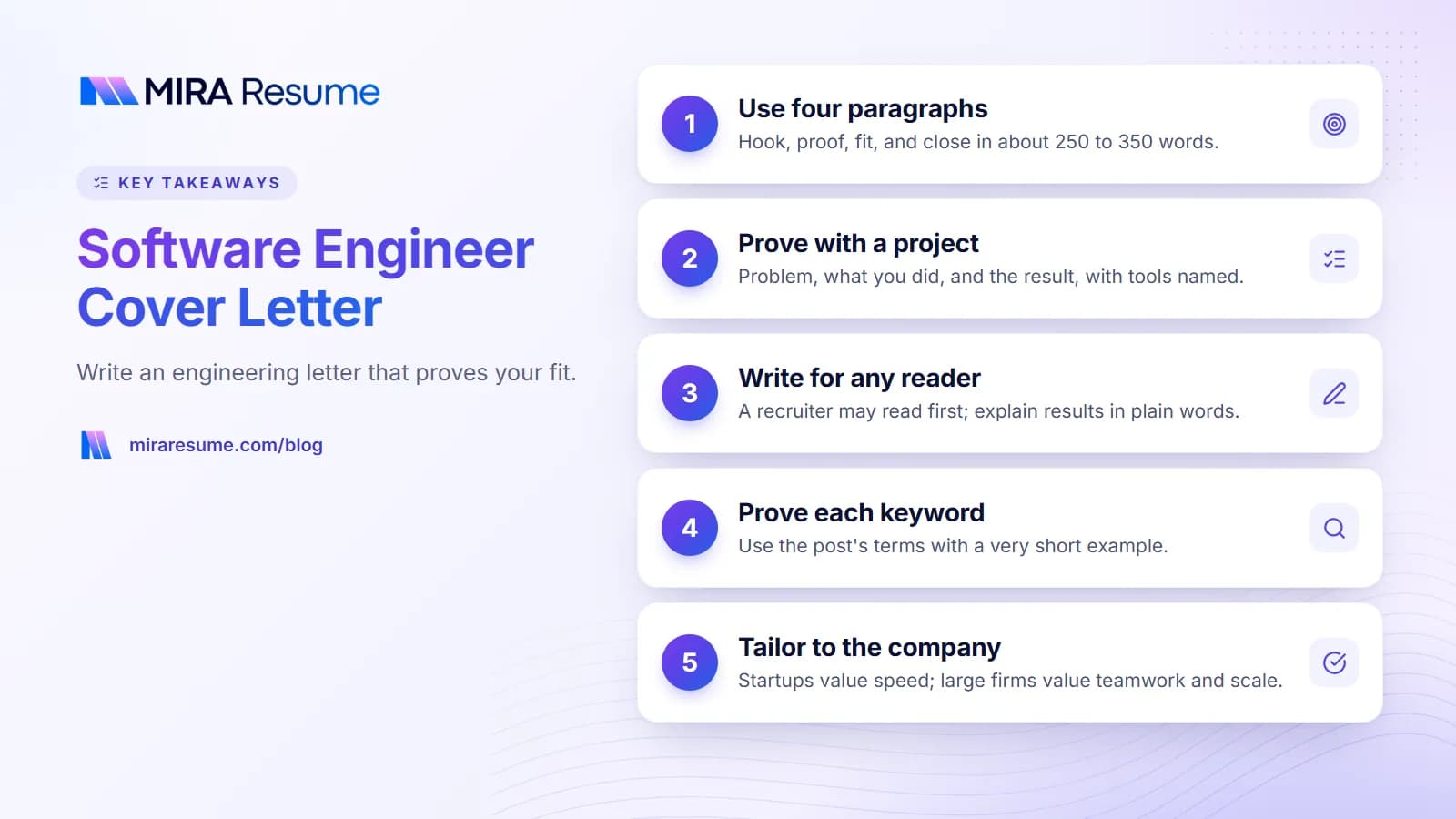
Keep the letter to one page and about 250 to 350 words. Use this order.
- Hook. Name the role and one reason you want to work on this product or team. Be specific.
- Proof. Describe one project in three parts: the problem, what you did and the result. Name the tools you used.
- Fit. Link a second skill or habit to the team's needs, such as testing, code review, documentation or working with design.
- Close. Say you would like to talk, mention your resume and any links, and thank the reader.
Place your contact details at the top in a simple header. Our guide to the cover letter header shows the right order, and how to format a cover letter covers spacing and fonts. For links, you can add a repository or portfolio. See how to put LinkedIn on a resume.
Keep the technical level right
The first reader may be a recruiter, not an engineer. Write so that both can follow. Name your tools, but explain the result in plain words. For example, "I rebuilt the checkout page in [framework], which made it faster for shoppers" works for any reader.
Software engineer cover letter examples
These samples are illustrative. Use the shape, not the words, and keep only what is true.
Example 1: Experienced engineer
Dear [Hiring Manager Name],
I am applying for the [Job Title] role at [Company]. I have used [product or service] and admire how it [specific, true detail]. The post mentions [problem or technology], which is close to what I have built over the past [X] years.
At [current employer], I led work on [project], using [languages and tools]. The old system was [problem]. I [what you did], and the result was [result you can support, such as faster pages, fewer support tickets or simpler deployments].
I like working with product and design early, writing clear tickets and reviewing code kindly. I also mentor [number] junior engineers and enjoy helping teams ship steadily.
I would welcome a chance to talk about how I can help your team. My resume and [repository or portfolio link] are attached. Thank you for your time.
Sincerely,
[Your Name]
Example 2: Entry-level or new graduate
Dear [Hiring Manager Name],
I am a recent [degree] graduate from [School] and I am excited to apply for the [Job Title] role at [Company]. I use [product] often, and I enjoyed reading your engineering write-up about [topic].
In my final-year project, my team of [number] built [app or tool] using [languages and tools]. I wrote the [part you built], added [tests or feature] and fixed [issue] after feedback from users. The project is on [repository link], and I would be glad to walk you through it.
I also completed an internship at [company], where I [task] under the guidance of [role]. I learn fast, ask good questions and write code others can read.
Thank you for considering my application. I would love to talk about the role.
Sincerely,
[Your Name]
Example 3: Career changer
Dear [Hiring Manager Name],
After [X] years in [old field], I moved into software through [bootcamp, degree or self-study]. I am applying for the [Job Title] role at [Company] because [honest reason].
My old work taught me [transferable skill, such as clear communication with clients or careful handling of data]. In my new work, I built [project] using [tools], which [result or feature]. You can see it at [link].
I know I am early in my engineering career, and I am ready to learn from your team. I would value a conversation about the role.
Thank you,
[Your Name]
If you are applying for an internship, our IT internship cover letter sample is shaped for that stage, and cover letter with no experience helps if you have little work history.
Keywords and what to prove with them
Use the post's exact terms when they are true for you. Then prove each term with a very short example.
| Keyword | What it signals | How to show it in one line |
|---|---|---|
| Languages and frameworks | You can work in their stack | Built [feature] with [language/framework] |
| Testing | You care about quality | Added [type of tests] that caught [issue] early |
| Code review | You work well with others | Reviewed [number] pull requests a week and shared clear feedback |
| Performance | You improve systems | Cut [load time or cost] on [service] by [number you can support] |
| Collaboration | You work across roles | Worked with design and product to ship [feature] |
| Documentation | You help future teammates | Wrote setup notes that cut onboarding time for new hires |
| Cloud and deployment | You can ship | Set up [pipeline] to deploy [service] on [platform] |
Do not list every tool you have touched. Choose the ones in the post and those you know well enough to discuss in an interview. For a longer list of words that work in letters, see cover letter keywords.
Before and after: stronger sentences
Small edits make a big difference. Here are common weak lines and better versions.
| Weak line | Better line |
|---|---|
| I am passionate about technology. | I spent my last three weekends building [small project] because I wanted to learn [skill]. |
| I have strong problem-solving skills. | When [problem] slowed our releases, I traced it to [cause] and fixed it with [approach]. |
| I am a team player. | I pair with teammates on tricky bugs and leave clear review comments. |
| I am a fast learner. | I picked up [tool] in [timeframe] to ship [feature] on schedule. |
| I would be a great fit. | Your post asks for [skill]. I used it daily at [employer] to [result]. |
Each better line gives the reader something to picture. Use this approach for every paragraph in your letter, and cut any sentence that could appear in anyone's letter. If you need help with action words for your resume, see action verbs for resume.
Showing projects without long links
One link is enough. Pick your best repository, demo or write-up and make sure the page loads and the readme is clear. A tidy project with a short description beats a long list of unfinished ones.
Tailoring your letter to a company
Engineering teams care about different things. A small startup may want someone who learns quickly and wears many hats. A large company may care about process, scale and teamwork. Read the post and the company site, then choose your examples to match.
- Startup: show speed, ownership and range.
- Large company: show collaboration, testing and care for scale.
- Agency or consulting: show client communication and quick delivery.
- Product company: show interest in users and the product itself.
Look for one real detail to mention: a blog post, a product feature, an open-source project or the way they describe their culture. One specific line is enough. If you cannot find anything honest to say, look at other companies first.
Match the letter to your resume
The letter and resume should tell the same story. Reuse key terms, but do not copy bullets. You can check your resume with the ATS checker and read how ATS works to see how scanners handle skills. Build or refresh your resume in the resume builder, and browse cover letter templates for a matching layout.
Sending it by email or through an application portal
Most engineers apply through a portal, a referral or a direct email. Each has small rules.
| Channel | What to do |
|---|---|
| Portal upload | Attach a PDF with a clear name, such as [FirstName]-[LastName]-Cover-Letter.pdf. Keep the layout plain. |
| Portal text box | Paste the body only, with no header block. Keep it under 300 words. |
| Email to a recruiter | Use a clear subject, a short note in the body and attach the resume and letter. |
| Referral | Thank the person who referred you, mention their name in the first line if they agree, and keep the letter short. |
A good email subject is: Software Engineer application, [Your Name]. If a friend referred you, add their name: Referred by [Name]: Software Engineer application.
A short email you can paste
Hello [Name],
I am applying for the Software Engineer role. I have [X] years building [type of product] with [main language and tools]. A recent highlight was [project and result].
My resume and cover letter are attached, and my work is at [link]. I would welcome a chance to talk.
Thank you,
[Your Name] | [Phone]
Follow up politely if you do not hear back. Our guide on follow up email when you haven't heard back includes timing and samples.
Common software engineer cover letter mistakes
- Listing every technology. Pick the few that matter to this job.
- Repeating the resume. Add context, the why and the story.
- Vague claims. "Improved performance" means little without scope.
- Exaggerating. Interviewers ask follow-up questions. Only claim what you can explain.
- Ignoring the company. A letter that could go to any employer reads like spam.
- Too long. Keep it to one page.
- Broken links. Test every link before you send.
- Typos in tool names. Check capitalization, such as JavaScript and GitHub.
For closing lines, see how to close a cover letter. After an interview, send a short note using thank you letter after interview. If you still need examples in other styles, the cover letter examples page has more.