
A computer science resume for a student or new graduate is built differently from a resume for a working engineer. You may not have much work history, and that is fine. Employers hiring for internships and entry-level roles look for proof that you can build things, learn fast, and explain your work in plain words.
This guide focuses on that early-career stage. It gives you a simple layout for students, a table of skills to include, project bullets you can adapt, and an example layout. If you already work as an engineer, our software developer resume page is a better fit.
The best computer science resume format for new grads
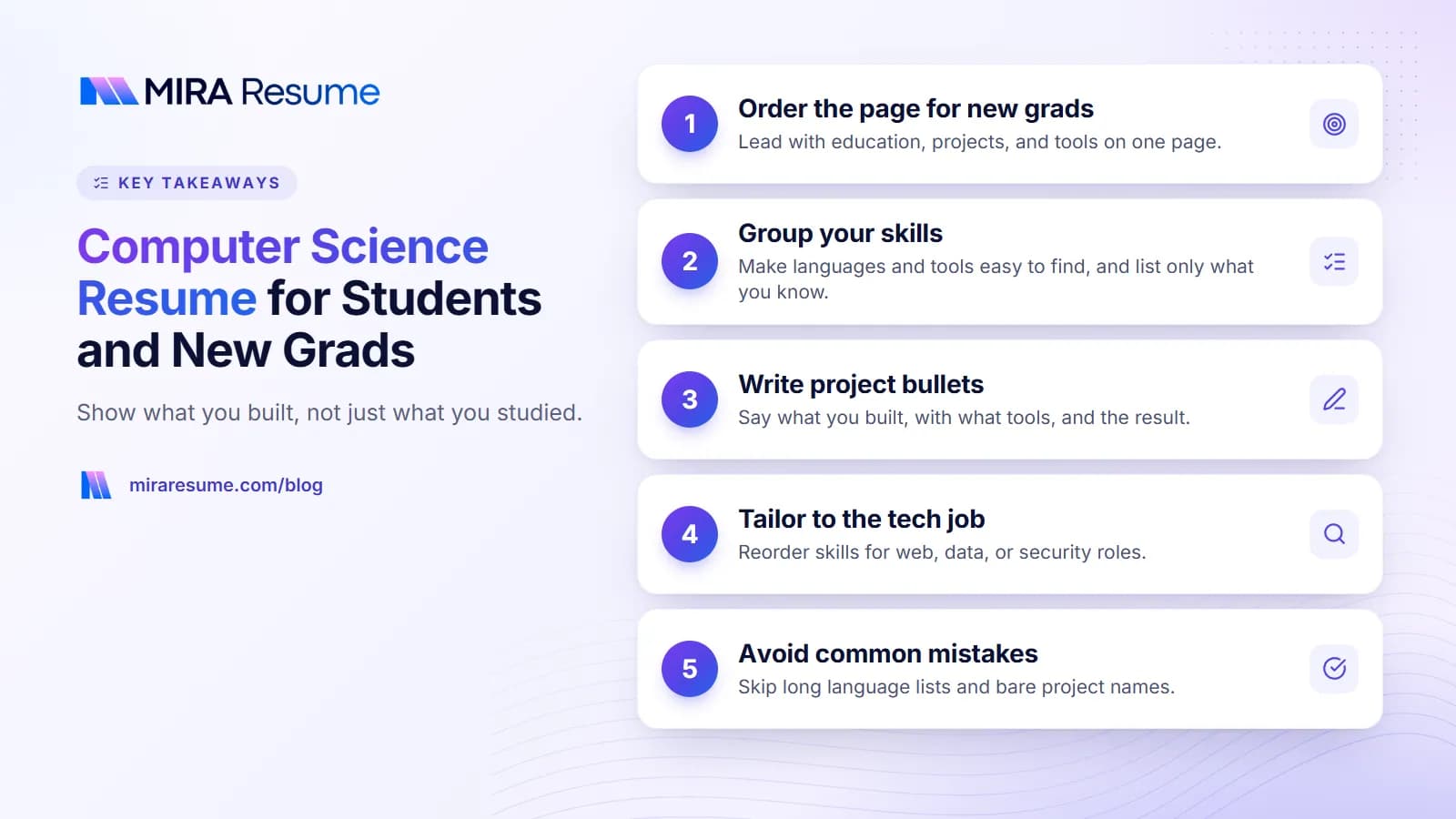
Recruiters in tech often scan a resume in under a minute, so order matters. For students and new graduates, this order works well.
- Header: name, email, phone, city, and links to GitHub, LinkedIn, or a portfolio.
- Education: degree, school, graduation date, and relevant courses.
- Technical skills: languages, tools, and platforms, grouped.
- Projects: 2 to 4 of your best, each with a short description and result.
- Experience: internships, research, part-time jobs, and teaching assistant roles.
- Extras: hackathons, clubs, awards, and certifications.
Why projects come before work history
If you have little paid experience, projects are your proof. If you have a strong internship, swap the order and place Experience first.
Layout rules
- One page. Two pages only after several years of work.
- One column, normal fonts, plain bullets. Hiring software can scramble fancy layouts. See our ATS resume scanner guide for what goes wrong.
- Use real links, written out, such as github.com/yourname.
- Skip photos, ratings bars, and a "references available" line.
For tips on page length, read how many pages a resume should be.
Skills to list on a computer science resume
Group your skills so a quick reader can find what they need. List only tools you can talk about in an interview.
| Group | Examples | Advice |
|---|---|---|
| Languages | Python, Java, JavaScript, TypeScript, C, C++, SQL | Put your strongest first. Add "familiar" ones only if you could do a simple task in them. |
| Web and apps | HTML, CSS, React, Node.js, REST APIs, Android | Match to the job post |
| Data and databases | PostgreSQL, MySQL, MongoDB, pandas | Show use in a project |
| Tools and platforms | Git, GitHub, Linux, Docker, VS Code, AWS, Google Cloud | Name the specific services you used |
| Concepts | Data structures, algorithms, object-oriented design, testing, version control | Show them inside bullets, not only in the list |
| Working skills | Agile teams, code review, documentation, technical writing | Prove with a project or club example |
Skill levels: be honest
Avoid star ratings or percent bars. They tell the reader nothing and do not read as text. A sorted list is better. If you must show levels, use "Proficient" and "Familiar" in words.
Match the posting
If an internship post asks for Python and SQL, make sure those words are easy to find if you know them. Our job analyzer can pull out the key terms from a post, and the guide on skills to put on a resume explains how to choose.
How to write project bullets that show real skill
A project is only as useful as your description of it. Write what you built, how you built it, and what happened. Here is a simple pattern.
Built [what] using [tools] to [purpose], which [result].
| Vague line | Clear line |
|---|---|
| Made a website for a class | Built a course-schedule web app with React and a Node.js API that lets students compare timetables; used by about 30 classmates during registration |
| Worked on a team project | Led a team of four in building a budgeting app, splitting tasks in GitHub issues and reviewing every pull request before merging |
| Used Python for data | Cleaned a public dataset of 50,000 rows with pandas and built charts that showed seasonal trends in bike rentals |
| Wrote a game | Created a 2D puzzle game in Java with 12 levels and a save system, and fixed three bugs found by playtesters |
| Studied algorithms | Implemented search and sorting algorithms from scratch and compared their speed on lists of different sizes |
These examples are illustrations. Use your own real projects, numbers, and tools, and never list work you did not do.
What to include for each project
- A project name and a one-line purpose.
- Tech stack in words the job post uses.
- One or two bullets with actions and results.
- A link to the code or live demo, if public and clean.
Clean up your GitHub first
Recruiters may click your link. Pin your best repositories, add a short README for each that explains what it does and how to run it, and remove half-finished or private-looking clutter.
For starting words, see action verbs for resume. You can also try the AI bullet enhancer to smooth wording, then check it matches what you did.
Computer science resume example: a one-page layout
This example uses an invented student. Use it only for structure.
Alex Kim
City, State | [email protected] | 555-555-0188 | github.com/alexkim-example | linkedin.com/in/alexkim-exampleEducation
B.S. in Computer Science, Example State University, expected May 2027
Relevant courses: Data Structures, Algorithms, Databases, Operating SystemsTechnical Skills
Languages: Python, Java, JavaScript, SQL
Tools: Git, Linux, Docker, React, PostgreSQLProjects
Study Planner (React, Node.js, PostgreSQL)
- Built a web app that turns course deadlines into a weekly plan; about 30 classmates tested it
- Wrote automated tests for the API and fixed five bugs before release
Campus Bike Share Analysis (Python, pandas)
- Analyzed 50,000 ride records and presented findings to a student clubExperience
IT Help Desk Assistant, Example State University, 2025 - Present
- Resolved about 15 support tickets per week for students and staff, writing clear steps in the ticket notes
Why it works
- It fits on one page and has no graphics.
- Every project has a stack, a purpose, and a result.
- The non-coding job still adds value, because it shows communication and reliability.
Need a clean frame? Browse our resume templates or start from the AI resume builder and add your own content.
Entry-level vs. experienced: how the resume changes
As your career grows, the resume shifts from "what I learned" to "what I delivered."
| Part | Student or new grad | 1 to 5 years in the field |
|---|---|---|
| Top section | Education | Experience |
| Main proof | Projects, internships, coursework | Shipped features, systems, and team impact |
| Skills style | Languages and tools grouped | Skills tied to work done, kept short |
| Summary | Optional; often skipped | 2 to 3 lines on focus area |
| Length | One page | One page, sometimes two |
Internship resumes
For an internship, list relevant courses and your expected graduation date. Hiring managers need to know when you can start and when you will finish. If you are applying for a first tech internship, our IT internship cover letter sample can pair well with your resume.
Switching into tech from another field
Career changers should lead with a short summary and a skills-and-projects section, followed by earlier work. Show how your old job built problem-solving or teamwork skills.
What about research and teaching?
Research assistant and teaching assistant roles count as real experience. Name the lab or course, the tools, and what you handled, such as grading for a class of 60 students.
Certifications, courses, and degrees: what to say
Computer science hiring varies a lot. Some employers want a degree, others focus on skills and projects. Read each post, because requirements differ by employer and country.
Degree
List your degree, major, school, and graduation date, or expected date if you are still studying. Add GPA only if it is strong (often 3.5 or above) and requested or helpful. Relevant courses help when your experience is limited.
Certifications and online courses
- Cloud certifications from major providers can help for cloud-related roles.
- Online course certificates show interest but carry less weight than projects. Include only those linked to the job.
- Bootcamp certificates are fine to list; describe the projects you built there.
Honest wording
Write "In progress" for anything you have not finished. Do not claim a certification you hold only in part, and do not copy code or projects you did not write.
Tailor your resume to the kind of tech job
"Computer science" covers many careers. A web internship, a data role, and a security job all value different pieces of your background. Change the order of your skills and projects to match the job.
| Target role | Move to the top | Project ideas that fit |
|---|---|---|
| Web or app development | JavaScript, React, APIs, databases, Git | A working site with login, data storage, and a live link |
| Data analysis or data science | Python, SQL, statistics courses, charts | A cleaned dataset with questions asked and answered |
| Software engineering (general) | Data structures, algorithms, testing, one main language | A tool with tests, clear README, and code reviewed by peers |
| IT support or systems | Operating systems, networking basics, troubleshooting | A home lab or help desk experience described with real tasks |
| Security | Networking, Linux, scripting, capture-the-flag events | A write-up of a lab you completed, with your own notes |
Hackathons and clubs
List hackathons by name and year with one line on what you built. If you led a club or ran a workshop, add it. These show initiative and communication, two skills technical teams want from new graduates.
Open source and personal work
Small contributions to open source projects, such as fixing documentation or a minor bug, are good to mention if you can link to them. Do not exaggerate. A line like "Fixed a documentation error in a public library" is honest and still shows you can work with other people's code.
Describe teamwork carefully
If you worked in a group, say what you built. "Built the login system for a four-person team project" is better than "We made an app." Interviewers often ask follow-up questions, so be ready to explain your part in detail.
Link your resume to your story
Your resume and your cover letter should agree. If you are applying for an internship and want a short, clear letter, read our cover letter with no experience guide, which works well for students.
Common computer science resume mistakes
- Listing every language you have touched. Fifteen languages with no depth look weak. Choose your strongest six or so.
- No explanation of projects. A project name alone proves nothing.
- Skill bars and icons. They do not carry meaning, and text may not be readable by software.
- Dead or messy links. Test every link before you send.
- Burying education. For students, education belongs near the top.
- A two-page resume as a student. Cut weaker items.
- Same resume for every job. Move the most relevant project and skills up for each post.
Many large employers use hiring software to sort applications. Our plain-English guide on how ATS works explains what to expect.
Check your resume before you submit
- Copy the job post and mark the languages, tools, and tasks it names.
- Move matching projects and skills higher on your page.
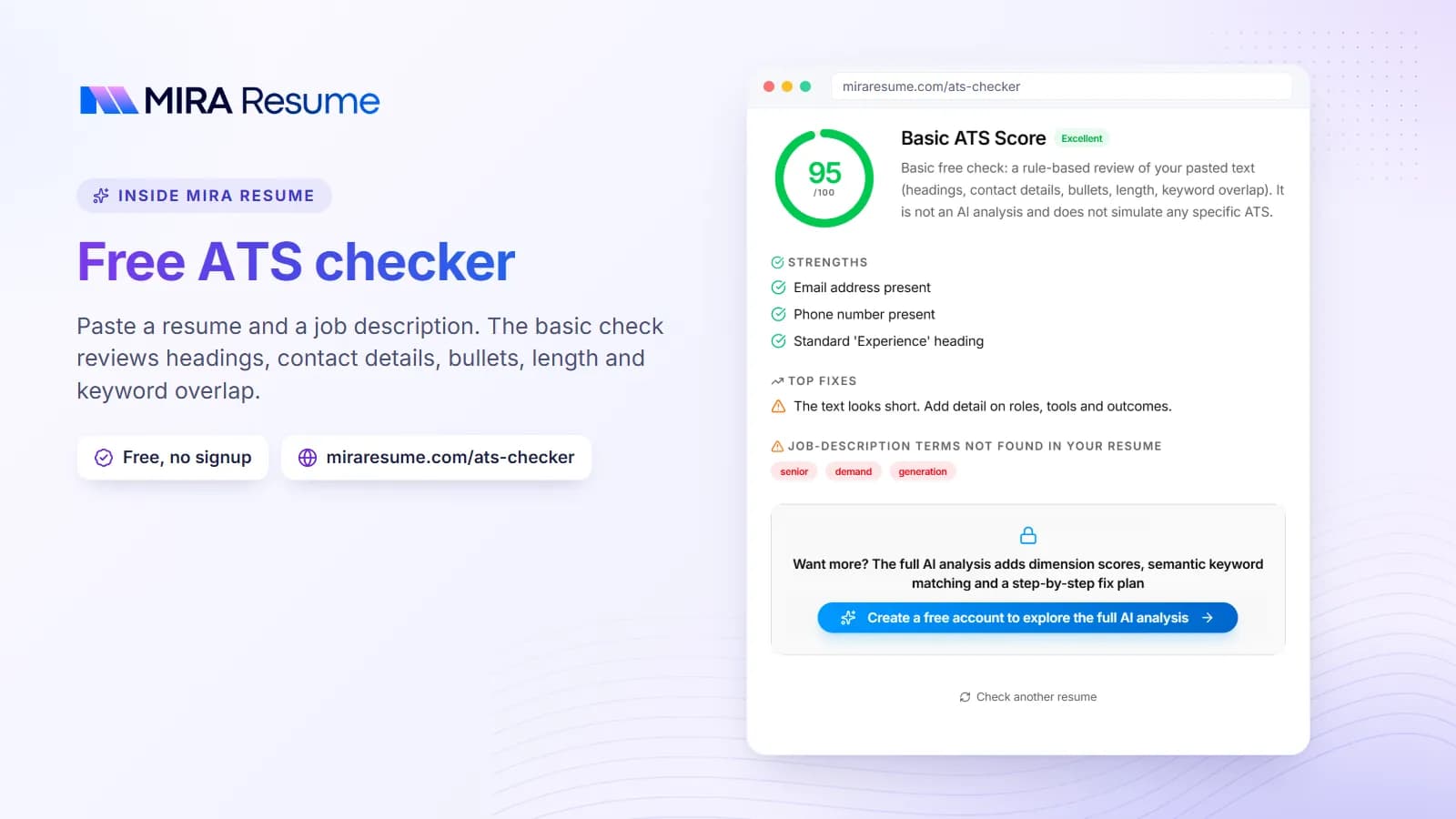
- Run the file through the free ATS checker with the job description to catch missing keywords and layout problems.
- Ask a friend or a career center to read it for clarity.
- Save as a text-based PDF and name it clearly, such as Alex-Kim-Resume.pdf.
No tool can promise an interview. A clear page of true, specific work gives your skills the best chance of being noticed.