
Waiting is the hardest part of a job search, and sending a follow up email when you haven't heard back is a normal, polite step. A good one is short, friendly and useful. It repeats your interest, gives the reader an easy way to answer and never sounds angry or pushy.
Below you will find simple timing rules, a table of subject lines, and five copyable emails for different moments: after applying, after a first call, after an interview, after a deadline, and as a last note. Replace each [bracket] with your own details.
Is it okay to follow up on a job application?
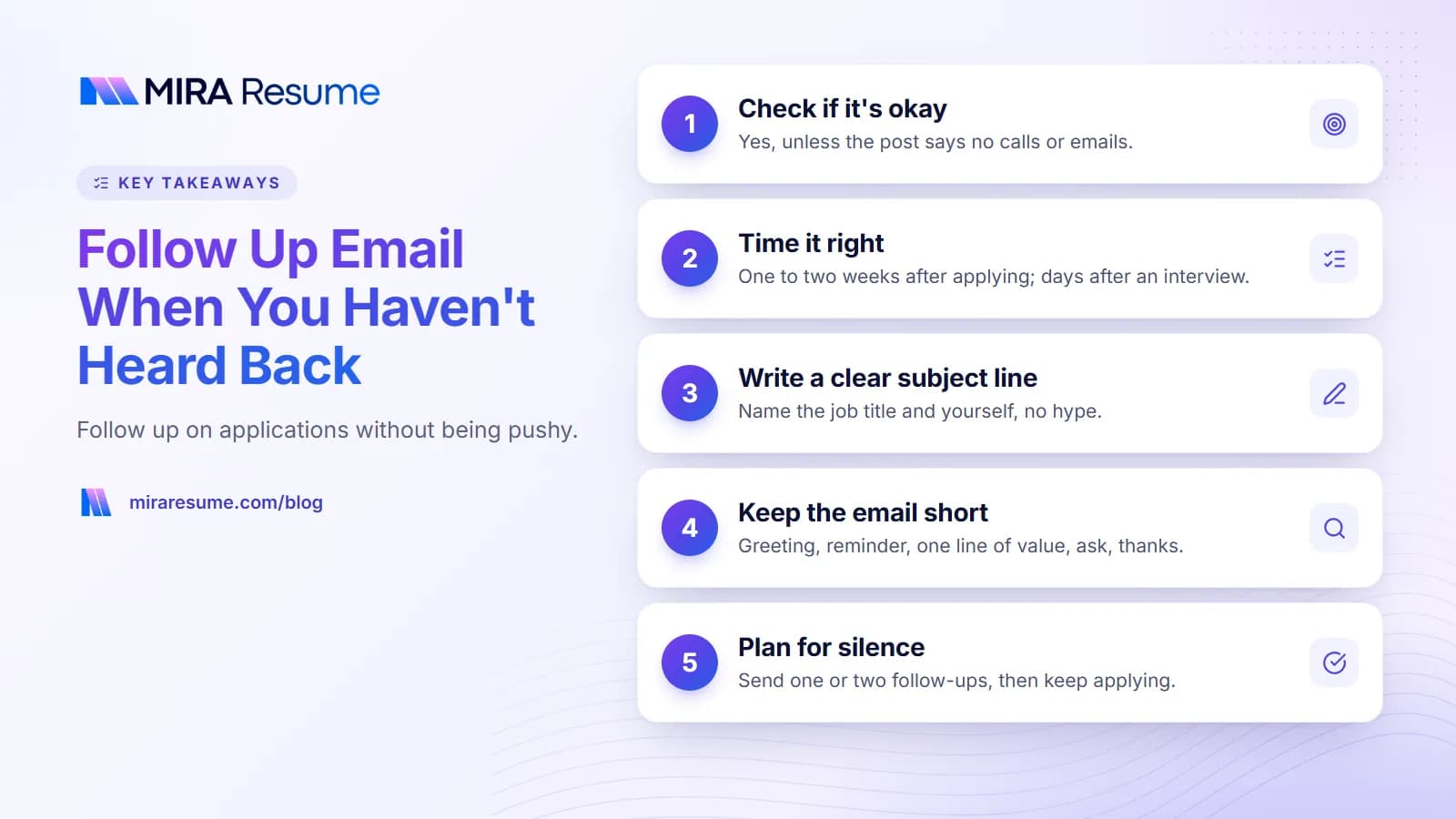
Yes. Hiring teams are busy, applications get buried, and a polite note can bring yours back to the top. A follow-up shows interest and good manners. The only time you should hold off is when the post says "no calls or emails". In that case, respect the request.
A follow-up will not rescue a weak application, and it cannot guarantee a reply. Still, it costs little and sometimes helps. Keep your expectations realistic and your tone calm.
What a good follow-up does
- Reminds the reader who you are and which job you applied for
- Repeats one reason you fit the role
- Asks a small, clear question, such as the status or next steps
- Makes it easy to reply
Before you send anything, make sure your resume is strong. If you have not heard back from many applications, the problem may be the resume, not the lack of a follow-up. Try our resume checker or ATS checker, and read fix my resume for ideas.
When to send a follow up email: timing rules
Timing matters. Too early looks impatient. Too late looks careless. Use these simple guides, and always check what the job post or recruiter told you first.
| Situation | When to follow up | What to send |
|---|---|---|
| Applied online, no reply | About one to two weeks after applying, or after the closing date | A short status check |
| After a phone screen | If you were given no timeline, wait three to five business days | A thank-you plus a gentle check-in |
| After an interview | Send a thank-you within a day, then check in after the date they gave you | See follow-up email after interview |
| They said they would call by a date | One or two business days after that date | A polite reminder |
| Still no answer | About a week after the first follow-up | One final short note |
Stop after two follow-ups. More messages rarely help and can hurt. Send on a weekday, ideally in the morning, since inboxes are busiest then and your note stays near the top.
Who to send it to
Use the recruiter or hiring manager if you know their name. If you do not, look at the job post, the company website or professional networks. If you cannot find a person, send to the contact listed in the post or to a general careers address. Keep the tone friendly and avoid blaming anyone for delays.
Subject lines that get opened
Your subject line should say who you are and why you are writing in a few words. Skip all caps, hype and tricks.
| Moment | Subject line |
|---|---|
| After applying | Following up: [Job Title] application, [Your Name] |
| After a phone call | Thank you and next steps: [Job Title] |
| After an interview | Thank you for your time, [Job Title] interview |
| Past the promised date | Checking in on [Job Title] decision |
| Final note | Still interested in [Job Title] at [Company] |
If you are replying to an earlier message, keep the same subject line with "Re:" so the reader can find the thread. That keeps your history in one place.
Follow up email samples you can copy
Each sample is short. Replace brackets and keep only what is true.
1. After applying online, no response
Subject: Following up: [Job Title] application, [Your Name]
Hello [Name],
I applied for the [Job Title] role on [date] and wanted to confirm that you received my application. I am very interested in the position, especially the chance to [specific part of the job].
My background in [skill or experience] fits the needs listed in the post. If you need anything else from me, I am happy to send it.
Thank you for your time.
[Your Name] | [Phone] | [Email]
2. After a phone screen with no update
Subject: Checking in: [Job Title]
Hello [Name],
Thank you again for speaking with me on [date] about the [Job Title] role. I enjoyed learning about [topic]. I am still very interested and wanted to ask whether there is an update on next steps.
Please let me know if I can share anything else.
Best,
[Your Name]
3. After an interview and the promised date has passed
Subject: Checking in on [Job Title] decision
Hello [Name],
I hope your week is going well. I wanted to follow up on the [Job Title] interview on [date]. You mentioned a decision by [date], so I wanted to check in on the timeline.
I remain excited about the role and the chance to [specific contribution]. Thank you for your time and consideration.
Sincerely,
[Your Name]
4. Second follow-up, one week later
Subject: Re: Checking in on [Job Title] decision
Hello [Name],
I know hiring can take time, so I wanted to send one more note. I am still interested in the [Job Title] role. If it has been filled or the plan has changed, I would appreciate knowing so I can plan.
Thank you again.
[Your Name]
5. Final note that keeps the door open
Subject: Staying in touch, [Your Name]
Hello [Name],
Thank you for considering me for [Job Title]. If another role opens that fits my background in [skill], I would love to hear about it. I will keep an eye on your careers page too.
Best wishes,
[Your Name]
Follow up after an interview versus after applying
These two situations feel similar but call for different notes. After applying, you ask whether your application arrived and offer more information. After an interview, you thank the person, mention one thing from the talk and ask about the timeline.
- After applying: short, factual, one idea.
- After interviewing: warmer, with a specific detail from the conversation.
Our guide to the thank you letter after interview covers the first thank-you. The follow-up email after interview guide covers what to send later. If you are still preparing for the interview, remember to bring a clean copy of your resume.
If you applied through a form or portal
Many applications go into a system and are screened by software first. If you want to know how that works, read how ATS works and AI resume screening. Following up cannot fix a file that the software cannot read, so check that your PDF is text-based and uses standard headings.
If you know someone at the company
A short note to a contact can be more powerful than a message to a general inbox. Ask whether they can pass your name along, and make it easy by attaching your resume. Be polite and never pressure them.
How to write the email: tone, length and structure
You do not need clever words. You need a clear message that a busy person can read in ten seconds. Use this simple structure every time.
- Greeting. Use the person's name if you have it.
- Reminder. Name the job and the date you applied or interviewed.
- Value. Add one short line on why you are a fit or what you liked about the talk.
- Ask. Request an update or next steps.
- Thanks and details. Close politely with your phone and email.
| Do | Avoid |
|---|---|
| Write under 120 words | Long stories about your job search |
| Use a friendly, calm tone | Phrases like "I have not heard anything and this is unprofessional" |
| Offer to send more information | Attaching ten new files |
| Say you are still interested | Begging or asking for a favor |
| Check names and job titles | Using the wrong company name |
Plain English beats formal English
Write the way you would speak to a respectful colleague. Short sentences work best. Say "I wanted to check on the status" instead of "I am writing to inquire regarding the present status of my candidacy." If English is not your first language, a simple message with clear facts is perfectly fine.
What if the job is already filled?
Sometimes the reply is a no. Thank them for telling you, ask to be kept in mind for similar roles and move on. A gracious response leaves a good impression, and recruiters often return to candidates who were kind in a rejection.
What to do if you still hear nothing
Silence is common, and it is not always personal. Companies pause hiring, change plans or lose track of applicants. Here is a plan to keep moving.
- Send one or two follow-ups using the timing above.
- Keep applying to other roles. Do not wait for one answer.
- Update and test your resume. See how to update your resume.
- Reach out to a contact or alumni network for a warm introduction.
- Send a letter of interest to other companies you like.
- Track every application in a simple list with dates and next steps.
If your job search has been long, a personal check-in with a trusted friend can help your mood. When you do get an offer, or you decide to leave a role, our guides on how to resign from a job and two weeks notice email help you finish well.
Common follow-up mistakes to avoid
- Following up too soon. Give the team at least a week after applying.
- Writing long messages. Aim for under 120 words.
- Sounding annoyed. Never blame them for being slow.
- Sending many emails. Two is enough.
- Calling and emailing on the same day. Choose one channel at a time.
- Forgetting the job title. Recruiters handle many roles at once.
- Skipping proofreading. A typo in a follow-up undoes good work.
If a recruiter has asked you not to contact them, follow their instructions. Courtesy matters more than speed.
Make sure the application behind the email is strong
A follow-up email only works if the application deserves a second look. Before you send a note, spend a few minutes on the basics.
- Does your resume match the job post's main skills? Review resume keywords.
- Is it clean and easy to read? See how to format a resume.
- Did you include a cover letter if the post allowed one? Read how to write a cover letter.
You can build a new resume with the resume builder or browse resume templates if yours needs a refresh. The AI resume builder can suggest bullet wording. As with any AI tool, review the suggestions and keep only what is true. For cover letters, see cover letter templates.