Coming soon
Templates and Formats

Resume Format for Experienced Professionals: Layout, Length and Examples

The best resume format for experienced professionals: chronological or combination layout, two pages, how far back to go, and leadership bullets with numbers.

Mira Resume Editorial Team · Career content team Published Updated 9 min read
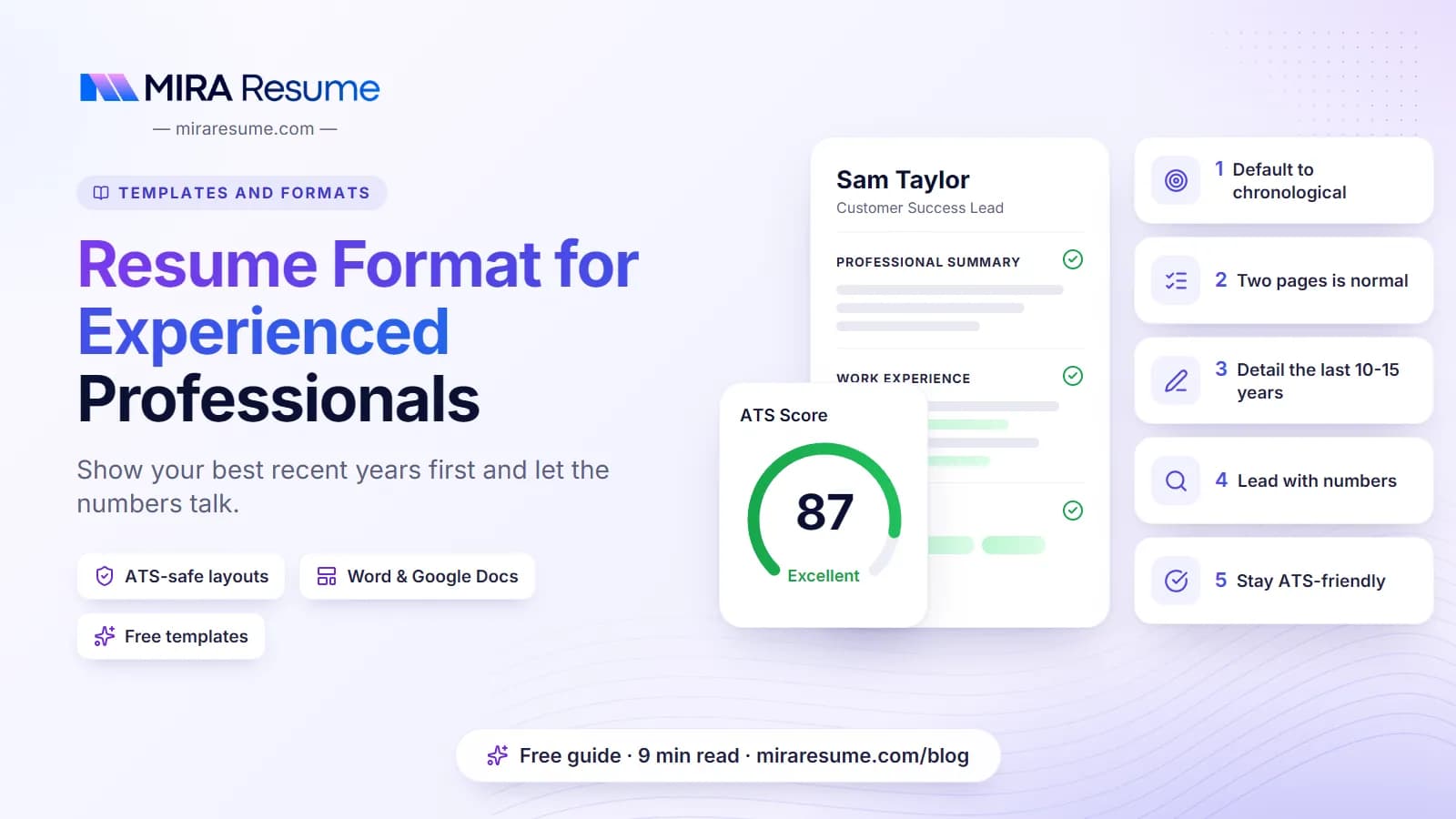
Resume Format for Experienced Professionals: cover image for the Mira Resume guide, with an example resume and the 5 main points

The right resume format for experienced candidates is not the one you used when you were starting out. After eight, twelve or twenty years of work, the problem is no longer filling a page. It is choosing what to leave out, so a recruiter can see your biggest results in the first few seconds.

This guide explains which layout works best once you have real depth (usually reverse-chronological, sometimes combination), how long the resume should be, how far back to go, how to summarize your early career, and how to write leadership achievements with numbers. It ends with a sample layout for a resume with 10 years of experience and a checklist to keep it ATS-friendly.

If you are early in your career, our guide to the resume format for freshers is a better fit.
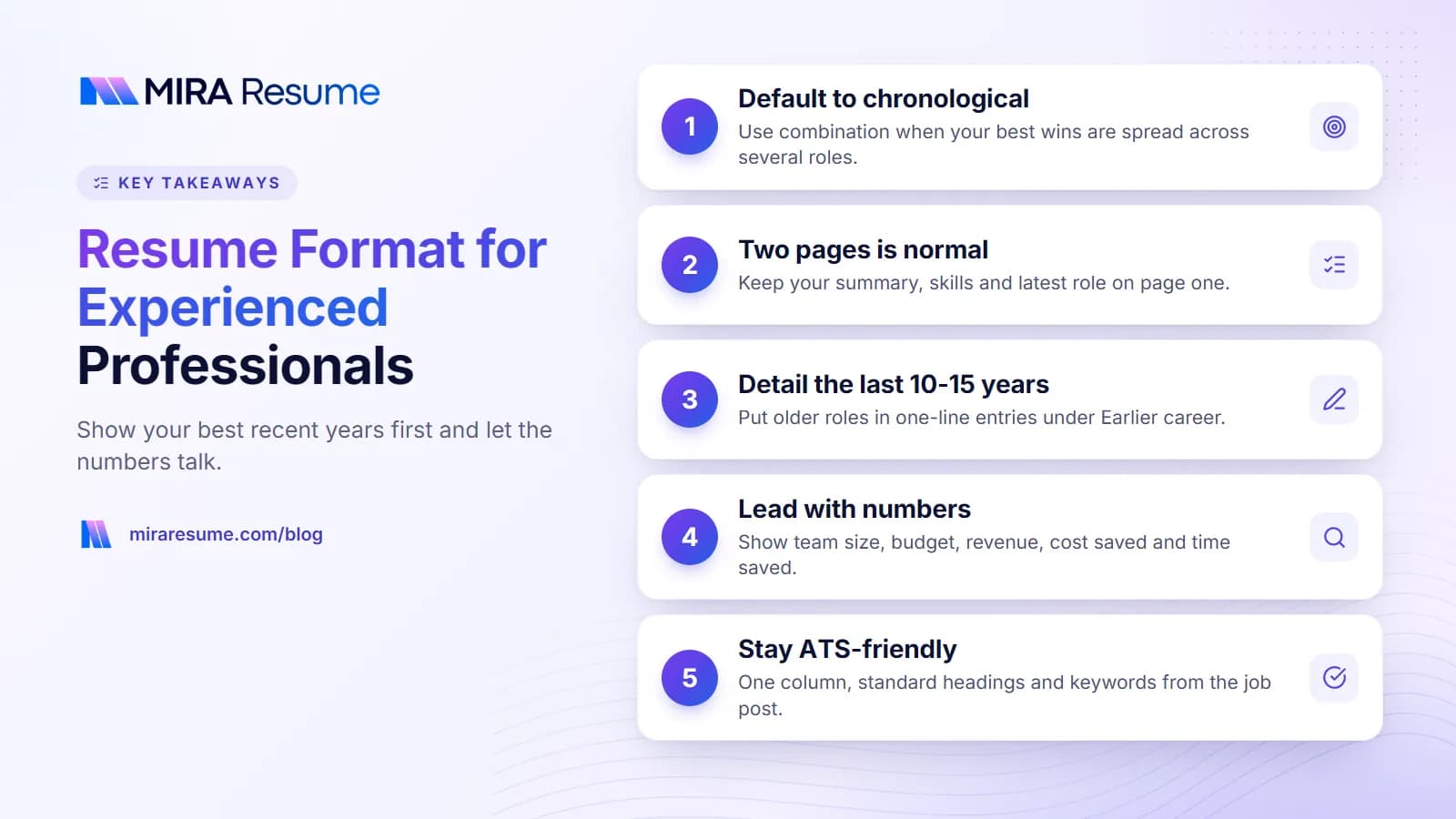
Key takeaways: 1. Default to chronological; 2. Two pages is normal; 3. Detail the last 10-15 years; 4. Lead with numbers; 5. Stay ATS-friendly
Key takeaways from this guide.

Which resume format works best for experienced professionals?

There are three classic resume formats. For most experienced people, the choice is really between the first two.

FormatHow it worksBest forWatch out for
Reverse-chronologicalJobs listed newest first, each with bulletsSteady progression in one field, most corporate rolesGaps and short stints are easy to see
Combination (hybrid)Summary and key achievements first, then dated work historySenior people with varied roles, consultants, moves into a related fieldCan run long; achievements must link back to real jobs
FunctionalSkills grouped by theme, little or no job historyRarely the right choice for experienced candidatesRecruiters may wonder what is missing, and software expects dates and employers

Reverse-chronological is the safe default. Recruiters know where to look, and the story of your growth is clear at a glance. Our chronological resume template shows the layout.

Combination works well when your best results are spread across several roles, or when you want a short "career highlights" block before your history. See our combination resume template for the full structure.

Functional resumes hide the timeline, which is the thing an experienced resume should show off. Our functional resume guide explains the narrow cases where it can still help.

A quick way to choose

  • Your last two or three roles are in the same field and show growth: use reverse-chronological.
  • Your strongest achievements are scattered across roles, or you are moving into a nearby field: use combination.
  • You are changing careers completely: use combination, and read our career change resume guide.

Section order for an experienced resume

This order works for most experienced resume templates, whether you choose chronological or combination.

OrderSectionWhat to include
1HeaderName, city, phone, email, LinkedIn. No full street address.
2Professional summaryThree or four lines: title, years of experience, specialty and one or two headline results
3Core skills8 to 12 skills or keywords from your target job posts
4Career highlights (optional)Three or four top achievements with numbers, mainly in a combination layout
5Professional experienceThe last 10 to 15 years in detail, newest first
6Earlier careerOne-line entries for older roles
7EducationDegree and school; the year is optional
8Certifications and trainingCurrent and relevant only
9Extras (optional)Board roles, publications, patents, languages, speaking

Skip the objective statement. At this stage, a summary that says what you have done is far more useful than a sentence about what you want. Our resume summary examples include several for senior roles.

How long should an experienced resume be?

Two pages is standard for most experienced professionals. It gives you room for a summary, a skills list and several detailed roles without asking the reader to dig.

  • One page can still work if you have fewer than about seven years of relevant experience, or if your target field values brevity.
  • Two pages suits most people with 8 to 25 years of experience.
  • Three pages is occasionally fine for senior executives, academics or highly technical roles, usually when a recruiter asks for more detail. US federal jobs have their own rules, covered on our federal resume page.

Whatever the length, page one carries the weight. Your summary, skills and most recent role should all sit there. If page two is only a few lines long, either tighten to one page or fill it with genuinely useful detail, not padding. Our guide on how many pages a resume should be has more on this.

How far back should your resume go?

A widely used guideline is to show the last 10 to 15 years in detail. Older roles still matter, but mainly as proof of a solid foundation, so they need far less space.

Total experienceShow in detailWhat to do with the rest
5 to 10 yearsAll relevant rolesOne or two bullets for the earliest job
10 to 15 yearsThe last 10 to 15 yearsOlder roles as single lines under "Earlier career"
15 to 25 yearsThe last 10 to 15 yearsGroup older roles; dates are optional
25 years or moreThe last 10 to 15 yearsA one-sentence summary of your early career

There are three reasons to trim. Relevance: what you did fifteen years ago rarely matches today's job post. Tools: software and methods change, and old ones can make you look out of date. Space: every line spent on 2005 is a line not spent on your biggest recent win.

Age discrimination is illegal in many countries (in the US, federal law protects workers aged 40 and over), but many experienced candidates still prefer to keep the focus on recent work and leave out graduation years. That is a personal choice. Whatever you decide, never change dates or titles to mislead, and give your full history honestly when an application form asks for it.

How to summarize your early career

You have two simple options for older roles: an "Earlier career" section with one line per job, or a short paragraph. Both keep employer names and titles visible, which helps background checks match your resume.

Earlier career
Senior Analyst, Corvale Logistics (fictional) | Analyst, Tamsin Freight Group (fictional)
Progressed from analyst to senior analyst in four years and built the demand forecasting model later used across the company.

A few rules make this section work:

  • Keep the job title and employer for every role, even if you drop the bullets.
  • Add one achievement only if it still supports your target job.
  • Dates are optional for roles older than about 15 years, but stay consistent within the section.
  • If you were promoted several times at one company, show the progression in a single entry. Our guide on how to show a promotion on a resume has layouts.
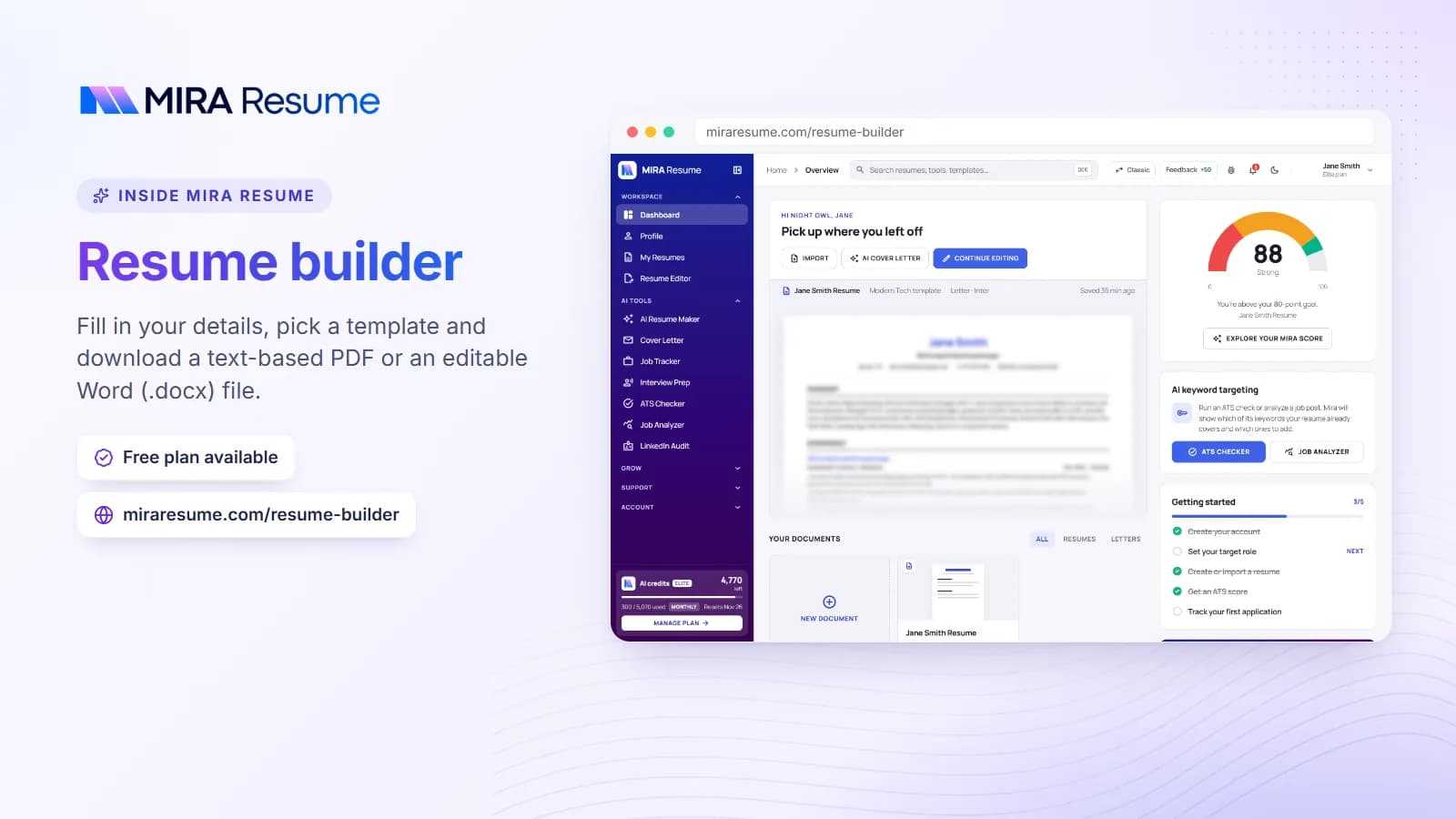
Screenshot of the Mira Resume resume builder (Fill in your details, pick a template and download a text-based PDF or an editable Word (.docx) file.)
Screenshot: Resume builder: Fill in your details, pick a template and download a text-based PDF or an editable Word (.docx) file.Try it

How to write leadership achievements with numbers

Experienced resumes are judged on results. The simplest formula is: action verb + what you led + scale + result. The examples below are made up to show the pattern; use your own real figures, round them honestly, and be ready to explain each one in an interview.

Weak (duty)Strong (achievement)
Responsible for a sales teamLed a 14-person sales team that grew regional revenue from $8.2M to $11.5M in two years
Managed budgetsOwned a $3.4M operating budget and cut vendor costs 12% by consolidating from nine suppliers to four
Improved processesRedesigned the month-end close, reducing it from 10 working days to 6
Hired staffHired and onboarded 22 engineers in 12 months while keeping first-year attrition under 10%
Worked on digital transformationLed the move of 140 internal apps to the cloud, retiring two data centers on schedule

What to measure as a leader

  • People: team size, hires, promotions, retention.
  • Money: budget owned, revenue, cost saved, margin.
  • Time: cycle time, launch dates met, hours saved.
  • Scale: customers, sites, countries, users, transactions.
  • Quality and risk: error rates, audit findings, safety incidents, uptime.

If you do not have an exact figure, use a careful estimate with "about" or a range, and only claim results you genuinely drove or shared in. Our resume bullet points guide has more patterns.

Resume for 10 years experience: a sample layout

Here is a shortened, fictional example for an operations manager with about ten years of experience. Names, companies and numbers are invented.

Daniel Reyes
Chicago, IL | (312) 555-0148 | [email protected] | linkedin.com/in/danielreyes

Professional Summary
Operations manager with 10 years of experience in e-commerce fulfillment and third-party logistics. Leads teams of up to 60 across two sites. Cut cost per order 18% and raised on-time shipping from 91% to 98% at a mid-size online retailer.

Core Skills
Warehouse operations | Lean and continuous improvement | WMS implementation | Budget ownership | Carrier negotiation | Team leadership | KPI reporting

Operations Manager, Brightlane Commerce, Chicago, IL | 2021 – Present

  • Lead 4 shift supervisors and 55 associates across two fulfillment centers handling about 9,000 orders a day.
  • Reduced cost per order 18% in two years by re-slotting inventory and renegotiating two carrier contracts.
  • Raised on-time shipping from 91% to 98% by adding a mid-shift capacity check and clearer cut-off times.
  • Led a warehouse management system rollout across both sites, with no missed shipping days during cutover.

Operations Supervisor, promoted to Assistant Operations Manager, Corvale Logistics, Joliet, IL | 2017 – 2021

  • Promoted after two years; ran a night shift of 25 associates.
  • Cut picking errors by about 40% by adding a barcode verification step.

Earlier Career
Inventory Analyst, Tamsin Freight Group | 2016 – 2017

Education
B.S. Supply Chain Management, [University name]

Certifications
Lean Six Sigma Green Belt

Notice how the summary repeats the two biggest results from the bullets, the promotion is shown in one entry, and the earliest role takes a single line. That balance is what most recruiters want from a resume for 10 years of experience.

Senior professional resume format: tips for directors and executives

At director level and above, the reader wants to know the size of what you ran and what changed because you were there.

  • Lead with scope. Put headcount, budget or P&L size and regions near the top of each role.
  • Show strategy through outcomes. "Repositioned the product line for mid-market clients, growing that segment from 15% to 32% of revenue" beats "Set strategic direction".
  • Add an optional section for board seats, advisory roles, patents, publications or speaking, if they support your target role.
  • Stay at two pages unless a recruiter asks for more. A tight document signals judgment.
  • Use a cover letter or short bio for the narrative, so the resume can stay factual.

Our executive resume page covers the leadership layout in more depth. Technical leaders can also look at our senior software engineer resume guide for how to show architecture and team impact.

Keeping an experienced resume ATS-friendly

Many employers use an applicant tracking system (ATS) to collect and search resumes. In the push to look senior, experienced resumes often add two-column designs, logos, text boxes and shaded tables, which some systems read poorly. A plain layout looks confident and is easier to parse.

  • Use one column and standard headings such as Professional Experience, Education and Skills.
  • Write job title, employer, location and dates in the same order for every role.
  • Put contact details in the main body, not only in the document header or footer.
  • Mirror the wording of the job post where it is accurate. Our job description analyzer pulls out the key terms, and our guide to resume keywords explains how to use them naturally.
  • Spell out important acronyms once, for example "Enterprise Resource Planning (ERP)".
  • Save as .docx or a text-based PDF, unless the employer asks for something else.

Before you send it, run the file through our ATS checker to see how it reads.

Common mistakes on experienced resumes

  • Listing every job since college. Detail the last 10 to 15 years and summarize the rest.
  • Describing duties, not results. Every role should show what changed because of you.
  • A generic summary. "Results-driven leader with a proven track record" says nothing. Name your field, scope and best result.
  • Outdated skills. Drop tools and methods nobody uses any more, unless the job asks for them.
  • Dense paragraphs. Use three to six bullets per recent role, each one or two lines long.
  • Too many acronyms. Internal team names and project codes mean nothing outside your company.
  • Inconsistent dates. Pick one style and use it everywhere.

When you are ready, start from one of our clean resume templates or build the whole thing in the resume builder.

Frequently asked questions

What is the best resume format for experienced professionals?

For most experienced professionals, the reverse-chronological format is best. It lists your jobs newest first, so recruiters can see your progression quickly. A combination format, with a short career highlights section before your dated history, also works well for senior people whose best results are spread across several roles or who are moving into a related field.

Can an experienced resume be two pages?

Yes. Two pages is normal for most people with eight or more years of relevant experience. Keep your summary, skills and most recent role on page one, and use page two for earlier roles, education and certifications. Go to three pages only for very senior, academic or technical roles, ideally when a recruiter asks for that detail.

How many years of experience should I show on my resume?

A common guideline is to show the last 10 to 15 years in detail. Older roles can go in a short "Earlier career" section with job titles and employers but few or no bullets. This keeps the resume focused on recent, relevant work while still showing your full career path honestly.

Should I remove dates from old jobs or my degree?

You can leave dates off roles older than about 15 years and off your graduation year if you prefer to keep the focus on recent work. Stay consistent within each section. Never change dates to mislead, and give complete, accurate dates whenever an application form or background check asks for them.

Is a combination resume good for senior roles?

It can be. A combination resume puts a summary and three or four career highlights above your work history, which helps when your biggest wins came from different employers. Keep the dated history underneath, with titles, employers and bullets, because recruiters and applicant tracking systems still expect to see a clear timeline.

Do experienced professionals need a resume summary?

Yes, a short summary helps. Three or four lines naming your title, years of experience, specialty and one or two measurable results give a recruiter the headline before they read the detail. An objective statement is rarely needed at this stage, because your experience already shows the kind of role you want.

Found this useful? Share it

Send it to a friend who is job hunting, or save it for later.

Read this guide with AI

Get a plain-language summary and help applying it to your own resume. Pick an assistant; it opens with this article and a ready prompt.

Back to Templates and Formats hub

All articles