
A strong senior software engineer resume reads differently from a mid-level one. It is less about which languages you know and more about what you were trusted to own. Hiring managers for senior roles look for scope, technical judgment, and proof that other engineers worked better because you were on the team.
This guide covers what separates senior from mid-level on paper, how to write impact bullets with a before-and-after table, summary examples for senior, staff, and principal engineers, how to structure a skills section, when projects still matter, page length, and how to tailor each application to the job description.
If you are earlier in your career, our software developer resume page covers the basics, and the computer science resume guide helps students and new grads.
What separates a senior developer resume from a mid-level one
A mid-level engineer usually shows that they can deliver features well. A senior engineer shows that they can choose what to build, design it so it lasts, and bring others along. Your resume should make that shift visible.
| Signal | Mid-level resume often shows | Senior resume should show |
|---|---|---|
| Scope | Features and tickets inside one service | Ownership of a system, domain, or platform used by other teams |
| Technical leadership | Took part in design reviews | Wrote and led designs, made tradeoff calls, set standards |
| System design | Built endpoints or components | Designed architecture for scale, failure, and change |
| Mentoring | Helped teammates sometimes | Grew engineers, ran onboarding, raised review quality |
| Cross-team impact | Worked with own team | Aligned several teams, unblocked dependencies, drove migrations |
| Reliability and cost | Fixed bugs on call | Owned SLOs, cut incidents, reduced cloud or infrastructure cost |
| Delivery | Shipped assigned work | Broke down ambiguous problems and delivered multi-quarter projects |
You do not need every row. Two or three strong signals, shown clearly in your most recent role, carry more weight than a long list of technologies.
How to write impact bullets: scale, latency, cost, reliability, delivery
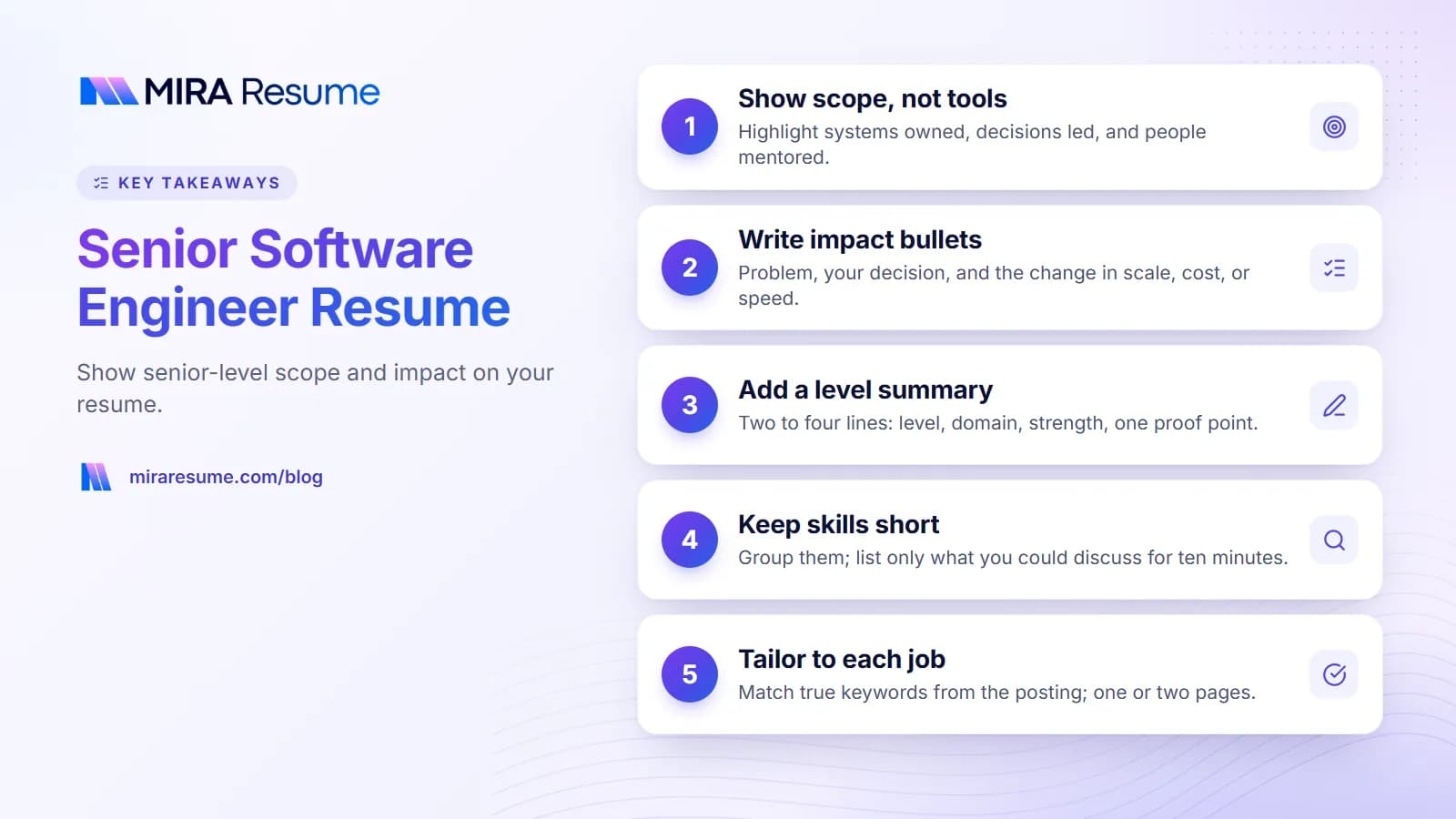
Good senior bullets answer three questions: what problem, what you did (including the decision you made), and what changed. Most results fall into five buckets: scale, latency, cost, reliability, and delivery speed. Numbers help, but they must be real. The figures below are examples only. Replace them with your own, or describe the outcome in words if you cannot share data.
| Before (task-focused) | After (impact-focused, example figures) |
|---|---|
| Worked on the payments service | Led the redesign of the payments service to an event-driven model, supporting about 3x peak traffic without adding database capacity |
| Improved API performance | Cut p99 latency on the search API from about 900 ms to 250 ms by adding a caching layer and removing N+1 queries |
| Helped reduce AWS costs | Owned a cost review across [number] services and right-sized compute and storage, lowering monthly cloud spend by about [percent] |
| Was on call for the platform | Defined SLOs for [number] core services and led incident reviews, reducing paging incidents by about [percent] over two quarters |
| Set up CI/CD | Rebuilt the CI pipeline with parallel test runs and caching, cutting average build time from about 25 to 8 minutes for [number] engineers |
| Mentored junior developers | Mentored [number] engineers, two of whom were promoted to mid-level, and created the team's design review checklist |
| Worked with other teams on migration | Drove a cross-team migration from a legacy monolith to [number] services, coordinating [number] teams and finishing with no customer-facing downtime |
A simple bullet formula
Try: Verb + system or problem + your decision or method + result + scale. For example: "Designed a queue-based retry system for webhook delivery, replacing synchronous calls, which reduced failed deliveries to near zero for about [number] merchants." The STAR method for resumes is a helpful way to find the result hidden inside each project.
When you cannot share numbers
Some employers restrict sharing metrics. Use relative terms you can defend ("roughly halved"), describe the scale ("services handling millions of daily requests," only if true), or name the business result ("unblocked the launch in two new regions").
Senior software engineer resume summary examples
A summary is optional, but at senior levels it helps the reader place you fast. Keep it to two to four lines: level, domain, strongest area, and one proof point. The people and figures below are fictional.
Senior software engineer
Senior software engineer with [number] years building backend systems in fintech. Owns the design and reliability of payment and ledger services written in Go and Java on AWS. Leads design reviews, mentors three engineers, and has cut incident volume on core services while shipping new payment methods each quarter.
Staff engineer
Staff engineer focused on platform and developer experience across a [number]-engineer organization. Sets technical direction for build, deploy, and observability tooling. Led a multi-team migration to Kubernetes and a shared CI platform, and partners with engineering managers on roadmap and hiring.
Principal engineer
Principal engineer responsible for architecture across [product area], spanning [number] teams. Drives long-range technical strategy, reviews major designs, and represents engineering in planning with product and leadership. Background in distributed data systems and large-scale migrations.
A staff engineer resume should lean even harder into influence beyond one team: direction you set, standards others adopted, and problems you identified before anyone asked. For general phrasing help, see our resume summary examples.
How to structure the skills section (without listing 40 technologies)
A long list of every tool you have touched makes it harder to see what you are good at. At senior level, keep the skills section short, grouped, and honest. A good test: could you talk about each item for ten minutes in an interview?
| Group | Example entries | Tip |
|---|---|---|
| Languages | Go, Java, TypeScript, Python | List the three to five you use most |
| Systems and architecture | Distributed systems, event-driven design, API design, data modeling | Match words from the job post |
| Cloud and infrastructure | AWS, Kubernetes, Terraform, Docker | Name the platforms you ran in production |
| Data | PostgreSQL, Redis, Kafka, BigQuery | Keep to what you designed with |
| Reliability and practices | Observability, SLOs, incident response, CI/CD, code review | Back each with a bullet |
Drop very basic items like Git, HTML, or "Microsoft Office" unless the post asks for them. Drop old tools you would not want to work in again. The skills that matter most should also appear in your bullets, where they have context.
Experience vs projects at the senior level
For early-career engineers, side projects often carry the resume. At senior level, your professional experience should do most of the work. Projects still help in a few cases:
- Switching domains or stacks. A project in the new area shows you are ramping up.
- Open source maintainership. Maintaining a used library shows design judgment, code review, and community work.
- Work you cannot describe. If your past roles were under strict confidentiality, public work can fill the gap.
Inside your experience section, consider grouping bullets under a short project heading within each job, such as "Payments platform redesign." This lets you show a multi-quarter effort as one story with several results. Put your most recent and most relevant role in the most detail, and trim older roles to two or three bullets.
One page or two for a resume for senior software engineer roles?
Two pages is common and acceptable for senior engineers with many years of relevant work. One page can work too, and it forces focus. The question is not length but density: every line should help the reader see your level.
- Use one page if you have under about eight years of experience, or if your most recent two roles tell the full story.
- Use two pages if you have a longer career with distinct senior roles, published work, patents, or major open source projects.
- Never use three for an industry role. Cut older jobs to a title, company, and dates line.
Our guide on how many pages a resume should be covers this in more detail.
GitHub, portfolio, and other links
Links help when they show work that supports your level. Before adding one, check what a reviewer will find.
- GitHub: include it if it shows meaningful work, such as maintained repos, real contributions, or code reviews. Pin your best repos. An empty or abandoned profile adds little.
- Technical writing: engineering blog posts, design docs you can share, or conference talks show communication and leadership.
- Portfolio site: useful for frontend and full-stack engineers who want to show live work.
- LinkedIn: keep it consistent with your resume titles and dates.
Put links in the header as plain, readable URLs so they still work if your resume is printed or parsed into text.
ATS keywords and tailoring to the job description
Many tech companies use an applicant tracking system, and recruiters often search it for specific terms such as a language, a cloud platform, or "distributed systems." No resume format guarantees how a given system ranks you, but you can make sure the important words from the posting are on your page where they are true.
A quick tailoring routine
- Paste the posting into the job description analyzer to pull out the main skills and responsibilities.
- Note the level words: "lead," "own," "mentor," "set direction," "cross-functional."
- Reorder your bullets so the most relevant ones come first in each role.
- Adjust your summary to name the domain and stack the team uses.
- Check your skills section against the post, removing items that distract.
Common keywords in senior postings include system design, distributed systems, scalability, microservices, cloud platforms, CI/CD, observability, technical leadership, mentoring, code review, and stakeholder collaboration. Our resume keywords guide shows how to place them naturally, and our IT resume examples cover nearby infrastructure and support roles.
Senior software engineer resume layout to copy
This outline uses a fictional engineer and placeholder figures. Use it for structure only.
Alex Chen
City, State | [email protected] | github.com/example | linkedin.com/in/exampleSummary
Senior software engineer with [number] years in backend and platform work. Owns the design and reliability of high-traffic services on AWS and mentors engineers across two teams.Skills
Languages: Go, Java, TypeScript | Systems: distributed systems, event-driven design, API design | Infrastructure: AWS, Kubernetes, Terraform | Data: PostgreSQL, Kafka, Redis | Practices: SLOs, incident response, CI/CDExperience
Senior Software Engineer, Example Payments Co., 2022 - Present
Payments platform redesign
- Led design and rollout of an event-driven payments pipeline across [number] teams
- Cut p99 latency on checkout APIs by about [percent] through caching and query fixes
Reliability and team
- Defined SLOs and led incident reviews, reducing pages by about [percent]
- Mentored [number] engineers and ran the team's design review process
Software Engineer, Example Retail Tech, 2018 - 2022
- Built inventory APIs used by [number] internal services
- Promoted to senior in 2021 after leading the search service rewriteEducation
B.S. Computer Science, Example University
The resume builder gives you clean one-column templates for this structure. A text-based PDF works for nearly all applicant portals. If a recruiter asks for a Word file, send a .docx version and check the layout before you send it.
Common senior software engineer resume mistakes
- Listing technologies instead of outcomes. A stack is not an achievement. Tie tools to results.
- Hiding leadership. Design ownership, mentoring, and cross-team work are what make you senior. Put them near the top of each role.
- Using "we" for everything. Be clear about your part: "I led," "I designed," "I proposed."
- Inflating numbers. Interviewers at this level will dig into your metrics. Use figures you can explain.
- Same resume for every role. A platform role and a product role want different stories. Reorder and reword for each.
- Dense walls of text. Keep bullets to one or two lines.
- Skipping the cover letter when asked. If the application asks for one, see our software engineer cover letter guide.
Before you apply
- Check that your most recent role shows scope, leadership, and at least two measurable results.
- Match your summary and skills to the posting.
- Run your file through the ATS checker with the job description to catch missing keywords and parsing issues.
- Prepare stories behind your top bullets for system design and behavioral rounds. The interview prep tool can help you practice.
- If you were promoted, show it clearly. See how to show a promotion on a resume.