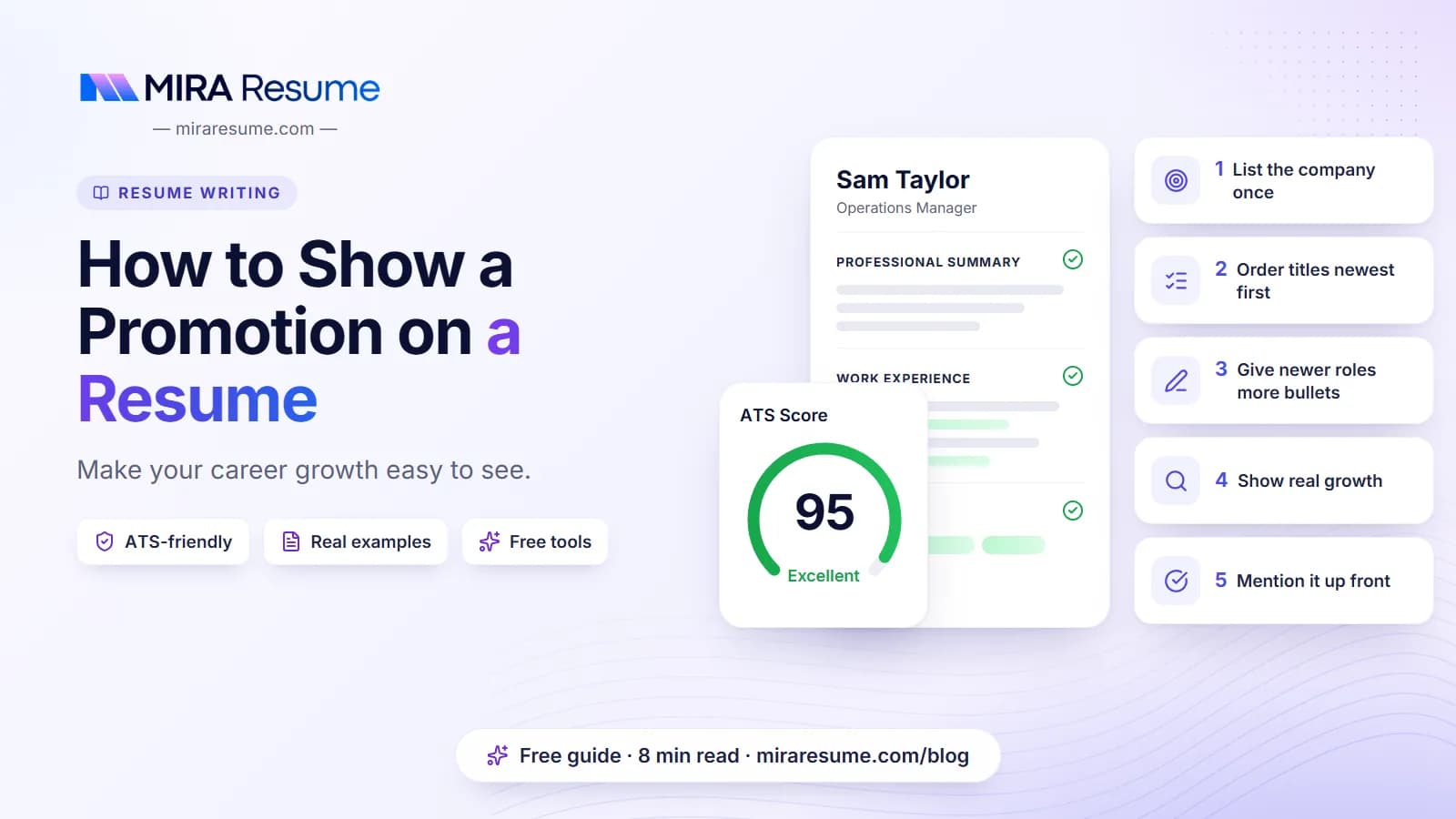

How to show promotion on resume pages is simple once you know the pattern: write the company name one time, then stack your job titles underneath it, each with its own dates and bullet points. This makes growth easy to see and avoids making it look like you changed employers.
A promotion tells a hiring manager that your employer trusted you with more. You want that to stand out, not get lost. Below are four ways to list promotions, examples you can copy, advice for special situations such as title changes without a raise, and the common mistakes to avoid. Always use real titles and dates, and check the job posting to decide which achievements to highlight.
Why showing a promotion matters
A promotion is a clear sign of progress. It suggests that you did good work, took on more duties, and earned your employer's trust. It is one of the easiest ways to show growth on paper.
But if you list each title as if it were a separate company, or if you merge them into one line, the reader can miss that. A clean format helps in three ways:
- It shows the full length of your time at the company.
- It makes the step up in responsibility easy to see.
- It keeps your resume short, since you do not repeat the company name.
Employers read resumes quickly, so structure matters. Our simple resume format guide shows a layout that suits the formats below.
Four ways to list promotions on a resume
Pick the format that fits your history. All four are acceptable. Choose the one that makes your growth clearest.
| Format | Best for | Main benefit |
|---|---|---|
| 1. Company once, titles stacked | Most promotions | Shows growth and keeps dates clear |
| 2. Separate entries for each role | Very different duties | Gives each role full space |
| 3. Combined title line | Short or minor moves | Saves room |
| 4. Single entry with highlight bullets | Long careers with lots of detail | Focuses on achievements |
Format 1: Company once, titles stacked (recommended)
Harbor Supply Co., Portland, OR | 2019 to present
Operations Manager | 2023 to present
Lead a team of 12 and manage a yearly budget of $400,000.
Cut late deliveries by reworking the weekly schedule.
Operations Supervisor | 2021 to 2023
Supervised 6 staff and trained new hires on safety rules.
Warehouse Associate | 2019 to 2021
Picked and packed orders, meeting daily targets.
This is the clearest way to show promotion on resume pages. The company name appears once, and the stack of titles tells the story.
Format 2: Separate entries for each role
Use this when the jobs were very different, such as moving from a sales role to a finance role in the same company. Give each its own block with the company name repeated and a note like "(promoted)".
Senior Analyst, Brightline Insurance | 2022 to present (promoted)
Analyst, Brightline Insurance | 2019 to 2022
Format 3: Combined title line
Use this for small moves. Show both titles on one line with the full date range.
Customer Service Representative, promoted to Team Lead | Orbit Telecom | 2020 to 2024
Format 4: One entry with highlight bullets
Use this for long careers. Show the top title, the total time, and a note of your progress, then give your best results.
Senior Account Manager (promoted twice from Account Coordinator), Redwood Media | 2014 to 2025
Grew the largest client account by adding two new services.
Trained 8 junior staff on contract and billing steps.
How to list multiple positions at the same company
When you have held three or more titles at one employer, list them from newest to oldest. Follow these rules:
- Put the company name and total years on the first line.
- Under it, add each title with its own date range.
- Write more bullets for the newest or most relevant role.
- Write one or two bullets, or none, for earlier roles that are less relevant.
- Keep dates in the same style throughout, such as "Mar 2021 to Jun 2023".
Example with three titles
Greenfield Hospital, Denver, CO | 2016 to present
Charge Nurse, Medical-Surgical Unit | 2022 to present
Guide shifts of 10 nurses and set daily assignments.
Coach new nurses during their first 90 days.
Registered Nurse | 2018 to 2022
Cared for up to 5 patients per shift and taught patients about home care.
Nursing Assistant | 2016 to 2018
Helped patients with daily needs and recorded vital signs.
If you are applying to a similar role, our guides to the CNA resume and medical assistant resume show healthcare layouts.
How to write bullet points that show growth
The titles show the step up. The bullets should show what changed. Look for these signs of growth:
- More people: from helping a team to leading it.
- More money: from handling a small budget to a larger one.
- More range: from one task to a full process.
- More trust: from following steps to setting them.
Bullet examples that show the step up
| Earlier role | Promoted role |
|---|---|
| Answered customer questions by phone and chat. | Led a team of 8 agents and reviewed weekly call notes. |
| Entered invoices into the accounting system. | Managed month-end close for three business units. |
| Stocked shelves and kept displays tidy. | Planned weekly stock orders and trained 4 new staff. |
| Wrote product descriptions for the website. | Planned the content calendar and edited work from 3 writers. |
Strong openings help too. Use words like led, managed, planned, trained, and oversaw, as listed in our action verbs for resume guide. You can also use the AI bullet enhancer to polish the wording, then check each line is accurate.
Special cases: how to put a promotion on a resume when it is not simple
A promotion with no raise
Some employers give a bigger title without a change in pay. You can still list it. The title and the duties are real. Focus your bullets on what you did in the new role, and do not mention pay.
A title change that was not a promotion
Companies sometimes rename roles. If the duties did not change, list one title, or write the new name and add the old one in brackets, such as "Customer Care Specialist (formerly Customer Service Agent)".
A lateral move
If you moved sideways to a different team or skill area, list the roles as separate entries, but do not label it a promotion.
An acting or interim role
Write the title and add "Acting" or "Interim": "Acting Store Manager, 2024". Describe what you handled during that time. Do not claim the full title if you did not hold it.
Promoted and later moved to a new company
List the first company with its stack of titles, then your new company above it. Newest always goes first.
A short time between promotions
Quick promotions are a good sign. Show them as they are. If three titles fit in two years, you can use the combined title line to save room, as long as the dates are clear.
When you were promoted to your current job and plan to leave
Take care with how you speak about it. If you plan to resign, our guides on how to resign from a job and the two-week notice letter may help you leave well.
Where promotions fit in your summary and cover letter
Do not rely on the experience section alone. Mention your growth where the reader will see it first. In a resume summary, one line can do the job:
Operations leader with 6 years at one company, promoted twice from warehouse associate to manager. Known for cutting late orders and training new staff.
In a cover letter, give one sentence on your path. For example: "I joined as an associate, was promoted to supervisor after two years, and now manage a team of twelve." If you need help, see what a cover letter is and how to build one.
Honest, concrete detail beats big claims. A phrase such as "fast-tracked" or "rising star" says little by itself. A title, a date, and a result say much more.
A full before-and-after example
Here is how one person might fix a resume that hides a promotion.
Before
Sales Associate, Maple Street Outfitters | 2020 to 2022
Sold outdoor gear and helped customers.
Department Lead, Maple Street Outfitters | 2022 to 2024
Led the department and did ordering.
Assistant Store Manager, Maple Street Outfitters | 2024 to present
Help manage the store.
Problems: the oldest role comes first, the company name repeats, the bullets are vague, and there are no results.
After
Maple Street Outfitters, Boise, ID | 2020 to present
Assistant Store Manager | 2024 to present
Open and close the store, balance the till, and set shift plans for 14 staff.
Trained 5 new team members on returns and the stock system.
Department Lead, Footwear and Apparel | 2022 to 2024
Planned weekly stock orders and kept the department tidy and full.
Coached 4 sales associates on fitting boots and packs.
Sales Associate | 2020 to 2022
Helped up to 60 shoppers a day find the right gear.
The new version is shorter, the growth is clear, and each step has duties that grow in scope. Notice that no title is overstated, and every number is the kind a person would know from their own work. If you do not know an exact figure, use a plain fact instead.
What to do if your records are messy
Not every company keeps tidy title records. If you are unsure about a date or title, check old emails, pay slips, or a performance review. You can also ask HR to confirm. Matching your resume to the company records avoids problems during a background check.
Think about the job you want
Your promotions may not all matter equally for the next role. If you are applying for a management job, put extra weight on the roles where you led people. If you are applying for a technical job, put extra weight on the roles with technical duties. The goal is to show the path that leads to this role. The job analyzer can show which parts of a posting to answer first.
Common mistakes when listing promotions
- Repeating the company name with no link between roles. It can look like you jumped between employers.
- Merging all titles into one line without dates. The reader loses track of your path.
- Listing the oldest role first. Resumes should run newest to oldest.
- Repeating the same bullets under each title. Show new duties for each step.
- Overstating a title. Use the title you held. Employers may check.
- Leaving out dates. Each title needs its own date range.
- Writing a long block of text. Keep bullets short and focused on results.
Software also reads your layout. Run your final draft through the ATS checker to make sure your titles and dates are picked up cleanly.
Quick checklist
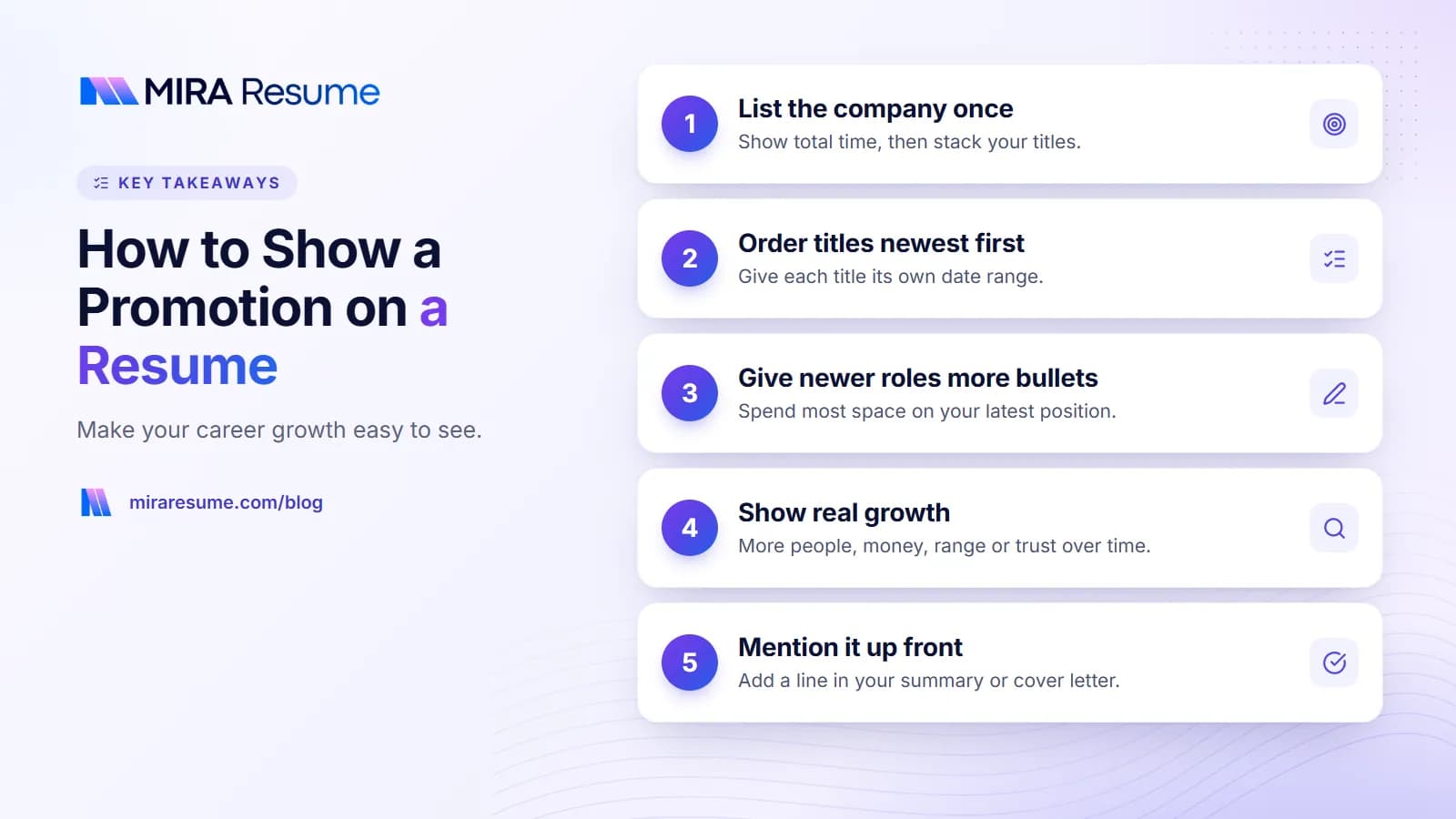
- Company name appears once, with total time at the company.
- Titles run from newest to oldest, each with its own dates.
- Newest role has the most bullets.
- Bullets show more people, money, range, or trust over time.
- Titles and dates are exactly as on your records.
- The resume still fits your target length, as covered in how many pages a resume should be.
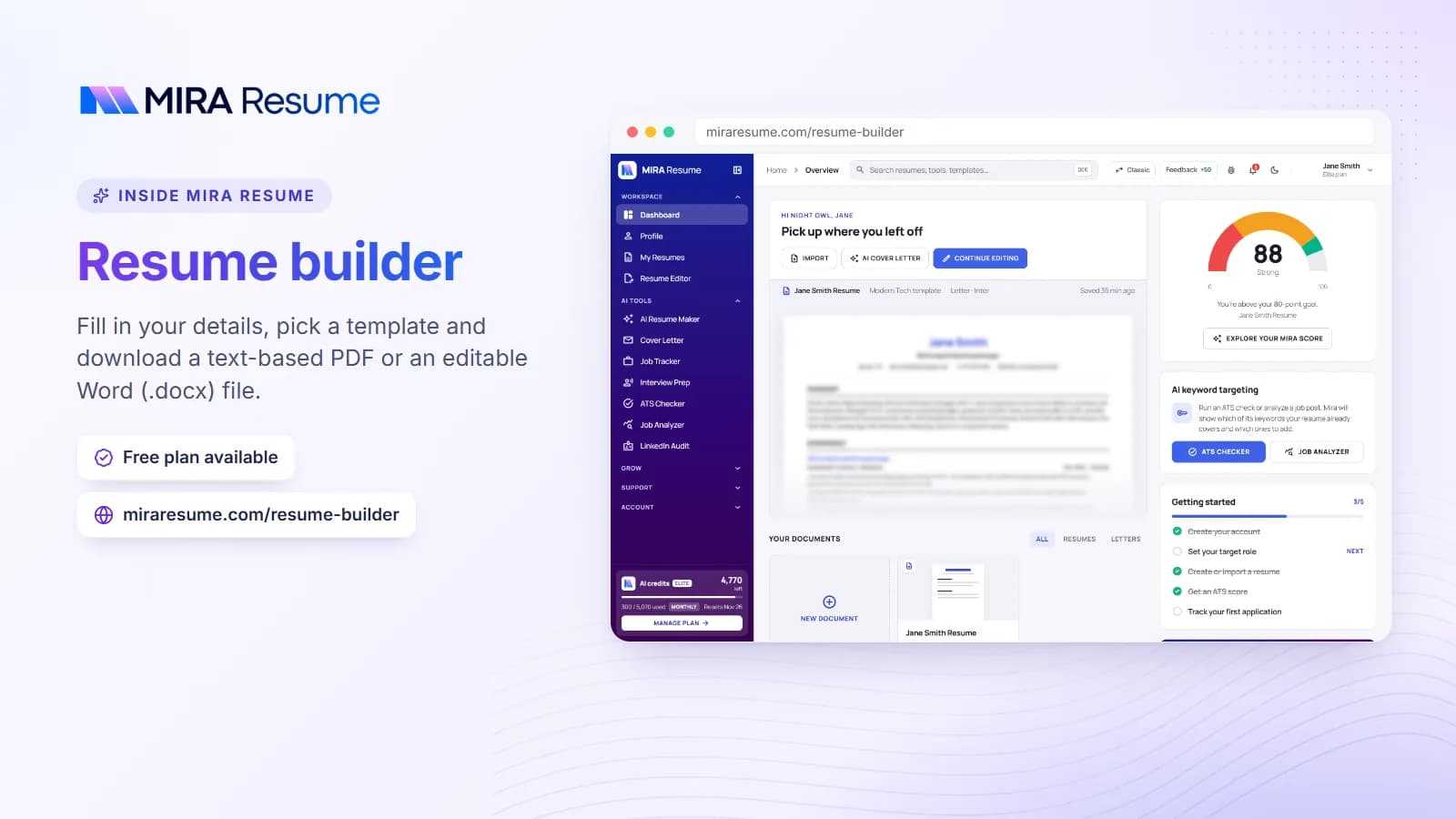
To lay it out quickly, try the resume builder, where you can add several roles under one employer, or browse resume examples for finished pages.