Coming soon
CV Formats by Country

CV Format for Gulf Jobs: A Practical Guide for the GCC

The CV format for Gulf jobs: what GCC recruiters expect on photo, nationality, visa status and notice period, plus a section order, example and scam checks.

Mira Resume Editorial Team · Career content team Published Updated 11 min read
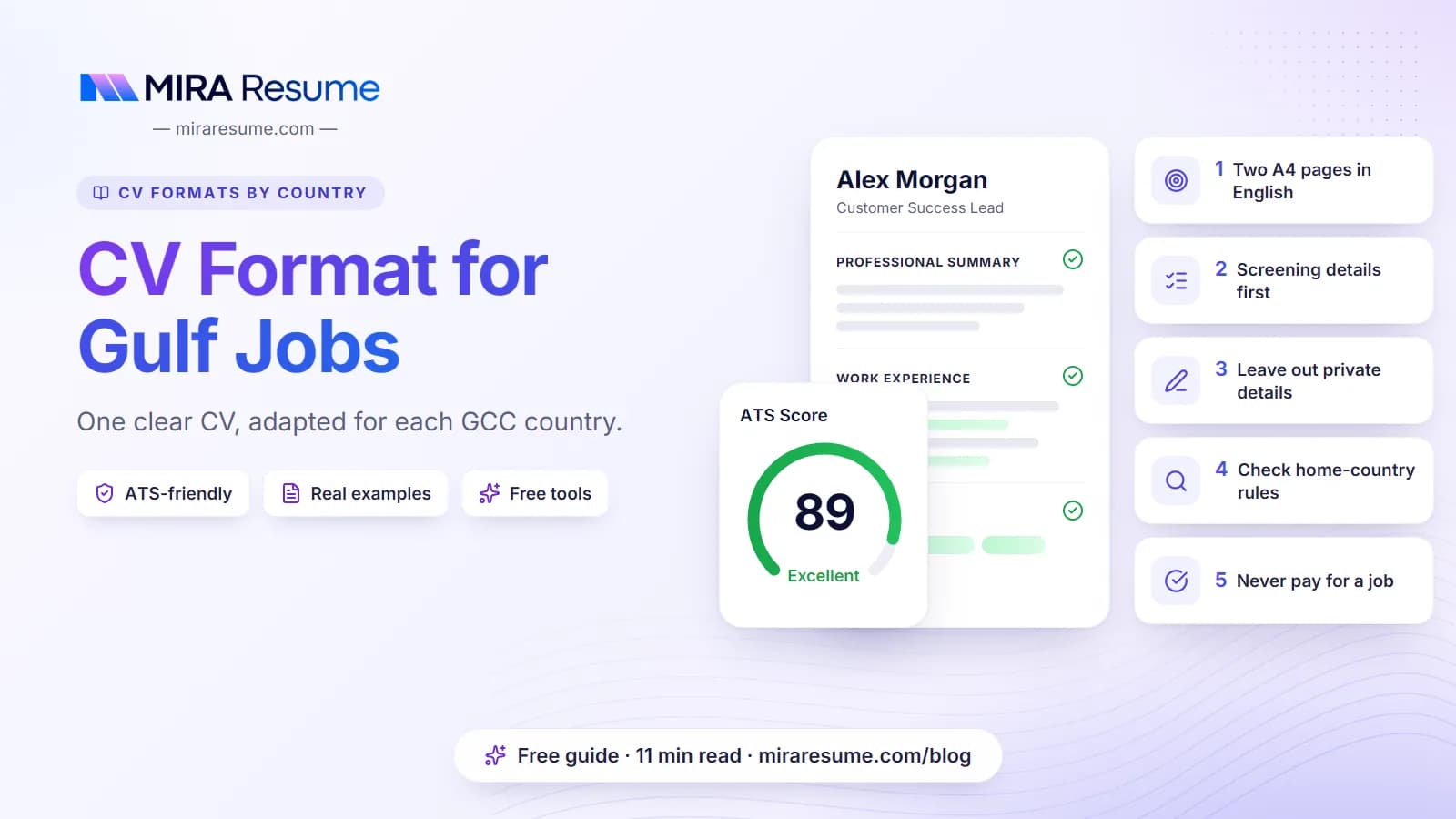
CV Format for Gulf Jobs: cover image for the Mira Resume guide, with an example resume and the 5 main points

The CV format for Gulf jobs looks a little different from what you may use at home. Recruiters in the UAE, Saudi Arabia, Qatar, Kuwait, Oman and Bahrain commonly ask for details that a UK or US employer would not expect, such as your nationality, your visa status and how soon you can join. They also read a lot of CVs for each role, so a clear, simple layout matters as much as the content.

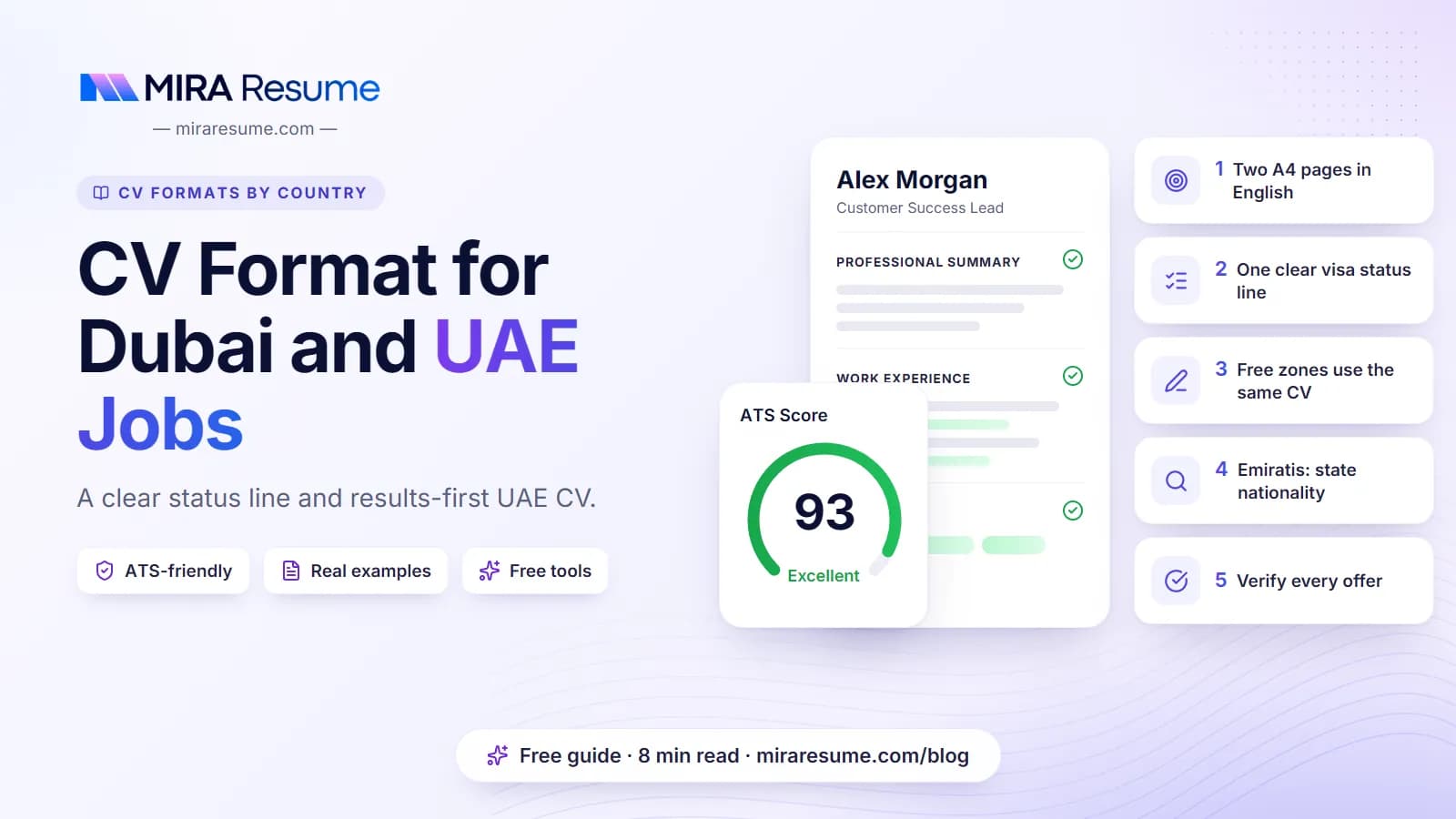
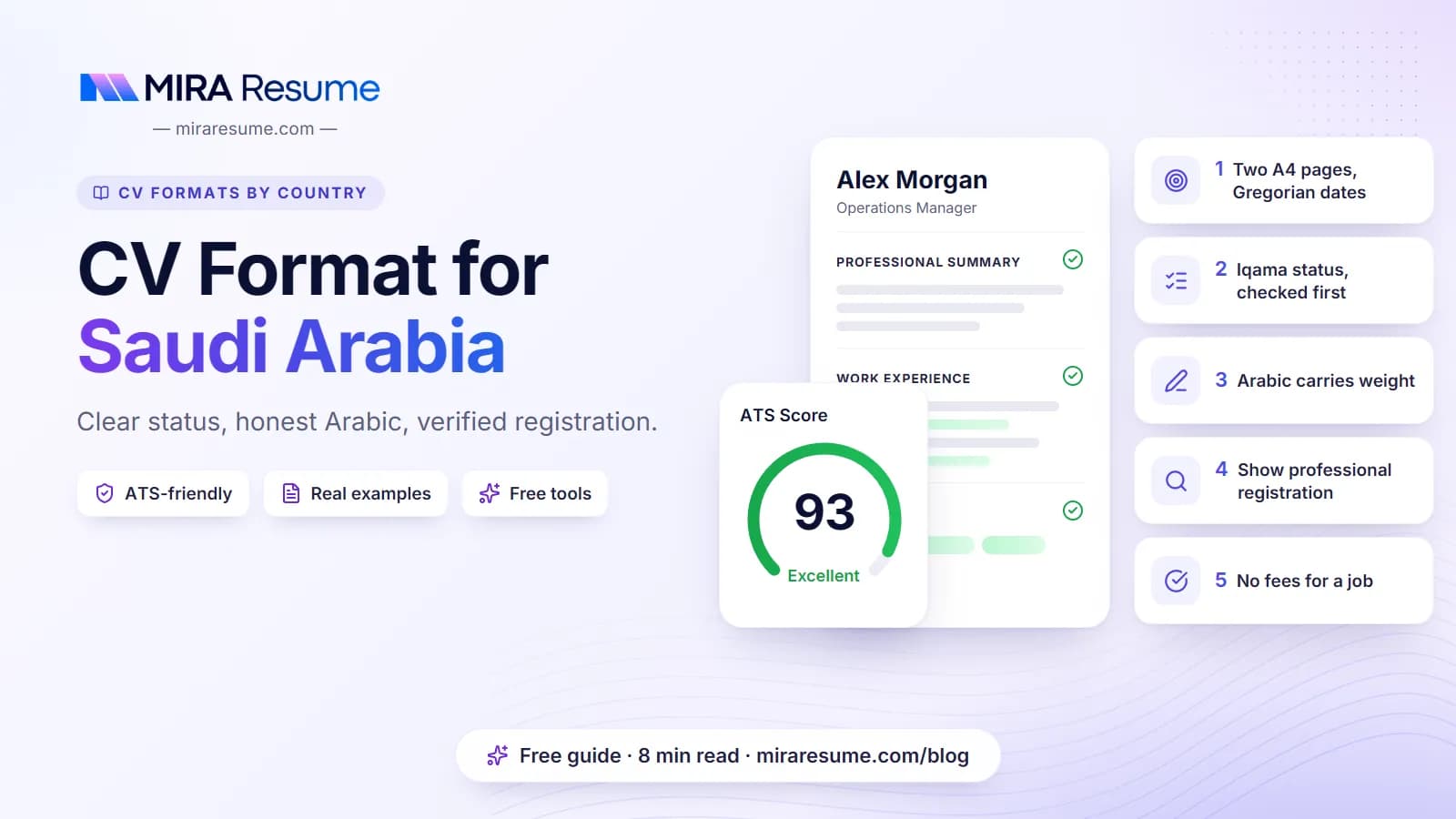
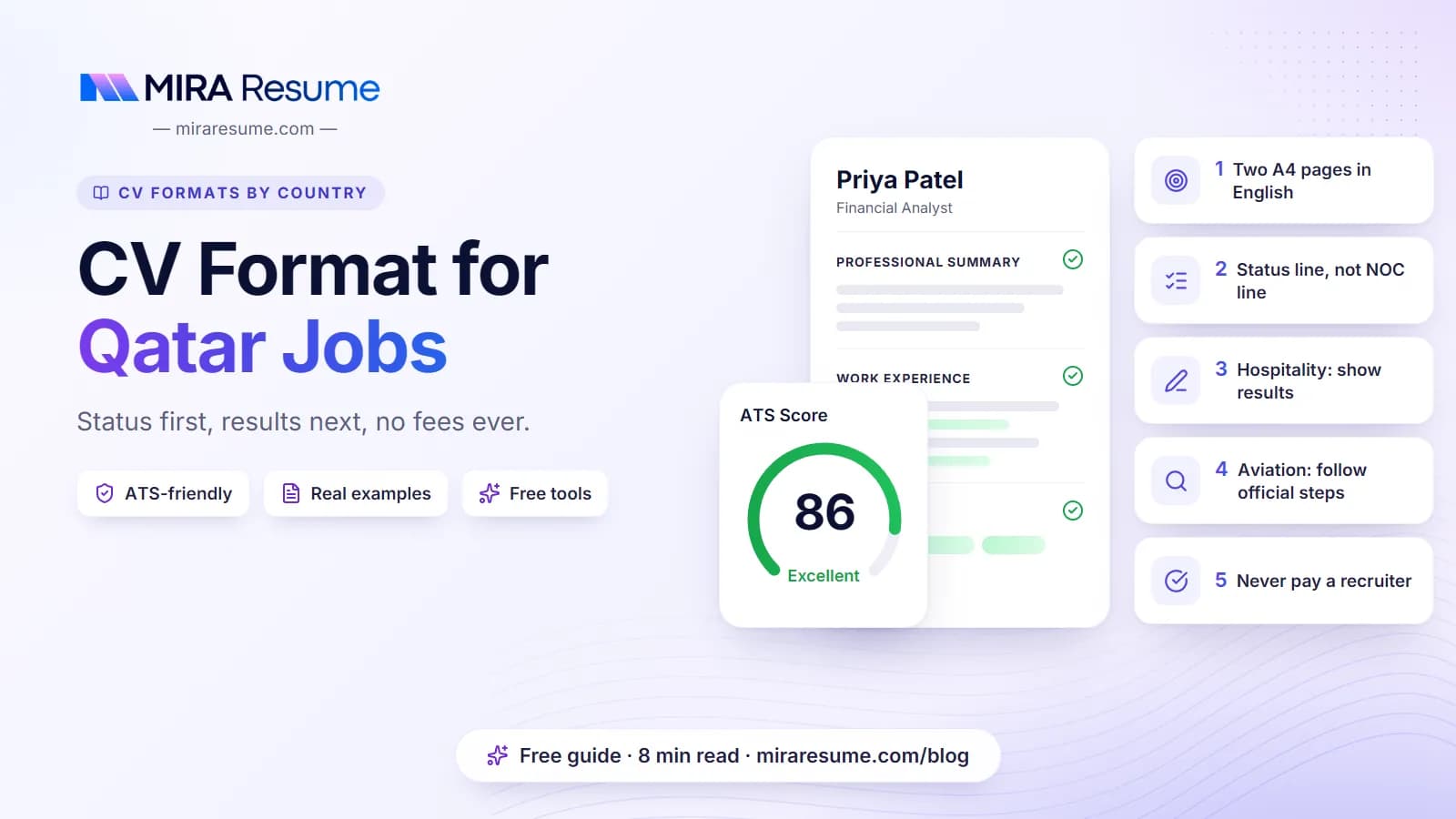
This guide covers the whole Gulf Cooperation Council (GCC) region. It explains what to put at the top of your CV, the section order most Gulf employers are used to, and a short fictional example you can adapt. It also has advice for applicants from India, Pakistan, the Philippines, Sri Lanka, Nepal, Bangladesh and Africa, including how to spot fake job offers. For country detail, see our guides to the Dubai and UAE CV format, the Saudi Arabia CV format and the Qatar CV format.

One note before you start: this is practical CV advice, not legal or immigration advice. Visa and labour rules change, so always check the official government portal of the country you are applying to and confirm details with your employer.
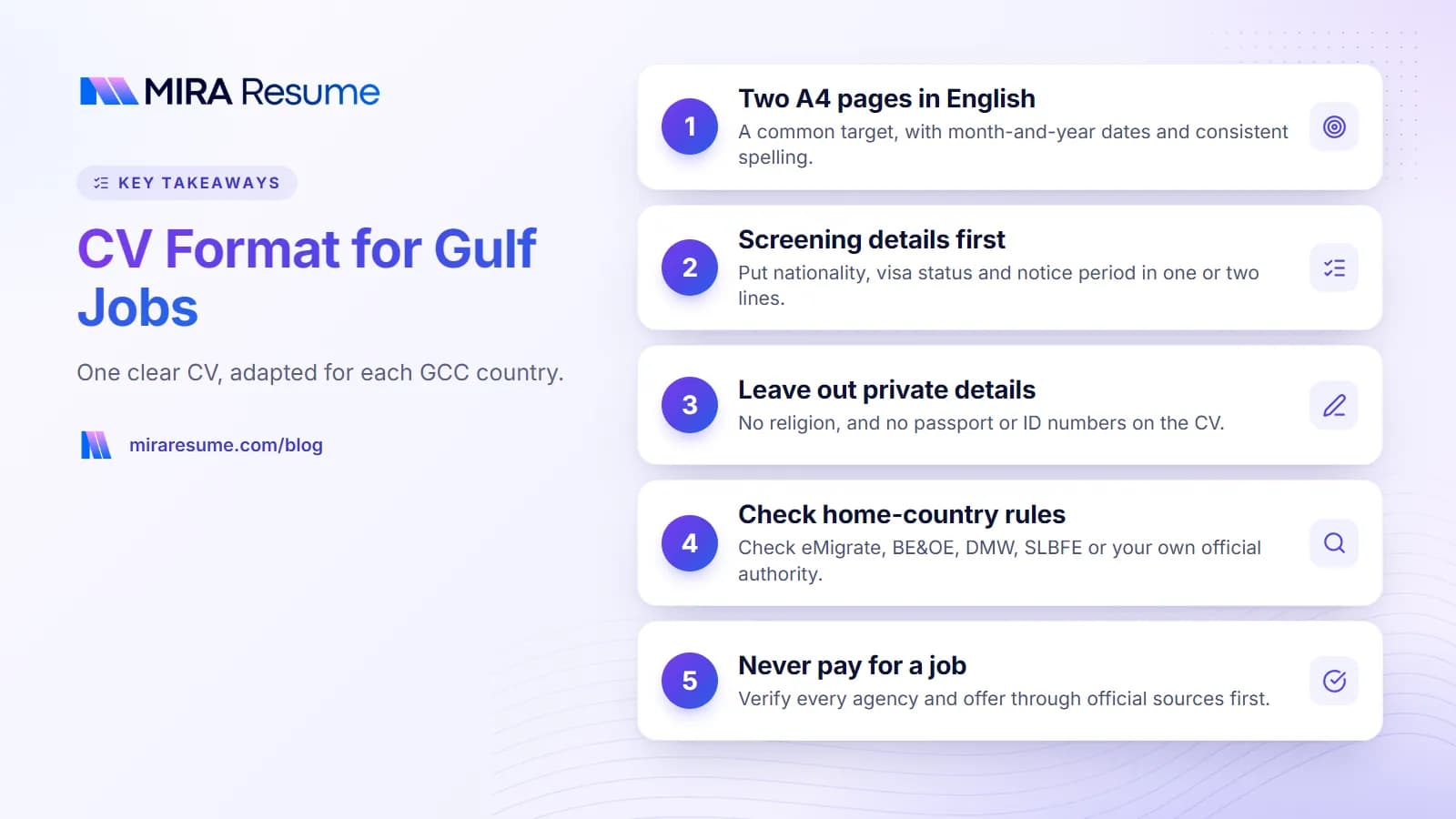
Key takeaways: 1. Two A4 pages in English; 2. Screening details first; 3. Leave out private details; 4. Check home-country rules; 5. Never pay for a job
Key takeaways from this guide.

What a Gulf CV looks like

Across the GCC the document is almost always called a CV. Some job ads say "resume" or "CV/resume", and in practice they mean the same thing: a focused summary of your work history. If you have ever wondered about the difference, our guide to CV vs resume explains it. The good news is that the CV format for Gulf countries is broadly shared, so one well-built CV can be adjusted for each country rather than rewritten.

Length, paper and language

  • Length: two pages is a common target. Fresh graduates can often use one page; senior engineers, doctors and managers sometimes need three.
  • Paper size: A4 is standard across the region.
  • Language: English is the usual language of private-sector hiring. Arabic matters more for government roles, many customer-facing jobs and a good number of Saudi employers.
  • Spelling: British or American spelling are both accepted. Pick one and keep it consistent.
  • Dates: write month and year in words, such as "Mar 2021 to Present", because all-number dates are read differently in different countries. Our guide to CV date formats has examples.

Why Gulf CVs carry more personal details

Most Gulf jobs held by expatriates depend on an employer-sponsored work permit and residence visa. That is why recruiters often want your nationality, location and residence status before they read your experience: these details tell them how long hiring will take. They are not a reason to share private information unrelated to the job.

The six GCC countries at a glance

The six GCC countries share many hiring habits, but each has its own labour ministry, visa system and national employment programme. Use this table as a starting point, then read the official sources before you rely on any rule.

CountryWhere to check official rulesNational hiring programmeCV note
UAEMinistry of Human Resources and Emiratisation (MOHRE), u.ae portalEmiratisationState your visa type and whether you are in the country
Saudi ArabiaMinistry of Human Resources and Social Development (HRSD), QiwaSaudization (Nitaqat)Give your Iqama status if you live in the Kingdom
QatarMinistry of LabourQatarizationSay whether you are in Qatar and give your notice period
KuwaitPublic Authority for Manpower (PAM)KuwaitizationMention Kuwait experience and any local driving licence
OmanMinistry of LabourOmanisationCheck the ad is open to all nationalities
BahrainLabour Market Regulatory Authority (LMRA)BahrainisationNote your permit status if you are in Bahrain

Every GCC country runs programmes that encourage or require private companies to hire their own citizens, so some roles are open to nationals only and ads often say so. Expatriates should read each ad carefully. GCC nationals should state their nationality clearly, because many employers actively look for national candidates.

Personal details Gulf recruiters commonly expect

The top of a Gulf CV usually carries more than a name and phone number. Here is what is common, what is optional and what is best left out.

DetailCommon practiceOur advice
Full nameAlwaysUse the name on your passport so it matches later paperwork
Phone and emailAlwaysInclude the country code (+971, +91) and a professional email
Current locationVery commonCity and country, such as "Kochi, India"
PhotoCommonA professional headshot, unless the employer asks for none
NationalityVery commonInclude it; visa processing depends on it
Visa or residence statusVery commonOne line, such as "In India, requires employment visa"
Notice periodVery common"Notice period: 1 month" or "Available immediately"
Date of birth, marital statusOften seen, optionalInclude only if you are comfortable; neither shows your skills
Driving licenceCommon for field and sales rolesName the country, such as "UAE driving licence"
LanguagesVery commonEach language with an honest level
ReligionSeen on old templatesLeave it out; it has no bearing on the job
Passport, Emirates ID, Iqama or QID numbersSometimes seenLeave them out; share ID only with a verified employer

A word on fairness

The UAE's labour law (Federal Decree-Law No. 33 of 2021), for example, prohibits discrimination on grounds including race, colour, sex, religion, national or social origin and disability, while allowing measures that support the employment of UAE citizens. You never need to list your religion, health or family plans to look like a serious candidate.

A GCC CV format that works for most roles follows a simple reverse-chronological layout, with the screening details placed early.

OrderSectionWhat to include
1HeaderName, job title, phone, email, city and country, optional photo
2Personal detailsNationality, visa or residence status, notice period, languages, driving licence
3Professional summaryThree or four lines: years of experience, specialism, GCC experience, one strong result
4Core skillsEight to twelve skills that match the job ad
5Work experienceMost recent first; company, city, country, dates and three to six bullet points with results
6EducationDegree, institution, country and year
7Certifications and licencesName, issuing body and year; professional licences and registrations
8Training and awardsOptional; only what helps for this job
9References"Available on request" or two named referees

Our CV summary examples and the guide on how to list certifications help with sections 3 and 7.

Fictional example: header, summary and one job

Ahmed Khan
Electrical Supervisor
Lahore, Pakistan | +92 3XX XXXXXXX | [email protected]
Nationality: Pakistani | Status: in Pakistan, requires employment visa | Notice period: 1 month
Languages: English (fluent), Urdu (native), Arabic (basic) | Driving licence: Pakistan

Summary: Electrical supervisor with 8 years of experience in commercial building fit-outs, including 4 years on projects in Saudi Arabia. Leads teams of up to 20 technicians, reads single-line diagrams and works to client safety standards. Holds a diploma in electrical engineering and an IOSH Managing Safely certificate.

Electrical Supervisor, Sandline Contracting Co. (fictional), Riyadh, Saudi Arabia | Jun 2019 to Aug 2023

  • Supervised low-voltage installation across a 14-floor office tower and handed over the electrical package two weeks ahead of the main programme.
  • Led a team of 18 technicians with no lost-time incidents over the full project.
  • Prepared daily progress reports and material requests for the project engineer.

Notice that the details recruiters screen for first (nationality, status and notice period) take up just two lines. They answer the early questions quickly and leave the rest of the page for experience.

Screenshot of the Mira Resume resume builder (Fill in your details, pick a template and download a text-based PDF or an editable Word (.docx) file.)
Screenshot: Resume builder: Fill in your details, pick a template and download a text-based PDF or an editable Word (.docx) file.Try it

Applying from India, Pakistan, the Philippines, Sri Lanka, Nepal, Bangladesh and Africa

Many Gulf employers hire from abroad, and candidates from South Asia, Southeast Asia and Africa often compete for the same roles. A few extra lines make a CV for Middle East jobs much easier to process.

Make your Gulf relevance obvious

  • If you have worked in any GCC country, say so in your summary ("5 years of GCC experience"). Many ads ask for it.
  • Write the city and country for every job.
  • Translate local job grades into plain terms, such as "team of 12" or "reported to the plant manager".

Check your home country's rules before you travel

Many sending countries regulate overseas recruitment and require workers to register or get clearance before departure. The details are set by your own government, so check the official source.

Home countryOfficial body to checkWhat to look for
IndiaMinistry of External Affairs, eMigrate portalRegistered recruiting agents; emigration clearance if your passport is in the ECR category
PakistanBureau of Emigration and Overseas Employment (BE&OE)Licensed Overseas Employment Promoters and Protector registration
PhilippinesDepartment of Migrant Workers (DMW)Licensed agencies and approved job orders
Sri LankaSri Lanka Bureau of Foreign Employment (SLBFE)Licensed foreign employment agencies and registration
NepalDepartment of Foreign EmploymentLicensed recruitment agencies and the approvals needed before departure
BangladeshBureau of Manpower, Employment and Training (BMET)Licensed recruiting agencies and pre-departure registration
African countriesYour labour ministry and your embassy in the destination countryLicensed agencies and any registration rules for overseas work

Indian applicants, for example, will often see Gulf recruiters ask whether a passport is ECR or ECNR. That is because ECR passport holders going to work in ECR countries, which include all six GCC states, need emigration clearance through eMigrate. Whatever your nationality, treat this table as a starting point and confirm the current process on the official website.

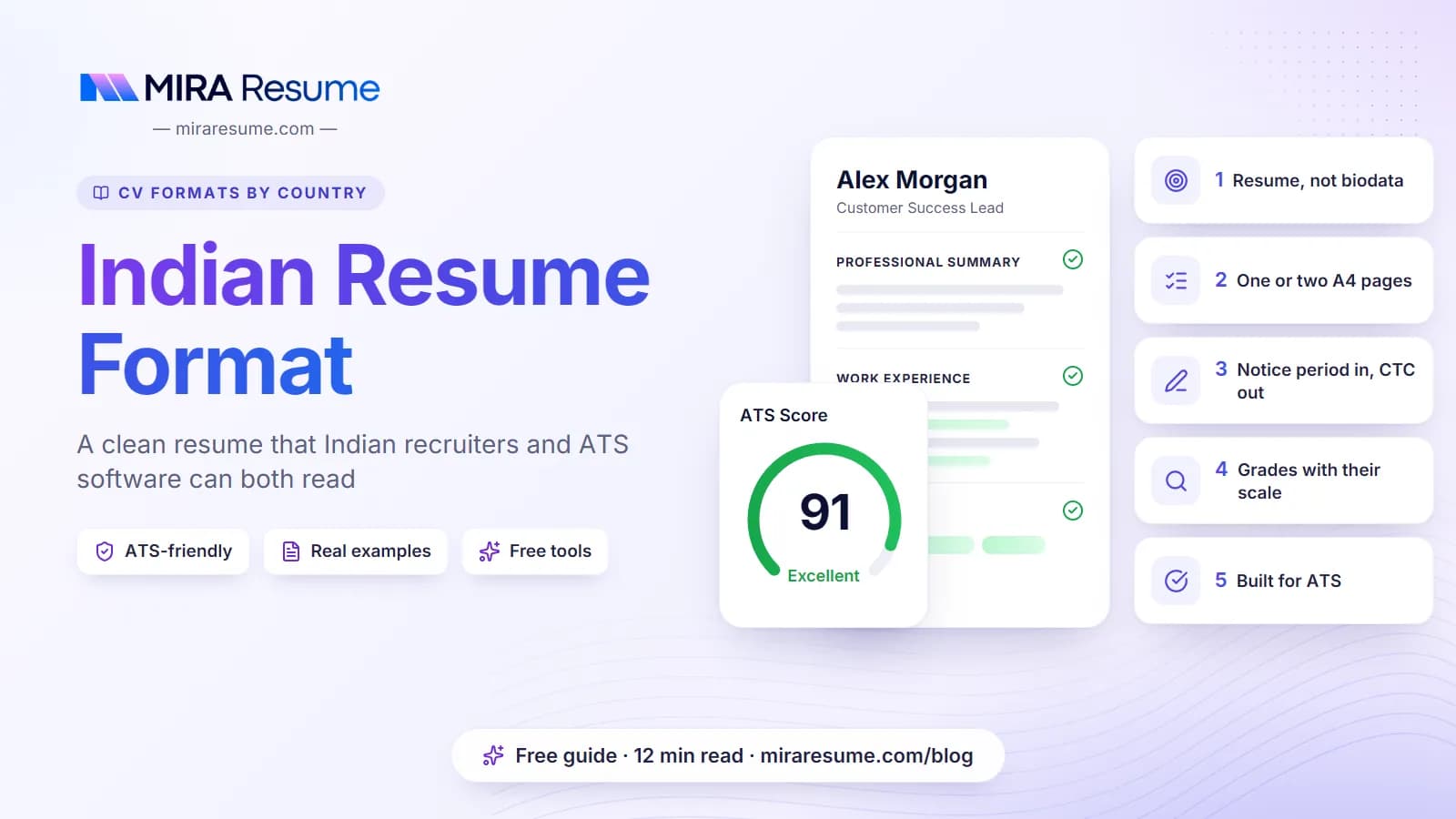
If you are also shaping your CV for the home market, our guides to the Indian resume format, Pakistan CV format, Philippines resume format and Sri Lanka CV format explain local conventions.

Attested certificates

Gulf employers and authorities often ask for educational certificates to be attested before a work visa or professional licence is issued. The chain usually starts with authorities in the country that issued the certificate, then the destination country's embassy, then its Ministry of Foreign Affairs. Steps differ, so check the destination's official attestation page and ask your employer what they need. If it is already done, a line such as "Degree certificate attested for UAE" can help.

Agencies, job offers and how to avoid scams

Recruitment agencies are a normal part of Gulf hiring, and many are licensed and reputable. Scammers know this and copy their style, so a few rules will protect you.

Who pays recruitment costs

Gulf labour laws generally put recruitment costs on the employer. The UAE's labour law says an employer must not charge a worker recruitment and employment costs, directly or indirectly. Saudi Arabia's labour law makes the employer responsible for recruitment fees and for the residence and work permit fees of non-Saudi workers. Qatar's law prohibits licensed recruitment agencies from collecting recruitment fees and costs from workers. Rules on what agencies in your home country may charge are separate and vary, so check your own government's guidance. As a simple rule, treat any request to pay for a job, a visa or a "processing" step as a warning sign until you have checked it with an official source.

Red flags

  • An offer arrives without a proper interview, or after a short chat on a messaging app.
  • The salary is far above what similar roles usually pay.
  • You are asked to pay for a visa, medical test, training or "guarantee" before you travel.
  • You are asked for a passport scan or bank details before any formal offer.
  • You are told to enter on a visit visa and "convert it later" with nothing in writing.

How to check an offer

  • Call the company on the number listed on its own website, not the number in the message.
  • Check the agency's licence with the authority in your home country (see the table above).
  • In the UAE, MOHRE says job offers use its official template and can be checked through its channels. UAE authorities also stress that a visit visa does not give you the right to work.

ATS and online applications in the Gulf

Large Gulf employers, government-linked companies and recruitment firms often use applicant tracking systems (ATS) to sort applications. Common channels include LinkedIn, Bayt, GulfTalent, Naukrigulf and company careers pages. Whichever you use, the same basics apply to any resume format for Gulf countries:

  • Use one column and standard headings such as "Work Experience", "Education" and "Skills".
  • Keep your photo in the header and never put important text inside images or text boxes.
  • Save as .docx or a text-based PDF unless the portal asks for something else.
  • Use the exact job title and key skills from the ad, where they truthfully describe you.
  • Fill in every portal field, including nationality, location and notice period, because recruiters filter on them.

You can test your file with our ATS checker and compare it with a job ad using the job description tool. For a layout that parses cleanly, see our ATS friendly CV template.

A short cover note of four to six lines (the role, your experience, your status and notice period) suits most email applications. Our AI cover letter generator can draft one.

Gulf CV do's and don'ts

DoDon't
Put nationality, status and notice period near the topHide them on page two
Use a professional photo if the employer accepts photosUse a selfie, a group crop or a heavily filtered picture
Show results: team size, budget, project value, targets metList duties without outcomes
State GCC experience clearly in your summaryAssume the recruiter will work it out
List licences and certifications with issuing body and yearClaim a licence or title you do not hold
Keep it to about two A4 pagesSend a five-page CV for a mid-level role
Leave out religion, passport and ID numbersShare ID scans before a verified offer
Tailor keywords to each adSend the same CV to every job

Final Gulf CV checklist

  1. Header with name, title, phone with country code, email and location.
  2. Nationality, status and notice period in one or two lines.
  3. A summary that mentions GCC experience if you have it.
  4. Skills and experience that match the ad, with results.
  5. Certifications and licences with issuing bodies and years.
  6. No religion, ID numbers or salary history.
  7. One column, .docx or text-based PDF, about two A4 pages.
  8. Every agency and offer checked against official sources.

When you are ready, build your Gulf CV in our CV builder and adapt it for each country. You can find more guides like this one in our CV formats by country collection.

Frequently asked questions

Should I put a photo on my CV for Gulf jobs?

In most Gulf countries a photo is common and often expected, especially in hospitality, sales and customer-facing roles. Use a recent, professional headshot with a plain background and neat work clothing. Some multinational employers prefer CVs without photos, so follow the job ad or company instructions when they say otherwise. A photo will never replace strong experience, so keep it small and in the header.

How long should a CV be for Gulf countries?

Two A4 pages is a common target for most experienced candidates applying in the GCC. Fresh graduates can usually fit everything on one page. Senior engineers, doctors and project managers with long project lists sometimes use three pages, but only when every line is relevant. Recruiters scan quickly, so put your strongest, most recent experience on the first page.

Do I need to mention my nationality and visa status on a Gulf CV?

It is very common to include both, because work permits and residence visas in the Gulf depend on them and recruiters use them to plan hiring. Write one plain line, such as your nationality, whether you are in the country and on what kind of visa, and your notice period. Be accurate. If you are unsure of your status, check with the relevant government portal first.

Is it normal to pay an agency to get a Gulf job?

You should be very cautious. The UAE, Saudi Arabia and Qatar all have rules that put recruitment costs on employers or stop licensed agencies charging workers recruitment fees. Rules about agency charges in your home country differ, so check your own government's guidance. Treat any request to pay for a job, a visa or processing as a warning sign until you verify it officially.

Should my CV for Middle East jobs be in Arabic?

For most private-sector and multinational roles, an English CV is standard and enough. An Arabic version can help for government and semi-government roles, Arabic-speaking teams and many employers in Saudi Arabia. If you write one, keep the content identical to your English CV and have a fluent speaker check it. Always list your real Arabic level in the languages section.

What is the best file format for a Gulf CV?

A .docx file or a text-based PDF is the safest choice, because both are widely accepted by applicant tracking systems and recruiters. Use one column, standard headings and a common font. Avoid scanned images of your CV, text inside graphics and complex tables. If a portal or ad names a format, use that one instead of your default.

Found this useful? Share it

Send it to a friend who is job hunting, or save it for later.

Read this guide with AI

Get a plain-language summary and help applying it to your own resume. Pick an assistant; it opens with this article and a ready prompt.

Back to CV Formats by Country hub

All articles